Tag Archives: sonnet variation

Sonnet Crown: Amit Majmudar, ‘Recourse’

1.

Time, like love, is cyclic. Please come back
to me. I’ll stand here waiting, wanting while
the mare without her rider rounds the track.
I want to weave a crown for you, design
a daisy chain whose threaded stems become
a bracelet that handcuffs your wrist to mine.
My shadow’s gnomon tilts like a sun dial’s.
I know you’re somewhere close. I feel a thrum,
a thrill beneath the stillness of the earth,
the way a woman, days before the birth,
places her husband’s hand on the sea swell
that rises out of her and passes through her,
and, touching so much vastness, he can tell
for all their time as one, he never knew her.

2.

For all our time as one, I never knew you—
but doesn’t learning come from repetition?
I’ll do this better if I do it over.
I’ll know your every need by heart, pursue you
like truth. I’ll learn to be a truthful lover.
I’ll circle back to freshman year and woo you.
No song’s recorded in a single session.
No sinner’s shriven after one confession.
It’s time that grows the pearl. Nacre layers
the sand grain, like a secret in the mouth.
Repentance grows, too—grows by daily prayers
into a faith whose trigger seed was doubt.
I am a pearl diver in your depth.
I never left. I just came up for breath.

3.

I never left, I just came up for breath,
but now I am ready to follow you all the way down.
I’ve read we get euphoric as we drown.
Samsara swirls us under. When we break
the whitecaps for an instant, that is death.
Don’t make us wait to be reborn before
we love again. You know me—I’ll just make
the same mistakes. Or make things even worse.
So what if time’s a circle? Doesn’t mean
we have enough of it. The now we’re in
will never come again. So come again
into my life, and love me sight unseen.
We’re both at sea, and no good at dead reckoning.
A burning town’s the only lighthouse beckoning

4.

Our house of light is burning down. It beckons in
the gloaming. The road I’m roaming is a ring.
All time is circular. We’re only seconds in.
All reasoning is circular. I sing
the seasons all the way around the year.
There was a chemist once whose dream disclosed
benzene’s atomic structure. What appeared
before him was a serpent swallowing
its tail—aroma’s O, ouroboros.
I’m wise at last to what the image knows.
I see my answer now, my big mistake.
A ring! Why couldn’t it have been this clear
back then? I see it best when I’m awake.
I’ve circled back. But there is no one here.

5.

I’ve circled back, but there is no one where
the ring road ends. It ends in newfound ruins,
a shell-flecked nest, a rain-worn blade that bears
a message for us. Who can read the runes?
Nietzsche proclaimed the eternal return
and threw his arms around a bleeding horse
to feel the centuries reversing course.
His gooseflesh rose like spores that pock a fern.
Let vultures circle, only widdershins
above the ring road where I wait alone,
knifing in bark a promise of my own.
I know the ring road ends where it begins.
Time is a circle I can put to use:
a wheel to roll things back, a crown, a noose.

6.

A wheel to roll things back, a crown, a noose:
My own Venn diagram of rings to choose
from. Fill its center up with hourglass sand,
and that’s where Archimedes, kneeling, draws.
This is the Roman siege of Syracuse;
he’s hard at work on time, its shape and laws.
He looks up from a boot. A soldier stands
above him, dripping gladius in hand.
Do not disturb my circles, says the Greek.
The soldier studies them, then runs him through—
and so reveals what Archimedes seeks,
the circle, like a circuit, broken, weeks
and months and centuries and aeons spilling
in slow, concentric circles from the killing.

7.

In slow, concentric circles from the still-pink
narcotic kiss print of the cupping glass,
let your memories ripple outward, killing
the pain I’ve caused you. We are not our past,
though time is cyclic. Cycles can be broken,
souls reborn in this life, sleepers woken.
Not that I can sleep beneath this star.
Horizon, magic circle, boxing ring—
time is the space, the spell, the place we spar,
the dome in which your name is echoing.
It’s where I pray the theory into fact
that love, like time, is cyclic. Please come back.

*****

Amit Majmudar writes: “The sonnet crown is a naturally recursive form of forms. The beginning of each sonnet is also an ending, and vice versa. A candle tilts to light a candle that tilts to light a candle, until the occult circle of flame is complete, and the poet sits inside it, meditating the next line, which may well be the line just written.

“This sonnet crown took, as its subject, the tendency of lovers, or at least their memories, to relapse. “Relapse” means to fall back, etymologically. To fall back in love; to fall back out of love. The sonnets enact through form and content alike the recrudescence of the past. The last line of the overall crown matches the first line of the overall crown. The reappearance of the old pain makes it a crown of thorns.

“I wrote this sonnet crown first line to last. I had never even attempted one before, but I relinquished myself to the music-making. I could do that because I circled around a theme–recursion in love–rather than trying to tell a story or present a philosophical argument or any such prosaic thing. Just pure pursuit of the right sounds. This crown came at the end of a sonnet-writing tear so my hand was in practice, as it were.

“Close readers will notice that the crown is imperfect, however. In the final, truncated sonnet, the speaker makes haste to return to the beginning, to break the process of endless recursion. Accordingly, the rhyme word of the line where the deviation begins is “broken”–and it’s there that the formal pattern–the “cycle”–itself is broken. Broken/woken collapses the separated rhyme sounds into a couplet, with a second couplet to conclude the 12-line ending–a couplet of couplets, the original pair formation and the hoped-for repeat pair formation, embodied in the music of the ending that is, at last, a new beginning. “

*****

Amit Majmudar is a poet, novelist, essayist, and translator. He works as a diagnostic nuclear radiologist in Westerville, Ohio, where he lives with his wife and three children. Recent books include Twin A: A Memoir (Slant Books, 2023), The Great Game: Essays on Poetics (Acre Books, 2024), and the hybrid work Three Metamorphoses (Orison Books, 2025). “Recourse” was first published in Plume Poetry, and will be appearing in Majmudar’s forthcoming collection, Things My Grandmother Said, in early 2026. 
More information at www.amitmajmudar.com

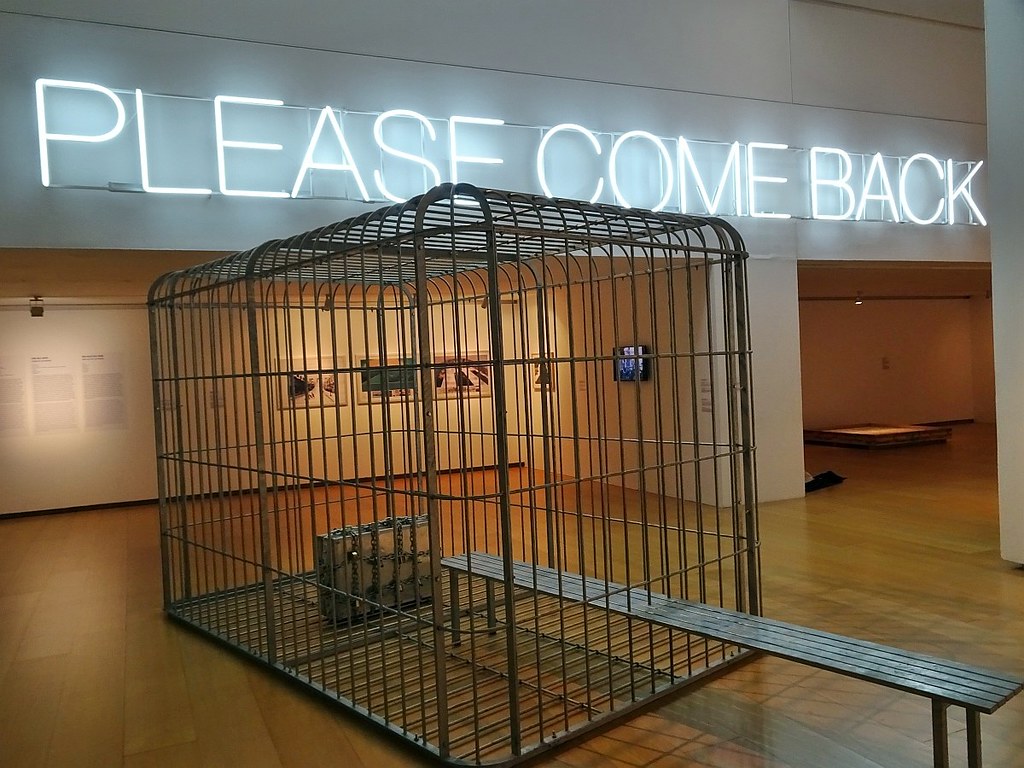
Photo: “0103-IVAM – Please Come Back 05” by gibbix1 is licensed under CC BY-NC 2.0.

Using form: sonnet variation: Amit Majmudar, ‘List of Demands’

All the twists in all the tongues, all
the zeroes, all the ones, all the arms of all the goddesses, all
the names of the nameless and bodiless, all the ways the all-
one embodies, all at once, the alls there are, all
our alleles and alphabets, all the forms, yes all,
even the sestina, all our alternating lives and deaths, all
the kingdoms, phyla, classes, orders, all
the peoples borderless as breaths, all the altars, all the all,

none of the zealots with knives for minds, none
of the wars, proxy, holy, shadow, cold, none
of the for-profit prophets in pulpits of gold, none
of the land grabs in the names of the long lost, none
of the one true anything, book or way or son, none
of that nonsense, absolutely none.

*****

Amit Majmudar writes: “The monorhymed sonnet (each line of the octet ending with the same word, each line of the sestet ending with another) is a chance to goad one’s creativity with a constraint just light enough. You have to come up with lines that stay interesting to the reader even though the reader knows how each line is going to end. In that, the line resembles, say, a formulaic genre novel where the hero gets the girl and defeats the villain at the end. Or one of Conan Doyle’s detective stories: You know that Holmes is going to solve the mystery. The number of characters is so low in a Holmes short story that the culprit has to be one of the few people introduced. But the delight is all in how he figures it out. Poems can work like that, too. The foregone conclusion of all, all, all, all, all, all, all, all, none, none, none, none, none, none is the equivalent of the certainty that Holmes will crack the case. The internal rhymes and alliteration, the images, the poem’s message exalting pluralism over zealotry—these are, collectively, the equivalent of the mystery and the ingenious solution to the mystery, the Sherlock-unlock, the puzzle (hopefully) satisfyingly worked out.”

‘List of Demands’ was first published in Plume.

Amit Majmudar is a poet, novelist, essayist, and translator. He works as a diagnostic nuclear radiologist in Westerville, Ohio, where he lives with his wife and three children. Recent books include Twin A: A Memoir (Slant Books, 2023), The Great Game: Essays on Poetics (Acre Books, 2024), and the hybrid work Three Metamorphoses (Orison Books, 2025). A new poetry collection, Things My Grandmother Said, is forthcoming in 2026. 
More information at www.amitmajmudar.com

Photo: “Inclusive community (citation needed) (2205859730)” by Matt Mechtley from Heidelberg, Deutschland is licensed under CC BY-SA 2.0.

Sonnet: ‘Maz’ Griffiths, ‘Internal Memo’

Dear Stomach,
… Look, we’ve really had enough.
Your job is simply to digest the stuff
supplied by Hands and Tongue, to move it through,
not chuck it up. Spurned food is déjà vu
and hurts Oesophagus; she’s frankly pissed,
and Face says please forget The Exorcist,
because projectile vomits are not fun
and bloody heartburn hacks off everyone.
Lungs say they’re worried by a niggling cough
and Guts say if you won’t perform: Sod off!
That’s not my phrase–I’m mediating here,
but want to stress the general atmosphere.

Please see these hiccups don’t occur again.
I sign myself, sincerely,
… Upper Brain

*****

Margaret Ann “Maz” Griffiths, born in 1947, suffered for years from a stomach ailment which finally killed her in 2009. Her frankness, good humour, range of interests and insights and her technical skill make her one of the very best English language poets of the early 21st century.

I recommend ‘Grasshopper‘, the 350-page compilation of her known verse, to anyone interested in modern poetry. It is one of those rare books that I reread every couple of years. I would be glad to hear of any more of her verse that has turned up since 2011.

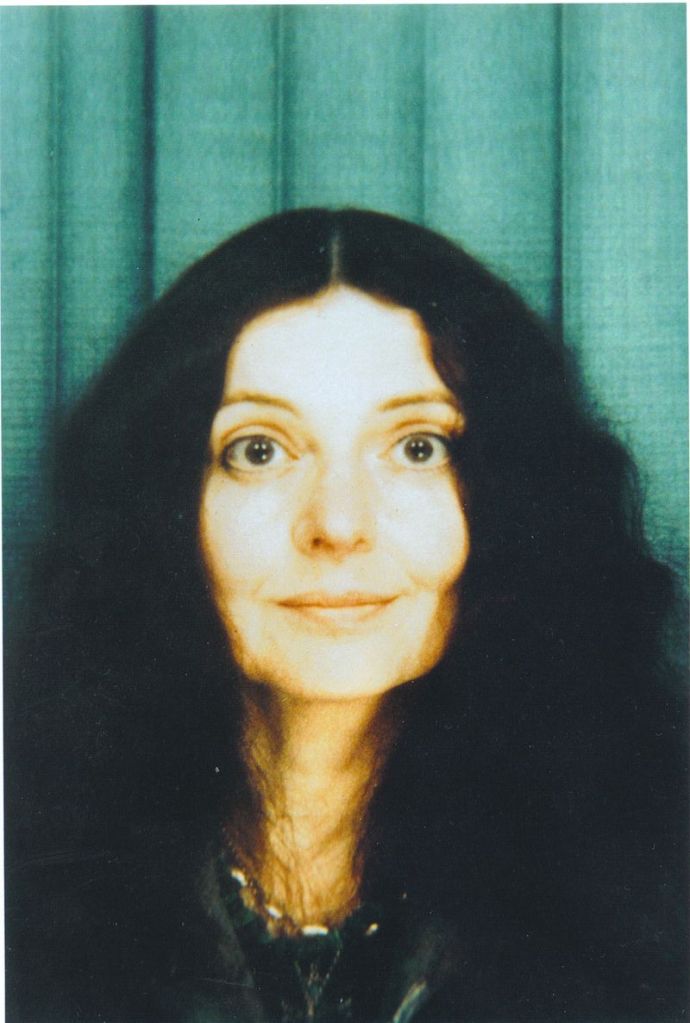
Photo: By David Adkins – Scanned photo provided by David Adkins with permission for reuse, CC0, https://commons.wikimedia.org/w/index.php?curid=16997441

Sonnet variation: Juleigh Howard-Hobson, ‘Sylvan Episode’

He looked at me as if I ought to know
just who he was
but I did not. I looked away, then so
did he. Alas
I didn’t recognize the Great God Pan
in human form.
I simply thought he was another man.
I felt a warm
gaze inviting me once more. I turned to
see him changed. A
God again, hooves and furry legs, horns grew.
He gestured “Hey?”
I was too dumbstruck to do more than stare.
He shook his curls and sprinted off somewhere.

*****

Juleigh Howard-Hobson writes: “I wrote this when I lived off-grid on ten acres up in rural Washington State.The forest that made up half my property was dark and creepy. The Great God Pan was no more out of place than BigFoot or werewolves. All of which I imagined I saw/heard from time to time (I use italics as I am not absolutely convinced it was all imagination). Nothing out there ever hurt me, so all’s well that ends well–I’ve since moved back to civilization, which is far more frightening in many ways. As for the form–well, that just was how the poem decided to be.”

Juleigh Howard-Hobson’s work can be found in Think Journal, Able Muse, New Verse Review (including this poem), The Deadlands, Autumn Sky Poetry and other venues. She has been nominated for “The Best of the Net”, Pushcart, Elgin & Rhysling Awards. Her latest book is Curses, Black Spells & Hexes (Alien Buddha). A member of the HWA and the SFPA, she lives on the coast of the Pacific Northwest. In a poetically haunted house. 
X: poetforest

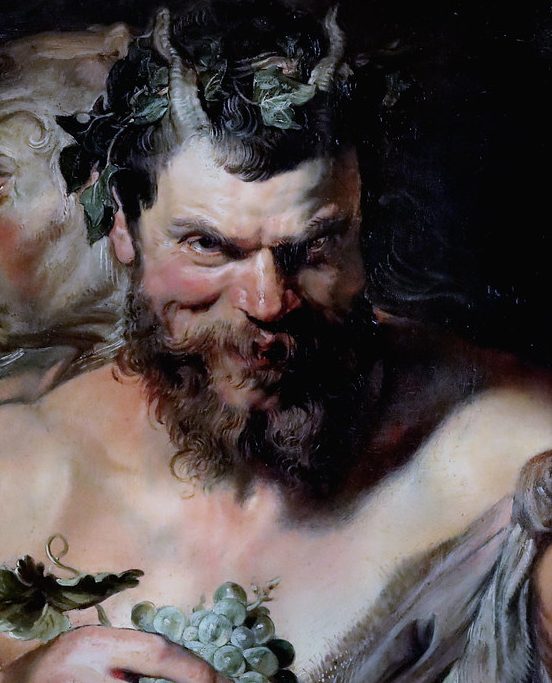
Photo detail “IMG_4017RBA Peter Paul Rubens 1577-1640 Anvers Deux Satyrs Two Satyrs ca 1619 Munich Alte Pinakothek” by jean louis mazieres is licensed under CC BY-NC-SA 2.0.

Sonnet variation: J.D. Smith, ‘Lullaby for the Bereaved’

Your hours of tears won’t let you follow
Those who’ve left you alone.
Tonight your head lies on a pillow,
Not beneath earth and stone.

The dead won’t be returning,
Not for all of your pleas,
Not for all your candles burning.
Get up off your knees.

The deceased, removed from their rest
Can take up all your hours
Until your mind, denied a fair rest,
Is deprived of its powers.

The road set before you is rocky and steep,
So seize the night’s respite and drift off to sleep.

*****

J.D. Smith writes: “Though I do not sing, play an instrument or read music, I had Brahms’ Lullaby in the back of my mind while attempting to deal with various losses, and the poem roughly follows its tune. In adjusting to a new reality (I hesitate to say “move on” or “get over,” phrases that smack of empathic failure), sometimes all one can do is rest.”

J.D. Smith has published six books of poetry, most recently the light verse collection Catalogs for Food Loversand he has received a Fellowship in Poetry from the United States National Endowment for the Arts. This poem is from The Killing Tree (Finishing Line Press, 2016). Smith’s first fiction collection, Transit, was published in December 2022. His other books include the essay collection Dowsing and Science, and his seventh collection, The Place That Is Coming to Us, will be published by Broadstone Books in 2025. Smith works in Washington, DC, where he lives with his wife Paula Van Lare and their rescue animals.
X: @Smitroverse

Photo: “Grief” by That One Chick Mary is licensed under CC BY-NC-ND 2.0.

Unrhymed sonnet: Peggy Landsman, ‘Shortly Before Another Winter Solstice in South Florida’

The seasons flow from much too hot to warm;
the moon balloons from farther south to north.
I struggle with myself to catch sunrise;
I shiver at sunset as darkness dawns.
Two clouds drift by in stillness as in dream.
My mind makes small confessions in the dark.
I wander through this ordinary night
discovering new doubts about myself.
The weather of my moods, not too extreme;
the climate of my life in crisis blooms.
The winter days grow short; my life, too long.
My understanding pales beneath the moon.
We creatures who’ve evolved to change the world
have not evolved enough to change ourselves.

*****

Peggy Landsman writes: “It did take me quite a while to make the transition from Berkeley, California, but now, after twenty-one years in South Florida, I’m finally over my culture shock.
I love walking on the beach and swimming in the ocean when the water temperature is at least 80°. I love the birds I see more of here than in other places: ibises, egrets, herons, ospreys, pelicans, etc. And I get all the culture I need for free from my local public county library. If they don’t have a movie, cd, or book on their shelves, they order it through ILL (inter-library loan).
I spend most of my time writing and hanging out with my favorite other person. What more could any septuagenarian poet want?
Also: The poem was first published under the slightly shorter title “Before Another Winter Solstice in South Florida” in the Winter 2024 issue of The Orchards Poetry Journal. And, by the way, that’s a very friendly journal for formal poetry. Thanks, Karen and Jenna!”

Peggy Landsman is the author of the full-length poetry collection, Too Much World, Not Enough Chocolate (Nightingale & Sparrow Press, 2024), and three other books, including the poetry chapbook Our Words, Our Worlds (Kelsay Books, 2021). She lives in South Florida where she spends as much time as possible at the beach. To learn more about her and her work, visit: https://peggylandsman.wordpress.com/

Photo: “Walk on a Warm Beach” by justenoughfocus is licensed under CC BY-NC 2.0.
Using form: Spenserian sonnet: Charles Martin, ‘On the Problem of Bears’

Bears are frustrated by their lack of speech,
Their claws leave blackboards shrieking for repairs,
And that’s why bears are seldom asked to teach
And almost never get Distinguished Chairs
Unless they come across one unawares
Whose rich upholstery they quickly shred.
Some of them have been known to have affairs
With a man or woman lured into their bed—
This often ends up badly with one dead,
The other executed for the crime,
Or given a life sentence in a zoo.
Bears are familiar with existential dread,
Bears put their pants on one leg at a time:
The problems bears have are your problems too.

*****

Charles Martin writes: “The poem is written in a variation on the Spenserian Sonnet form, which I have been writing for several years now. In this case, I enjoy the contrast between the strictness of the form and the raucousness of its subject. As I recall, I began it on a morning walk, and I think finished it shortly after the walk ended. 

“The poem will next appear in The Khayyam Suite this spring, published by The Johns Hopkin University Press, which has published my last two collections of poetry, Signs & Wonders and Future Perfect, both of which are still in print. (Future Perfect has a sonnet sequence written in the Spenserian form.) Poems have recently been published in Literary Matters, The Hudson Review, Classical Outlook, and in Best American Poetry, 2024.”

Charles Martin is a poet, translator of poetry, and essayist. The Khayyam Suite is the fifth of his eight books of poetry to appear in the Fiction and Poetry Series of the Johns Hopkins University Press. His poems have appeared in Poetry, The New Yorker, The Yale Review, The Hudson Review, Literary Matters, The Hopkins Review and, in numerous anthologies, including Best American Poetry, The Norton Anthology of Poetry, and War No More: Three Centuries of American Antiwar and Peace Writing. He has received an Academy Award in Literature from the American Academy of Arts and Letters, a Creative Writing Fellowship from the National Endowment for the Arts, an Ingram Merrill Grant, a Bess Hokin Award from Poetry magazine, and a Pushcart Prize. His residencies include the Djerassi Foundation and Ragdale, and he served as Poet in Residence for five years for the American Poets’ Corner at the Cathedral of Saint John the Divine. His translation of Ovid’s Metamorphoses received the 2004 Harold Morton Landon Award from the Academy of American Poets, and he has also translated The Poems of Catullus and the Medea of Euripides. He is the author of the critical introduction to Catullus in the Hermes Book series of Yale University Press and of numerous essays on, and reviews of, classical and contemporary poetry.

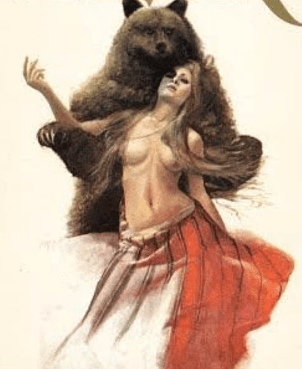
Photo: from the Bantam/Seal cover of Marian Engle’s novel ‘Bear’, referenced in https://www.cbc.ca/radio/ideas/why-the-classic-canadian-novel-bear-remains-controversial-and-relevant-1.5865107

Weekend read: Sonnet variation: Michael R. Burch, ‘Erin’

All that’s left of Ireland is her hair—
bright carrot—and her milkmaid-pallid skin,
her brilliant air of cavalier despair,
her train of children—some conceived in sin,
the others to avoid it. For nowhere
is evidence of thought. Devout, pale, thin,
gay, nonchalant, all radiance. So fair!

How can men look upon her and not spin
like wobbly buoys churned by her skirt’s brisk air?
They buy. They grope to pat her nyloned shin,
to share her elevated, pale Despair …
to find at last two spirits ease no one’s.

All that’s left of Ireland is the Care,
her impish grin, green eyes like leprechauns’.

*****

Michael R. Burch writes: “My poem is set in the present and really has nothing to do with poverty. All that’s left of Ireland of yore is the young mother’s red hair, fair skin, a tendency toward melancholy (“despair), and her train of children. She’s a practicing Catholic except for a few affairs. Otherwise she’s a modern woman, drinking and flirting in a pub. I was trying to capture a bit of Ireland in a young mother, very loosely inspired by one of my Irish cousins who was a bit of a “wild child” in her youth.”

(Editor’s aside: My bad for thinking that “All that’s left” implied poverty, which was not in Michael R. Burch’s mind at all. True, Ireland goes through enormous swings of fortune, but the Ireland of even some years ago no longer matches the fabulously rich Ireland of today – the people are 50% richer than Americans or Norwegians…

2024 top GDP.png

… putting the UAE and Switzerland in the shade as well.)

Michael R. Burch’s poems have been published by hundreds of literary journals, taught in high schools and colleges, translated into 22 languages, incorporated into three plays and four operas, and set to music, from swamp blues to classical, 61 times by 32 composers. He is also the founder and editor-in-chief of The HyperTexts.

Photo: “Irish Fire at the Barn” by Trey Ratcliff is licensed under CC BY-NC-SA 2.0.

RHL, ‘The Sun is Always Setting’

The sun is always setting, always setting on your day;
you sense the dark approaching, wish that it would stay away.
Do you want a life unchanging? Wish to still be a newborn?
Don’t you know life’s not a rosebud, but has root and leaf and thorn?

The sun is always setting and the black drapes are unfurled;
but notice that the sun sets on your world, not on the world:
it’s rolling into brightness in another’s happy land,
and the dark is evanescent and the brightening is grand.

The sun is always setting on the dinosaurs, but birds
are flocking into being, as are Serengeti herds;
and the sun that lights humanity? Of course it’s going to set,
and elsewhere light new tales of which we’ll just be a vignette.

The sun is always setting, but that view is just your choice;
I say the world is turning and evolving; I rejoice.

*****

Sometimes I’m told that my poetry is too bleak. But I think that’s only so if you want everything to stay as it is now. If, on the other hand, you expect change, and that change will ultimately provide more benefit than loss to the universe as a whole, then <shrug>… so it goes.

This poem has 14 lines but is hardly a sonnet. It was recently published in Pulsebeat Poetry Journal. Thanks, David Stephenson!

Photo: “Sunset Sadness” by BaboMike is licensed under CC BY-NC 2.0.