Tag Archives: spring

RHL, ‘In the Spring’

In the spring, an old man’s fancy
ruefully reviews his youth;
thinks of girls both past and present,
wonders can he hide time’s truth.

His always googly gardening eyes
all ever which ways scan and glower
at the bud-bursting blossoming girls
exploding in their flower of power.

What is this green and noisy growth
that’s flourishing, fresh and unkempt?
Old’s good, so’s young… could one be both?
O Fates! from fate make me exempt!

*****

‘In the Spring’ was published in Bewildering Stories, an online weekly of Speculative Fiction, Poetry, Art, etc. Thanks, Don Webb!

at the museum” by derpunk is licensed under CC BY-NC-SA 2.0.

Max Gutmann, ‘Spring Villanelle’

Sandro Botticelli. (Alessandro di Mariano di Vanni Filipepi) 1444-1510.Florence. La Naissance de V?nus. Florence. Le Printemps. 1480. Florence. Mus?e des Offices.

Plants flower, swallows sing, and bunnies boff.
All nature gleams with joy. But time’s a sprinter.
When spring arrives, can winter be far off?

Take care. The festive glass from which you quaff–
at least half empty–soon will freeze and splinter,
though tulips bloom, swifts fly, and bunnies boff.

I glance away, then clear my throat and cough
to see you celebrating spring, that minter
of tender babes whose end is not far off.

You’ll soon require that heavy coat you doff,
eyes glinting so. Each year I see that glint err
as pansies flare, doves coo, and bunnies boff.

A peak makes more acute the coming trough.
Life’s script is not by Disney; it’s by Pinter:
one knows a heavy pause is not far off.

This bitter wisdom’s scorned, but, though you scoff,
each spring remains a harbinger of winter.
The primrose shines, wrens chirp, and bunnies boff,
all certain signs that winter’s not far off.

*****

Max Gutmann writes: “In this one, I tried to balance newness and repetition, like spring.”

‘Spring Villanelle’ was originally published in Light.

Max Gutmann has contributed to New StatesmanAble MuseCricket, and other publications. His plays have appeared throughout the U.S. (see maxgutmann.com). His book There Was a Young Girl from Verona sold several copies.

Photo: “IMG_6269A Sandro Botticelli. (Alessandro di Mariano di Vanni Filipepi) 1444-1510.Florence.” by jean louis mazieres is licensed under CC BY-NC-SA 2.0.

RHL, ‘The Queen’

In March the Queen came, flirting on her throne;
April, I loved her gladly,
And in May I’ll love her madly,
And in June I may act badly
For July I’ll love her sadly,
Cause when August comes, I know that she’ll be gone.

*****

This poem was just published in Rat’s Ass Review – thanks, Roderick Bates… who, in accepting it, wrote “By the way, I assume the queen is Cassiopeia, who is always visible at my latitude.” I’m happy with that interpretation; but it’s actually about the lighthearted springtime attractions that, sensibly, go nowhere.

Photo: “flirt” by cloud.shepherd is licensed under CC BY 2.0.

Short poem, ‘Vetch in the Spring’

Love comes back like vetch in the Spring:
You knew it was there, but it’s still a surprise –
The flower is lovely, but wildly unwise.
Love comes back like vetch in the Spring,
You keep pulling it out but you’re never free;
You think it’s gone, but it won’t ever be.
It just comes back like vetch in the Spring.
Love’s just a thing.

*****

With a bit more attention, this poem might have made a satisfactory rondelet (like the previous post by Susan McLean)… but it’s in the form that it occurred to me and, like vetch, it’s just there in its undisciplined fashion. Published this month in Allegro Poetry Magazine, edited by Sally Long.

Photo: “vetch flower and tendril, with ant” by Martin LaBar is licensed under CC BY-NC 2.0.

John Beaton, ‘Year-Leap’

This field in winter forms a wetland, quiet
except for hushing rainfall, rushing hail,
a breeze that, fussed with snowflakes, seems to sigh at
the calls of robin, chickadee, and quail,
and swishing noises as a buck picks through
a copse of wild roses, red with thorns,
briar stems, and rose hips, which he’ll chew
as velvet slowly silences his horns.

And then the frogs! These mudlark choristers,
raucous for amplexus, now rejoice–
last night we heard no chirrups, chirps, or chirrs;
tonight they’d overwhelm a stentor’s voice–
and, swamping winter with their song, they bring
good news: the year is sound, and crouched to spring.

*****

John Beaton writes: “On our Vancouver Island acreage, frogs herald the spring,  In this poem I tried to convey the sense of joyous surprise I feel when hearing them for the first time each year.
It’s a fairly straightforward sonnet—pentameter rhymed ababcdcd efefgg. I started out softly with feminine a-rhymes then moved to masculine. Line eight introduces the turn with a line of which I’m fond, one of those that, when they fall into your lap, make writing poetry great fun. I delighted myself with quite a bit of alliteration, internal rhyme, and selective vocabulary.”

John Beaton’s metrical poetry has been widely published and has won numerous awards. He recites from memory as a spoken word performer and is author of Leaving Camustianavaig published by Word Galaxy Press. Raised in the Scottish Highlands, John lives in Qualicum Beach on Vancouver Island.
https://www.john-beaton.com/

Painted Glass Frog & Swamp Window– Completed Strawbale House Build in Redmond Western Australia” by Red Moon Sanctuary is licensed under CC BY 2.0.

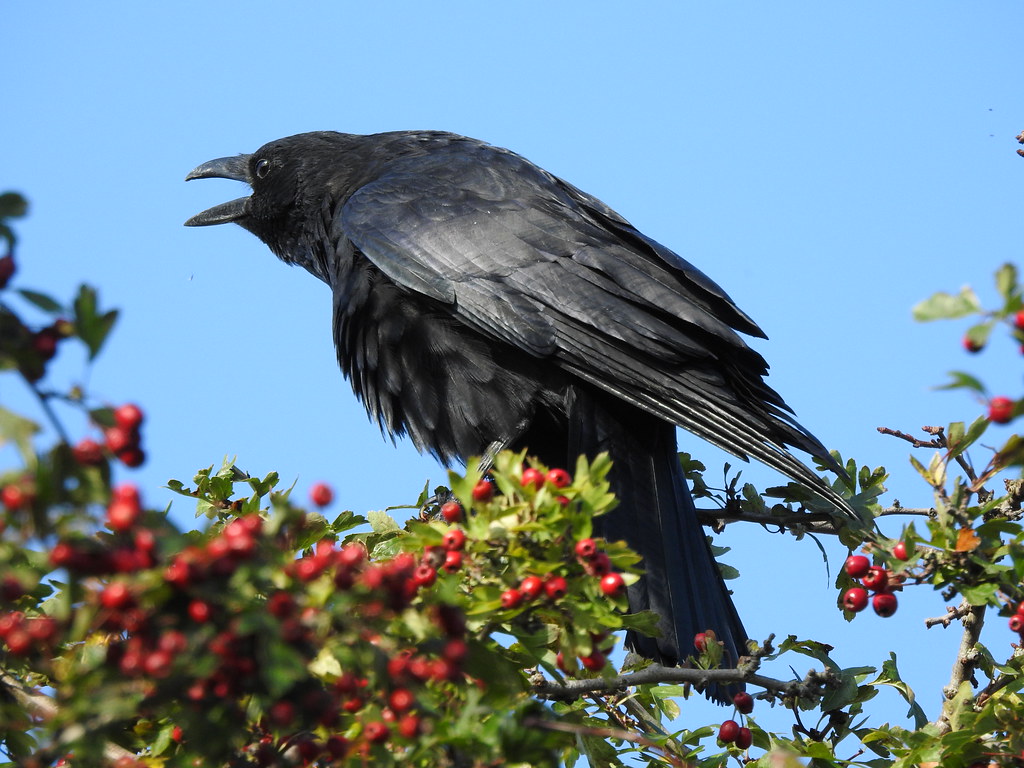
Potcake Poet’s Choice: Jerome Betts, ‘Morning Calls’

Though buds, light-headed, arrow to the sun,
Wood-pigeons cautiously descend to drink
As through the roof the first faint cheepings run
From half-fledged nestlings in some straw-warm chink,
While welling far and near − to float and sink
Like spidery fibre silvered on the lawn −
Mercurial lark song trails out link by link,
Rocking serrated-throated crows have drawn
Their broad indelible raw weals across the dawn.

Jerome Betts writes: “Have only tried the intricate patterning of the ‘Spenserian stanza‘ a couple of times. On the first occasion it seemed to suit a comment on the design of a 4th century Roman mosaic floor and on the second, in ‘Morning Calls’, appearing in Snakeskin, a memory of the rich dawn chorus in rural Herefordshire many years ago. The point of particular interest for me is the phrase ‘rocking serrated-throated crows’ in Line 8, unchanged from one jotted at the time. The words fitted a rocking or bobbing movement, but why ‘serrated-throated’?  This is appropriate for ravens with their ‘shaggy throat feathers’  (RSPB Handbook 2014) but not, I thought, crows. The words resisted attempts at tweaking and the stanza stalled. Some weeks later I saw a crow standing on top of a Devon street light rhythmically calling and rocking . . . and as it did so its neck feathers briefly parted on the upstroke of the movement. The line had preserved an exact observation made when young and then forgotten.”

Jerome Betts edits the quarterly verse webzine Lighten Up Online in Devon. His work has appeared in Amsterdam Quarterly, Angle, Autumn Sky Poetry Daily, Pennine Platform, Light, The Rotary Dial, and Snakeskin, other American, British and Canadian publications and two Iron Press anthologies.
www.lightenup-online.co.uk

Photo: “A Crow calling – gardenDSCN9711” by ianpreston is marked with CC BY 2.0.

Potcake Poet’s Choice: Kate Bernadette Benedict, ‘The Sureties’

Some things you can still rely on.
Forsythia hedges contribute their usual yellow;
Callery pears exhibit their annual white.
The vernal light is cast as it was cast last year—
Cimmerian, then milky, then bright.
Tulips accrue, woodpeckers adhere
to their nourishing boles, a piccolo.
sounds in the park. Lovers have new grass to lie on.

Some things you can still depend on.
I buried my mother today in the family plot.
Her ashes were housed inside a simple casket—
an easy-to-carry container with little heft,
light as an already plundered Easter basket
when only a couple of elegant eggs are left.
I’d been there before; I’d stood on the very spot.
I’m accustomed to the conditions that lives end on.

Kate Bernadette Benedict writes: “Sureties are few in life yet I feel sure that many of us today are going through our daily motions in an elegiac mood—because of the pandemic, of course, and the illness and deaths we learn of on the news and experience in our lives. Last spring (2020), we were all in a panic and this spring we are, perhaps, inured to loss, at least to some degree. So I feel this poem about spring and death fits my mood perfectly, and perhaps the mood of you, the reader, too.”

Kate Bernadette Benedict may have lost a portion of herself when she took on her pen name; still, she has grown accustomed to its saintly qualities which represent, she well knows, an unattainable goal. She is the author of three full-length collections, the most recent being Earthly Use: New and Selected Poems. Kate has been holed up for a year in her apartment in Riverdale, the Bronx, but is now twice-jabbed and hopes to be re-materializing very soon. Her website suffered a crash but some content is still readable at katebenedict.com, where links to three formal-friendly publications may be found: Umbrella, Bumbershoot, and Tilt-a-Whirl.
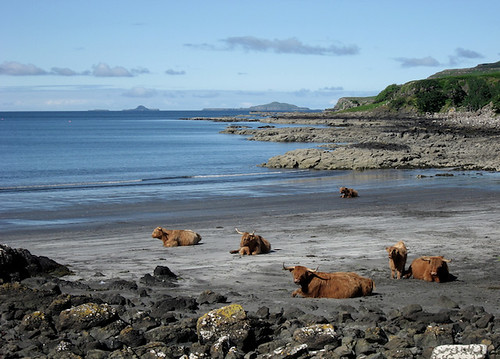
Poem: ‘Highland Spring’

Bulls lean head to head
In motionless battle;
Notionless cattle
Stroll the strand
And graze;
Sheep
Sleep
Or idly stand
Idly gaze
Down on the rocks
By the sea snore.

This poem was originally published in Candelabrum, one of the rare magazines that lived to support traditional verse through the winter of the mid to late 20th century. Traditional verse survived, and springs forth with new shoots. And, yes, it’s now spring in the northern hemisphere! The beginning of the good times! That’s my mood, anyway… things certainly feel more positive than they did a year ago, whether your spring beaches are populated by highland cattle or northern tourists.

“Highlanders at Torloisk Beach” by Simaron is licensed under CC BY-NC-SA 2.0

Poem: “Seasonal”

When Mr. Warm-as-winter-under-the-covers
Meets Cool-as-summer-in-the-evening-breeze
He’ll spring to leave ideas they could be lovers –
But her thoughts fall away like leaves from trees.

First published in Lighten-Up Online.