At six o’clock, I wake, And plod down to the kitchen table In time to greet the sun, And hear the news on cable But focus on my sugar flakes; I don’t watch it none.
At eight, I hit the tees— I’m done faster without a foursome— And watch the wheeling hawks— At times, the game is boresome— And leave the club at ten oh three, In time for business talks.
At three, I call my mom, Who asks keenly about my meetings; I don’t have much to say. She wants to know I’m eating; I tell her yes to keep her calm. We do this every day.
At six I disconnect And meet friends at my favorite diner And drink a single glass. At eight, in my recliner, I grab my clicker to select The way the time will pass.
By nine, I’m back in bed, My teeth brushed and my body showered. The bed is soft and deep, My screens unplugged, unpowered. The pillow yields beneath my head. At four, I fall asleep.
*****
Narcisse Tardif writes: “I watch some crime documentaries here and there, and I’m struck whenever the murderer or would-be murderer just seems like a normal person. I wanted to use my poem to explore what life could be like for a “normal-person” murderer who got away with it. OJ was a big inspiration, but the poem is not meant to just be a retelling of the OJ story.
“The form is an ad hoc invention. I liked the double stress of “plod down” because of its evocative nature, so I built the second line around that, using a trochaic substitution in the second foot of each second line. The rest of the form is meant to be somewhat conversational, mimicking the ebb and flow of daily life, with some variation here and there, but the repetition of the exact form in every stanza still leaves enough sameness to evoke routine. I don’t know whether you have a policy regarding overexplaining poems on your blog, but the line about drinking a single glass is supposed to be a hint, as well as the more obvious sleepless night. On a more subtle note, the complete absence of a romantic partner is a bit of subtext throughout the whole poem.”
Narcisse Tardif self-describes as “Poet grappling with the ironies and incongruities of heartbreak, religion, meditation, and mortality. I write mostly in English, but also in French and sometimes other languages. First person ≠ autobiographical.”
From worship and tenderness to profanity. Two poems becoming one through the contrapuntal technique.
Quatorzain I: Secrecy.
Solemn prayers fill the empty church; hallow’d songs arise from pews of birch.
Midnights are when angels fill the halls— neither flaw nor sin to weight their calls— right where Heaven’s ardent mercy falls. Yes, Amen, and God, they sing aloud, earnest praises proudly thus avowed, bless’d by secrecy’s embrace and shroud.
Only God may hear them. Only he knows the meaning of their cry and plea. Yet-unknown and his alone to see, choirs outbreathe a psalm when no one’s near as an offering at last sincere, echoed up in majesty and fear.
Quatorzain II: In Sacred Places.
Caressing, smiling, both confiding, enamored dreamers kiss in hiding. In sacred places coinciding, grotesque to Earth, they birth a treasure, humanity devoid of measure, melodic in its throes of pleasure.
Secure’s the love away from judges— revealed to none who touch begrudges, observes the bruising lips and smudges— liturgical in eyes’ occlusion. Neglect has borne them disillusion, religion out of shared seclusion.
Nocturnal lovers taste affection seduced by solitude. Perfection.
Contrapuntal: Secrecy in Sacred Places.
Solemn prayers fill the empty church; Caressing, smiling, both confiding, Hallow’d songs arise from pews of birch.
Enamored dreamers kiss in hiding. Midnights are when angels fill the halls— In sacred places coinciding,
Neither flaw nor sin to weight their calls— Grotesque to Earth, they birth a treasure, Right where Heaven’s ardent mercy falls.
Humanity devoid of measure, Yes, Amen, and God, they sing aloud, Melodic in its throes of pleasure.
Earnest praises proudly thus avowed, Sincere’s the love away from judges— Bless’d by secrecy’s embrace and shroud.
Revealed to none who touch begrudges, Only God may hear them. Only he Observes the birth of bruising smudges—
Knows the meaning of their cry and plea. Liturgical within seclusion. Yet-unknown and his alone to see,
Neglect has borne them disillusion— Choirs outbreathe a psalm when no one’s near Religion out of shared seclusion.
Asan offering at last sincere, Nocturnal lovers taste affection, Echoed up in majesty and fear. ’ Seduced by solitude. Perfection.
*****
Brooklyn Crane writes:
This God-Forsaken Contrapuntal!
Contrapuntal poetry seems complicated, and it actually is. Merging lines and meanings can be quite tricky! However, I’ve read several of them either composed of poems which barely hold up on their own or too short enough to be manageable, and in response to this, I obviously went over the top. Let’s see everything you can do by blending two poems together!
A contrapuntal text is the result of the intercalary arrangement of two separate pieces of writing which creates a hidden meaning.
When I prepared to pitch the idea of writing a complex-as-all-hell contrapuntal to my friend and fellow writer Narcisse Tardif, the very first thought that came to mind was that of how most contrapuntal poetry out there simply isn’t formal at all. I mean, who has the time for that? Of course, this being my publication, the name of which is Scheming Rhymes, I naturally had to do something about that. Two questions came out of this train of thought, and these were:
What if it was a contrapuntal between two sonnets?
What if I could produce an acrostic resulting from their intercalation?
If you’ve actually read my poem, you will obviously notice that the sonnets are not sonnets at all—or at least not in the traditional sense of the word. They are indeed quatorzains, as the silly French call the 14-line arrangements that most sonnets adhere to, but the only thing these have in common with them is the couplet of the Shakespearean variant. Undeniably, I could have just written two sonnets. However, it’s never that simple on Scheming Rhymes, and you’re here for it. We’ll get there in a bit.
Regarding the acrostic, yes—there’s a reason for the italicized start of every line. Why did I do this? I just wanted to leave a signature in this poem. Here it is!
Fourteen and fourteen from each poem constituting this contrapuntal add up to twenty-eight lines for me to work with. Scheming Rhymes perfectly fills half of that space while Brooklyn Crane sadly leaves me one letter short. Upon this ill-fated realization, I added the S at the end and pretended myself to be a brilliant strategist who can overcome anything with enough delusion. Surely the reader will know that an apostrophe precedes itbecause, you know, the poem is mine.
It is now that we can address the odd rhyme schemes of the quatorzains as, with the previous information in mind, I went ballistic.
“Could I arrange the poems in a way that their merging results in a different form? If so, which form would that be?”
SO! Because I had just recently posted my terza rima composition breakdown, it was freshly in my mind that a possible solution to this conundrum was such a form. I mean, think about it. Terza rima poems work on a formula of 3x + 1 (or 2), so I did 28 minus 1, divided by 3, and I landed on– I KNOW YOU ARE NOT HERE FOR THE MATH! Anyway, I landed on 9 tercets plus 1 loose line, accounting for all twenty-eight verses.
Next was the question of what the rhyme schemes had to be in order to fulfill this crazy dream. Terza rima works on a ABA BCB CDC … YZY Z (or ZZ) scheme, so I superimposed it on the acrostic as follows.
I hope that you are starting to see the way these two bastards came into existence. We now have the structural guidelines for both quatorzains and the resulting terza rima. This would absolutely be enough for a sane person to go about their day. It’s a double quatorzain/terza rima/contrapuntal/acrostic after all.
It was not enough for me, but I will not bore you with the metrical choices made in this poem. It’s explained on the paid-for section of my terza rima post, though.
Oh, yes. This is a shameless plug for my paid subscription. Come on—you already love Scheming Rhymes!
With all of these guardrails to work with, it was finally time to write. It was absolute hell.
But why do this?
The short answer is: because I can, lol. The actual answer, however, is that I do it because it can be done. Scheming Rhymes is all about exploring what we can do to enrich poetry, understanding both the traditions that educate our verse today and the techniques that might innovate its composition tomorrow. This work is not perfect, I’m aware, and there is sure to be someone who executes the planning behind it more expertly, but we ought to encourage writers to challenge themselves and produce beauty through effort, not through simply making poetry easier.
So there you have it. Here’s to more brutal antitheses to free verse poetic prose!
Join the madness—or don’t!
As with all previously explored forms and techniques, I am not here to police you about how you write and what decisions you make. You can make lines vary in syllable count, ditch the rhymes, change the number of lines per stanza, or anything else you want to do. All I intend on this publication is to give you a starting point from which to find your identity as a writer. Here’s the text by Ani Beeler that inspired me to explore this technique using a completely different approach:
Brooklyn Crane: Celebrating human ingenuity in poetry! Writer, advocate, unapologetic rhyme addict, and public enemy of AI content. Subscribe to Scheming Rhymes—read more of my work and learn more about poetry forms and techniques.
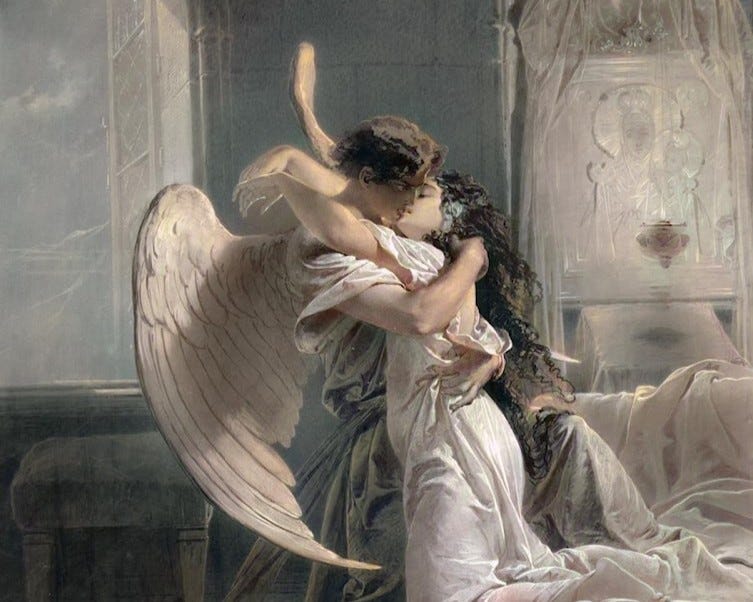
Illustration attributed to Mihály Zichy based on Mikhail Lermontov’s poem The Demon, via Art Renewal Center.