Tag Archives: using form

Using form: Rondeau: J.D. Smith, ‘Sans Issue’

What ends with me? A set of genes,
The notion that my slender means
Might turn into a son’s estate,
The hope that, at some distant date,
Beside my grave, my line convenes

To recollect my days’ routines,
My counsels, and the vanished scenes
Whose witnesses would recreate
What ends with me:

The consciousness that struts and preens
In holding that its passing means
An altering of our species’ fate,
My thought possessed of untold weight.
Yet, on that thought, the question leans–
What ends with me?

*****

J.D. Smith writes: “After reaching a certain age and making certain commitments, I found myself coming to grips with never being a parent. As in other instances of following form, the repetitions of the rondeau gave me a way to enclose and develop my response to the situation.”

J.D. Smith has published six books of poetry, most recently the light verse collection Catalogs for Food Loversand he has received a Fellowship in Poetry from the United States National Endowment for the Arts. This poem is from The Killing Tree (Finishing Line Press, 2016). Smith’s first fiction collection, Transit, was published in December 2022. His other books include the essay collection Dowsing and Science, and his seventh collection, The Place That Is Coming to Us, will be published by Broadstone Books in 2025. Smith works in Washington, DC, where he lives with his wife Paula Van Lare and their rescue animals.
X: @Smitroverse

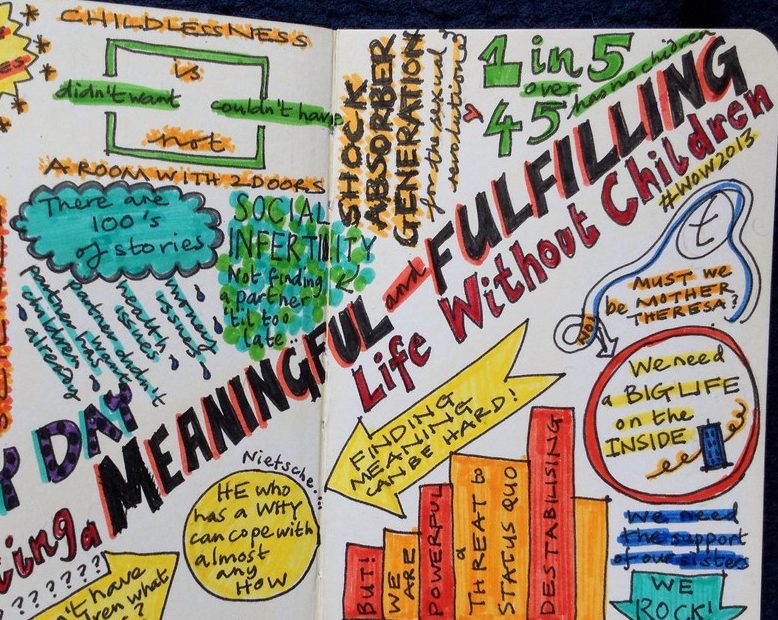
Photo: “Creating a meaningful and fulfilling life without children #sketchnotes #gatewaywomen #jodyday” by etcher67 is licensed under CC BY-NC-ND 2.0.

Using form: Shakespearean sonnet: Susan McLean, ‘Foreshadowing’

You’re a holiday.
—”Holiday,” The Bee Gees

One month from when you met me, when you brought
the first of many gifts, a 45
of plaintive praise and longing, who’d have thought
that forty-five years later we’d survive
on weekends, holidays, and summer breaks,
a foretaste of the end in every start,
anticipation ballasted with aches
as we put love on hold and live apart?

You are a holiday. The working week
unspools like toilet paper from a roll.
My attitude goes airborne when we speak,
and when we meet, my heart swoops like a shoal
of fish. Would we have lost this giddy glow,
living together? Better not to know.

*****

Susan McLean writes: “It makes me feel ancient to realize that for younger readers I will have to explain that a 45 was a record with one song on each side, which played on a record player at 45 revolutions per minute. Love poems themselves tend to feel old-fashioned these days, though this one is about a relatively modern problem, the long-term, long-distance relationship in which both people are employed full time at jobs far apart from one another. The form, a Shakespearean sonnet, mirrors the content, in that the rhymes are separated from one another until the end, when they are reunited. The poem was originally published in the online journal of female formalist poets Mezzo Cammin, and it later appeared in my second book of poetry, The Whetstone Misses the Knife.

Photo: “File:45 record.png” by laurianne is marked with CC0 1.0.

Using form: William Trowbridge, ‘Song of the Black Hole’

radially extracted by NASA

You can almost see Vincent Price, black-robed,
hunched above the console of a jumbo organ
in the bowels of his creaky haunted manse; or
maybe a stadium of damned souls, strobed
in lurid red and howling nettle-robed
as they plummet into Pandemonium, pore
and pith aflame. It’s no troubadour,
undoubtedly, this vast atonal gob.

As with the Roach Motel, we’d check in,
but never out—us or anything, since
it can swallow errant planets whole, and still,
however much the mass, can’t eat its fill.
Though it’s larger far than Jupiter or Mars,
we can barely see it, thank our lucky stars.

*****

 William Trowbridge writes in Rattle, where this poem was published: “I’ve spent most of my years as a poet writing free verse, though lately I find myself turning toward form. Unlike those who see formalist verse as dry and effete, I find it can generate power by means of barriers to play against—‘the net’ as Frost put it, by which he also meant boundary lines. If you pour gunpowder in a pile and light it, a mere flash occurs. But pack it tightly into a container, and you can get something more powerful. And, as opposed to the notion that form is restrictive, I agree with Richard Wilbur that it often liberates one from choosing the easy word in order to discover the better, surprising one. I haven’t moved into this part of town yet, but I stop there more and more.”

William Trowbridge’s tenth poetry collection, Father and Son, was published by Wayne
State College Press Press in April. His poems have appeared in more than 45
anthologies and textbooks, as well as on The Writer’s Almanac, AnAmerican Life in
Poetry, and in such periodicals as Poetry, The Gettysburg Review, The Georgia Review,
The Southern Review, Plume, Rattle, The Iowa Review, Prairie Schooner, Epoch, and
New Letters. He is a mentor in the University of Nebraska-Omaha Low-residency MFA
in Writing Program and was Poet Laureate of Missouri from 2012 to 2016. For more
information, see his website, williamtrowbridge.net.

YouTube: Data Sonification: Black Hole at the Center of the Perseus Galaxy Cluster (X-ray), NASA’s Marshall Space Flight Center

Weekend read: Maryann Corbett, ‘A Valediction: of Maintenance Work’

Time was, we spent our muscle and our nous
propping an aging house
against the pummeling of its hundred years.
Clean paint, neat gardens, upkeep rarely in arrears,
sober as Donne. Yet now each year afresh
burdens us with new failings of the flesh:

Legs that once mounted ladders without qualm
tremble. Nor are we calm
confronting pipework; torsos will not shrink,
backs bend, or shoulders fold to grope below a sink.
Hands shake; eyeballs glaze over. What appalls
is that our bodies buckle like our walls:

plaque in arteries, soot in chimney stacks,
stubborn and troublous cracks
in teeth, in plaster. House! Ought we to call
ourselves—and you—new poster children for the Fall,
for that hard doctrine grumbling down the ages
that Sin’s to blame, with Death and Rot its wages?

Entropy as theology—would Donne
jape at it? Wink and pun
as in his randy youth? Or solemnly
robed in his winding sheet, sing Mutability,
spinning into the praise of God in Art
the fact that all things earthly fall apart?

Or pull from air some bit of modern science,
yoking (even by violence)
thermodynamics, shortened telomeres,
transplants, genetics, sex, the music of the spheres?
Strange physics and wild metaphors—all grand,
but Rot and Death, plain woes we understand,

are better fought with checkbooks than with verse.
We’ll sit, these days. We’ll nurse
our beers, while able bodies stir their dust.
A distant siren whines—we sigh; it whines for us.
Let plumbers, painters, carpenters begin
this season’s round of battling Death and Sin.

*****

Maryann Corbett writes: “Last summer, Clarence Caddell was just beginning work on a new magazine, The Boroughand was planning a second issue while the first came together. He had in mind an issue centered on Donne, and he commissioned me to contribute a poem. I’d read the wonderful biography Super-Infinite: The Transformations of John Donne by Katherine Rundell not many months before, so a lot of the life was fresh in my mind–but it was also the season of endless repair that is the eternal truth of owning a house that’s 113 years old.  It wasn’t hard to pull together a poem about the woes of home ownership with tidbits that “everyone knows” about Donne–his worldly-to-holy conversion, the familiar line about his yoked-by-violence metaphors–under an allusive title, and in a stanza form a bit like one of his. (Alas, this blog can’t show you the indents that would best imitate Donne’s way of laying out a poem. You’ll have to imagine all the trimeter second lines indented and the hexameter fourth lines hanging out farther left.) In the end, Clarence had to use the poem to fill out his first issue, so it sat alone, unassisted by an issue theme.”

Maryann Corbett earned a doctorate in English from the University of Minnesota in 1981 and expected to be teaching Beowulf and Chaucer and the history of the English language. Instead, she spent almost thirty-five years working for the Office of the Revisor of Statutes of the Minnesota Legislature, helping attorneys to write in plain English and coordinating the creation of finding aids for the law. She returned to writing poetry after thirty years away from the craft in 2005 and is now the author of two chapbooks and six full-length collections, most recently The O in the Air (Franciscan U. Press, 2023). Her work has won the Willis Barnstone Translation Prize and the Richard Wilbur Award, has appeared in many journals on both sides of the Atlantic, and is included in anthologies like Measure for Measure: An Anthology of Poetic Meters and The Best American Poetry.


Photo: “House Repairs” by JessNityaJess is licensed under CC BY-NC-SA 2.0.

Using form: Spenserian sonnet: Charles Martin, ‘On the Problem of Bears’

Bears are frustrated by their lack of speech,
Their claws leave blackboards shrieking for repairs,
And that’s why bears are seldom asked to teach
And almost never get Distinguished Chairs
Unless they come across one unawares
Whose rich upholstery they quickly shred.
Some of them have been known to have affairs
With a man or woman lured into their bed—
This often ends up badly with one dead,
The other executed for the crime,
Or given a life sentence in a zoo.
Bears are familiar with existential dread,
Bears put their pants on one leg at a time:
The problems bears have are your problems too.

*****

Charles Martin writes: “The poem is written in a variation on the Spenserian Sonnet form, which I have been writing for several years now. In this case, I enjoy the contrast between the strictness of the form and the raucousness of its subject. As I recall, I began it on a morning walk, and I think finished it shortly after the walk ended. 

“The poem will next appear in The Khayyam Suite this spring, published by The Johns Hopkin University Press, which has published my last two collections of poetry, Signs & Wonders and Future Perfect, both of which are still in print. (Future Perfect has a sonnet sequence written in the Spenserian form.) Poems have recently been published in Literary Matters, The Hudson Review, Classical Outlook, and in Best American Poetry, 2024.”

Charles Martin is a poet, translator of poetry, and essayist. The Khayyam Suite is the fifth of his eight books of poetry to appear in the Fiction and Poetry Series of the Johns Hopkins University Press. His poems have appeared in Poetry, The New Yorker, The Yale Review, The Hudson Review, Literary Matters, The Hopkins Review and, in numerous anthologies, including Best American Poetry, The Norton Anthology of Poetry, and War No More: Three Centuries of American Antiwar and Peace Writing. He has received an Academy Award in Literature from the American Academy of Arts and Letters, a Creative Writing Fellowship from the National Endowment for the Arts, an Ingram Merrill Grant, a Bess Hokin Award from Poetry magazine, and a Pushcart Prize. His residencies include the Djerassi Foundation and Ragdale, and he served as Poet in Residence for five years for the American Poets’ Corner at the Cathedral of Saint John the Divine. His translation of Ovid’s Metamorphoses received the 2004 Harold Morton Landon Award from the Academy of American Poets, and he has also translated The Poems of Catullus and the Medea of Euripides. He is the author of the critical introduction to Catullus in the Hermes Book series of Yale University Press and of numerous essays on, and reviews of, classical and contemporary poetry.

Photo: from the Bantam/Seal cover of Marian Engle’s novel ‘Bear’, referenced in https://www.cbc.ca/radio/ideas/why-the-classic-canadian-novel-bear-remains-controversial-and-relevant-1.5865107

Using form: Sonnet: Jenna Le, ‘Purses’

When our Quiz Bowl team of eighteen-year-olds snagged
a berth in the finals, held in New York City,

my small-town Minnesotan brain cells dizzied—
at last I’d be some place that mattered. Swag

was my teammate Anne’s fixation: knockoff bags
peddled in Chinatown, affixed with glitzy

Kate Spade labels. Anne bought a sack of six,
then forgot it on the airport shuttle’s shag

seats; someone swiped it within minutes. Kate,
I learned a fact of womanhood that year:

even we knockoff girls, cheap, desperate
to look like someone else, to imitate

a finer woman, have our value; we’re
wanted, wanted, until we disappear.

*****

Jenna Le writes: “The anecdote narrated in the first ten lines of the poem poured out of me easily and naturally enough. It was an anecdote that had been knocking around inside my brain for many years, but it wasn’t until I sat down to write the poem that the incident’s metaphorical meaning — that is, the epiphany contained in the poem’s last four lines — seemed to crystallize in the air in front of my eyes — and, to me, made the whole poem worthwhile. Honestly, until I sat down to write the poem, it had never even occurred to me that such a slight-seeming anecdote might have any metaphorical meaning at all. I sat down to write the poem more or less on a lark, and then the sonnet form just sort of took over and forced me to look deeper, to see more depth in my own material. This is one of the reasons I love the sonnet form.”

Jenna Le (jennalewriting.com) is the author of three full-length poetry collections, Six Rivers (NYQ Books, 2011), A History of the Cetacean American Diaspora (Indolent Books, 2017), and Manatee Lagoon (Acre Books, 2022), the last of which is the collection in which “Purses” appears and which can be purchased here: https://press.uchicago.edu/ucp/books/book/distributed/M/bo185843950.html

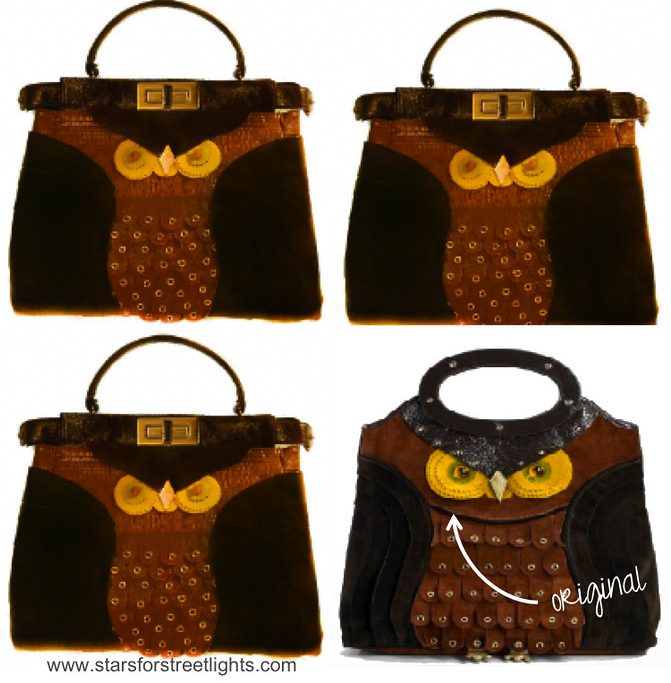
Photo: “DIY Kate Spade Owl Purse” by Stacie Stacie Stacie is licensed under CC BY-SA 2.0.

Cowboy poetry: Using form: Doc Mehl, ‘Poems Used To Rhyme’

Poems used to rhyme.
In time, the couplets were dispensed.
Incensed, today’s poet rebels from rhyming schemes,
It seems. The writer, newly shedding the shackles of quatrains,
Refrains from even a modicum of lilt.

And built now from unpaired diphthongs,
His songs have lost a measure of glue.
It’s true. No longer does the ear delight
In flight of fancy, in teeter-totter,
Like water on the endless sand, the to-and-fro,
And no, this tide will not abate.

Of late, I find that poems no longer draw me in.
They’re thin.

*****

Doc Mehl writes: “For the last two decades I’ve written rhyming western poetry, and I’ve performed both the poetry and my original western-themed music at cowboy poetry events in the western U.S. and Canada. I’ve recorded two spoken-word CDs of my rhyming poetry, and several CDs of my original music.
I’m not averse to free verse. (OK, I must pause momentarily to savor the rhyme in that sentence.) Still, the author of a free verse poem ought to be able to convincingly answer this question: “Why do you maintain that this work should be categorized as poetry rather than prose?”
In this poem (“Poems Used To Rhyme”), I liked the gamesmanship of sneaking the rhyming word of each “couplet” into the beginning of the second line rather than at the end of the second line. The resulting poem might first appear to be a tongue-in-cheek free verse poem about why rhyme is important. Still, the magic of the closely juxtaposed rhyming words can’t help but rise from the ether.”

‘Poems Used To Rhyme’ was first published in Rattle #85 with a link to audio.

Newly transplanted from Colorado to Black Diamond, Alberta, Al “Doc” Mehl traces his family roots to central Kansas, where his grandfather raised six children on the family homestead. His debut music CD is titled “Asphalt Cowboy,” and his second music CD titled “I’d Rather Be…” was released in 2008. Doc Mehl has also published a CD of original poetry titled “Cowboy Pottery,” and a second spoken-word poetry CD titled “The Great Divide,’ named 2013 “Cowboy Poetry CD of the Year” by both the Western Music Association and the Academy of Western Artists. In 2020, Doc published his first collection of poetry, “Good Medicine: Read Two Poems and Call Me in the Morning.” And in 2022, Doc released two new CDs of music, “West of the 22” and “Tried and True. Doc’s poems and musical lyrics have been featured on the website http://www.CowboyPoetry.com, he has been published in the poetry journal “Rattle,” and he was a first-place silver buckle winner at the National Cowboy Poetry Rodeo in Montrose, Colorado in 2009.

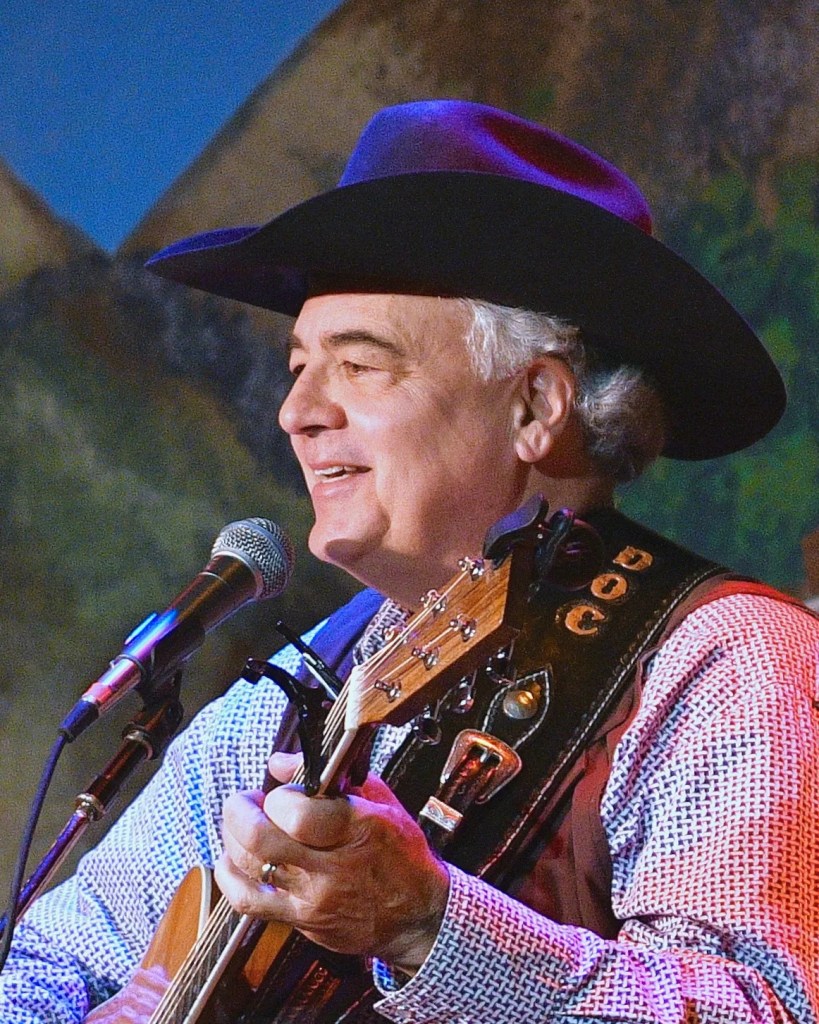
Photo: https://docmehl.com/photo-gallery

Using form: Nonce form, riddles: Aaron Poochigian, ‘The New New Amsterdam’

I am the scam
you go in for, the diamonds in the pavement,
ecstatic evenings caught on traffic cam,
rare toilets and consensual enslavement.

Scholars and brawlers are inside of me.
What could I be?

I am
the new New Amsterdam.

I am those glam
high-rises and the derelicts’ despair,
graffiti worthy of the Met, and sham
Versace hawked to chumps in Union Square.

Purists and tourists are inside of me.
What could I be?

I am
the new New Amsterdam.

I am the ham
ironist, the perverse poobah of shock,
the firetruck stranded in a rush-hour jam
while conflagration rages round the block.

Birders and murders are inside of me.
What could I be?

I am
the new New Amsterdam.

I am the slam
Where Subway Ends, a scrum of mad musicians,
Sunday phone calls with a far-off fam,
Halal street food, and infinite ambitions.

Shoo-ins and ruins are inside of me.
What could I be?

I am
the new New Amsterdam.

*****

Aaron Poochigian writes: “Riddles go back to a time before ‘English’ was our English, before Shakespeare and Chaucer, the time of bards and Beowulf. The Anglo-Saxon riddles have the rhythms of poetry. They tell it slant like poetry does sometimes. The tantalizing, first-person self-description that defines the genre gave me a ‘way in’ to talk about a subject that would have been too vast otherwise—New York City.”

‘The New New Amsterdam’ was first published in The Rising Phoenix Review.

Aaron Poochigian earned a PhD in Classics from the University of Minnesota and an MFA in Poetry from Columbia University. His latest poetry collection, American Divine, the winner of the Richard Wilbur Award, came out in 2021. He has published numerous translations with Penguin Classics and W.W. Norton. His work has appeared in such publications as Best American Poetry, The Paris Review and Poetry.
aaronpoochigian.com
americandivine.net

Twitter: @Poochigian
Facebook: Aaron Poochigian
Instagram: aaronpoochigian

Photo: “NYC Night Life” by Tom Roeleveld is licensed under CC BY-NC-ND 2.0.

Using form: Susan Jarvis Bryant, ‘To Autumn’

Your flare of red turns Winter’s hoary head
To gaze upon your blaze and feel the heat
      And fever of your beat.
Your spice and sizzle catch his breath and spread
Through icy sighs to melt the lick of frost
      That dusts the dawn
With hints of chill intent. His plot is lost
In honeyed-apple charm and plummy balm.

You temper smitten Winter’s bitter breeze.
Your foxy bronze and lush rufescent blush;
      Your gold and ruby rush
 Ignite the leaves that shiver on the trees.
You burn through thickest wisps of morning mist.
      Birds laud your glow.
The granite skies grow blue as clouds are kissed
By dreams so hot they thaw all thoughts of snow.

When it’s your time to go you’ll fade with grace
As branches shed their tawny tears of grief –
      Each crisp and crinkled leaf
Will pool and pile. As Winter shows his face
Your fluffy, brush-tailed fans will slump and sleep.
      They’ll hit the sack
Until they spy the coyest crocus peep –
Spring’s message to the world that you’ll be back!

*****

Susan Jarvis Bryant writes: “My poem is a quirky nod to Keats’ timeless and beautiful ode with a much louder and sassier version of the fall with not a mellow trait in sight.  There is no time for mourning loss in this poem. Autumn vows (in true Terminator style) she’ll be back! The form I chose is a nod to the traditional but with two short lines in each stanza – an act of rebellion in keeping with this fiery season.”

‘To Autumn’ was originally published in Snakeskin 321.

Susan Jarvis Bryant is originally from the U.K., but now lives on the coastal plains of Texas. Susan has poetry published on The Society of Classical Poets, Lighten Up Online, Snakeskin, Light, Sparks of Calliope, and Expansive Poetry Online. She also has poetry published in The Lyric, Trinacria, and Beth Houston’s Extreme Formal Poems and Extreme Sonnets II anthologies. Susan is the winner of the 2020 International SCP Poetry Competition and has been nominated for the 2024 Pushcart Prize. She has just published her first two books, Elephants Unleashed and Fern Feathered Edges.

Photo: “Fall Color on the Pond” by fossiled is licensed under CC BY-NC-SA 2.0.

Using form: Heterometric verse: Susan McLean, ‘Teaching to the Test’

I know you have no use for them,
poems with their sly quicksilver words
that won’t just speak their minds,
but carom through your head like startled birds.
Is that despair or longing in their cries?
Their dolors make no sense.
They’ll never buy you larger-screened TVs
or seats at sports events.

But someday, as you watch a pair hold hands
and leap from a burning tower,
as you wait for test results or hear
your phone ring at an unaccustomed hour,
what you feel will circle wordlessly—
tense, accusing, gaunt.
You’ll find that you are tested and found wanting,
and these are what you’ll want.

*****

Susan McLean writes: “As a professor myself and a person who once worked on writing standardized tests, I am familiar with the complaint of teachers that they are often forced to “teach to the test,” i.e., teach only the sort of knowledge and skills that students need for passing that sort of test. But as a poet, I know that we are tested in life in all sorts of ways. Most people think that they can get through life just fine without poetry. They tend to find poetry annoying and impenetrable, something that needs to be decoded, that has no practical use. Yet in tragedies, when all hope and comfort are gone, there is some comfort in hearing that others who have been in similar situations were able to put into words the feelings that you can’t. And the most memorable and condensed of those responses are often poems.
This poem is rhymed and metrical, but the lines are of different lengths in unpredictable patterns, a form called “heterometric,” and the rhymes occur only every other line. That unpredictability is meant to mirror life, in which the bad news always seems to come out of nowhere. The poem originally appeared in Able Muse and later in my second poetry collection, The Whetstone Misses the Knife.”

Susan McLean has two books of poetry, The Best Disguise and The Whetstone Misses the Knife, and one book of translations of Martial, Selected Epigrams. Her poems have appeared in Light, Lighten Up Online, Measure, Able Muse, and elsewhere. She lives in Iowa City, Iowa.
https://www.pw.org/content/susan_mclean

Photo: “When Young Children ‘Hate’ School” by wecometolearn is licensed under CC BY 2.0.