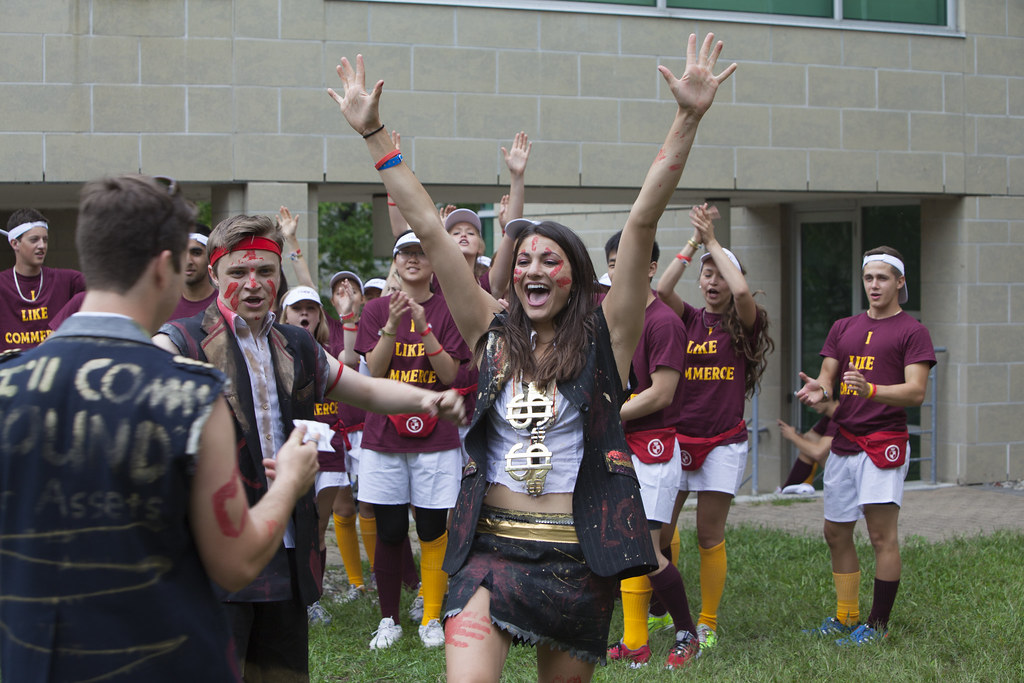
If, in the midst of this elated day, someone took him aside with the stern warning, Most of your life will not be like this morning, he’d never hear it. How–while fountains play beside clipped lawns and walkways arched with green maples that move to stipple white and gold on paths he and his harried parents have strolled laden for move-in–how could he hear? He’s seen Arcadia now, where classical facades put a straight face on tanglements of thought, and edgy spears of light and color, wrought in steel and glass, look daggers at the gods.
The whole week’s strewn with glittering temptations and parti-colored parties for the eyes: gown-sleeves aflap like tropical butterflies, professors float along in convocations. Some one of them, someday, and over a drink, will show him grittier visions: Rumor. Snark. Administrative bloat. Nowhere to park. How only summers bless you with time to think. How even the mind’s beauties fester, vexed by deadlines, balky software, budget hassle. How research builds its turreted air-castle, gorgeous for one day, rubble on the next.
But here, today, does anybody give a bleep for realness? Let us cleave to form, leaving him to his roommate and his dorm and whispering, Here’s the poison. Drink and live.
*****
Maryann Corbett writes: “A few years ago, I happened to be on the campus of a nearby university on move-in day during freshman orientation week. It was an experience that gave me poem-provoking nostalgia. “Orientation week is an institution I know well; I’ve lived my own college orientation and each of my children’s, and I’ve worked as a university staffer conducting such events. Freshman orientations usually take place in the week before classes begin in the fall and before other students return to campus. They’re meant to give new students everything they need to settle in and become part of the university community. “But in addition to practicalities like moving young people into their dormitories — and dealing with parents’ emotional goodbyes — orientations will always involve hype and hoopla. Beautiful campuses are part of that hoopla, part of the seduction of academe. There will also be welcoming events that overpraise what students have achieved just by being admitted, tours that overpraise the campus’s buildings and amenities, and academic convocations with professors in full regalia delivering speeches that overpraise everything about the academic world. “How true is all this as a picture of the scholarly life? I’ve been close enough to the facts of that life to know that the picture needs some correcting pessimism. The poem offers that but says it can wait. Let’s let the students fall in love with the vision before we tell them the truth.”
Maryann Corbett earned a doctorate in English from the University of Minnesota in 1981 and expected to be teaching Beowulf and Chaucer and the history of the English language. Instead, she spent almost thirty-five years working for the Office of the Revisor of Statutes of the Minnesota Legislature, helping attorneys to write in plain English and coordinating the creation of finding aids for the law. She returned to writing poetry after thirty years away from the craft in 2005 and is now the author of two chapbooks and six full-length collections, most recently The O in the Air (Franciscan U. Press, 2023). Her work has won the Willis Barnstone Translation Prize and the Richard Wilbur Award, has appeared in many journals on both sides of the Atlantic, and is included in anthologies like Measure for Measure: An Anthology of Poetic Meters and The Best American Poetry. ‘An Orientation’ is from her collection In Code.
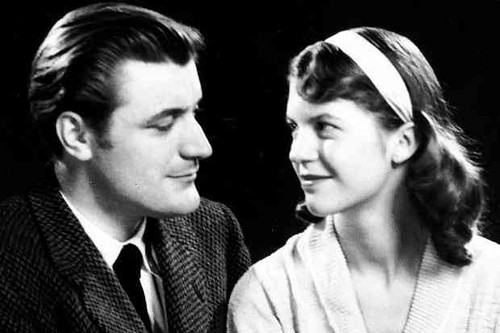
From the files of Sylvia Plath How unpleasant to meet Mrs. Hughes, Who’s so thoroughly, willfully odd. It’s a wonder Ted happened to choose Such a creature. (He’s rather a god.)
Her lipstick is always a mess. She’ll go on for an hour or three About Nazis or bees—as you’d guess, This does not get her asked out to tea.
Her headbands aren’t quite comme il faut. (They’re a match for her queer Yankee frocks.) She knows more than a lady should know Of low-voltage electrical shocks.
Come to think of it, lately she’s been More appalling than ever before. She looks sullen and terribly thin; If you knock, she won’t answer the door.
Her complexion grows whiter and whiter. She wears the most horrible shoes. You can certainly tell she’s a writer. How unpleasant to meet Mrs. Hughes!
*****
Melissa Balmain writes: “I believe this one started when a contest—probably in The Spectator—called for poems riffing on Edward Lear’s self-mocking ‘How Pleasant to Know Mr. Lear’ (and T.S. Eliot’s equally self-mocking parody of it). I found it funny and sad to imagine Sylvia Plath writing about how her English neighbors might see her. The poem was published in Mezzo Cammin.”
Melissa Balmain’s third poetry collection, Satan Talks to His Therapist, is available from Paul Dry Books (and from all the usual retail empires). Balmain is the editor-in-chief of Light, America’s longest-running journal of light verse, and has been a member of the University of Rochester’s English Department since 2010.
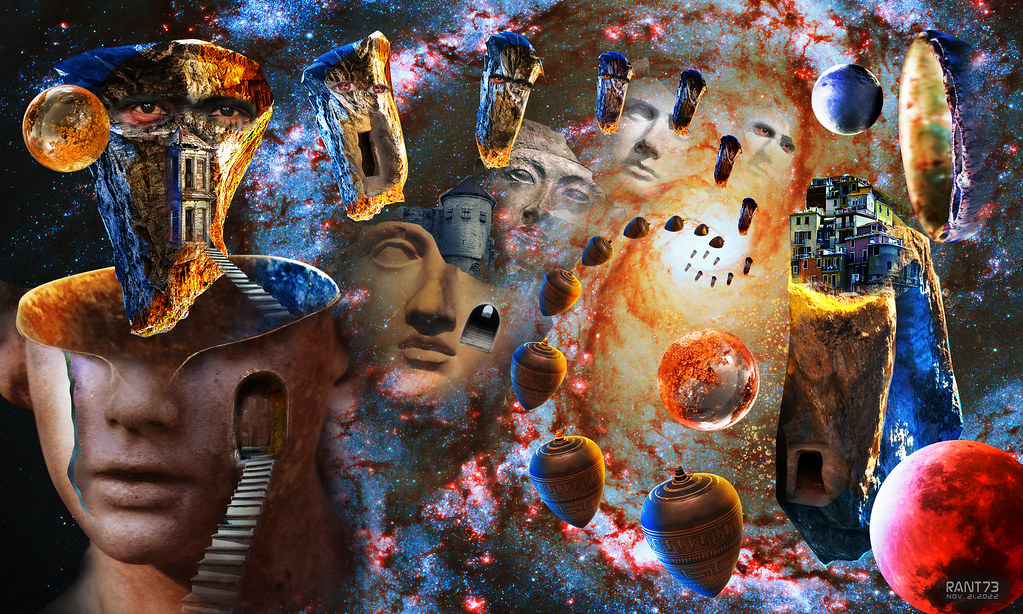
Gods! Admire us; we’re your virus formed of land and sea. Air and fire take us higher, a plague now breaking free; a wild agent of contagion through the galaxy; death-defying, modifying… infecting all we see.
*****
This brief poem was recently published in Bewildering Stories. Humans have already spread round the planet into all ecosystems like an uncontrollable virus; and now we’re seeing the beginnings of a far vaster expansion, presumably entailing endless mutations as we go. It’s going to be a wild ride and, once we’re established and self-sustaining off-planet, I don’t see anything stopping it.
(To those who don’t share this world view, I apologise for what must come across as a religious rant. Maybe it is. We’re all trying to make sense of a life that refuses to be pinned down, and quantum physics shows no more common sense than do tales of angels and demons.)
Having predicted the future in vague outline, I admit I think the future is unpredictable in detail. It is chaotic and formless… which is all the more reason for imposing what form we can in writing about it. Form is a good antidote to formless times. And understanding why we developed our cultural techniques over millennia, why we love song, dance, rhythm and rhyme, is useful in preparing ourselves for an unpredictably evolving future. We developed our cultural strengths for good reasons, and they speak to our evolving ape core. Yes, things will keep changing; but for good or ill we are social beings, and our rhythms and harmonies are part of what keep us grounded in society and prevent our mental collapse.
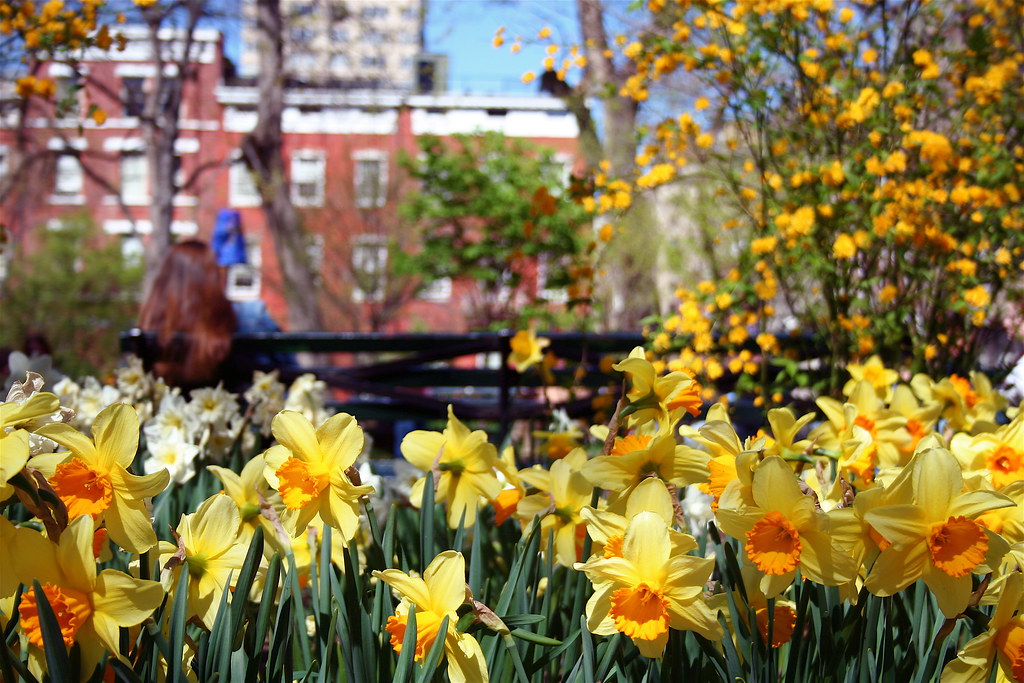
Those daffodils that I recall While lying on a bed settee Are faded now, their petals fall In nature and in memory.
It’s time to rise, to go outside And head off for a subway ride. I’m in New York’s YMCA Undressing for a midday swim;
A poet could not but be gay With bodies toned up in the gym. But I am getting no cheap thrills From dongs like dangling daffodils.
I twinkled at the twinkies there Tossing their heads in sprightly dance Or heading for the sauna where I might get lucky if, by chance,
One of the bronzed and buffed young men Is eager for my fountain pen. But, sadly, no one needs to hear This exiled poet strut his stuff.
I am an old Romantic queer, Ignored, unloved. I’ve had enough. I join the hustling New York crowd And wander lonely as a cloud.
*****
Conor Kelly writes: “Daffodils was submitted as a prompt poem to Rattle (https://www.rattle.com) and was printed in the Summer 2024 issue of the magazine. The prompt was to continue where another poem left off. So I disturbed Wordsworth on the couch where he lay remembering daffodils and sent him on his gay way to modern New York where he had some dubious adventures. I kept the stanzaic form, the metre, the rhyme scheme and even some of the original lines. I left him where he began, wandering lonely as that singular cloud.”
Conor Kelly was born in Dublin and spent his adult life teaching in a school in the city. He now lives in Western Shore, Nova Scotia from where he runs his twitter (X) site, @poemtoday, dedicated to the short poem. He has had poems printed in Irish, British, American, Canadian and Mexican magazines. He was shortlisted for a Hennessy New Irish Writers award. At the ceremony one of the judges, Fay Weldon, asked him, “Where are you in these poems?” He is still asking himself that same question.
No, Wilfred, I never believed your endeavour was more than a clever display. Did you think you could rescue the boys in the mess queue, or – no less grotesque – you’d betray your comrades by opting to stay in shock in Craiglockhart’s sick bay? Naive pretence is no defence for senseless sacrifice. Admit it, you were stupid to ignore Sassoon’s advice and blithely return to the fray, quite deaf to the price you would pay.
You based your decision on lack of a vision and fear of derision combined. You went back to that battle where kids died “as cattle” to leave tittle-tattle behind, regardless of what you might find. No doubt you were out of your mind! Or, more exact, you lacked all tact. Death was not your “chum”. One week passed, and then, at last, the Armistice had come. You thought you were helping mankind. Your nerves were so numb you were blind.
The telegram telling the news reached your dwelling as people were yelling “Hooray!” You were inconsequential despite your potential. What did you essentially say? “Was it for this the clay…?” Whose drum did you dumbly obey? You grew obsessed with your new quest; it made you big and bold. Was it fulfilled when you were killed, just twenty-five years old? I have to report with dismay there’s no lack of soldiers today.
*****
The following is an explanatory essay by Duncan Gillies MacLaurin, entitled ‘Owen, Sassoon, Barker and Me’:
If anything might rouse him now The kind old sun will know. – from Wilfred Owen’s sonnet, “Futility”
It would have been late 1976 or early 1977 when my English teacher, Peter MacDonald, introduced me, a 14-year-old Scottish public schoolboy, to Wilfred Owen. Pixie, as he was called by the boys, had hardly given us the gist of Owen’s life, death, and poetry, when I found myself pole-axed. I hadn’t got my head around the fact that Owen chose to return to fight in the war that he was denouncing in his poetry even though serious shellshock exempted him from service, when I was told that he was killed just one week before the Armistice. It was too much for me.
Reciting Wilfred Owen’s sonnet “Futility” in chapel a few weeks later, I sensed in poetry an alternative to the spiritual life I had known hitherto. Not that I reacted immediately. I didn’t begin writing poetry until I was 20. And it was not until late 1989 that I returned to the poet whose fate had hit me so hard.
It started the way it sometimes does, with a couple of lines scribbled down just before bedtime. The lines were: “If your heart is your legend,/ if your pen is your weapon…” The next day I sat down with my guitar and put the lines to a tune. Although I hadn’t had Wilfred Owen in my thoughts, I found that the piece was to be about him. A year later, “Letter to a Dead Poet” was published in The Dolphin Newsletter, an internal journal of the English Department at Aarhus University, Denmark.
Letter to a Dead Poet
Hey Wilfred Owen, where were you going when you got blown away? Had your heart been your legend, had your pen been your weapon, had your conscience elected to stay watching the sparrows play, you might have been here today. I don’t believe your sacrifice was generous or free; the fact you paid the highest price betrayed “Futility”: “Was it for this the clay…?” What were you trying to say?
What use are the laurels? What use are the morals in all of your quarrels combined? You went back to that battle where kids died “as cattle” to leave tittle-tattle behind and claimed you were just being kind. You must have been out of your mind! And when at last your blood was spilled Death was not your friend; one week after you were killed, the War was at an end. How could you be so blind? What were you hoping to find?
My English literature professor, Donald Hannah, who specialised in WWI poetry, was full of praise.
In 2008 (by chance the year Donald Hannah died) I started revising the piece, enlisting the help of other poets on a couple of online workshops. In the process I became even more critical of Wilfred Owen, and people were saying things like: “If he wasn’t already dead there’s a fair chance this would finish him off.” Even my wife, a novelist and investigative journalist, disliked my revisions. One poet, Janet Kenny, was sympathetic though. She commented:
You must have known that this would upset everybody. Owen is so beautiful and touches us in the deepest way. But I admire the courage this must have taken. It reminds me of Edward Bond’s “First World War Poets”:
You went to the front like sheep And bleated at the pity of it In academies that smell of abattoirs Your poems are still being studied You turned the earth to mud Yet complain you drowned in it Your generals were dug in at the rear Degenerates drunk on brandy and prayer You saw the front—and only bleated The pity! You survived Did you burn your general’s houses? Loot the new millionaires? No, you found new excuses You’d lost an arm or your legs You sat by the empty fire And hummed music hall songs Why did your generals send you away to die? They saw a Great War coming Between masters and workers In their own land So they herded you over the cliffs to be rid of you How they hated you while you lived! How they wept over you once you were dead! What did you fight for? A new world? No — an old world already in ruins! Your children? Millions of children died Because you fought for your enemies And not against them! We will not forget! We will not forgive! I just wanted to show that there was at least one other naughty boy. I love the poems of Wilfred Owen. I seriously like your poem. It would be impossible to imitate his voice (and unacceptable) but the irreverence IMO hits the correct note. Your poem is deliberately “vulgar” and unpretentious and is all the more telling for that reason.
(From the online workshop, Eratosphere, 2008, quoted with Janet Kenny’s permission)
Thus encouraged, I persevered, and in 2012 my new version was published in the newly-founded poetry e-zine, Angle. One of the editors was Janet Kenny.
The Real Pity
No, Wilfred, I never believed your endeavour was more than a clever display. Did you think you could rescue the boys in the mess queue, or – no less grotesque – you’d betray your comrades by opting to stay in shock in Craiglockhart’s sick bay? Naive pretence is no defence for senseless sacrifice. Admit it, you were stupid to ignore Sassoon’s advice and blithely return to the fray, quite deaf to the price you would pay.
You based your decision on lack of a vision and fear of derision combined. You went back to that battle where kids died “as cattle” to leave tittle-tattle behind, regardless of what you might find. No doubt you were out of your mind! Or, more exact, you lacked all tact. Death was not your “chum”. One week passed, and then, at last, the Armistice had come. You thought you were helping mankind. Your nerves were so numb you were blind.
The telegram telling the news reached your dwelling as people were yelling “Hooray!” You were inconsequential despite your potential. What did you essentially say? “Was it for this the clay…?” Whose drum did you dumbly obey? You grew obsessed with your new quest; it made you big and bold. Was it fulfilled when you were killed, just twenty-five years old? I have to report with dismay there’s no lack of soldiers today.
The two lines that inspired the piece are gone, yet the sentiment they express is still its backbone. My new title is a reference to something Owen wrote in a preface to a posthumous collection of his poetry: “My subject is War and the pity of War. The Poetry is in the pity.”
A significant new element in the latest version is the fact that Owen’s mother received the dreaded telegram just as the church bells in Shrewsbury were ringing out in celebration of the Armistice.
The alleged advice from Siegfried Sassoon in the first stanza is undocumented. It was an idea that came from reading about their relationship in Pat Barker’s historical novel, Regeneration (Viking Press, 1991), which is centred around the humane treatment that Owen, Sassoon and others received from the man in charge at Craiglockhart, Dr Rivers. Sassoon was at Craiglockhart (in Edinburgh) because his declaration proclaiming the futility of the war had been read aloud in Parliament. Sassoon wasn’t ill, but the government didn’t know what else to do with this war hero turned pacifist. Owen and Sassoon became good friends, and they had a lot in common. They were both homosexual and both strongly ambivalent about the war. Sassoon, the seasoned poet, recognised Owen’s budding poetical talent and helped him with it. There is no doubt that it was a case of hero worship on Owen’s part. Even though they would not allow themselves to refuse to go back to the front, because they saw it as their duty, on a personal level they would not have wanted each other to have to return. While Sassoon’s return to the front was merely the result of a mature adult’s battle with his own conscience, Owen was a damaged young man who should never have been allowed to return. I have imagined that Sassoon told Owen that he (Owen) didn’t need to return to the front, but that Owen chose to follow his hero’s example rather than his advice. Sassoon grieved bitterly over Owen’s death and claimed he would never be “able to accept that disappearance philosophically”. (Siegfried’s Journey, Faber and Faber, 1945, p. 72)
In an interview with critic Rob Nixon in 1992 Barker talks about issues that were central for the two poets: Barker: Yes, it is about various forms of courage. What’s impressive about Sassoon’s courage actually is not just the obvious thing that it takes a lot of courage to get decorated, and that it takes a lot of courage to protest against the war, so he’s being brave in two distinct ways. In fact, it’s a much deeper form of courage than that because—partly because of his sexual makeup—he had a very deep need, I think, to be visibly tough and heroic and hypermasculine and prove he could do it. The bravest thing he does, it seems to me, is to deny that psychological need in order to protest against the war. Nixon: I think one of the great strengths of the novel is the way it deals with the complexity of the condition of the pacifist-warrior rather than simply taking head-on the question “Is war good or bad?” It’s not an ethical book in that narrow, straightforward sense, but ethical by staging the dilemmas of that condition. Barker: It’s not an antiwar book in the very simple sense that I was afraid it might seem at the beginning. Not that it isn’t an antiwar book: it is. But you can’t set up things like the Somme or Passchendaele and use them as an Aunt Sally, because nobody thinks the Somme and Passchendaele were a good idea. So in a sense what we appear to be arguing about is never ever going to be what they [the characters] are actually arguing about, which is a much deeper question of honor, I think. “Honor” is another old-fashioned word like “heroism”, but it’s very much a key word in the book. p.7 of “An Interview with Pat Barker” in Contemporary Literature 45.1 (2004)
The ethos of the committed pacifist scorns mere personal safety. Both Owen and Sassoon returned to the War despite their opposition to it. Yet Barker also points to the ambivalence of the positions the two poets held: Barker: …part of the paradox of Sassoon’s position and, indeed, of Wilfred Owen’s, is that they are simultaneously condemning the war wholeheartedly and claiming for the combatant a very special, superior, and unique form of knowledge, which they are quite implicitly saying is valuable. That you cannot know what we know, and what unites us is something you cannot enter. (Ibid., p.8)
Barker later states the ambivalence the two men felt even more baldly. She is also astute in her assessment of the class privileges they enjoyed despite their pacifism: Barker: On the one hand, you’ve got the war poets telling everybody the horrors as vividly as they can. But at the same time, in both Owen’s and Sassoon’s cases, refusing to say the other truth, which is that a lot of it those two particular men enjoyed. So you get an alternative area of silence developing, and that interests me. The other thing that interests me is how in the second year of the war you had the increased persecution of the pacifists and the increased persecution of homosexuals. There were two very, very nasty campaigns going on. A lot of state spying of a very nasty kind. There was one poor woman, Alice Wheeldon, who was sent to prison with ten years’ hard labor because a police spy alleged that she had plotted to kill Lloyd George by sticking a curare-tipped blowdart up through his shoe. This was a woman who kept a second-hand clothes shop in Leicester. And she got ten years’ hard labor. Unlike Sassoon, you see, who didn’t get sent to prison. You need to be working class and a woman to actually get yourself sent there. (Ibid., p.19)
What spurred me to write this piece? As is often the case, it was the combination of two factors. On the one hand, my own public-school background meant that I was able to identify with and feel sympathy for Wilfred Owen. On the other hand, I wanted to condemn the elitist culture and stiff-upper-lip ethos that sent an excellent poet to an early grave.
Duncan Gillies MacLaurin, 4th November 2018
*****
Duncan Gillies MacLaurin is a Scottish poet who was born in Glasgow in 1962. He studied Classics at Oxford, left without a degree, and spent two years busking in the streets of Europe. He met a Danish writer, Ann Bilde, in Italy in 1986 and went to live in Denmark, where he teaches English and Latin. His collection of 51 sonnets, I Sing the Sonnet (2017), is online at Snakeskin. He blogs here.
One afternoon, my father chose to die. He was like, See ya later, guys. I think I understand, since I don’t know if I
can hang, myself. But hang myself? (Don’t try, they whisper, spooked.) Too young to buy a drink, but old enough to snatch one from a guy
who says, “I’m married, but–” His twinkling eye is trained, you know, to tell me with a wink I’ve made the cut. One hand explores my thigh,
the other fingering a Miller. Why are men so callous? Nowadays, I sink beneath the comforter. I’ll never cry
because my lover’s lover’s lovely–Thai, with toned and skinny limbs, her cheekbones pink and angular. Ohio girl, a Buckeye.
I’m from a land where bleach blond angels fly. Beneath the moonlight, friends and I will clink our cups; my wondrous-child eyes defy adulthood, till I sip. It’s bitter, dry.
*****
Editor: The poem was originally prefaced with “There are those who suffer in plain sight. – Randall Mann”
Alexis Sears writes: “I wrote this poem on the eve of my 20th birthday; nearly a decade later, I still hold it dear. ‘On Turning 20’ made me realize that what I had to say may have been more meaningful than I’d thought.”
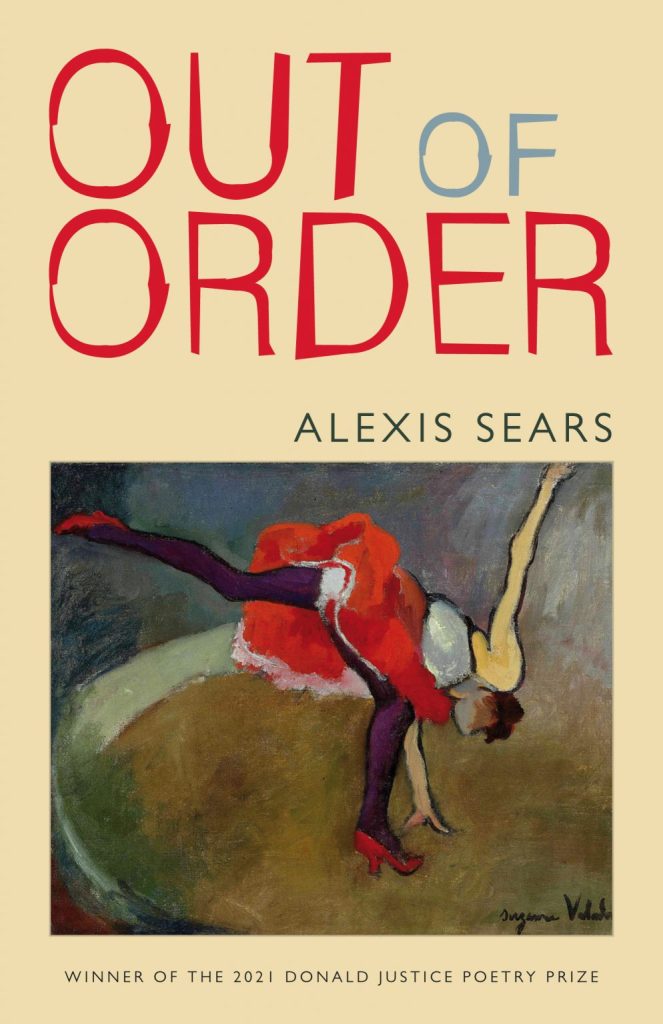
Alexis Sears is the author of Out of Order (in which this poem appears), winner of the 2021 Donald Justice Poetry Prize and the Poetry by the Sea Book Award: Best Book of 2022. Her work appears in Best American Poetry, Poet Lore, Cortland Review, Cimarron Review, Rattle, and elsewhere. She earned her MFA in poetry from the University of Wisconsin-Madison and her BA in Writing Seminars from Johns Hopkins University. Editor-at-Large of the Northwest Review and Contributing Editor of Literary Matters, she lives in Los Angeles. https://www.alexissears.com/
To poets, lovely Denmark’s not a friend: there’s too much commonsense, it’s too prosaic. These blonds just blindly make life a bland blend; but life should be a salad, a mosaic. Long live the Christiania anarchists! Bare feet, graffiti, dog shit, broken glass! Runaways, pushers, folk on Wanted lists, the type you’re careful around when they pass.
Well, maybe I exaggerate… I love museums, bike lanes, all the walking streets, orderly lines where people never shove, the clean green parks, the clean stores full of treats… And after all, I write in sonnet form: a lovely, useful, ordinary norm.
*****
I wrote this sonnet last month in Denmark, and it was published in the June Snakeskin, an all-rhyme issue. (I’ve tinkered with the title and one of the lines…) The opposing arguments for personal freedom and social responsibility are hardly new, and I agree with both. Perhaps I need to reread Matthew Arnold’s ‘Culture and Anarchy‘… <downloads> <peers>… hm… no, too much religion.
Two roads diverged in high school when a student chose to study women’s liberation to write her senior paper. Though imprudent, that choice provided her an education
in bias, inequality, derision, The Second Sex, The Feminine Mystique, historical erasure, long division, and talent gagged and shackled by physique.
She swore off make-up, wanted a career but maybe not a family. She read Kate Millett, Gloria Steinem, Germaine Greer, and gave a speech on beauty, which, she said,
turned women into objects and betrayed their goals. She didn’t want to be a mom or movie star. When she went out, she paid. Though never asked, she boycotted the prom.
The boys were baffled and the girls disdainful, for who would want to talk to, much less date her? And what she lost was obvious and painful, while what she gained was only clear years later.
*****
Susan McLean writes: “This poem starts with the opening phrase from Robert Frost’s ‘The Road Not Taken‘ and it records a turning point in my own life of the sort that his poem describes. Though I hope that feminists are not such a rarity among high school students anymore, the term “feminist” is still so loaded that I tend to think of it as “the new F-word.” At one level, it still mystifies me that looking for equal opportunity and equitable treatment remains so controversial, but at another level, every society has been built on unequal opportunity and inequitable treatment since recorded history began, so it is not surprising that each step away from that system has made some people feel that the world was ending.
“I learned long ago that what a poem doesn’t say is as important as what it does say, so the ending of this one does not specify what was lost or what was gained. I want the readers to think about those things, so I don’t want to tell them what to think. As for why I wrote this in the third person, these events happened so long ago that it almost feels as though they happened to someone else. I am and am not that girl.
Susan McLean has two books of poetry, The Best Disguise and The Whetstone Misses the Knife, and one book of translations of Martial, Selected Epigrams. Her poems have appeared in Light, Lighten Up Online, Measure, Able Muse, and elsewhere. She lives in Iowa City, Iowa. https://www.pw.org/content/susan_mclean


 Form in Formless Times