Author Archives: Robin Helweg-Larsen

Unknown's avatar

About Robin Helweg-Larsen

Director, Andromeda Simulations International, Bahamas: a global education company providing online and in-person workshops in business finance. Series Editor, Sampson Low's 'Potcake Chapbooks'. Formal verse about traveling, family, love, etc...

Sonnet: RHL, ‘Zombies and Wolves’

Women I’ve failed or wronged or left behind
approach my thoughts like zombies for the kill;
I’ve literary walled defences – still
given the chance, they’ll eat my brains, my mind.

Through forest, orchard, farmyard in decay,
a shadow of a wolf slips greyly in,
my thoughts of death, grim, wasted, ill, rib-thin,
tracking my weak resolve, hungry to slay.

Mountaintops blown apart, forests clear-cut,
where’s there to hide? Nature doesn’t exist;
her landscapes crushed in patriarchal fist.
This former farmland hides my ruined hut.

Impotent, I still write, thus giving birth
to future wolves and zombies of the earth.

*****

This sonnet was originally published in Candelabrum (a twice-yearly print magazine of formal verse that ran bravely from 1970 to 2010… now sadly defunct, eaten by wolves or zombies or whatever snacks on print poetry magazines), and republished in Bewildering Stories #1039, a decades-old online magazine of primarily speculative fiction.

Photo: “Full ‘Wolf’ Moon – January 22, 2008” by Rick Leche is licensed under CC BY-NC-ND 2.0.

Donald Trump’s favourite poem: ‘The Snake’ by Oscar Brown Jr.

On her way to work one morning
Down the path ‘longside the lake
A tender-hearted woman saw a poor half-frozen snake
His pretty colored skin had been all frosted with the dew
“Oh well,” she cried, “I’ll take you in and I’ll take care of you”
“Take me in, tender woman
Take me in, for heaven’s sake
Take me in, tender woman,” sighed the snake

She wrapped him up all cozy in a comforter of silk
And laid him by thе fireside with some honеy and some milk
She hurried home from work that night, and soon as she arrived
She found that pretty snake she’d taken in had been revived
“Take me in, tender woman
Take me in, for heaven’s sake
Take me in, tender woman,” sighed the snake

She clutched him to her bosom, “You’re so beautiful,” she cried
“But if I hadn’t brought you in, by now you might have died”
She stroked his pretty skin again and kissed and held him tight
Instead of saying thanks, that snake gave her a vicious bite
“Take me in, tender woman
Take me in, for heaven’s sake
Take me in, tender woman,” sighed the snake

“I saved you,” cried the woman
“And you’ve bitten me, but why?
And you know your bite is poisonous and now I’m gonna die”
“Oh shut up, silly woman,” said the reptile with a grin
“You knew damn well I was a snake before you took me in”
“Take me in, tender woman
Take me in, for heaven’s sake
Take me in, tender woman,” sighed the snake
“Take me in, tender woman,” sighed the snake

*****

Donald Trump has repeatedly read this poem in his political rallies as a way of attacking immigrants and the US Government’s immigration policies. The ironies are endless:
– that two of Trump’s wives are themselves immigrants (the current one having a very sketchy background as a “model”);
– that Trump always fails to credit Oscar Brown Jr as the song’s author, consistently naming Al Wilson instead;
– that Oscar Brown was a civil rights activist and for ten years a member of the Communist Party (he left when he decided he was “too black to be red”);
– that the song’s message, a variant on one of Aesop’s Fables, is that kindness can be betrayed;
– that Oscar Brown’s daughters have sent Trump cease-and-desist letters because Trump’s message is antithetical to all their father stood for;
– and as one of the daughters said on CNN, “the elephant in the room is that Trump is the living embodiment of the snake that my father wrote about in that song.

Photo: “JAZZ: Portrait of Oscar Brown, Jr.” by Professor Bop is licensed under CC BY-NC-ND 2.0. (Note: the portrait is by Edwin German.)

Weekend read: Marcus Bales, ‘Ambush’

You’re smiling, nodding, entering some room
Where what weight you once swung you swung for years,
Acknowledging this or that one, most of whom
Are people you politely call your peers.

And like the step you miss that wasn’t there
Kaboom: the rush returns. Awareness bursts
Enormously inside and out, the where
And when, the who and why, the lasts, the firsts.

Then no one listens as you start to speak,
And there’s another, higher, step you miss.
You squint, and almost hear the leather creak,
But readiness is all there is of this.

Your saddlebags and holsters do not rate.
There’s nothing to fight out of if you can.
The ambush turns, indifferently, to wait
For something more than you. Move on, old man.

*****

Editor: I like this poem as it is. However there appears to be more backstory, and Marcus Bales assembles the following: an excerpt from ‘Lonesome Dove’, and Daniel Keys Moran’s comments, and Marcus Bales’ own comments:

After a few minutes the empty feeling passed, but Call didn’t get to his feet. The sense that he needed to hurry, which had been with him most of his life, had disappeared for a space.
“We might as well go on to Montana,” he said. “The fun’s over around here.”

Augustus snorted, amused by the way his friend’s mind worked.

“Call, there never was no fun around here,” he said. “And besides, you never had no fun in your life. You wasn’t made for fun. That’s my department.”

“I used the wrong word, I guess,” Call said.

“Yes, but why did you?” Augustus said. “That’s the interesting part.”

Call didn’t feel like getting drawn into an argument, so he kept quiet.

“First you run out of Indians, now you’ve run out of bandits, that’s the pint,” Augustus said. “You’ve got to have somebody to outwit, don’t you?”

“I don’t know why I’d need anybody when I’ve got you,” Call said.

Even though he still came to the river every night, it was obvious to Call that Lonesome Dove had long since ceased to need guarding. The talk about Bolivar calling up bandits was just another of Augustus’s overworked jokes. He came to the river because he liked to be alone for an hour, and not always be crowded. It seemed to him he was pressed from dawn till dark, but for no good reason. As a Ranger captain he was naturally pressed to make decisions—and decisions that might mean life or death to the men under him. That had been a natural pressure—one that went with the job. Men looked to him, and kept looking, wanting to know he was still there, able to bring them through whatever scrape they might be in. Augustus was just as capable, beneath all his rant, and would have got them through the same scrapes if it had been necessary, but Augustus wouldn’t bother rising to an occasion until it became absolutely necessary. He left the worrying to Call—so the men looked to Call for orders, and got drunk with Augustus. It never ceased to gripe him that Augustus could not be made to act like a Ranger except in emergencies. His refusal was so consistent that at times both Call and the men would almost hope for an emergency so that Gus would let up talking and arguing and treat the situation with a little respect.

But somehow, despite the dangers, Call had never felt pressed in quite the way he had lately, bound in by the small but constant needs of others. The physical work didn’t matter: Call was not one to sit on a porch all day, playing cards or gossiping. He intended to work; he had just grown tired of always providing the example. He was still the captain, but no one had seemed to notice that there was no troop and no war. He had been in charge so long that everyone assumed all thoughts, questions, needs and wants had to be referred to him, however simple these might be. The men couldn’t stop expecting him to captain, and he couldn’t stop thinking he had to. It was ingrained in him, he had done it so long, but he was aware that it wasn’t appropriate anymore. They weren’t even peace officers: they just ran a livery stable, trading horses and cattle when they could find a buyer. The work they did was mostly work he could do in his sleep, and yet, though his day-to-day responsibilities had constantly shrunk over the last ten years, life did not seem easier. It just seemed smaller and a good deal more dull.
Call was not a man to daydream—that was Gus’s department—but then it wasn’t really daydreaming he did, alone on the little bluff at night. It was just thinking back to the years when a man who presumed to stake out a Comanche trail would do well to keep his rifle cocked. Yet the fact that he had taken to thinking back annoyed him, too: he didn’t want to start working over his memories, like an old man. Sometimes he would force himself to get up and walk two or three more miles up the river and back, just to get the memories out of his head. Not until he felt alert again—felt that he could still captain if the need arose—would he return to Lonesome Dove.

“Ambush” developed out of following Daniel Keys Moran on F*c*book. For some time now he has been posting about coming changes in his life, one of which is retirement from the work-force. My poem actually has no connection to his situation at all, apart from my also having retired. He was a much bigger deal, in charge of a lot more than I ever was, in any of my endeavors, but within my limits I was usually in charge of whatever small enterprises I participated in. I imagine the experience of going from being in charge to being supernumary   is about the same, internally, for everyone.

Moran posted the excerpt from McMurtry’s “Lonesome Dove” just recently, as, I inferred, a comment and possibly a reflection on his situation. It certainly resonated with me. Of course Call, the Captain in “Lonesome Dove”, and Moran, and the narrator of “Ambush” all have different situations and different reactions. But there is, I think a family resemblance.

*****

Not much is known about Marcus Bales except that he lives and works in Cleveland, Ohio, and that his work has not been published in Poetry or The New Yorker. However his ‘51 Poems‘ is available from Amazon. He has been published in several of the Potcake Chapbooks (‘Form in Formless Times’).

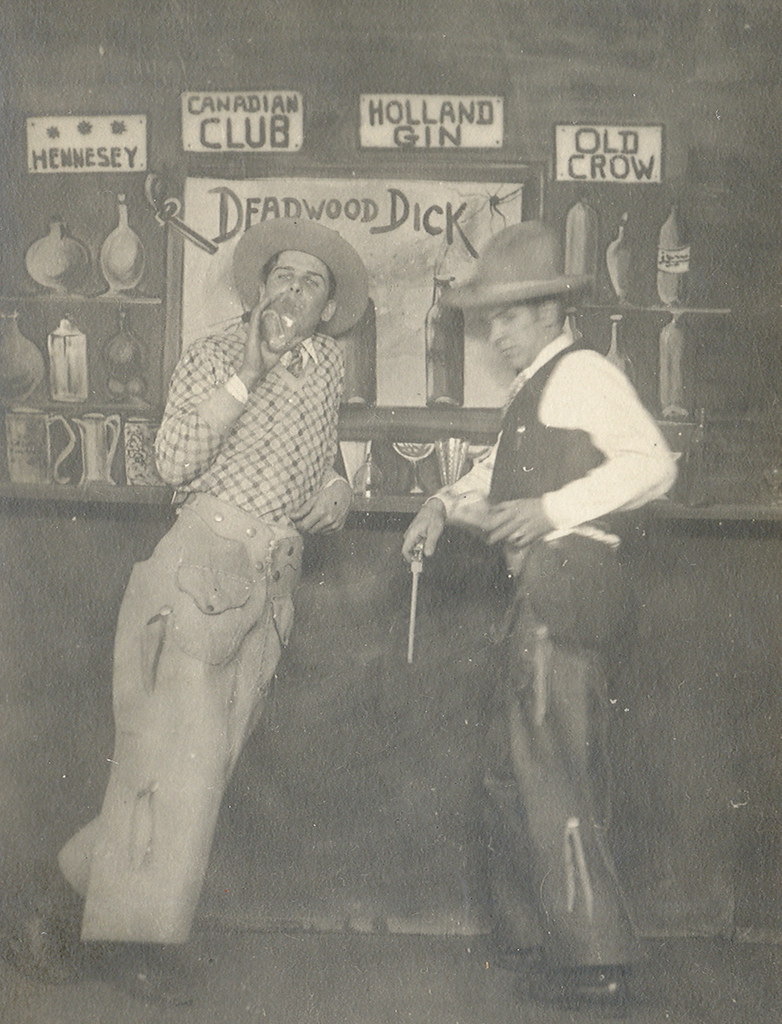
Photo: “Real Photo Hard Drinking Handsome Cowboys at the Deadwood Dick Saloon Studio Photograph RPPC AZO Stamp Box Hennesy Canadian Club Holland Gin Old Crow 2” by UpNorth Memories – Don Harrison is licensed under CC BY-NC-ND 2.0.

Poems on poets: ‘Maz’ Griffiths, ‘Lies’

Perhaps it’s true, as Twain implies,
statistics are the greatest lies
but point for point and size for size,
I think they tie for major prize
with poets’ modest little ‘i’s.

*****

Margaret Ann Griffiths, aka Maz, aka Grasshopper, was a British poet known almost exclusively for her online work. In his Preface and Personal Recollection, editor Alan Wickes speaks of her “belligerent modesty” and her lack of interest in the preservation of her verse. In 2008, after winning Eratosphere‘s annual Sonnet Bake-off with “Opening a Jar of Dead Sea Mud” and being praised by Richard Wilbur, she was a Guest Poet on the Academy of American Poets website, where she was hailed as “one of the up-and-coming poets of our time”.

Her poem ‘Lies’ speaks volumes (in a brief space) about the different types of modesty available to creative figures. Her reputation for wit, intelligence, astute criticism and kind-heartedness goes well with her wide-ranging subjects and diverse styles of verse. She was the preeminent English-language online poet of the early 21st century.

Her work was posthumously collected by fans and fellow poets in the 2011 ‘Grasshopper‘ from Arrowhead Press and Able Muse Press.

Photo: “Anjo da Vila, Vila Madalena, São Paulo, Brazil.” by ER’s Eyes – Our planet is beautiful. is licensed under CC BY-NC-SA 2.0.

Short NSFW poem: RHL, ‘The Fig Tree’

The fig leaf symbol’s one of History’s greats
As, inter alia,
It hides, discloses and exaggerates
Male genitalia.
The fruit itself suggests the female form —
Dripping with honey
The little hole breaks open, pink and warm…
The Bible’s funny.

First published in The Asses of Parnassus, this poem was republished in Better Than Starbucks, which earned a “Kudos on your brilliant ‘The Fig Tree'” from Melissa Balmain, editor of Light. And it has now been added by Michael R. Burch to my page in The HyperTexts. That’s a wonderful set of editorial acceptances – it makes me proud, and I have to erase my lingering suspicion that the poem would be thought too rude for publication. Now I rate the poem more highly, as being not just a personal favourite but also acceptable to a wider audience.

It sometimes feels that all I write is iambic pentameter. It is always reassuring when a poem presents itself with half the lines being something else, and the result is a lighter, less sonorous verse. The rhymes are good; the poem’s succinct and easy to memorise. I’m happy with it.

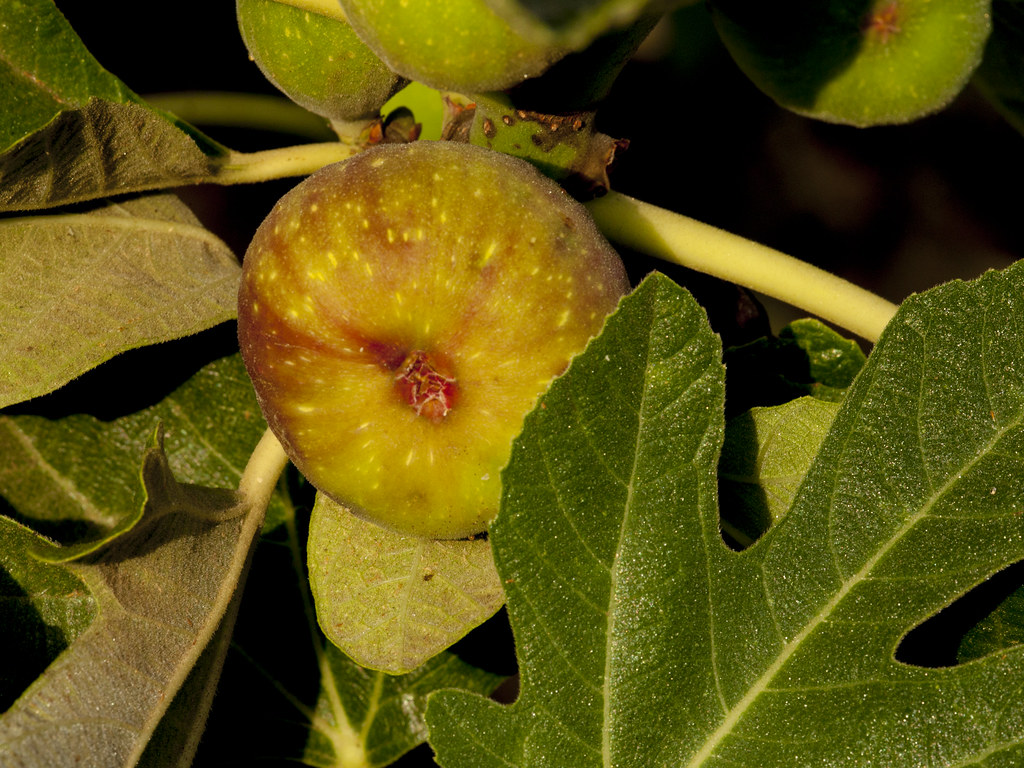
Photo: “Ripe Fig at Dawn” by zeevveez is licensed under CC BY 2.0.

Joe Biden’s favourite poem: Seamus Heaney, ‘The Cure of Troy’

Human beings suffer
They torture one another,
They get hurt and get hard.
No poem or play or song
Can fully right a wrong
Inflicted and endured.

The innocent in gaols
Beat on their bars together.
A hunger-striker’s father
Stands in the graveyard dumb.
The police widow in veils
Faints at the funeral home.

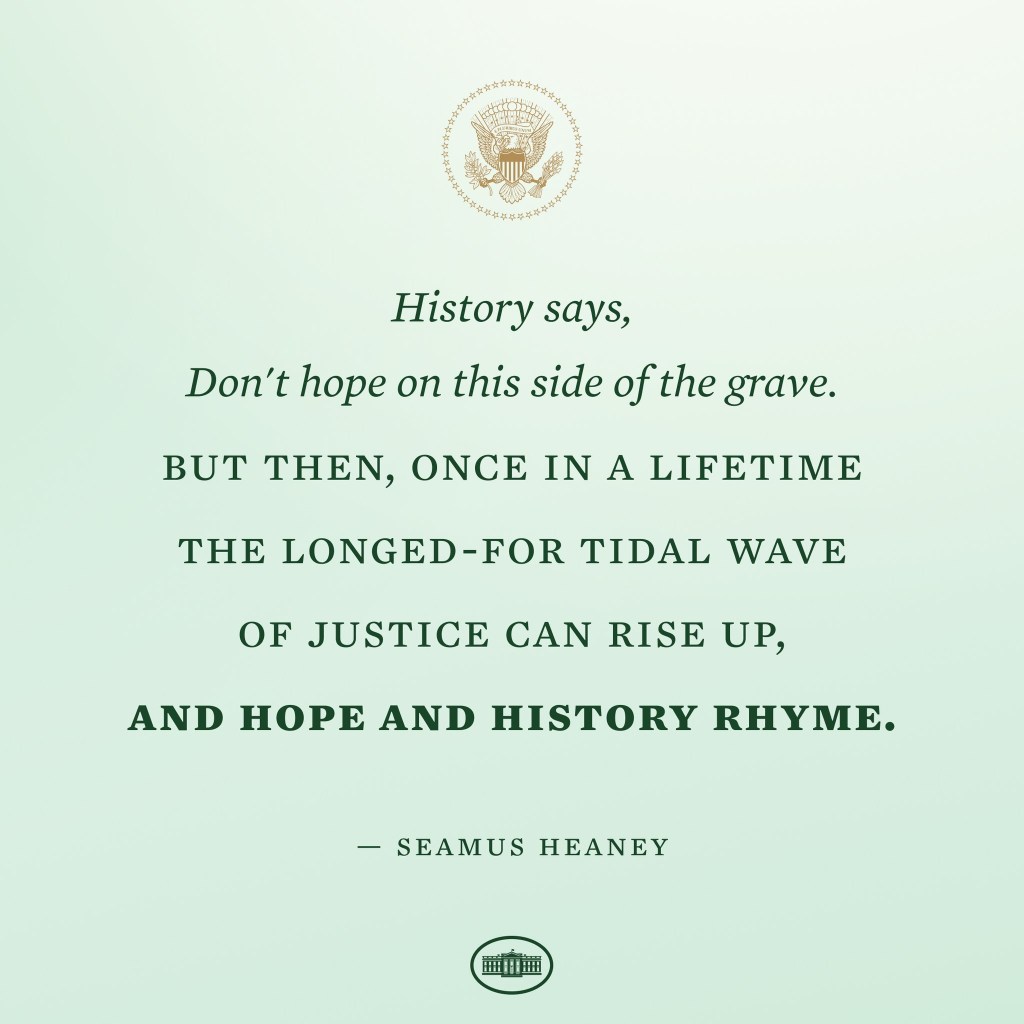
History says, Don’t hope
On this side of the grave…
But then, once in a lifetime
The longed-for tidal wave
Of justice can rise up,
And hope and history rhyme.

So hope for a great sea-change
On the far side of revenge.
Believe that a further shore
Is reachable from here.
Believe in miracles
And cures and healing wells.

Call miracle self-healing:
The utter, self-revealing
Double-take of feeling.
If there’s fire on the mountain
Or lightning and storm
And a god speaks from the sky

That means someone is hearing
The outcry and the birth-cry
Of new life at its term.
It means once in a lifetime
That justice can rise up
And hope and history rhyme.

*****

US President Joe Biden frequently quotes poets: Yeats and, especially, Heaney; often with the disclaimer that he doesn’t quote Irish poets because of his Irish heritage, but because Ireland has the best poets. And from the poem above, the verse that particularly resonates with him is:
History says, Don’t hope
On this side of the grave…
But then, once in a lifetime
The longed-for tidal wave
Of justice can rise up,
And hope and history rhyme.

Joe Biden may not be perfect, but it is reassuring to have an American President with at least some commitment to Justice… and the sensibility of reinforcing it through the memorisation of poetry.

Photo: Joe Biden’s White House Facebook post for St. Patrick’s Day 2022.

Weekend read: David Galef, ‘A Question of Emphasis’ or ‘Wanna Make Something of It?’

“poetry makes nothing happen . . . .”
—W. H. Auden, “In Memory of W. B. Yeats”

Poetry makes nothing happen.
Song lyrics, on the other hand,
Wedge into people’s hearts
When sung by a heartthrob band.

Poetry makes nothing happen.
It doesn’t enforce a cause.
That’s the way of propaganda,
With all its fixed applause.

Poetry makes nothing happen.
But I’ve seen something sublime
In the eyes of a student reading
Eliot’s Prufrock the first time.

Poetry makes nothing happen.
But must events take place
For poems to be eventful—
To make a normal pulse race?

*****

David Galef writes: “This poem was inspired by the memory of a graduate seminar taught by Edward Mendelson, a professor at Columbia University and the executor of the Auden estate. What Mendelson doesn’t know about Auden probably isn’t worth knowing, and what he brought to the study of Auden’s poetry was a deep knowledge of technique, context, and Auden’s modus cogitandi. Tired of those who quoted Auden’s famous line from “In Memory of W. B. Yeats” to indicate the inutility of poetry, Mendelson pointed out that the significance of “For poetry makes nothing happen” is more a point about art versus propaganda. The emphasis shouldn’t be on “nothing” but on “makes.” The aim of agitprop is to make all minds bend in one direction. True art, on the other hand, doesn’t force one meaning on the audience, though it may be powerfully suggestive. As Auden continues (and people who quote often omit surrounding words),
“it survives
In the valley of its making where executives
Would never want to tamper, flows on south
From ranches of isolation and the busy griefs,
Raw towns that we believe and die in; it survives,
A way of happening, a mouth.

Poetry does indeed enjoy a special, immortal status, but those who want it to be a crowd-controlling megaphone will probably be disappointed.
What I wanted to accomplish in ‘A Question of Emphasis’ is just what stressing the right
word can do, and how poetry can change lives, in its own way.”

David Galef has published over two hundred poems in magazines ranging from Light and Measure to The Yale Review. He’s also published two poetry volumes, Flaws and Kanji Poems, as well as two chapbooks, Lists and Apocalypses. In real life, he directs the creative writing program at Montclair State University.
www.davidgalef.com

Editor: I can’t help adding this 6-minute exposition of emphasis from Hamlet: https://vk.com/video17165_456239062 with its star-studded cast… Enjoy!

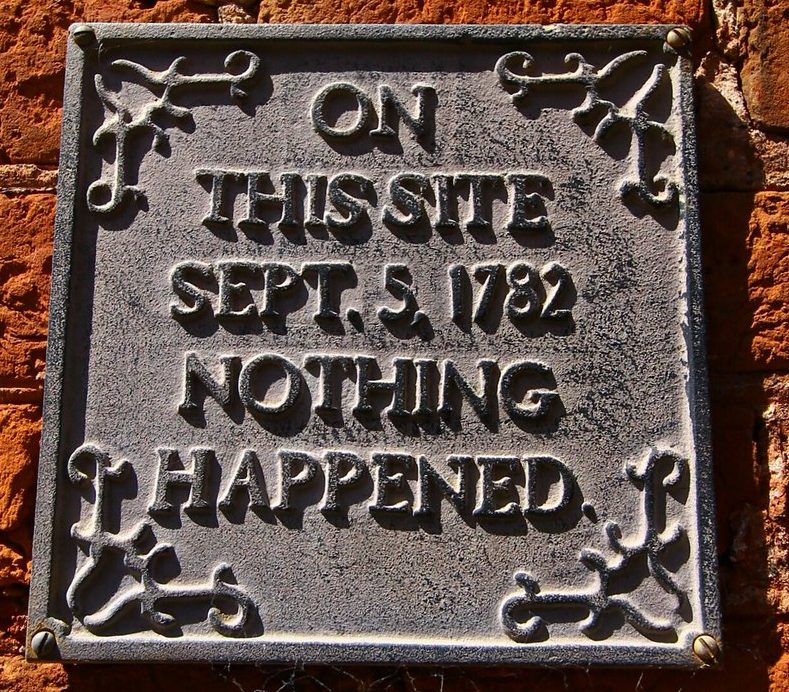
Photo: “Nothing happened” by Graham Ó Síodhacháin is licensed under CC BY-SA 2.0.

Melissa Balmain, ‘No Ifs, Ands, Or Bots’

Tradwife? No, thanks. I’m not the type you’ll find
exclaiming “Yippee!” “Yesiree!” or “YOLO!”
at thoughts of chores I might be doing solo –
especially the old-school kitchen kind.
Churn butter? Grow a sill of herbs? You’re kidding.
Give me boxed broth and Hellman’s mayonnaise
and sourdough I didn’t have to raise.
Give me technology that does my bidding.

Yet how I love to cook up verse from scratch:
to handpick thoughts I planted as a kernel
within the fertile pages of a journal,
add rhymes (a meaty or a salty batch),
then whip them into something that – although it
may stink at times – tastes vastly fresher than
the glop inside an algorithmic can
because you know it comes from me, Tradpoet.

*****

This poem was the lead poem in the latest Lighten Up Online (“LUPO”). Melissa Balmain writes: “Ironically, in the weeks since I wrote this poem, a health condition has forced me to do a lot more tradwifely stuff in the kitchen–making low-acid salad dressing, say. But I still refuse to churn butter.”

Melissa Balmain’s third poetry collection, Satan Talks to His Therapist, is available from Paul Dry Books (and from all the usual retail empires). Balmain is the editor-in-chief of Light, America’s longest-running journal of light verse, and has been a member of the University of Rochester’s English Department since 2010. She is a recovering mime.

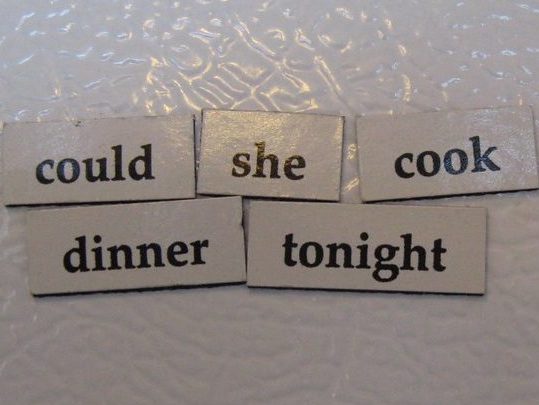
Photo: “could she cook” by aprilskiver is licensed under CC BY 2.0.

Short poem: RHL, ‘Flying to Majorca in March’

Drop me down out of the cold wet gloom
into the orange trees in bloom:
the olives, almonds, windmills, cypresses,
the black-eyed girls with wild tresses;
where once were barren hillsides, peasants, mules,
are now estates with swimming pools.

*****

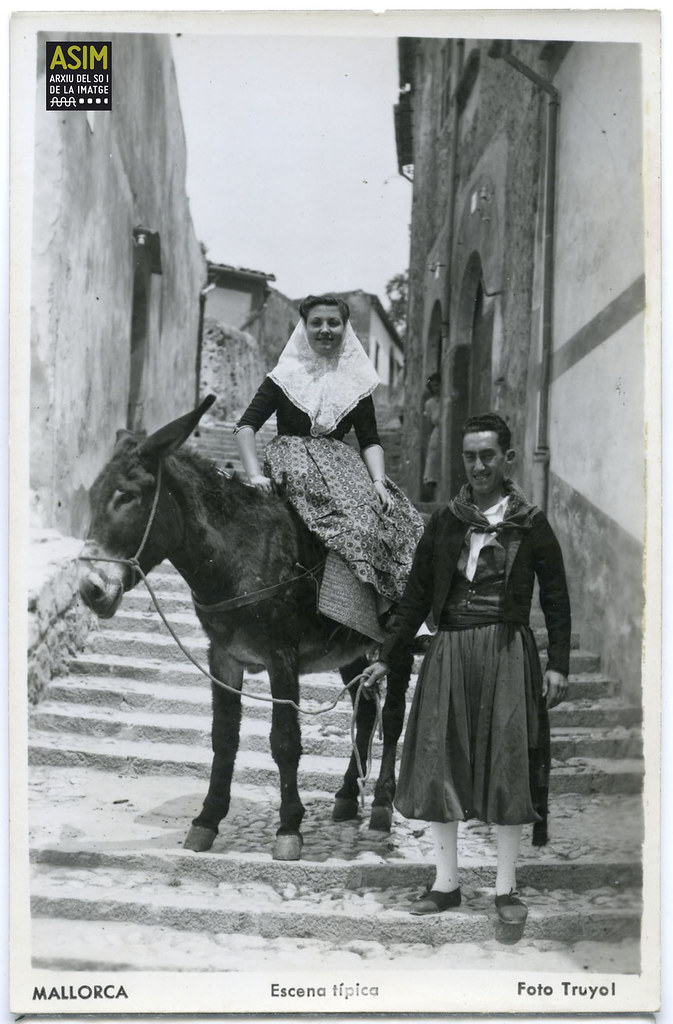
Mallorca, or Majorca to the English, has always been an attractive destination for people from further north. Frederic Chopin and George Sand moved there at the beginning of their relationship, spending three months while Chopin completed his 23 preludes in each of the major and minor keys (but the locals were suspicious of his coughing, and were antagonised by George Sand’s avoidance of church; the couple moved on). Robert Graves (whose Wikipedia entry’s Sexuality section is mind-boggling) lived for decades in the village of Deia, also associated with Anais Nin, Richard Branson, Mick Jagger, Mark Knopfler, etc. And these days Mallorca gets over 10 million tourists a year.

My short poem is inconsequential, but it has just been published in the September issue of Allegro, which is themed on ‘Flight’. It was a simple reflection on revisiting Mallorca decades after summer holidays there.

Photo: “Parella i ase” by Arxiu del So i de la Imatge de Mallorca is licensed under CC BY-NC-ND 2.0.
Using form: Villanelle with a limp: Susan McLean, ‘Instructions for Climbing and Descending’

Good foot goes to heaven; bad foot goes to hell.
When every step torments and pain is chronic,
you can’t do as you did before you fell

and sprained your ankle. As the tendons swell,
don’t make things even worse. Learn this mnemonic:
good foot goes to heaven; bad foot goes to hell.

Take one step at a time. Do not rebel
or grumble that restrictions are moronic.
You can’t do as you did. Before you fell,

you bounded up the stairs like a gazelle,
but now your gait is nearly catatonic:
good foot goes to heaven; bad foot goes to hell.

You’ve always known it doesn’t help to dwell
on loss. You should let go, but (how ironic!)
you can’t. Do as you did before you fell,

but try to play it safe while getting well.
The best advice is simple, yet Miltonic:
good foot goes to heaven; bad foot goes to hell.
You can’t do as you did before. You fell.

*****

Susan McLean writes: “I love villanelles. I like them partly because they are songlike and partly because they present interesting challenges for rhyming and for varying the repeating lines, known as repetends. I thought at first that I had set myself an impossible task with my “-onic” rhymes, but they kept surprising me and leading me in new directions. I was not planning to refer to Milton when I started, for example, but when I stumbled on “Miltonic,” it fit perfectly with the metaphors in the first line. When I started, I also didn’t realize how many ways the second repetend could be varied while still making literal sense.
“The idea behind the poem came from real-life experiences. I had sprained my right ankle once, and after I wrote this poem, I broke it twice. However, the first line, which is literally the mnemonic device offered by a physical therapist as a reminder of which foot to step on when going up or down stairs, was one I heard secondhand. My partner John was told it by his therapist when he had a painful foot. The rest of the poem is in lines with five beats (iambic pentameter), but that line has six. I decided to use it, nevertheless, because the extra beat in that repetend slows the line down, mimicking the slow gait of the person with the sprain. It also makes the line itself seem to limp.
The poem was originally published in First Things and later appeared in my second poetry book, The Whetstone Misses the Knife.”

Susan McLean has two books of poetry, The Best Disguise and The Whetstone Misses the Knife, and one book of translations of Martial, Selected Epigrams. Her poems have appeared in Light, Lighten Up Online, Measure, Able Muse, and elsewhere. She lives in Iowa City, Iowa.
https://www.pw.org/content/susan_mclean

Photo: “How Many Times Do You Have to Fall Before You End Up Walking” by Thomas Hawk is licensed under CC BY-NC 2.0.