Author Archives: Robin Helweg-Larsen

Unknown's avatar

About Robin Helweg-Larsen

Director, Andromeda Simulations International, Bahamas: a global education company providing online and in-person workshops in business finance. Series Editor, Sampson Low's 'Potcake Chapbooks'. Formal verse about traveling, family, love, etc...

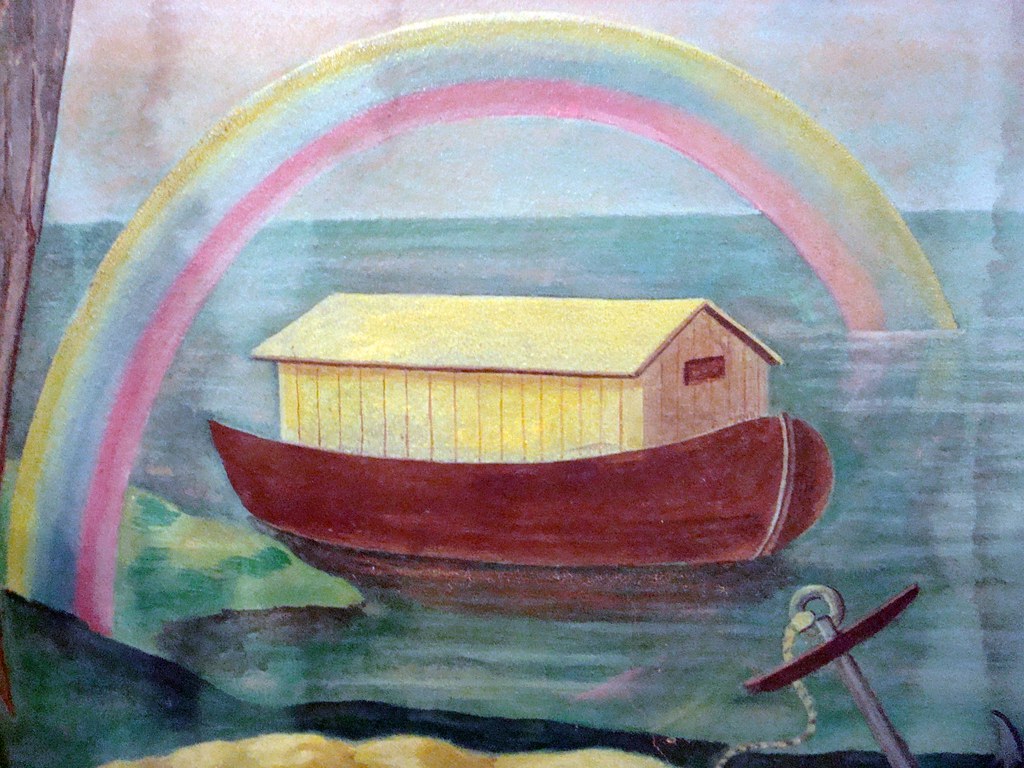
Short poem: ‘Rainbow’

God made the rainbow as a sign
for post-Flood men to see.
The sign says, “I am Merciful–
and you better fucking agree.”

*****

According to the Book of Genesis, after God flooded the entire world He told the one surviving family: “I have set my rainbow in the clouds, and it will be the sign of the covenant between me and the earth. I will remember my covenant between me and you and all living creatures of every kind. Never again will the waters become a flood to destroy all life.”

There are so many things to love in all this: the Noah’s Ark story, and the toys of it that delight children; the beauty of rainbows themselves; the alternative explanation that Irish leprechauns make rainbows to mark where they bury their gold; the Biblical suggestion that water droplets didn’t cause refraction of light before the Flood; the calculation that rain, to have flooded Mount Everest in 40 days, must have fallen at 29 feet per hour for that entire time… and above all the idea that God needed the rainbow to remind Him not to kill everyone whenever He gets angry.

But hey – rainbows are beautiful, at least we can all agree on that.

This poem was published in the most recent issue of Light.

Noah’s Ark” by Svadilfari is licensed under CC BY-ND 2.0.

Poem: ‘Full Disclosure’

“The trouble with this growing old,” he said,
“You lose so much . . . and you get what instead?
If you can hang a bath towel on your tool
it’s wasted when you’re in an all-boys school.
Time was, I’d come — as you’d expect —
with just a look, a touch.
Now, not so much.
The only thing that gets me full erect
is feeling flesh firming from kiss and grasp;
so all my work is trying to make her gasp!
I need her climax if I’m to get sated.”
He looked at her. She looked at him. He waited.

*****

This semi-formal poem was published in the Lighthearted Verse subsection of Formal Poetry in that wonderfully rich and varied magazine, Better Than Starbucks. Where else could you find such a variety of areas of expression as BTS’ Regular Feature Pages?
Free Verse
Haiku
Formal Poetry
Poetry Translations
Poetry for Children
International Poetry
African Poetry
Experimental, Form, & Prose Poetry
Poetry Unplugged
Fiction
Flash Fiction & Micro Fiction
Better Than Fiction (creative nonfiction)
The Interview
Interviewee Poems
… and From The Mind of Alfred Corn

And tolerant enough to put up with my verse on occasion! Unfortunately they have announced they are going on hiatus… hopefully they will be back in 2023, as they have been a truly excellent outlet for all manner of poetry and prose.

Photo: “Mystery Man meets a friend” by mossimoinc is licensed under CC BY-ND 2.0.

John Beaton, ‘A Sweetness Absent From the Ocean Air’

Full many a flower is born to blush unseen,
And waste its sweetness on the desert air.
Thomas Gray, Elegy Written in a Country Churchyard

The Weeping Window bleeds ceramic poppies
that blush St. Magnus’s cathedral wall
and each seems miniscule among them all—
the throng comprises nigh a million copies:
one bloom per British serviceman who died
in World War One, a massive flower bed
entitled Blood Swept Lands and Seas of Red
displayed in London where it dignified
that War’s centenary. Now part has traveled
to Orkney, here to mark one century
since dreadnought fleets waged battle on the sea
near Jutland. Lifelines tangled and unraveled—
in two short days eight thousand men and more
succumbed as riven battleships went down.
With Princess Anne, the envoy of the Crown,
their relatives are welcomed at the door
of this, the Viking edifice erected
in memory of Magnus, who eschewed
bad blood in favour of the holy rood,
a man of peace, nine hundred years respected.

Some families take pause and stare, as if
they hope the flower avatar of their
lost sailor lad will wave. As they repair
into the church, the poppies stand up, stiff
like soldiers at attention on parade;
their stems are wire, their heads are crimson clay
and, grouped, they seem ethereal, a fey
honour guard shipshapedly displayed.
The British and the German brass bands march
along the harbour front then through the streets;
this day there are no triumphs or defeats—
they gain the church grounds through a common arch—
and then the pipe band, clad in kilts, assemble.
No instrument of war can so foment
bravado then bestow such dark lament:
Great Highland Bagpipes set the air atremble,
the Weeping Window work of art revives,
more vehemently, the ones who drowned and bled,
and now we see, in child-tall blooms of red,
a sad cascade of young, foreshortened lives.

*****

John Beaton writes: In the late spring of 2016, my wife and I, on an annual trip to Orkney, attended a commemoration ceremony. The venue was St. Magnus cathedral, a magnificent edifice of Viking origin in Kirkwall, the main town on that little group of windswept islands off the north tip of Scotland.  To commemorate the centenary of the 1914 outbreak of World War I, artists had created a display outside the Tower of London: 888,246 ceramic poppies, one for each British soldier killed in that war. To commemorate the centenary of its largest naval engagement, the Battle of Jutland, organizers had taken a subset to Kirkwall and set it up as ‘The Weeping Window’, a dramatic crimson cascade from a lancet window high on the cathedral’s central tower. This poem describes the ceremony.
It won Goodreads Poem of the Month for December 2017 and has been previously published on the Thomasgray2016.org website and in my recent book, Leaving Camustianavaig (Word Galaxy Press).

Photo: Tom O’Brien, The Arcadian/ Orkney Media Group

Opposing Poems: Marcus Bales, ‘All the Blues’, ‘When the Sun Shines’

Since you left the sky’s expanse of grey
Is what the sun and clouds may briefly cruise
As light comes after dark for each dull day;
My lover leaving used up all the blues.

And since she left me I’ve been color-blind;
Now half the world’s in greys I cannot use
Since vivid red and yellow’s all I find:
My lover leaving used up all the blues.

My friends assure me better times will come,
But tinkly happy songs do not amuse
My soul still wants the searing wail and thrum
Of pain and sadness spreading like a bruise,
But now instead of tunes there’s just a hum —
My lover leaving used up all the blues.

Oh, since she left I don’t miss her at all
Though autumn leaves spread half a rainbow’s hues
Across a landscape ripening to fall:
My lover leaving used up all the blues.

*****

Marcus Bales writes: “Barbara Ehrenreich happened to read my poem ‘All the Blues’ on Facebook when I posted it some years back, and left the terse comment “It’s even worse when the sun shines.” I was at the moment so into the notion of the fall and the coming dark that I was startled by her insight, which prompted another poem, ‘When the Sun Shines’. I was gratified by her notice.

When The Sun Shines
for Barbara Ehrenreich

They sing their songs of their pure pain;
They lose their taste for the real wines
Of love and life when they weep rain.
It’s even worse when the sun shines.

When the sun shines
And the birds sing
And the green twines
On everything
And your love’s gone
And life’s a curse
In the dim dawn
Each poem’s lines
Are even worse
When the sun shines.

They write like they’ve known every hell
And mined despairing’s deepest mines;
But no one knew how far I fell.
It’s even worse when the sun shines.

Not much is known about Marcus Bales except that he lives and works in Cleveland, Ohio, and that his work has not been published in Poetry or The New Yorker. However his ’51 Poems’ is available from Amazon. He has been published in several of the Potcake Chapbooks (‘Form in Formless Times’).

Photo: “Shut out the world.” by Neil. Moralee is licensed under CC BY-NC-ND 2.0.

Odd poem: ‘The Naughty Preposition’ by Morris Bishop

I lately lost a preposition:
It hid, I thought, beneath my chair.
And angrily I cried: “Perdition!
Up from out of in under there!”

Correctness is my vade mecum,
And straggling phrases I abhor;
And yet I wondered: “What should he come
Up from out of in under for?”

*****

Morris Bishop had a high regard for light verse: “The aim of poetry, or Heavy Verse, is to seek understanding in forms of beauty. The aim of light verse is to promote misunderstanding in beauty’s cast-off clothes. But even misunderstanding is a kind of understanding; it is an analysis, an observation of truth, which sneaks around truth from the rear, which uncovers the lath and plaster of beauty’s hinder parts.”

Bishop was an acknowledged master of rhyme and meter, but that doesn’t imply that he would be limited by the grammatical restrictions of the apparently well-educated. He employed and enjoyed common speech.

Now this may sound strange coming from me, someone who writes a blog dedicated to the expansion of formal verse, but many “rules of grammar” are garbage. To me, correct speech is whatever unambiguously communicates what the speaker intended. This is naturally aided by the use of predictable patterns of word usage, because we are a pattern-recognition species, and this in turn leads to “rules”; but these rules are really only “commonly used patterns”.

Similarly the forms of traditional verse are there because they are useful: rhythm guides and builds emotion; rhyme, rhythm and wordplay all create engagement and help memorisation. The forms are neither arbitrary nor sacrosanct. The formality is purely useful (and part of its use is creating fun). Grammatical rules and formal verse have that in common.

Winston Churchill is often cited as the author of a scribbled comment on someone “correcting” his grammar: “This is the sort of nonsense up with which I will not put.” But that joke appears to predate his involvement with the issue: there is a lengthy discussion of it here in the Quote Investigator.

English has particularly confusing and contradictory rules because of the blending of several waves of Germanic speakers (Anglo-Saxons, followed by Danish invaders and later Dutch merchants) overrunning the British (i.e. Celtic speakers with their complicated auxiliary verbs: “How did you do that?”), in turn being overrun by French-speaking conquerors supported by Latin-speaking priests. (I recommend John McWhorter’s ‘Our Magnificent Bastard Tongue‘.) It was this latest ruling class that was averse to (among other things) ending a sentence with a preposition. But that’s a natural and correct part of speech for a Dane to end with.

And I’m an Anglo-Dane.

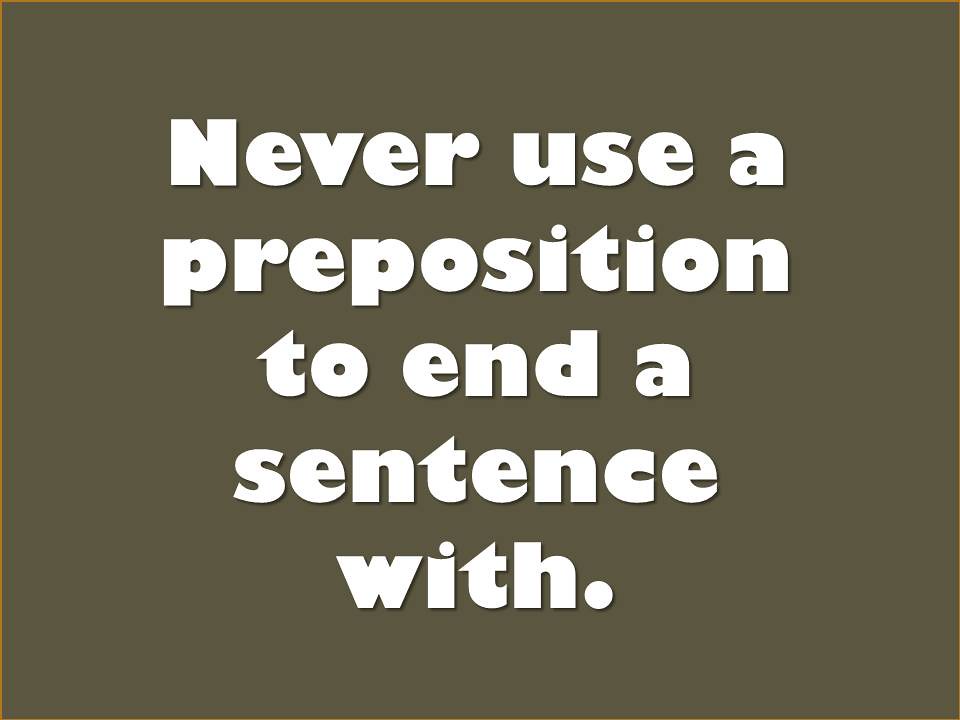
T-shirt Slogan: ‘Never use a preposition to end a sentence with.’” by Ken Whytock is licensed under CC BY-NC 2.0.

Political poem: Nina Parmenter, ‘Led by Donkeys’

Donkey, show me your big boy teeth,
show me expensive dentistry.
Mine are NHS wonky,
but you’re a donkey.

Donkey, show me your pearly hooves,
stomp them down on my two-bit shoes.
Mine are M&S clonky,
but you’re a donkey.

Donkey, show me your government car
driving to where the dollars are.
Mine is a wee bit shonky.
You’re still a donkey.

Donkey, show me your public school,
show me your passport to ruin us all.
You think it’s your right, but you’re wrong, see,
cos you’re a donkey.

*****

Nina Parmenter writes: “As the world looks on, bewildered, the political stupidity in the UK continues to know no bounds. The title of this poem is borrowed from a group of political activists – they, in turn, borrowed it from a First World War phrase describing British soldiers as ‘Lions led by donkeys’.

Today we have different threats – hunger, a declining health service, fuel poverty – but our leading class of donkeys remain seemingly blinkered to ordinary people’s welfare. Money, after all, is their master.

All this is build up to a rather silly poem in which donkey is proudly rhymed with wonky, clonky and shonky. A quick terminology guide for non-Brits: NHS = National Health Service, M&S = Marks and Spencer (a Very Ordinary Store), and ‘public school’ in the UK means a private school – no, don’t ask, I don’t understand why either. 😉”

Nina Parmenter has no time to write poetry, but does it anyway. Her work has appeared in Lighten Up Online, Snakeskin, Light, The New Verse News, Ink, Sweat & Tears, and the Potcake Chapbook ‘Houses and Homes Forever’. Her home, work and family are in Wiltshire.
https://ninaparmenter.com/

Photo: “Charming” by Another Seb is licensed under CC BY-NC-ND 2.0.

Julia Griffin: ‘Arachne’s Double’

We had a lot in common:
Grey eyes to stop and summon;
A taste for shifts and shuttles,
For instigating battles;
An aptitude for order,
A talent to embroider.
We kept ourselves in stitches;
We were each other’s matches.

As deity and woman,
We shared a kind of famine;
Vicarious in action,
Our work confined to fiction,
To woven elegiacs,
We craved our own heroics:
To beat our favourite heroes;
To share their blazing sorrows.

What have we now in common,
Besides not being human?
Only the understanding
Of what is past amending:
That all this endless weaving
Is just suspended living.
That loving is devouring.
That starving is enduring.

*****

Julia Griffin writes: “That appeared in Mezzo Cammin 14.2 (Winter, 2019). I’m pleased with it because I feel the form works with the subject-matter. It was inspired by a dear friend of mine, Candy Schille, who died tragically in November 2017: she was so quick and charismatic, and we had a sort of sparring relationship before we became friends.”

Julia Griffin lives in south-east Georgia/ south-east England. She has published in Light, LUPO, Mezzo Cammin, and some other places, though Poetry and The New Yorker indicate that they would rather publish Marcus Bales than her. Her poem ‘Wasp Waste’ was reprinted in the Potcake Chapbook ‘Robots and Rockets‘, and much more of her poetry can be found in Light, at https://lightpoetrymagazine.com/?s=julia+g&submit=Search

Photo: “Arachne” by J. Star is licensed under CC BY-NC-SA 2.0.

Marcus Bales: ‘Villains, Too’

Villains, too, believe they’re righting wrongs,
Their traumas just as blunt as yours or mine.
They write their manifestoes, sing their songs,
And hope their cancer screens turn out benign;
It’s where they differ that the trouble lies.
Their personal concerns are all they see.
For them there are no others’ laughs or cries —
We’re furniture to them, not you, not me.
They see us not as people, but as means
For them to harm a world that helped their foes,
Or if we give them pleasure, as machines
To give whatever pleasure that they chose.
They see themselves as victims who must seize
Their rights to do whatever they may please.

*****

Marcus Bales writes: “Villains, Too is one more in a series of attempts to write this poem. If I knew exactly what I was trying to say I hope I’d have actually said it by now. The forlorn fragments of phrases strung through my notes for poems show that this business recurs and wants something from me. I hope to get this done, eventually. In the meantime, without spending too much time trolling through my own failings, here’s the last time I tried:

Grinning Henchmen

They do not wake up sharing bwahahas
With grinning henchmen as they shave, and think
“Today I shall be evil!” No, the laws
Are on their side. They never even blink
At all the tears and suffering they cause.
They’ve got their lives to live, and they don’t shrink
From living them, like you and me, with flaws
And virtues, growing families, food and drink,
And love and death. They look at life and view it
Just like us. And in our common murk
They did each evil deed and never knew it
To be evil. No one, king to clerk,
Has thought they’re doing evil as they do it;
They always think they’re doing some god’s work.”

Not much is known about Marcus Bales except that he lives and works in Cleveland, Ohio, and that his work has not been published in Poetry or The New Yorker. However his ’51 Poems’ is available from Amazon.

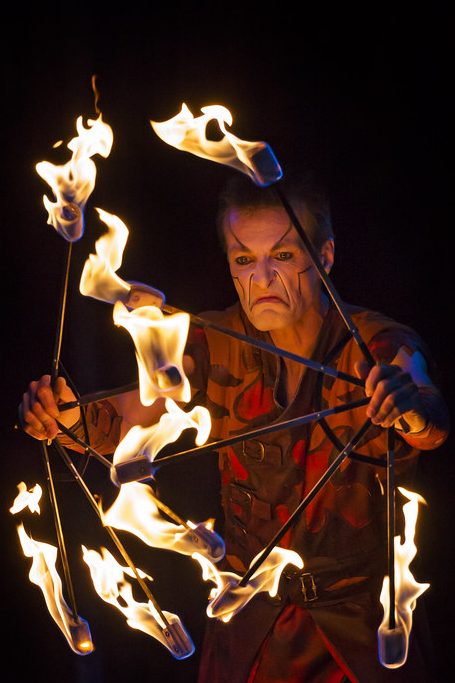
Photo: “Villain with fire” by Tambako the Jaguar is licensed under CC BY-ND 2.0.

A.M. Juster: ‘Cancer Prayer’

Dear Lord,
Please flood her nerves with sedatives
and keep her strong enough to crack a smile
so disbelieving friends and relatives
can temporarily sustain denial.

Please smite that intern in oncology
who craves approval from department heads.

Please ease her urge to vomit; let there be
kind but flirtatious men in nearby beds.

Given her hair, consider amnesty
for sins of vanity; make mirrors vanish.

Surround her with forgiving family
and nurses not too numb to cry. Please banish
trite consolations; take her in one swift
and gentle motion as your final gift.

*****

A.M. Juster writes: “One of my favorites.”

A.M. Juster is the Plough Quarterly poetry editor. His work has appeared in Poetry, Paris Review, Hudson Review and other journals. His tenth book is Wonder and Wrath (Paul Dry Books 2020) and his translation of Petrarch’s Canzoniere is due from W.W. Norton in early 2024.
www.amjuster.net

Photo: “A Silent Calling” by Alyssa L. Miller is licensed under CC BY 2.0.

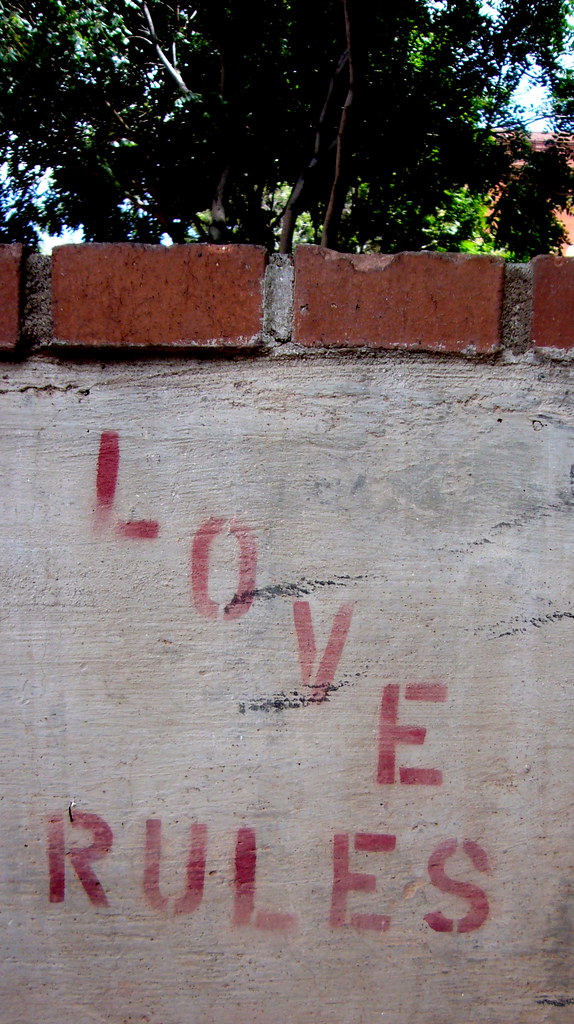
Susan McLean, ‘Rules for Love’

Don’t wear make-up, ever. Don’t act girly.
Don’t collect shoes or shop until you drop.
If your hair is straight, don’t make it curly.
Don’t play dumb or play his games. Don’t stop
reading or saying what you think. Don’t flatter.
Don’t claim that you love football if you don’t.
Don’t sidestep. Don’t pretend it doesn’t matter
if he puts down your friends or if he won’t
do his fair share of housework. Do your best
to give your talents scope and free his own.
Grill steaks; eat chocolate. This is not a test.
If he won’t love you, you’ll do fine alone.
Sex is a bonus. Give as good as you get,
but make it clear you don’t intend to marry.
Love what you have, and what you don’t, forget.

These worked for me. (Your own results may vary.)

*****

Susan McLean writes: “This poem got its start in answer to a contest at the magazine The Spectator in the UK for a poem about “rules for love.” The words rules and love don’t normally go together, because love is something that often seems to break all the rules. Yet most people have their own mental set of requirements for love, which they will not easily set aside, as well as an internalized list of dos and don’ts that they think are the way to achieve love. I found it entertaining to try to pin down some of mine, knowing that each person will have a different list. How often women run into articles in women’s magazines that purport to tell them exactly how to find lasting love! This poem tries to be funny by saying the sorts of things that would never appear in those articles. It was not among the winners at The Spectator, but it was a lot of fun to write. Trying to pin down one’s own rules for love produces an indirect self-portrait. The poem first appeared in my second book, The Whetstone Misses the Knife.”

Susan McLean has two books of poetry, The Best Disguise and The Whetstone Misses the Knife, and one book of translations of Martial, Selected Epigrams. Her poems have appeared in Light, Lighten Up Online, Measure, Able Muse, and elsewhere. She lives in Iowa City, Iowa.
https://www.pw.org/content/susan_mclean

Photo: “love rules” by hmmlargeart is licensed under CC BY-NC-ND 2.0.