Author Archives: Robin Helweg-Larsen

Unknown's avatar

About Robin Helweg-Larsen

Director, Andromeda Simulations International, Bahamas: a global education company providing online and in-person workshops in business finance. Series Editor, Sampson Low's 'Potcake Chapbooks'. Formal verse about traveling, family, love, etc...

Poem: ‘Hunting’

The Osprey splashes, misses, and flies by
skimming the waves, rising, five yards away.
What’s its success rate? Does it care?
The Stingray searches, gliding, mouth to sand
five yards beyond the shallows where I stand.
Its Roomba-work’s its own affair.
The water splishes, burbles random rhythms.
The sun confuses, over-hot, then hidden.
The Oystercatcher calls. The Osprey rocks
on its branch in a casuarina,
flaps down-beach to another.
Along the margins of the shore, alone, each stalks.
They hunt for food
and I hunt them for what they mean, or could.

A semi-formal poem: rhymes and slant rhymes, iambic rhythm, but little structure beyond that. I was hunting for a poem about hunting for a poem, and, well, you don’t catch everything you want every time…

Published recently in the British periodical ‘Obsessed With Pipework‘ – thank you, Charles Johnson!

“Osprey landing_9566” by Don Johnson 395 is licensed under CC BY-ND 2.0

Review: ‘The Lesser Mortal’ by Geoff Lander

Geoff Lander has produced a score of full-page formal poems about various scientific luminaries: Maxwell, Einstein, Mendeleev and so on, combining career highlights with odd trivia about them. The poems are technically very skilful, with a variety of forms and metres being used (though the book is marred in a couple of places by the typesetting failing to follow the structure of lines and rhymes). Here is an excerpt from ‘On the Shoulders of Others’:

Does the gentle polymath,
Monsieur Henri Poincaré,
buried there in Montparnasse,
ponder how it came to pass
Einstein’s name now dominates
all things relativité?
(…)
In the central USA
near St. Louis one fine day
in 04 he first declared
E might equal mc2.

That was news to me. And it does raise the question of why Einstein should get all the recognition. Another of Lander’s poems, ‘Socks Off to Einstein’, suggests a possible answer:

While others may claim to have seen mc2,
they weren’t sock-eccentric, they weren’t spiky haired.
Their names are forgotten. Quite rightly that rankles–
the price you might pay if you coddle your ankles.
So three cheers for Albert, and get your heels bared!

Lander is a chemist by training and a computer programmer by profession, and poetry only came along when he started writing out other people’s verse to help his right hand recover from a stroke. Then, “encouraged from Scotland by Helena Nelson and from the grave by John Betjeman”, he started writing his own verse of which only a tiny fraction has been published.

New historical information and skilful light verse makes for a powerful combination! This very interesting little book from HappenStance Press contains most of what Geoff Lander has published to date.

Potcake Poet’s Choice: Jerome Betts, ‘In Northampton Museum’

Among the hide-and-canvas lace-ups made
For some poor elephant’s giant tender feet
And leathery minutiae of trade
     In boots, dissected or complete,

Mint Army-issue, every shade of bruise,
With Tudor scraps from trenches workmen dig,
You find a case containing John Clare’s shoes,
    Asylum-worn, and very big.

Jerome Betts writes: ”In Northampton Museum, published in Angle and The Hypertexts, is for me one of those pieces in which some lines just seem to arrive fully formed. In 1969-70 I lived for eighteen months in Northampton and sometimes visited its Shoe Museum whose displays reflected the traditional local industry. The town also still had the former Northampton County Asylum (now a private psychiatric hospital) where John Clare spent his last years. Somehow, the military  footwear, the curious elephant boots and Clare’s shoes all seemed to come together. Oddly enough, nearly  two years ago  I received a Lighten Up Online contribution about elephants from someone in the USA who, it turned out, knew another contributor who knew the American leader of the expedition in 1950, testing some theory about Hannibal’s’ crossing of the Alps, for which the elephant boots had been made.”

Jerome Betts was born and brought up on the Welsh border, but now lives in South Devon, where he edits the quarterly Lighten Up Online. In addition to articles and verse in consumer and specialist magazines his work has appeared in Pennine Platform, Staple and The Guardian, as well as anthologies like The Iron Book of New Humorous Verse, Limerick Nation, Love Affairs At The Villa Nelle,  Extreme Sonnets, Extreme Formal Poems and The Potcake Chapbooks 1 & 2, and online at Amsterdam Quarterly, Angle, The Asses of Parnassus, Autumn Sky Poetry Daily, Better Than Starbucks,  The Hypertexts, Light, The New Verse News, Parody, The Rotary Dial, Snakeskin, and other sites.

https://www.lightenup-online.co.uk/

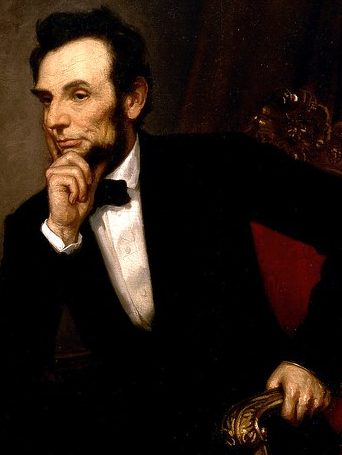
Odd poem: Abraham Lincoln, ‘The Suicide’s Soliloquy’

Here where the lonely hooting owl
Sends forth his midnight moans,
Fierce wolves shall o’er my carcase growl
Or buzzards pick my bones.

No fellow-man shall learn my fate,
Or where my ashes lie;
Unless by beasts drawn round their bait,
Or by the ravens’ cry.

Yes! I’ve resolved the deed to do,
And this the place to do it:
This heart I’ll rush a dagger through,
Though I in hell should rue it!

Hell! What is hell to one like me
Who pleasures never knew;
By friends consigned to misery
By hope deserted too?

To ease me of this power to think,
That through my bosom raves,
I’ll headlong leap from hell’s high brink,
And wallow in its waves.

Though devils yell, and burning chains
May waken long regret;
Their frightful screams, and piercing pains,
Will help me to forget.

Yes! I’m prepared, through endless night,
To take that fiery berth!
Think not with tales of hell to fright
Me, who am damn’d on earth!

Sweet steel! come forth from out your sheath,
And glist’ning, speak your powers;
Rip up the organs of my breath,
And draw my blood in showers!

I strike! It quivers in that heart
Which drives me to this end;
I draw and kiss the bloody dart,
My last—my only friend!

This poem was published anonymously in the April 25, 1838 edition of The Sangamo Journal of Springfield, Illinois, under this introduction: “The following lines were said to have been found near the bones of a man supposed to have committed suicide, in a deep forest, on the Flat Branch of the Sangamon, sometime ago.” For various reasons it is now commonly assumed that this is the poem that Lincoln’s friend Joshua Speed told Lincoln’s biographer William Herndon about, a poem that the President had written on suicide as he struggled through a period of deep depression.

A full discussion of the identification of the poem with Lincoln can be found in the magazine Shenandoah, and I happily quote their assessment of Lincoln’s merits as a poet:

The poem is similar to other mortality poems of the period, though even more melodramatic than most (the last stanza, in which the speaker continues to narrate his feelings after he has stabbed himself through the heart, is particularly painful). Aside from the historical curiosity of its authorship, the piece—with its glamourizing of suicide and its overwrought morbidity—does little to distinguish itself from other amateur poetry in the school of Poe.

Photo: “16 Abraham Lincoln” by US Department of State is marked with CC PDM 1.0

Potcake Poet’s Choice: Terese Coe, ‘The Bumbly’ (after Edward Lear)

He ran the State in a daze, he did,
In a daze he ran the State:
In spite of howls and obnoxious jeers
And those who said it would end in tears
In a daze he ran the State!
And when the daze became a rout
That turned the country inside out
The Bumbly cried, I’m much too big!
I’m Alpha male, I’m never-fail,
the biggest gig and vig!
In a daze I’ll run the State!

So vast and vain, so vast and vain
Is the bog where the Bumbly brays;
His face is green, to think a strain,
And he ran the State in a daze.

He carried on in a daze, he did,
In a daze he carried on,
With carrion eaters on his staff,
Perpetual sneers and snickery laughs,
And predators stalking prey;
And though they said they’d legislate
They knew too little and much too late,
And worse, they could not stand up straight!
For in their skin was a powerful hate
That chewed them up till dawn.
So vast and vain, so vast and vain
Is the bog where the Bumbly brays;
His face is green, to think a strain,
And he ran the State in a daze.

And while he ran the State, he did,
And flew far over the seas
He incurred great debt and was bought by a bro
With a host of spies and some quid pro quo
And a hive of slithery sleaze.
And he bought a city or two, and some laws,
And when he was fitted with monkey claws
His climbed a tree, shrieked Chee-chee-chee!
And his arms reached down to his knees.
So vast and vain, so vast and vain
Is the bog where the Bumbly brays;
His face is green, to think a strain,
And he ran the State in a daze.

In twenty years they all were dead,
In twenty years or less,
And the people said How good they’re gone!
For they’d been through the muck of the Swamp-a-Thon,
And the dung of Fakery Cess.
And they feasted and drank at the Bumbly grave
With homemade wine and a weeklong rave,
And everyone sang, We shall live in chalets!
If only we live! We’ll attack and raze
The ruins of Fakery Cess!

So vast and vain, so vast and vain
Is the bog where the Bumbly brayed;
His face was green, to think a strain,
And he ran the State in a daze.

Terese Coe writes: “Writing this was more fun than I can say!”

Terese Coe’s poems and translations have appeared in Agenda, Alaska Quarterly Review, The Cincinnati Review, The Moth, New American Writing, New Writing Scotland, Ploughshares, Poetry, Poetry Review, The Stinging Fly, Threepenny Review, and the TLS, among many other journals. Her collection Shot Silk was listed for the 2017 Poets Prize. https://en.wikipedia.org/wiki/Terese_Coe

‘The Bumbly’ was first published in Xavier Review, 2019. Her ‘Apology From Fiji’ appeared in the Potcake Chapbook ‘Tourists and Cannibals’ from Sampson Low Publishers.

Potcake Poet’s Choice: Edmund Conti, ‘In Memoriam’

John Betjeman cannot read his In Memoriam.  Not
Today
    Or ever.

So what’s the use of writing another jot.
    Why, pray,
    Endeavor?

For he who could best compose one is decomposing.  Rot!
    Away
    Forever.

His spirit lives in every ingle-nook where England claims the heart
    And soul.

That poet so lightly musical, so serious and straight (an art)
    And droll.

Whose lines were seen and heard in every church, in every mart.
    And knoll.

Muckby-cum-Sparrowby cum Sphinx, County Westmeath, Cheltenham;
    The set.

Henley-on-Thames, also Highgate, Bristol, Clifton, Mint-on-Lamb:
    Gazette.

Places etched forever in his poems, each one a Betje-gram.
    Je bet!

We remember chintzy cheeriohs in his brilliant combinations.
    Cheeribye.

Farewell, so long, bunghosky, too — Goodbye to all his permutations.
    Never grim.
    Never dry.

Well, it’s getting time for supper and we’ve had our ruminations.
    This is him.
    Dry your eye.

Edmund Conti writes: “I remember saying (to myself) in high school after writing a few verses, “I’m not a poet I don’t like poetry, I just like to rhyme and scan.” I had an image of who poets were and what poetry was, and it just didn’t fit my imagined profile. I stuck to my guns for a while even as I was sending out my verse and getting comments like, “Please, no more rhymes” and “How about sending your smug cloaca elsewhere?” But eventually some poems were accepted and published and I met more poets and I got married. Marilyn loved poetry (no, she didn’t say real poetry but I imagined her thinking it). She was a member of a woman’s poetry group that called themselves The Lady Blue Stockings. They would smack their lips over Amy Lowell (“Christ, what are patterns for?”) and E. E. Cummings (“How do you like your blue-eyed boy, Mister Death?”). Marilyn tolerated my poetry but didn’t appreciate any of my parodies of her favorites.

Meanwhile, I met other poets and joined two groups: The South Mountain Poets and the Bards Buffet. The former was a local group (in NJ) and met weekly and discussed each other’s poems. I was usually advised to have more gravitas. The Bards, all light versifiers, met in a penthouse dining room of an insurance company in Manhattan.  Among them Willard Espy, William Rossa Cole, inventor of River Rhymes and other well-published poets.

So, in spite of myself, I was becoming a poet and appreciating others. Among them, Wallace Stevens, Robert Wallace, Vachel Lindsay, Frank O’Hara, and Robert Southey. And more and more swam into view. Luckily Marilyn brought many poetry books to the marriage and I found myself one day leafing through “John Betjeman’s Collected Poems.” There I came across his poem titled (entirely) “I.M. Walter Ramsden, ob. March 26 1947, Pembroke College, Oxford”. I loved the poem, the rhyming and the place names. Of course, I had to write my own version, not as parody, but an appreciation.  It was fun playing with the format and making up some English place names. One of my two or three favorite poems.

This was originally published in Orphic Lute. Later I sent it to Lighten-Up Online. They accepted it, made some changes to the place names and changed some of the wording. It was republished in my book “Just So You Know” from Kelsay Books. There I had problems with line lengths, some lines longer than Kelsay’s book limits allowed. Here it is, back in its original format.

Edmund Conti has recent poems published in Light, Lighten-Up Online, The Lyric, The Asses of Parnassus, newversenews, Verse-Virtual and Open Arts Forum. His book of poems, Just So You Know, released by Kelsay Books
https://www.amazon.com/Just-You-Know-Edmund-Conti/dp/1947465899/
was followed by That Shakespeherian Rag, also from Kelsay
https://kelsaybooks.com/products/that-shakespeherian-rag

His poems have appeared in several Potcake Chapbooks:
Tourists and Cannibals
Rogues and Roses
Families and Other Fiascoes
Wordplayful
all available from Sampson Low Publishers

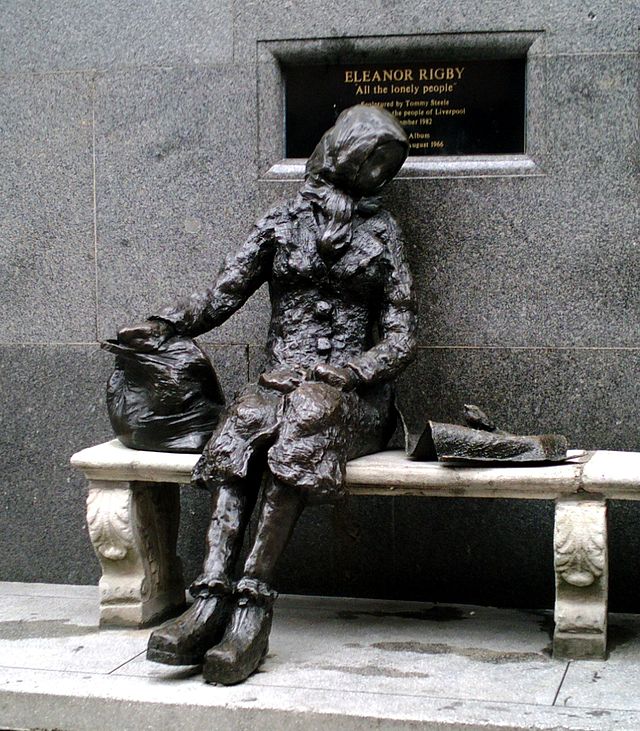
Songs as poems: Lennon-McCartney, ‘Eleanor Rigby’

Eleanor Rigby picks up the rice in the church where a wedding has been,
Lives in a dream.
Waits at the window, wearing the face that she keeps in a jar by the door,
Who is it for?

All the lonely people,
Where do they all come from?
All the lonely people,
Where do they all belong?

Father McKenzie writing the words of a sermon that no one will hear,
No one comes near.
Look at him working, darning his socks in the night when there’s nobody there,
What does he care?

All the lonely people, (etc)

Ah, look at all the lonely people!

Eleanor Rigby, died in the church and was buried along with her name,
Nobody came.
Father McKenzie, wiping the dirt from his hands as he walks from the grave,
No one was saved.

All the lonely people, (etc)

Written and released in 1966 on the Revolver lp and also as a double-A-side single with Yellow Submarine, ‘Eleanor Rigby’ was part of the Beatles’ dramatic move away from simple pop love songs into a vastly larger realm of portraits and social concerns and musical experimentation. Here, in a few lines, we have the protagonist’s lonely day-to-day life and unattended funeral, weaving back and forth with the empty church and its equally lonely priest. If Paul Simon’s ‘I Know What I Know’ is like a condensed Alice Munro short story, ‘Eleanor Rigby’ could be a full-length novel by Knut Hamsun or Kazuo Ishiguro… reduced to three 4-line verses and a refrain or two. The ideas are expressed as simple visual events, without speech. The words are straightforward, the rhymes uncomplicated–and some are slant rhymes, almost unnoticeable in song: been/dream, from/belong, grave/saved. But the impact is very powerful.

So who is the poet behind the song? Its article in Wikiwand states:

McCartney wrote the first verse by himself, and the Beatles finished the song in the music room of John Lennon’s home at Kenwood. John Lennon, George Harrison, Ringo Starr and Lennon’s childhood friend Pete Shotton all listened to McCartney play his song through and contributed ideas. Harrison came up with the “Ah, look at all the lonely people” hook. Starr contributed the line “writing the words of a sermon that no one will hear” and suggested making “Father McCartney” darn his socks, which McCartney liked. It was then that Shotton suggested that McCartney change the name of the priest, in case listeners mistook the fictional character in the song for McCartney’s own father.

McCartney could not decide how to end the song, and Shotton finally suggested that the two lonely people come together too late as Father McKenzie conducts Eleanor Rigby’s funeral. At the time, Lennon rejected the idea out of hand, but McCartney said nothing and used the idea to finish off the song, later acknowledging Shotton’s help.

Lennon was quoted in 1971 as having said that he “wrote a good half of the lyrics or more” and in 1980 claimed that he wrote all but the first verse, but Shotton remembered Lennon’s contribution as being “absolutely nil”. McCartney said that “John helped me on a few words but I’d put it down 80–20 to me, something like that.” Historiographer Erin Torkelson Weber has studied all available historical treatments of the issue and has concluded that McCartney was the principal author of the song, while speculating that Lennon’s assertions to the contrary were the result of lingering unresolved anger and the influence of manager Allen Klein.

John Lennon may have the stronger reputation as a poet, but this gem appears to be Macca’s. (Sorry; Sir Paul’s.)

Wikiwand credit: CC BY-SA 4.0 license

R.I.P. Susan de Sola

Wonderfully warm and witty poet Susan de Sola passed away last week after a short battle with cancer–she was only 59, very active, and had recently published ‘Frozen Charlotte‘ with Able Muse Press. Tributes in Snakeskin’s blog and Light Poetry Magazine have shown some of her charming, amusing work.

Her work appeared in a couple of the Potcake Chapbooks–‘Family and Other Fiascoes’ and ‘Strip Down’–but I think the most fitting poem for showing her spirit is the last poem in ‘Frozen Charlotte’. She likens the lives of humans to the brief lives of fruit flies and ends, acceptingly, with
“The fruit is fine, the day is long.
Let us feed, buzz, rejoice
.”

Indeed. But many of us miss you, all the same.

Potcake Poet’s Choice: Noam D. Plum, ‘Making a Clean Breast of It’

(Three of four men, according to a survey,) would rather take a shower with a beautiful celebrity than with their partner. “I’m not surprised,” said lifestyles counselor Carol Wise. – Reuters

Wise Wise
Replies,
“It’s no surprise.
It’s thighs–
Not ties–
That tantalize.

“True love’s the prize?
It’s otherwise.

“If four comprise
The sampling size,
Three guys
Revise
Their picks. Love dies.

“The fourth one lies.”

—–

Noam D. Plum writes: “The counselor’s name exerted a strong pull toward writing this. I like that the title is as funny as the poem. I was surprised and delighted that Mary Meriam considered this enough of a sonnet to include it in Irresistible Sonnets.”

Another poet’s pseudonym, Noam D. Plum has published in The Spectator, The Country Mouse, Light Poetry Magazine (where this poem was first published) and elsewhere. Having won several prizes, he is a more successful breadwinner than the poet for whom he fronts.

His poems have appeared in the Potcake Chapbooks ‘Wordplayful’ and ‘Murder!’

New magazine’s Call For Submissions – Pulsebeat Poetry Journal

Poet (and engineer) David Stephenson contacted me recently with the message “I am starting a new journal, Pulsebeat Poetry Journal, for poems with a strong musical element, especially poems in meter and rhyme. I don’t think there are enough venues for rhyming poetry.” He is putting out a general Call for Submissions on his web page https://pulsebeatpoetry.com/guidelines/

“Poems full of music, using meter and rhyme or other means, previously unpublished… Theme should be the human condition… Submissions by December 31, 2021, for the first issue to be posted in January, 2022.” More submission details are at that link above.

David Stephenson has published in The Formalist, The Lyric, etc. His ‘Rhythm and Blues‘ won the Richard Wilbur Award in 2007, which puts him in excellent company. On the Masthead page of his web site you can find links to more recent poems of his, published in Autumn Sky Poetry and Avatar Review.

I look forward to reading the Pulsebeat Poetry Journal, and wish David Stephenson good luck with the venture.