Category Archives: dialect verse

Dialect verse: William Henry Drummond, ‘The Wreck of the Julie Plante’

On wan dark night on Lac St. Pierre,
      De win’ she blow, blow, blow,
  An’ de crew of de wood scow “Julie Plante”
      Got scar’t an’ run below—
  For de win’ she blow lak hurricane,
      Bimeby she blow some more,
  An’ de scow bus’ up on Lac St. Pierre
      Wan arpent from de shore.

  De captinne walk on de fronte deck,
      An’ walk de hin’ deck too—
  He call de crew from up de hole,
      He call de cook also.
  De cook she ‘s name was Rosie,
      She come from Montreal,
  Was chambre maid on lumber barge,
      On de Grande Lachine Canal.

  De win’ she blow from nor’ -eas’ -wes’,—
      De sout’ win’ she blow too,
  W’en Rosie cry, “Mon cher captinne,
      Mon cher, w’at I shall do ?”
  Den de captinne t’row de beeg ankerre,
      But still de scow she dreef,
  De crew he can’t pass on de shore,
      Becos’ he los’ hees skeef.

  De night was dark lak wan black cat,
      De wave run high an’ fas’,
  W’en de captinne tak’ de Rosie girl
      An’ tie her to de mas’.
  Den he also tak’ de life preserve,
      An’ jomp off on de lak’,
  An’ say, “Good-bye, ma Rosie dear,
      I go drown for your sak’.”

  Nex’ morning very early
      ‘Bout ha’f-pas’ two—t’ree—four—
  De captinne—scow—an’ de poor Rosie
      Was corpses on de shore,
  For de win’ she blow lak hurricane,
      Bimeby she blow some more,
  An’ de scow bus’ up on Lac St. Pierre,
      Wan arpent from de shore.

MORAL
  Now all good wood scow sailor man
      Tak’ warning by dat storm
  An’ go an’ marry some nice French girl
      An’ leev on wan beeg farm.
  De win’ can blow lak’ hurricane
      An’ s’pose she blow some more,
  You can’t get drown on Lac St. Pierre
      So long you stay on shore.

*****

William Henry Drummond (1854 – 1907) was born in Ireland shortly after the end of the Great Famine, and came to Canada as a boy with his parents. He became a doctor, but gained fame as the ‘Poet of the Habitant’, celebrating the rural communities of Quebec with humour and goodwill.

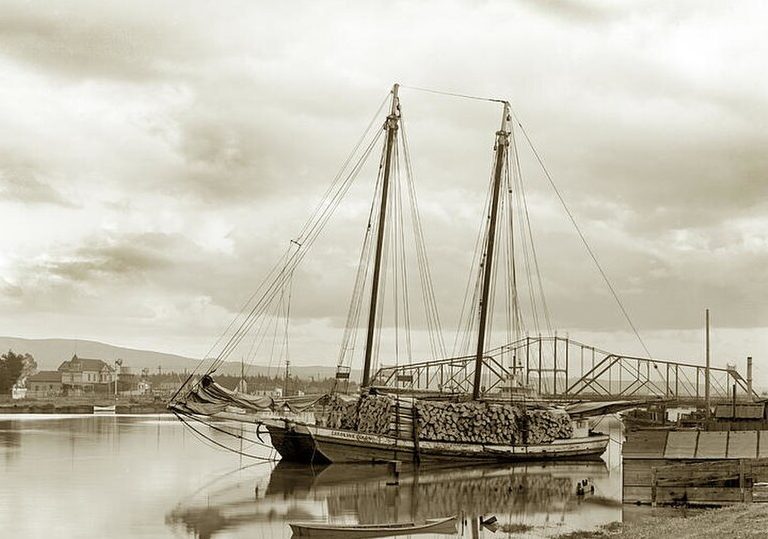
Photo: The scow schooner Caroline Dixon with a load of wood for the match factory.

Dialect verse: Louise Bennett, ‘Back to Africa’

Back to Africa, Miss Mattie?
You no know wha you dah seh?
You haf fe come from somewhe fus
Before you go back deh!

Me know say dat you great great great
Granma was African,
But Mattie, doan you great great great
Granpa was Englishman?

Den you great granmader fader
By you fader side was Jew?
An you granpa by you mader side
Was Frenchie parlez-vous?

But de balance a you family,
You whole generation,
Oonoo all barn dung a Bun Grung–
Oonoo all is Jamaican!

Den is weh you gwine, Miss Mattie?
Oh, you view de countenance,
An between you an de Africans
Is great resemblance!

Ascorden to dat, all dem blue-yeye
White American
Who-fa great granpa was Englishman
Mus go back a Englan!

What a debil of a bump-an-bore,
Rig-jig an palam-pam
Ef de whole worl start fe go back
Whe dem great granpa come from!

Ef a hard time you dah run from
Tek you chance! But Mattie, do
Sure a whe you come from so you got
Somewhe fe come back to!

Go a foreign, seek you fortune,
But no tell nobody say
You dah go fe seek you homelan,
For a right deh so you deh!

*****

The trick with dialect verse is to read it aloud, and let it make sense. Then a word like “doan” will clarify itself as “don’t”. Perhaps the most difficult line in this poem is “Oonoo all barn dung a Bun Grung–” which is “You all born down in Burnt Ground”, a rural community in Jamaica.

Louise Bennett (1919 – 2006), more formally Louise Simone Bennett-Coverley OM OJ MBE, more commonly known by her pen name Miss Lou, was a Jamaican poet, folklorist, actress, writer and educator. She wrote and performed her poems in Jamaican Patois. Raised in Jamaica, educated at RADA on a British Council scholarship, she built her career in Jamaica but moved to Canada in her later years.