Category Archives: Poems

Sonnet: Janice D. Soderling, ‘September Morning’

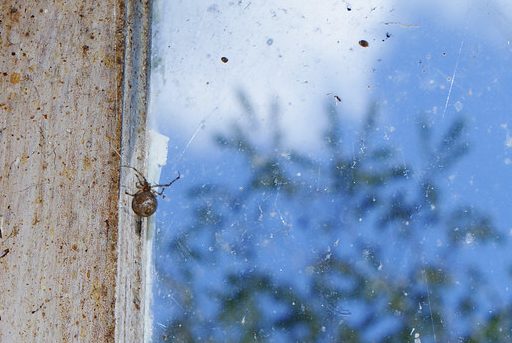
Across a sun-lit pane, deft, unconcerned,
a spider struts the steps of an old dance,
a set design, in no part happenstance:
and I again to sun and rune returned.
Stumbling along, half blind, half deaf, half-learned,
in yet a day of quarrel and circumstance,
I turn from cluttered web to view askance
night’s daughter, she who never can be turned.

Sleek spider dame with one plan, to consume,
to suck the juice from each unwary fly,
with no grand need to query or presume
if there was meaning in your quarry’s sigh.
Here, in the corner of my fog-filled room,
Atropos grins, her scissors lifted high.

*****

Janice D. Soderling writes: “I don’t write much these days, preferring to use the shortening days to read. But I woke up this morning with the last two lines in my head, and knowing it was an ending to a sonnet, I proceeded to write the rest. Perhaps it asks too much of the reader. Perhaps it is a pretentious piece, of interest only to me. Never mind, I shall keep it, having poured three hours into it.”

Janice D. Soderling has published poems, fiction and translations in hundreds of print and online journals and anthologies over the years. Her most recent poetry collection is ‘Rooms and Closets‘ available at all online bookshops.

Photo: “Spider In Window” by trekkie313 is licensed under CC BY 2.0.

Weekend read: Odd poem: Benjamin Disraeli, ‘To A Beautiful Mute (The Eldest Child of Mr. Fairlie)’

Tell me the star from which she fell,
Oh! name the flower
From out whose wild and perfumed bell
At witching hour,
Sprang forth this fair and fairy maiden
Like a bee with honey laden.

They say that those sweet lips of thine
Breathe not to speak:
Thy very ears that seem so fine
No sound can seek,
And yet thy face beams with emotion,
Restless as the waves of the ocean.

‘Tis well. Thy face and form agree,
And both are fair.
I would not that this child should be
As others are:
I love to mark her indecision,
Smiling with seraphic vision

At our poor gifts of vulgar sense
That cannot stain
Nor mar her mystic innocence,
Nor cloud her brain
With all the dreams of worldly folly,
And its creature melancholy.

To thee I dedicate these lines,
Yet read them not.
Cursed be the art e’er refines
Thy natural lot:
Read the bright stars and read the flowers,
And hold converse with the bowers.

*****

This poem for a mute girl and another (‘To a Maiden Sleeping After her First Ball’) can be found in All Poetry; they each have an accurate but uninspiring AI-driven analysis after them; the subsequent comments are more engaging:
WolfSpirit – “keep writing, Benjamin. you may just be a known poet someday. 
Linda Marshall – “I know Disraeli as a novelist and (of course) as a politician.
This is the first poem of his I’ve ever read!
It has its moments and of course tastes were different in those days but there are rhythmical infelicities and some rhymes that verge on the comic.
I can see why he’s known for his prose rather than his poetry!”

Benjamin Disraeli was born into a Jewish family in 1804; his father quarrelled with the synagogue and renounced Judaism, and had all the children baptised into the Church of England when Disraeli was 12. After school, Disraeli was articled to a law firm at age 16, and his career went from there to stock market speculation, financial ruin, novel writing, and then politics. He was twice Prime Minister of the United Kindom, and was appointed Earl of Beaconsfield by Queen Victoria in 1876. He died in 1881, unmourned as a poet.

Photo: Earl of Beaconsfield, K.G. Photographed at Osborne by Command of H.M. The Queen, July 22, 1878. This file was derived from: Benjamin Disraeli CDV by Cornelius Jabez Hughes, 1878.jpg

Sonnet: ‘Maz’ Griffiths, ‘The Bateleur’

She was returning to the gauntlet when
some dolt yee-hawed a horn. She slewed left, fetched
off course, alarmed, towards the misty fen.
I heard the sharp cries of the crowd, and stretched
my ungloved wrist out wide. She landed there
as softly as a stork re-sits its nest.
She gazed at me and I absorbed her stare.
She preened her wind-combed quills, then came to rest
sphinx-still, her eyes a blaze of feral gold.
The handler bustled up to break the charm.
He mentioned luck, unlocked her talon-hold,
and claimed the eagle from my unscathed arm.
Between her wingbeats, Nature spurned the rule
that beauty shows no mercy to a fool.

*****

Margaret Ann Griffiths, aka Maz, aka Grasshopper, was a British poet known almost exclusively for her online work. She had been active on Eratosphere, and when she died in 2009 ‘The Bateleur’ was a frequently mentioned poem by other contributors remembering her. In his Preface and Personal Recollection to her posthumous collection ‘Grasshopper‘ (Arrowhead Press and Able Muse Press), editor Alan Wickes writes: “There is much in the poem that typifies Margaret Griffiths’ art. The subject matter seems both ancient and modern simultaneously. The sonnet itself is wonderfully organised, metre, form and meaning honed into a rich amalgam. Most of all the poem is beautifuly phrased. Maybe it seems a bit far-fetched to suggest the way the startled eagle settles upon the poet’s ungloved wrist is a metaphor for the power of art over nature, nevertheless there is something mythic about the bird’s return. It is a magical piece in the best sense of that over-used word.”

Bateleur (eagle), Terathopius ecaudatus at Kruger National Park” by Derek Keats is licensed under CC BY 2.0.

Sonnet: RHL, ‘Zombies and Wolves’

Women I’ve failed or wronged or left behind
approach my thoughts like zombies for the kill;
I’ve literary walled defences – still
given the chance, they’ll eat my brains, my mind.

Through forest, orchard, farmyard in decay,
a shadow of a wolf slips greyly in,
my thoughts of death, grim, wasted, ill, rib-thin,
tracking my weak resolve, hungry to slay.

Mountaintops blown apart, forests clear-cut,
where’s there to hide? Nature doesn’t exist;
her landscapes crushed in patriarchal fist.
This former farmland hides my ruined hut.

Impotent, I still write, thus giving birth
to future wolves and zombies of the earth.

*****

This sonnet was originally published in Candelabrum (a twice-yearly print magazine of formal verse that ran bravely from 1970 to 2010… now sadly defunct, eaten by wolves or zombies or whatever snacks on print poetry magazines), and republished in Bewildering Stories #1039, a decades-old online magazine of primarily speculative fiction.

Photo: “Full ‘Wolf’ Moon – January 22, 2008” by Rick Leche is licensed under CC BY-NC-ND 2.0.

Donald Trump’s favourite poem: ‘The Snake’ by Oscar Brown Jr.

On her way to work one morning
Down the path ‘longside the lake
A tender-hearted woman saw a poor half-frozen snake
His pretty colored skin had been all frosted with the dew
“Oh well,” she cried, “I’ll take you in and I’ll take care of you”
“Take me in, tender woman
Take me in, for heaven’s sake
Take me in, tender woman,” sighed the snake

She wrapped him up all cozy in a comforter of silk
And laid him by thе fireside with some honеy and some milk
She hurried home from work that night, and soon as she arrived
She found that pretty snake she’d taken in had been revived
“Take me in, tender woman
Take me in, for heaven’s sake
Take me in, tender woman,” sighed the snake

She clutched him to her bosom, “You’re so beautiful,” she cried
“But if I hadn’t brought you in, by now you might have died”
She stroked his pretty skin again and kissed and held him tight
Instead of saying thanks, that snake gave her a vicious bite
“Take me in, tender woman
Take me in, for heaven’s sake
Take me in, tender woman,” sighed the snake

“I saved you,” cried the woman
“And you’ve bitten me, but why?
And you know your bite is poisonous and now I’m gonna die”
“Oh shut up, silly woman,” said the reptile with a grin
“You knew damn well I was a snake before you took me in”
“Take me in, tender woman
Take me in, for heaven’s sake
Take me in, tender woman,” sighed the snake
“Take me in, tender woman,” sighed the snake

*****

Donald Trump has repeatedly read this poem in his political rallies as a way of attacking immigrants and the US Government’s immigration policies. The ironies are endless:
– that two of Trump’s wives are themselves immigrants (the current one having a very sketchy background as a “model”);
– that Trump always fails to credit Oscar Brown Jr as the song’s author, consistently naming Al Wilson instead;
– that Oscar Brown was a civil rights activist and for ten years a member of the Communist Party (he left when he decided he was “too black to be red”);
– that the song’s message, a variant on one of Aesop’s Fables, is that kindness can be betrayed;
– that Oscar Brown’s daughters have sent Trump cease-and-desist letters because Trump’s message is antithetical to all their father stood for;
– and as one of the daughters said on CNN, “the elephant in the room is that Trump is the living embodiment of the snake that my father wrote about in that song.

Photo: “JAZZ: Portrait of Oscar Brown, Jr.” by Professor Bop is licensed under CC BY-NC-ND 2.0. (Note: the portrait is by Edwin German.)

Poems on poets: ‘Maz’ Griffiths, ‘Lies’

Perhaps it’s true, as Twain implies,
statistics are the greatest lies
but point for point and size for size,
I think they tie for major prize
with poets’ modest little ‘i’s.

*****

Margaret Ann Griffiths, aka Maz, aka Grasshopper, was a British poet known almost exclusively for her online work. In his Preface and Personal Recollection, editor Alan Wickes speaks of her “belligerent modesty” and her lack of interest in the preservation of her verse. In 2008, after winning Eratosphere‘s annual Sonnet Bake-off with “Opening a Jar of Dead Sea Mud” and being praised by Richard Wilbur, she was a Guest Poet on the Academy of American Poets website, where she was hailed as “one of the up-and-coming poets of our time”.

Her poem ‘Lies’ speaks volumes (in a brief space) about the different types of modesty available to creative figures. Her reputation for wit, intelligence, astute criticism and kind-heartedness goes well with her wide-ranging subjects and diverse styles of verse. She was the preeminent English-language online poet of the early 21st century.

Her work was posthumously collected by fans and fellow poets in the 2011 ‘Grasshopper‘ from Arrowhead Press and Able Muse Press.

Photo: “Anjo da Vila, Vila Madalena, São Paulo, Brazil.” by ER’s Eyes – Our planet is beautiful. is licensed under CC BY-NC-SA 2.0.

Short NSFW poem: RHL, ‘The Fig Tree’

The fig leaf symbol’s one of History’s greats
As, inter alia,
It hides, discloses and exaggerates
Male genitalia.
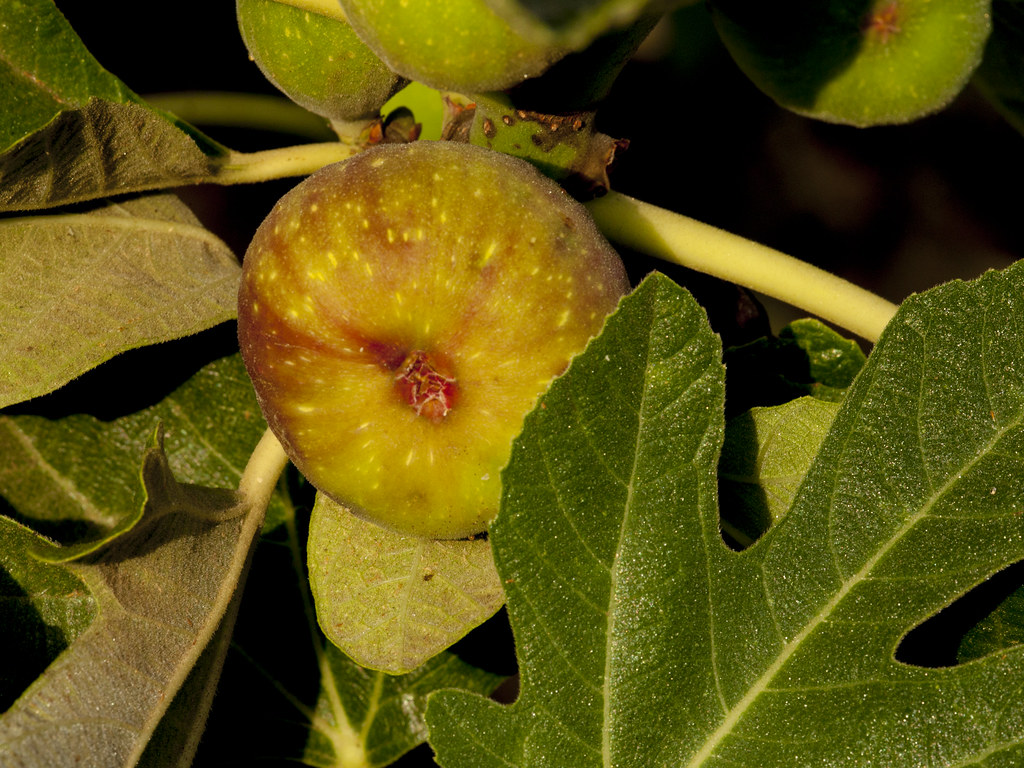
The fruit itself suggests the female form —
Dripping with honey
The little hole breaks open, pink and warm…
The Bible’s funny.

First published in The Asses of Parnassus, this poem was republished in Better Than Starbucks, which earned a “Kudos on your brilliant ‘The Fig Tree'” from Melissa Balmain, editor of Light. And it has now been added by Michael R. Burch to my page in The HyperTexts. That’s a wonderful set of editorial acceptances – it makes me proud, and I have to erase my lingering suspicion that the poem would be thought too rude for publication. Now I rate the poem more highly, as being not just a personal favourite but also acceptable to a wider audience.

It sometimes feels that all I write is iambic pentameter. It is always reassuring when a poem presents itself with half the lines being something else, and the result is a lighter, less sonorous verse. The rhymes are good; the poem’s succinct and easy to memorise. I’m happy with it.

Photo: “Ripe Fig at Dawn” by zeevveez is licensed under CC BY 2.0.

Joe Biden’s favourite poem: Seamus Heaney, ‘The Cure of Troy’

Human beings suffer
They torture one another,
They get hurt and get hard.
No poem or play or song
Can fully right a wrong
Inflicted and endured.

The innocent in gaols
Beat on their bars together.
A hunger-striker’s father
Stands in the graveyard dumb.
The police widow in veils
Faints at the funeral home.

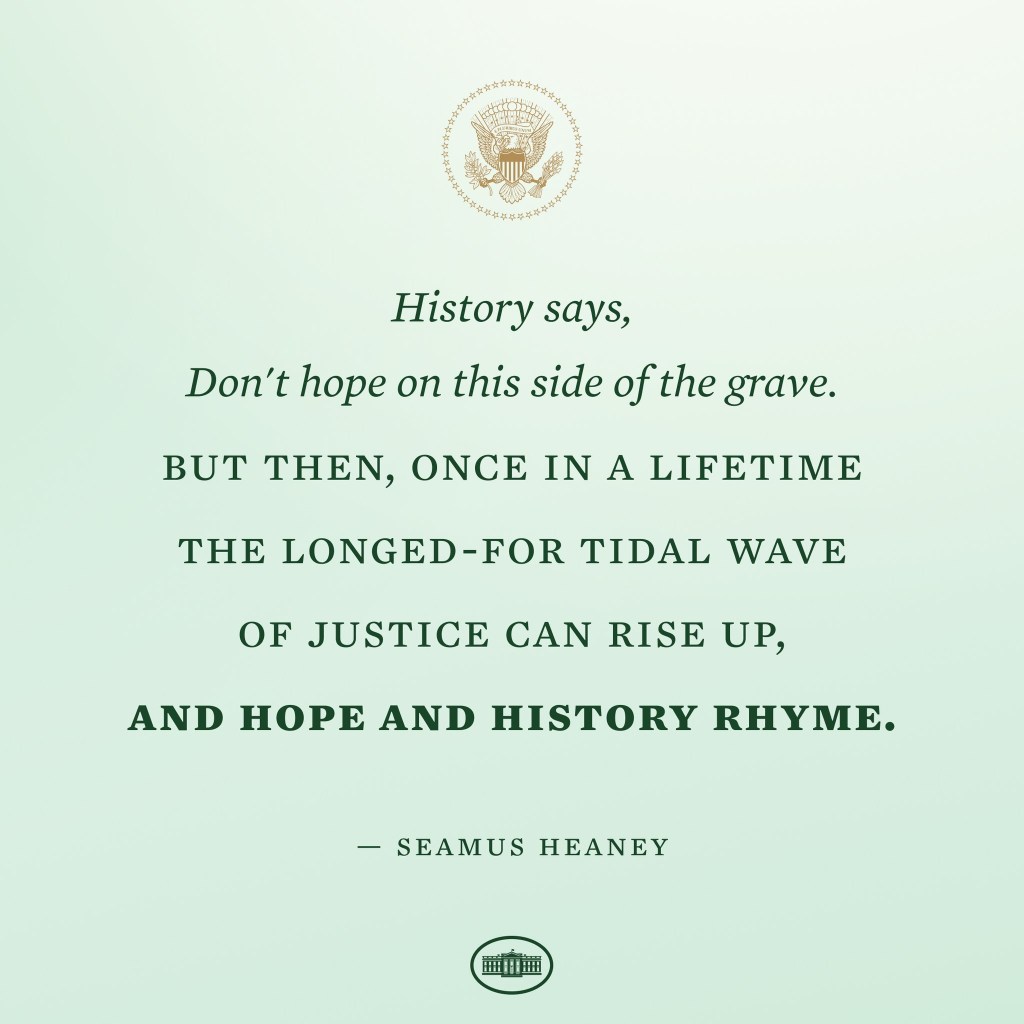
History says, Don’t hope
On this side of the grave…
But then, once in a lifetime
The longed-for tidal wave
Of justice can rise up,
And hope and history rhyme.

So hope for a great sea-change
On the far side of revenge.
Believe that a further shore
Is reachable from here.
Believe in miracles
And cures and healing wells.

Call miracle self-healing:
The utter, self-revealing
Double-take of feeling.
If there’s fire on the mountain
Or lightning and storm
And a god speaks from the sky

That means someone is hearing
The outcry and the birth-cry
Of new life at its term.
It means once in a lifetime
That justice can rise up
And hope and history rhyme.

*****

US President Joe Biden frequently quotes poets: Yeats and, especially, Heaney; often with the disclaimer that he doesn’t quote Irish poets because of his Irish heritage, but because Ireland has the best poets. And from the poem above, the verse that particularly resonates with him is:
History says, Don’t hope
On this side of the grave…
But then, once in a lifetime
The longed-for tidal wave
Of justice can rise up,
And hope and history rhyme.

Joe Biden may not be perfect, but it is reassuring to have an American President with at least some commitment to Justice… and the sensibility of reinforcing it through the memorisation of poetry.

Photo: Joe Biden’s White House Facebook post for St. Patrick’s Day 2022.

Short poem: RHL, ‘Flying to Majorca in March’

Drop me down out of the cold wet gloom
into the orange trees in bloom:
the olives, almonds, windmills, cypresses,
the black-eyed girls with wild tresses;
where once were barren hillsides, peasants, mules,
are now estates with swimming pools.

*****

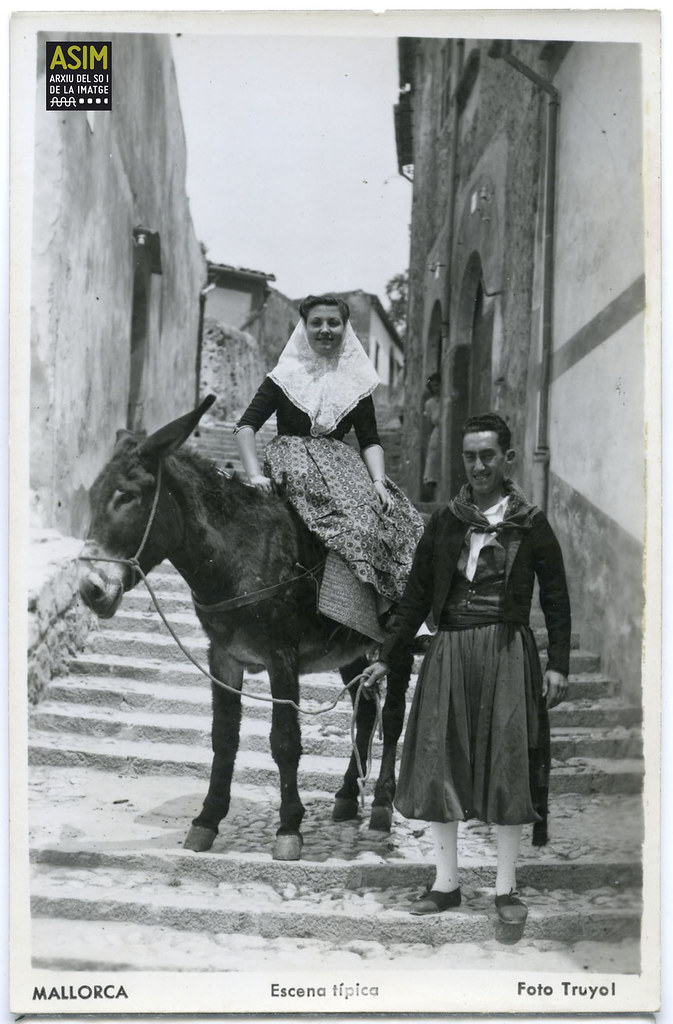
Mallorca, or Majorca to the English, has always been an attractive destination for people from further north. Frederic Chopin and George Sand moved there at the beginning of their relationship, spending three months while Chopin completed his 23 preludes in each of the major and minor keys (but the locals were suspicious of his coughing, and were antagonised by George Sand’s avoidance of church; the couple moved on). Robert Graves (whose Wikipedia entry’s Sexuality section is mind-boggling) lived for decades in the village of Deia, also associated with Anais Nin, Richard Branson, Mick Jagger, Mark Knopfler, etc. And these days Mallorca gets over 10 million tourists a year.

My short poem is inconsequential, but it has just been published in the September issue of Allegro, which is themed on ‘Flight’. It was a simple reflection on revisiting Mallorca decades after summer holidays there.

Photo: “Parella i ase” by Arxiu del So i de la Imatge de Mallorca is licensed under CC BY-NC-ND 2.0.

Using form: Villanelle with a limp: Susan McLean, ‘Instructions for Climbing and Descending’

Good foot goes to heaven; bad foot goes to hell.
When every step torments and pain is chronic,
you can’t do as you did before you fell

and sprained your ankle. As the tendons swell,
don’t make things even worse. Learn this mnemonic:
good foot goes to heaven; bad foot goes to hell.

Take one step at a time. Do not rebel
or grumble that restrictions are moronic.
You can’t do as you did. Before you fell,

you bounded up the stairs like a gazelle,
but now your gait is nearly catatonic:
good foot goes to heaven; bad foot goes to hell.

You’ve always known it doesn’t help to dwell
on loss. You should let go, but (how ironic!)
you can’t. Do as you did before you fell,

but try to play it safe while getting well.
The best advice is simple, yet Miltonic:
good foot goes to heaven; bad foot goes to hell.
You can’t do as you did before. You fell.

*****

Susan McLean writes: “I love villanelles. I like them partly because they are songlike and partly because they present interesting challenges for rhyming and for varying the repeating lines, known as repetends. I thought at first that I had set myself an impossible task with my “-onic” rhymes, but they kept surprising me and leading me in new directions. I was not planning to refer to Milton when I started, for example, but when I stumbled on “Miltonic,” it fit perfectly with the metaphors in the first line. When I started, I also didn’t realize how many ways the second repetend could be varied while still making literal sense.
“The idea behind the poem came from real-life experiences. I had sprained my right ankle once, and after I wrote this poem, I broke it twice. However, the first line, which is literally the mnemonic device offered by a physical therapist as a reminder of which foot to step on when going up or down stairs, was one I heard secondhand. My partner John was told it by his therapist when he had a painful foot. The rest of the poem is in lines with five beats (iambic pentameter), but that line has six. I decided to use it, nevertheless, because the extra beat in that repetend slows the line down, mimicking the slow gait of the person with the sprain. It also makes the line itself seem to limp.
The poem was originally published in First Things and later appeared in my second poetry book, The Whetstone Misses the Knife.”

Susan McLean has two books of poetry, The Best Disguise and The Whetstone Misses the Knife, and one book of translations of Martial, Selected Epigrams. Her poems have appeared in Light, Lighten Up Online, Measure, Able Muse, and elsewhere. She lives in Iowa City, Iowa.
https://www.pw.org/content/susan_mclean

Photo: “How Many Times Do You Have to Fall Before You End Up Walking” by Thomas Hawk is licensed under CC BY-NC 2.0.