Category Archives: political poem

Using form: Villanelle: Discoveria, ‘October 7’

Your actions have unleashed a living hell.
Each day Israelis, Palestinians die;
Netanyahu, Hamas: go fuck yourselves.

October 7: gunfire and the smell
of death in the kibbutzim testify:
your actions have unleashed a living hell.

The siege of Gaza, ground invasion, tell
the UN of the “risk of genocide”.
Netanyahu, Hamas: go fuck yourselves.

And when the hospitals are bombed as well,
and there’s no water, food, or power supply,
your actions have unleashed a living hell.

Across the world the rage and hatred swell
and everyone feels forced to pick a side.
Netanyahu, Hamas: go fuck yourselves.

This one cannot be silent, for the bells,
they toll for everybody; none shall hide.
Your actions have unleashed a living hell;
Netanyahu, Hamas: go fuck yourselves.

*****

Discoveria writes: “I wrote this piece as a response to what was, at the time, a perception that people were being demanded to pick a side in the conflict between Hamas and the Israeli government, leaving no room for legitimate criticism of both. I wanted to express my anger and frustration at the situation, in which both sides have chosen the path of death and cyclical violence. The repeated refrains in the villanelle form emphasise these emotions. The piece was written overnight and posted in the early hours of Remembrance Day, 11/11/2023, after a little doomscrolling. I cannot pretend that there is much subtlety to the poem; it is what it is.”

Discoveria publishes much of their work at AllPoetry, saying “Due to the politically sensitive topic of the poem I would prefer to be credited under my username.”

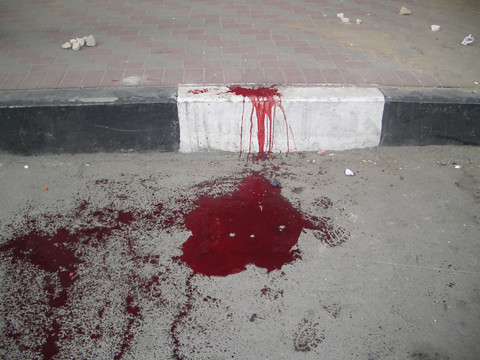
Photo: “17 year old boy killed by Israeli army during demonstration in solidarity with Gaza” by ISM Palestine is licensed under CC BY-SA 2.0.

RHL, ‘Deuteronomy 20: 16-18’

You’ve no autonomy
under Deuteronomy;
it’s your obligation
to your tribal nation
to kill all Palestinians
so you don’t sin against
God, who’s neurotic.
Yes, Yahweh’s psychotic.
No escaping his wrath,
no path but the psychopath.

*****

For Christians and Jews who state (as Jesus did) that every reported command by God in the Torah / Old Testament must be obeyed, I ask their position on Deuteronomy 20. This contains the command for the complete genocide of the non-Jews living in the land which Moses claimed had been given to the Jews by God. (Note: not expulsion or enslavement of the people living there, but the death of all of them and their animals.) The reason? So that they don’t teach evil ways to the Jews:

16 But of the cities of these people, which the Lord thy God doth give thee for an inheritance, thou shalt save alive nothing that breatheth:
17 But thou shalt utterly destroy them; namely, the Hittites, and the Amorites, the Canaanites, and the Perizzites, the Hivites, and the Jebusites; as the Lord thy God hath commanded thee:
18 That they teach you not to do after all their abominations, which they have done unto their gods; so should ye sin against the Lord your God.

To the extent that fundamentalist Jews constitute a large percentage of the Israeli population and are influential in the national government, the Palestinian situation cannot be resolved until scriptural passages like this are dragged out into the open and examined and discussed: was that passage only for then, and things are different now? Or does the command to massacre non-Jews still hold for today’s Jews in “the Holy Land”?

This poem was first published in The HyperTexts, where Michael R. Burch maintains extensive collections of poetry related to both the Holocaust and the Palestinian Catastrophe.

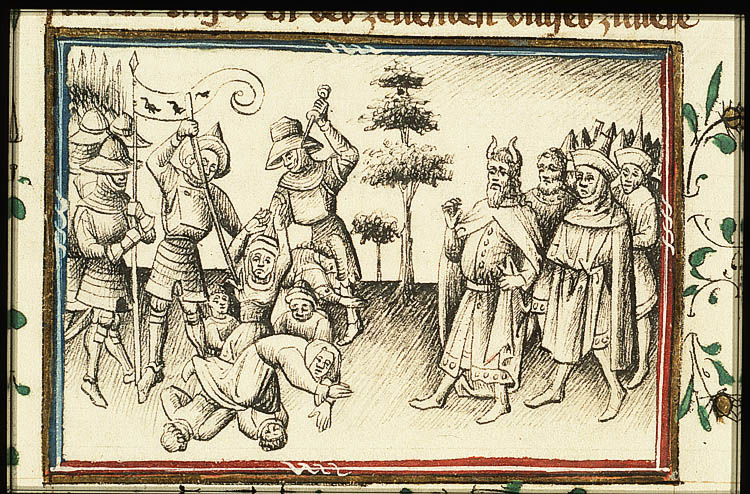
Illustration: “Moses has the mature women and the male children of the Midianites killed” is marked with Public Domain Mark 1.0.

Michael R. Burch, ‘Suffer the Little Children’

for the children of Gaza

I saw the carnage . . . saw girl’s dreaming heads
blown to red atoms, and their dreams with them . . .

saw babies liquefied in burning beds
as, horrified, I heard their murderers’ phlegm . . .

I saw my mother stitch my shroud’s black hem,
for in that moment I was once of them . . .

I saw our Father’s eyes grow hard and bleak
to see his roses severed at the stem.

How could I fail to speak?

*****

Michael R. Burch writes: “Three decades ago, I began working with Jewish Holocaust survivors and other Jewish poets to publish translations of previously unpublished poems written in Polish and Yiddish by victims of the Holocaust. Some were written by children. In some cases the poems survived but the names of the poets did not. I considered it a sacred task and believed we were saying “Never again!” to any and all Holocausts. But in my discussions with my Jewish friends, it became apparent that “Never again!” did not apply to the Palestinians. When I asked questions about Israel’s brutal abuses of Palestinians and the theft of their land – armed robbery – my Jewish friends became defensive and told me, essentially, to shut up and never question Israel. Their sudden change in attitude convinced me that something was wrong, deeply wrong. I decided to research the subject independently, invested considerable time, and came to the conclusion that the Palestinian Nakba (“Catastrophe”) is a Holocaust sans ovens, a modern Trail of Tears. And while my country, the United States, has opposed other Holocausts, it is funding this one and supplies Israel with terrible weapons that are being used to mass murder children and their mothers, fathers and families. I will continue to say “Never again!” to any and all Holocausts and invite readers to join me and do what they can to end and prevent such atrocities.”

‘Suffer the Little Children’ has been published by Art in Society (Germany), Pick Me Up Poetry, Jadaliyya (Egypt), The HyperTexts andMESPI (Middle East Studies Pedagogy Institute). According to Google the poem now appears on 462 web pages.

Michael R. Burch is an American poet who lives in Nashville, Tennessee with his wife Beth, their son Jeremy, two outrageously spoiled puppies, and a talkative parakeet. Burch’s poems, translations, essays, articles, reviews, short stories, epigrams, quotes, puns, jokes and letters have appeared in hundreds of literary journals, newspapers and magazines. He is also the founder and editor-in-chief of The HyperTexts, a former columnist for the Nashville City Paper, and, according to Google’s rankings, a relevant online publisher of poems about the Holocaust, Hiroshima, the Trail of Tears and the Palestinian Nakba. Burch’s poetry has been taught in high schools and universities, translated into 19 languages, incorporated into three plays and two operas, set to music by 31 composers, and recited or otherwise employed in more than a hundred YouTube videos. To read the best poems of Mike Burch in his own opinion, with his comments, please click here: Michael R. Burch Best Poems.   

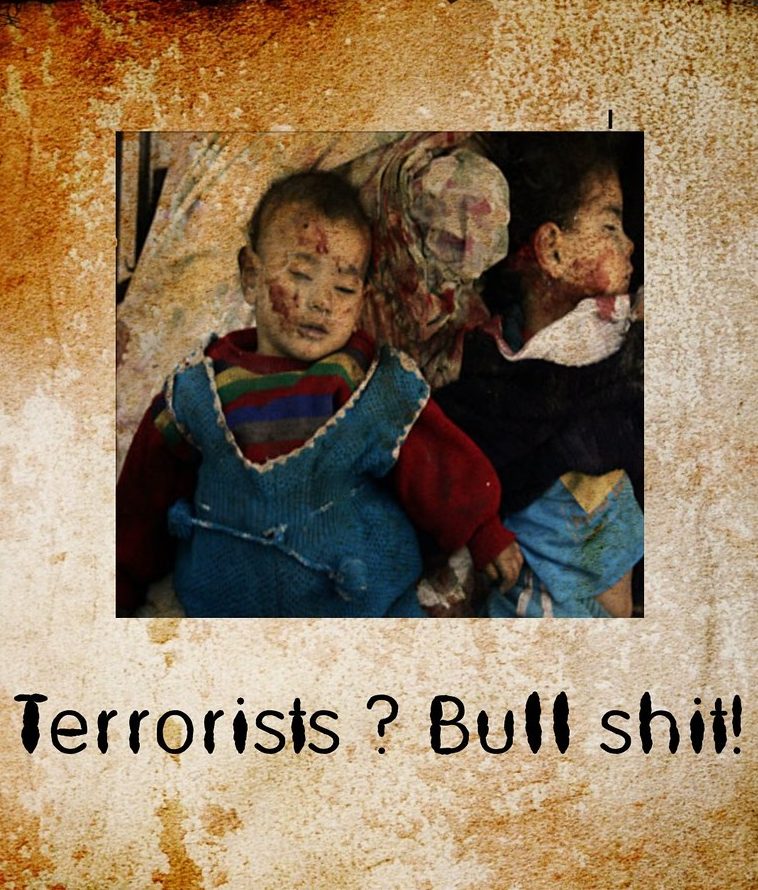
Photo: “Untermensch – Hannukah 2008 – Palestinian children killed by Israel in Gaza” by smallislander is licensed under CC BY-NC-SA 2.0.
Using form: Edmund Conti, ‘A Clutch of Clerihews’

Barack Obama
Doesn’t do drama.
The play’s not the thing
Wherein he’ll catch the conscience of Larry King.

Hillary Clinton
Likes to have a mint on
Her hotel pillow
Whether she’s in Islamabad or Amarillo.

Joe Biden
Can never decide on
Which words to use to ready us for the long haul.
So he uses them all.

Sean Hannity
Doesn’t think sanity
Should be one of the necessary talents
For reporting the news with fairness and balance.

Sarah Palin
Drives another nail in
Her chances for success
when she answers a question with anything but ‘No’ or ‘Yes’.

*****

Edmund Conti writes: “The problem with Clerihews is that when you start you can’t stop writing them. I don’t think Edmund Clerihew Bentley had any strict rules for them, except finding the fitting rhyme for the principal’s name. I was fortunate at that time to find five notable persons with easy rhymable names. Anyway, we Edmunds have to stick together.”

Edmund Conti has recent poems published in Light, Lighten-Up Online, The Lyric, The Asses of Parnassus, newversenews, Verse-Virtual and Open Arts Forum. His book of poems, Just So You Know, released by Kelsay Books
https://www.amazon.com/Just-You-Know-Edmund-Conti/dp/1947465899/
was followed by That Shakespeherian Rag, also from Kelsay
https://kelsaybooks.com/products/that-shakespeherian-rag

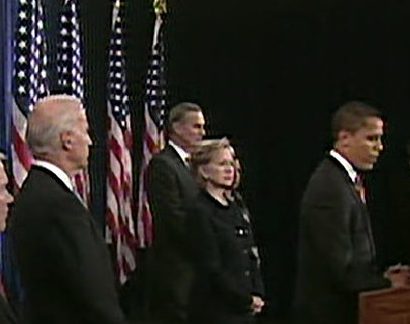
Photo detail of: “Holder, Napolitano, Baker, Biden, Obama, Clinton, Jones, Rice” by scriptingnews is licensed under CC BY-SA 2.0.

Sonnet: ‘Sad, Actually’

Unreconstructed, with unhealthy heft—
the image of uncivilised great ape—
a fraud who tries to win by lies and theft,
a man who’d propagate by power and rape,
racist extoller of his genes alone,
a would-be genocidal patriarch,
successful in some twilight Darwin zone,
uncultured as a mugger in the park…
But note, behind the thin success veneer,
the shallow love of gold and gilt and glitz,
gloating dismissals and the bloated sneer,
the self-aggrandisement that never quits:
an unloved child’s in some deep down recess,
the secret of the man’s unhappiness.

*****

I can’t help feeling sorry for people who were raised so badly that they have never learnt to find security, inner peace, personal meaning. On the other hand I can’t help rejoicing when some destructive, selfish racist is exposed as a cheat and a fraud under the control of a foreign power, and is removed from positions of authority. I think of that sympathy/schadenfreud dichotomy as a healthily balanced contradiction; but then, I’m a Libra…

This sonnet (Shakespearean, being in iambic pentameter and rhyming ABAB CDCD EFEF GG) has just been published in Shot Glass Journal, an online journal of short poetry. Most of what they publish is not formal verse, but most of mine is.

Photo: “File:Vladimir Putin and Donald Trump (2019-06-28) 06.jpg” by Presidential Press and Information Office is licensed under CC BY 4.0.

Jeff Gallagher, ‘History’

The rock and the club and the spark to make fire,
A hide and a carcass, a spear and a knife,
The sowing, the harvest, the store for the winter,
The village, the empire, the civilised life.

Philosophy, culture, the pride of the warrior,
The need for a leader to show you the light,
Indecision, suspicion, the hoarding of plenty,
And fighting for causes they told you were right.

The stake and the axe and the flaming hot poker,
Lies, superstition, false promises, famine,
Rhetoric, lost hope and man made disasters,
The killing of children, the torture of women.

Murder rebranded as collateral damage,
The constant suppression of anything odd,
Like those with a different language or culture,
And those who believed in the wrong sort of god.

Heroes defending what cowards had stolen,
Inequality hidden by national pride,
Swastikas, heraldry, crosses and eagles,
Bright flags and platitudes for those who had died.

Destroying the planet disguised as prosperity,
Dreamers and schemers ignoring the science,
Marketing rubbish as essential to living,
Envy and greed in one more grand alliance.

After desert and snowstorm and flood and pandemic,
The poor go to heaven, the rich go to Mars;
The rest live in caves, find a spark to make fire,
Start another new history, then weep at the stars.

*****

Jeff Gallagher writes: “This poem was inspired by George Santayana’s remark that ‘those who do not remember their history are condemned to repeat it’. In UK schools at least, History is now very much an optional subject, which is a tragedy in my opinion. Humanity’s continued failure to find peaceful solutions to conflict only confirms the truth of Santayana’s remark.”

Jeff Gallagher is from Sussex, UK. His poems have featured in publications such as Rialto, The High Window and The Journal. He has had numerous plays for children performed nationwide. He was the winner of the Carr Webber Prize 2021. He also appeared (briefly) in an Oscar-winning movie. He has no handles.

http://www.carrwebberprize.org/ … Scroll down to ‘Winners 2021’

Illustration: “ESCENA EN EL FIN DEL MUNDO // SCENE AT THE END OF THE WORLD (April 09 / 2007)” by Simon Wilches is licensed under CC BY-NC-ND 2.0.

Odd poem: Kwame Nkrumah, ‘Ethiopia Shall Rise’

Ethiopia, Africa’s bright gem
Set high among the verdant hills
That gave birth to the unfailing
Waters of the Nile
Ethiopia shall rise
Ethiopia, land of the wise;
Ethiopia, bold cradle of Africa’s ancient rule
And fertile school
Of our African culture;
Ethiopia, the wise
Shall rise
And remould with us the full figure
Of Africa’s hopes
And destiny.

*****

Kwame Nkrumah delivered this poem at the end of his speech on May 25, 1963, in Addis Ababa at the close of the meeting that created the Organisation of African Unity.

Born and raised in the British colony of the Gold Coast, Nkrumah had received his university education in the United States. He got both his Bachelor of Arts and Bachelor of Theology from Lincoln University, then his Masters of both Philosophy and Education from the University of Pennsylvania. Back in the Gold Coast he led non-violent resistance to British rule, was sentenced to a year in prison, but when his party did well in the colony’s first General Election he was released, and he became Prime Minister in 1952. In 1957 he helped lead the Gold Coast and British Togoland to independence as Ghana.

Initially popular because of new roads, schools and hospitals and the Africanisation of employment, his government became increasingly authoritarian, corrupt and incompetent while Nkrumah himself focused on his Pan-African vision and Third World solidarity. He was a driving force in creating the OAU in Addis Ababa in 1963. He was ousted in a military coup in 1966.

Technically there isn’t much in his OAU poem to justify the term in the sense of “verse”; there are two pairs of rhymes in the middle of the piece (rise/wise; rule/school), but none of the rhythms or structures that English-language poetry is built on. But though Nkrumah was fluent in English, his mother tongue was Fante – so for all I know, the poem above is a translation of his original thoughts… and translations are notoriously unpoetic, especially when the two languages have different poetic traditions. But equally the poem may be no more than a rhetorical flourish at the end of his OAU speech.

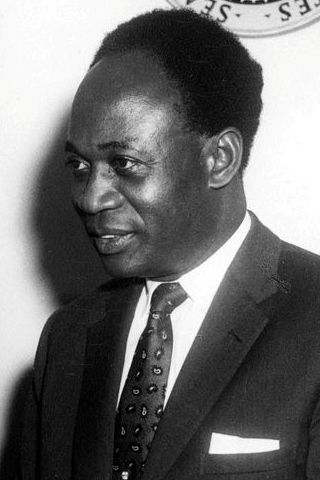
Photo: Kwame Nkrumah during a state visit to the United States, by Abbie Rowe, 8 March 1961; John F. Kennedy Presidential Library and Museum

Political poem: Nina Parmenter, ‘Led by Donkeys’

Donkey, show me your big boy teeth,
show me expensive dentistry.
Mine are NHS wonky,
but you’re a donkey.

Donkey, show me your pearly hooves,
stomp them down on my two-bit shoes.
Mine are M&S clonky,
but you’re a donkey.

Donkey, show me your government car
driving to where the dollars are.
Mine is a wee bit shonky.
You’re still a donkey.

Donkey, show me your public school,
show me your passport to ruin us all.
You think it’s your right, but you’re wrong, see,
cos you’re a donkey.

*****

Nina Parmenter writes: “As the world looks on, bewildered, the political stupidity in the UK continues to know no bounds. The title of this poem is borrowed from a group of political activists – they, in turn, borrowed it from a First World War phrase describing British soldiers as ‘Lions led by donkeys’.

Today we have different threats – hunger, a declining health service, fuel poverty – but our leading class of donkeys remain seemingly blinkered to ordinary people’s welfare. Money, after all, is their master.

All this is build up to a rather silly poem in which donkey is proudly rhymed with wonky, clonky and shonky. A quick terminology guide for non-Brits: NHS = National Health Service, M&S = Marks and Spencer (a Very Ordinary Store), and ‘public school’ in the UK means a private school – no, don’t ask, I don’t understand why either. 😉”

Nina Parmenter has no time to write poetry, but does it anyway. Her work has appeared in Lighten Up Online, Snakeskin, Light, The New Verse News, Ink, Sweat & Tears, and the Potcake Chapbook ‘Houses and Homes Forever’. Her home, work and family are in Wiltshire.
https://ninaparmenter.com/

Photo: “Charming” by Another Seb is licensed under CC BY-NC-ND 2.0.

Political poem: appallingly bad verse apparently in favour of Liz Truss

Bizzy lizzy will win by a.mile
She has got a lovely smile
Brians to match her lovely face.
She will win this pm race
Sunaks a snake
A back stabbee he is
He turned on boris
And will turn on liz
She will be a great pm
Not as good.as maggie but no one could be
Mrs thartcher mach 3
Liz will stand proud over our lands
Holdinh out her hand
If we wotk to gether we can
Get rid of the woke
And watch them. Cry into there cornflakes
As liz makes our country great.
In liz we trust god speed to our new pm

*****

In honour of Liz Truss’s trip to Balmoral Castle to be named Queen Elizabeth’s Prime Minister, I looked for poems by or about the new PM. The above is the best I could find, reposted in the Yorkshire Bylines by Jimmy Andrex under the heading Has the emergence of Liz Truss stimulated a new type of poetry?

Jimmy does a good serious job of discussing modern political poetry… sort of. But he fails to note that the quoted “poem” by “Bill Sutton” originated as a post to the Facebook group ‘Liz Truss Supporters (no trolls)‘ which is loaded with sarcastic commentary on the British Conservative Party in general and Liz Truss in particular.

So the answer to Jimmy’s question is No, of course. Scathing poetry, good or deliberately bad, has long been used as a political weapon. Bill Sutton’s post may be amusing, but is unlikely to resonate for as long as, say, Shelley’s rant the year before George III died: “An old, mad, blind, despised, and dying king, –

Good luck, Liz; hope you’ve got a thick skin.

Political poem: Bono’s St. Patrick’s Day poem on Zelenskyy

Oh, St Patrick he drove out the snakes
With his prayers but that’s not all it takes
For the snake symbolises
An evil that rises
And hides in your heart, as it breaks

And the evil has risen my friends
From the darkness that lives in some men
But in sorrow and fear
That’s when saints can appear
To drive out those old snakes once again

And they struggle for us to be free
From the psycho in this human family
Ireland’s sorrow and pain
Is now the Ukraine
And St Patrick’s name now Zelenskyy

OK, first of all I recognise that the Saint Zelenskyy artwork by Liliya Rattari is a complimentary parody of either St Michael or St George, not St Patrick – but who cares? Putin is a big enough snake to rate as a dragon, and Zelenskyy is heroic enough to be any saint you want.

U2 frontman Bono‘s three-limerick poem was sent by him to Nancy Pelosi for her to use on St Patrick’s Day this year, and she read it at the Annual Friends of Ireland Luncheon in Washington to the assembled guests including the particularly Irish Joe Biden. The poem may not be good enough to be revered eternally, but nor is that snake Putin. Hopefully St Zelenskyy will chase Putin out of the country soon, and the sorrows of Ukraine will become as distant as the sorrows of Ireland.