Category Archives: short poems

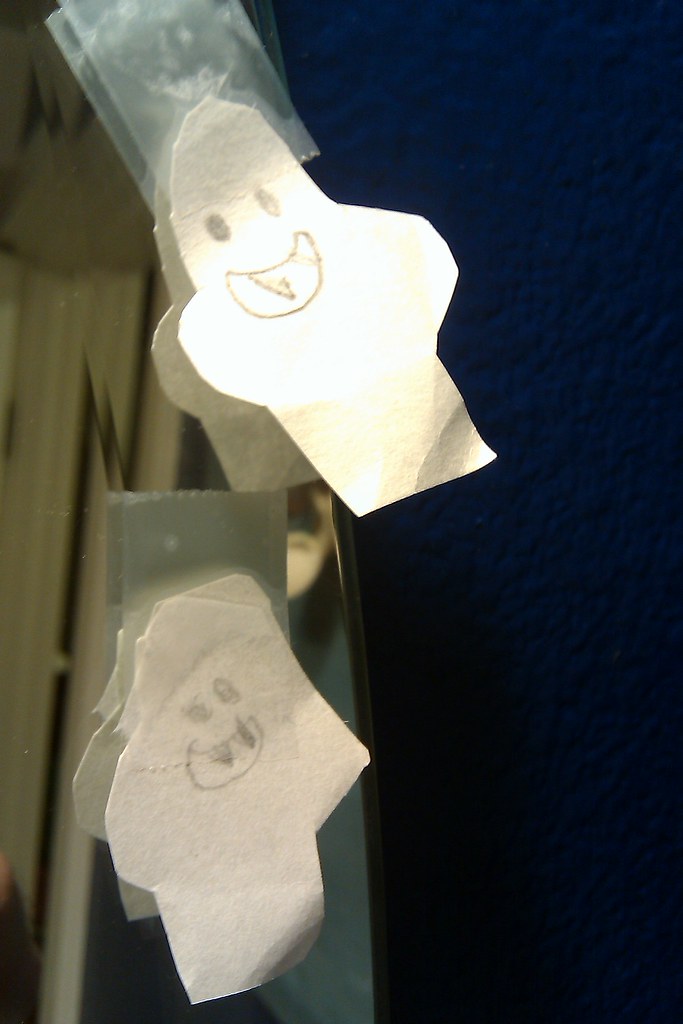
Short poem: ‘Ghost Tales’

Discounting tales of ghosts kids say appeared,
We teach them to be rational instead.

Jesus was scourged, then crucified, then speared…
You really think he came back from the dead?

*****

This poem was originally accepted for November 2016 publication in Quarterday, a Scottish quarterly that appeared in print and online for a few issues. There were some discrepancies with publication, and I never determined whether this poem made it into either format. The ambiguity is quite in keeping with all reports of ghosts, so I’m not complaining.

(But perhaps I should have blogged this at Easter.)

Photo: Ghosts by goldberg from Openverse

Short poem: ‘Loss’

Which is the worst –
Is it the loss, or memory of loss,
Or loss of memory? Who gives a toss
When the brain’s banks have burst
And all we valued yesterday
Is washed away?

*****

The above is a short poem, semi-formal (i.e. it’s in iambics, it rhymes, but it lacks formal structure) published in this month’s Snakeskin No. 298. I like semi-formal because it allows natural expression in a way that formal structure often prevents. Contrast these examples from Matthew Arnold of the formal (from The Scholar-Gipsy) and semi-formal (from A Summer Night):

Thee at the ferry Oxford riders blithe,
Returning home on summer-nights, have met
Crossing the stripling Thames at Bab-lock-hithe,
Trailing in the cool stream thy fingers wet…

The inversions of adjectives and phrases were used to fit rhyme and metre to line length. Drop the line length requirements and, even retaining the “thee”s and “thou”s, the expression is more naturally conversational:

And the rest, a few,
Escape their prison and depart
On the wide ocean of life anew.
There the freed prisoner, where’er his heart
Listeth will sail…

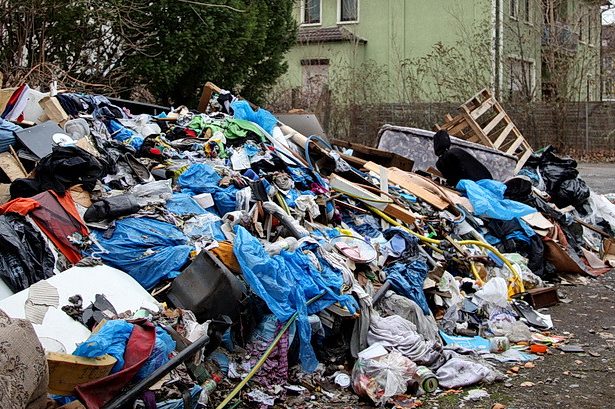
Poor Matthew Arnold! With his father a famous Headmaster and himself an Inspector of Schools, there is a sad irony in so much of his poetry being about escaping the tedium of regimented Victorian life.

Photo: “Müllhaufen Villa V R s 1000 s” by rosalux-stiftung is licensed under CC BY 2.0.

Short poem: ‘First Contact’

And when we leave this planet, even leave
corporeal necessity behind,
launch in new realms of space, new states of matter,
encapsuled and encoded, searching blind,
who will we find, as we have always found,
those others there before us, unconfined?
How will we meet them, how will we relate,
them settled formlessly, we coming late?

*****

Perhaps I owe an explanation to non-readers of science fiction. The premise of the poem is that we humans will continue to tinker with not just our bodies but our DNA, as we have always experimented with everything. We will produce ever more bizarre manifestations as posthumans, especially useful in off-planet environments (I recommend the short stories of John Varley), ultimately finding ways to exist with intelligence and control without being tied to physical bodies. (Try Vernor Vinge.) But as always, wherever and however we voyage in exploration, we will always find someone (some thing) is there before us. And then there will be all the usual situations that occur with first contact… confusion, lack of communication, miscommunication, trust and distrust, treachery, violence, accommodation, mutual benefit, all the things that social species engage in.

Appropriately this short poem was first published in Bewildering Stories (thanks, Don Webb!), an excellent weekly magazine of speculative stories both short and serialized, and speculative poetry and art. This eight-line poem is structurally pretty basic: it’s in iambic pentameter with the second, fourth and sixth lines rhyming and with a final couplet.

Jupiter – PJ16-13” by Kevin M. Gill is licensed under CC BY 2.0.

Short poem: ‘Into the Cryonics Dewar’

We had no destination ever, from birth,
save into the ultimate ocean, or ultimate fire, or ultimate earth.
Now we have not quite so ultimate ice.
For now, it will have to suffice.

The chance of reanimation from cryonic suspension may be small, but still greater than the chance of reanimation after cremation or burial in land or at sea. And I guess we now have a fifth option – ending up off-planet, adrift in space. But in effect that will be a variant on “not-quite-so-ultimate ice”. In space you’d end up near Absolute Zero, as with cryonics – but whereas with cryonics there is the miniscule hope of eventual reanimation, in space your ultimate fate would be that of all space debris: drifting for millions of years until burning up into a star or planet, or getting sucked into a black hole.

Life, death, quite fascinating. Not many options for changing the outcome, though various billionaires are throwing some of their money at the search for immortality, as people have done since at least the time of the pharaohs and early Chinese emperors. And why not? think it’s “just science fiction”? For thousands of years we used to dream we could fly to the moon, and that happened eventually…

This poem was originally published in Snakeskin #274, July 2020. Thanks, George Simmers!

Photo: cryonics.org

Short poem: ‘Remember’

Remember the whole world’s in your range,
When all your strength is gone.
If you can’t accept, then rearrange;
Can’t rearrange, move on.

I wrote this little poem when I was a very unsettled and directionless 20-year-old, and I lived by its tenets for several years, constantly changing jobs, countries and relationships. Eventually I slowed down, only changing jobs, countries and relationships once every few decades. But I still hold to the principle that you have no obligation to stay in an unsatisfactory situation, that you should actively try to identify what makes you happiest at the deepest level and then change your life in that direction. And sometimes random change is an appropriate if temporary solution.

This poem was finally published, decades later, in The Asses of Parnassus.

Photo: “File:Banksy Hitchhiker to Anywhere Archway 2005.jpg” by User:Justinc is marked with CC BY-SA 2.0.

Short poem: ‘The Inevitable Future’

Now that I’ve got Windows 10,
11 comes; and then, and then…
Next: self-driving flying cars,
Trump in jail and Musk on Mars.

Certain things appear inevitable in the businessman’s crystal ball… Well, we’ll see. This short poem was published in the ever-succinct Asses of Parnassus – thanks, Brooke Clark!

Potcake Poet’s Choice: Michael R. Burch, ‘Bible Libel’

If God
is good,
half the Bible
is libel.

Michael R. Burch writes: “This may be the first poem I wrote. I read the Bible from cover to cover at age 11, and it was a traumatic experience. But I can’t remember if I wrote the epigram then, or came up with it later. In any case, it was probably written between age 11 and 13, or thereabouts. It would be kinda cool to be remembered by a poem I wrote at such an early age. Plus, it’s short, so readers would probably finish it!

I have been using Google results to determine which of my poems are the most popular on the Internet. Some of my poems have gone viral, appearing on hundreds or thousands of web pages. That’s a lot of cutting and pasting, and I like to think people must like a poem in order to take the time to replicate it. This epigram, which I wrote around age 11 to 13, at one time returned over 405,000 results for the last two lines, and over 51,000 results for the entire poem. The last time I checked, it still returned over 292,000 results. I was especially pleased to see one of the first poems I wrote, and possibly the first, go viral. If I wrote anything earlier, I don’t remember it.

Michael R. Burch has over 6,000 publications, including poems that have gone viral. His poems have been translated into fourteen languages, incorporated into three plays and two operas, and set to music by seventeen composers. He also edits TheHyperTexts.

Photo: “Bible, Reading Glasses, Notes and Pen” by paul.orear is licensed under CC BY-SA 2.0

Short Poem: ‘Cryo Limerick’

The correct thing to do, when you’re dead,
Is have someone take care of your head;
There’s no chance of more drama
Without Futurama –
Don’t say you weren’t warned – act, instead.

Humans have tried to beat death since forever. Chinese herbs, Egyptian mummification, unlikely (but lucrative) promises of Paradise. In the present rapidly-evolving environment, transhumanism thrives on the ideas of physically and genetically modifying us for a longer life, and cryonics suggests being frozen as an “ambulance to the future” when repairs might be possible. The “head in a jar” image captures the wry appreciation that this stuff may work in the future, but won’t be of any use to us. But so what if the chance of success is a fraction of a percent? That still beats the chances of further life after cremation, or after being processed through the bodies of worms…

This limerick was originally published in ‘Transhumanity‘, edited by James Hughes. Both the magazine and the transhumanist movement have gone through changes of name and state, but the ideas are no longer as far on the fringe as they were a couple of decades ago.

“Futurama…?” by Emanuele Rosso is licensed under CC BY-NC-ND 2.0

Short Poem: ‘Days’

Where do they go, the days, twirling around?
Leaves in a dust-devil, swirled on the ground –
Water makes whirlpools just touching a drain –
Then the basin is empty. And no days remain.

September, heading towards the equinox and (in the northern hemisphere) winter. The end of the summer, back to school, back to work, loss of freedom, into the cold and the dark. Another year gone–having a September birthday doesn’t help!–the trees giving up, dry leaves falling and whirling in outside corners of asphalt and concrete… Head south, where it is still summer!

This short poem was published on a page of short pieces in the September issue of Lighten-Up Online – thanks, Jerome Betts!

“Water down the drain” by David Blackwell. is licensed under CC BY 2.0

Short poem: ‘Every Little Mammal’

Every little mammal
Likes a little cuddle.
Man or mouse or camel,
Life becomes a muddle
If there is no cuddle
For the simple mammal.

There’s nothing much to this little poem. Sometimes an awareness of a rhyme or near-rhyme sparks a thought, sometimes a random thought contains words that rhyme, or nearly… and if it’s not a large thought, it’s not a large poem. But it’s there all the same. And if you’re really lucky, you can find an appropriate illustration…

This short poem was originally published, like a hundred others of mine, in Snakeskin. Thanks for all of them, editor George Simmers!

“Illuminated Manuscript, Collection of poems (masnavi), A mouse, clutching the reins of a camel, at a stream of water, Walters Art Museum Ms. W.626, fol. 94b” by Walters Art Museum Illuminated Manuscripts is marked with CC0 1.0