Category Archives: sonnets

Tom Vaughan, ‘Swot’

It’s time to hunker down and swot
with coffee as my only friend

and each dawn closer to the end
which in the distance I can spot:

the happiness which lies ahead
when I’ll have passed with flying colours

and on a day unlike all others
will saunter through the streets instead.

I won’t be bored, I tell myself:
the world will sparkle, and the hours

will sprinkle down in golden showers.
I won’t need anything – my wealth

will be the knowledge I’ll forget
and which I haven’t learnt as yet.

*****

Tom Vaughan writes: “Swot was inspired by coming across this sonnet form in a collection of poems – This Afterlife – by AE Stallings. It was – at first – simple imitation of her layout. But then I came to like – and to feel – the tension between the couplet form and the cross-couplet rhyming, as if the poem wasn’t sure it was a sonnet. I like things which pull against one another, and most of all I like doubt.
It was subsequently heartening to learn, in June, that she had been elected as the new Oxford Professor of Poetry, given her combination of massive formal skills and deep classical culture, plus her sharp contemporary voice and relevance. So there’s still hope . . . “

Editor’s note: Some non-Brits may only connect the word “swot” with SWOT Analysis (Strengths, Weaknesses, Opportunities, Threats), but Vaughan is using it as the perjorative verb to study hard for an exam or, disapprovingly as a noun, a person who studies hard and avoids other activities. Swot was published in this month’s Snakeskin.

Tom Vaughan is not the real name of a poet whose previous publications include a novel and two poetry pamphlets (A Sampler, 2010, and Envoy, 2013, both published by HappenStance). His poems have been published in a range of poetry magazines, including several of the Potcake Chapbooks:
Careers and Other Catastrophes
Familes and Other Fiascoes
Strip Down
Houses and Homes Forever
Travels and Travails.
He currently lives in Brittany.
https://tomvaughan.website

Photo: “The Studious One” by Szoki Adams is licensed under CC BY-NC-ND 2.0.

Sonnet: ‘Parking Lot’

Although not of their class, I went to church
with Bryce and Nicky in the congregation.
In a shop’s parking lot and in the lurch
I asked Bryce for a job, loan, or donation.
Then Nicky’s car came up and Bryce got in,
the bastards swerved to hit me, ran me down;
when I got up, they ran me down again,
hit the wall with their car, left with a frown.
They don’t apologise, don’t feel the need –
“You caused it all ill-manneredly,” they say.
“Our car was damaged too.” (But did they bleed?)
I bothered them; they wanted me away.
The congregation says “Forgive, forget.”
Decades have passed. Forget? Forgive? Not yet.

*****

This Shakespearean sonnet (iambic pentameter, rhyming ABAB CDCD EFEF GG) has just been published in this month’s Snakeskin. Editor George Simmers expressed concern that it might be a true story… let me reassure everyone, I neither attend church nor get hit by cars. The poem is at most a parable, a parabolic approach to events.

Photo: from Snakeskin.

Sonnet: ‘Wanderer, or Odin/Merlin in the 21st Century’

It isn’t money, power, or (really) sex;
it’s wisdom, knowledge, understanding, truth,
the motivation from my earliest youth.
So now I watch as all our dreams turn wrecks,
as statesmen bluster, muscles bulge and flex,
economists forecast but can’t say sooth,
and life extension folks are thought uncouth–
they hoard possessions, but can’t save their necks.
I wandered, ragged, with a missing eye,
patched so none knew my implant’s extra sight,
seeking her who’d save from oblivion
the things I’ve found; for I see I must die,
and I’m now summoning the acolyte
who’ll carry knowledge on. Come, Vivien.

*****

The child wandering, the youth hitchhiking, the middle-aged tramp, the old hobo… in my view, they all have the spirit of Odin, Merlin, Hermes, Papa Legba, searching for knowledge, intermediary between the human and the divine/posthuman.

This sonnet was recently published in The Road Not Taken – a Journal of Formal Poetry. Thanks, Dr. Kathryn Jacobs!

Illustration: DALL-E

Susan McLean, ‘Dead Giveaway’

Who’ll take my dead? I’ve carried them so long
my mind is swaybacked from their aching weight.
I can’t just cast them off. It would be wrong
to leave them in some shed, like unclaimed freight.
How could I walk away as Cathy’s smile
collapsed, as Brian gently said “Take care,”
and Grammy begged “Please take me home now” while
I shut them in the dark and left them there?

I’ve jettisoned so much I took to heart—
the afterlife, belief in justice, prayer.
I’ll have to lay my dead down too, I know.
After a party, when my friends depart,
I wash up, stow away what’s left, yet they’re
still here. The dead are always last to go.

*****

Susan McLean writes: “I love the way a cliché can take on new life if the words are interpreted in a nontraditional way. The title of this poem seemed painfully poignant to me when I imagined it applying to the dead we all carry around with us. It would be nice to be able to walk away from that sadness, but of course who among us could bring ourselves to do it? Though I try to keep the voice of the poem sounding natural, I pay attention to the play of sounds in the words, as in the echoes of consonant and vowel sounds in the first two lines: “take,” “swaybacked,” “aching,” and “weight.” In the sestet of the sonnet, the imagined action of the speaker’s leaving her dead behind in the octave is reversed when she is herself left behind by her departing friends, with only her dead to keep her company.
This poem first appeared in the online journal 14 by 14, and later was published in my
second poetry book, The Whetstone Misses the Knife.”

Susan McLean has two books of poetry, The Best Disguise and The Whetstone Misses the Knife, and one book of translations of Martial, Selected Epigrams. Her poems have appeared in Light, Lighten Up Online, Measure, Able Muse, and elsewhere. She lives in Iowa City, Iowa.
https://www.pw.org/content/susan_mclean

Photo: “Ghosts of the old house” by Tree Leaf Clover is licensed under CC BY 2.0.

Gail White, ‘The Girls Who Got Ahead’

When all the bright young women studied law
and medicine, I thought a PhD
in Women and the Novel would unthaw
the frozen heart of Academe for me.
When all the bright girls married, where was I?
Still shacking up with poets that I met
in bars, convinced that genius and rye
would write us into fame and out of debt.
The bright girls made investments by the rules.
I kept on writing novels in my mind.
They sent their handsome kids to private schools
and I became the girl they left behind.
Bright girls got married and ahead and rich,
while I’m in debt again, and life’s a bitch.

*****

Gail White writes: “The Girls Who Got Ahead is a poem from the 90’s. Yes, everyone was in the professions or in graduate school but me. I was a poet and that means taking a vow of poverty. I thought I might as well make a sonnet out of it.”

Gail White is the resident poet and cat lady of Breaux Bridge, Louisiana. Her books ASPERITY STREET and CATECHISM are available on Amazon. She is a contributing editor to Light Poetry Magazine. “Tourist in India” won the Howard Nemerov Sonnet Award for 2013. Her poems have appeared in the Potcake Chapbooks ‘Tourists and Cannibals’, ‘Rogues and Roses’, ‘Families and Other Fiascoes’, ‘Strip Down’ and ‘Lost Love’. ‘Money Song’ is collected in ‘Asperity Street‘. Her new light verse chapbook, ‘Paper Cuts‘, is now available on Amazon.

Photo: “Women Entrepreneurs Blazing Trails” by World Economic Forum is licensed under CC BY-NC-SA 2.0.

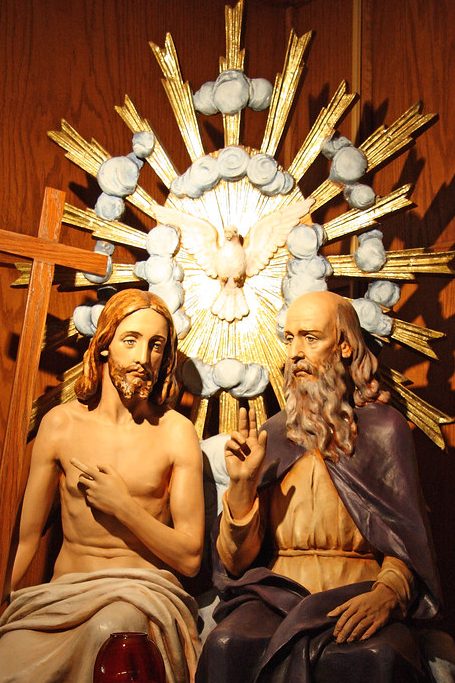
Edmund Conti, ‘Two’s Company’

Sweet are the uses of divinity
And sweeter yet in keeping us engrossed
Is the simple complex concept of the trinity
The Father, Son and Holy Ghost.

Is making sense of Them too much a bother?
Is there any way to master Three-in-One?
The son, the Holy Ghost and Father,
The Holy Ghost, the Father and the Son.

I use this ancient form, the cranky sonnet
To crank out my aberrant Dunciad
And what evolves from overthinking on it:
The Spook, the Kid and–dare I say it?–Dad.

It’s true that poems are made by fools like me
But only God can make himself a three.

*****

Edmund Conti writes: “I wasn’t going to get into any interpretations of the Trinity. Just noting that scholars writing about it don’t shed much light. So I decided to shed my own. Somewhere along the line I may have gone a little overboard. (Pray for me.) I think my cranky sonnet has its own rhyme scheme, not one from the books. Meanwhile I’ve forgotten what ”Dunciad” means except that it was a good rhyme word. Forgetting all that, I guess this whole thing was inspired by Joyce Kilmer’s memorable last line.”

Edmund Conti has recent poems published in Light, Lighten-Up Online, The Lyric, The Asses of Parnassus, newversenews, Verse-Virtual and Open Arts Forum. His book of poems, Just So You Know, released by Kelsay Books
https://www.amazon.com/Just-You-Know-Edmund-Conti/dp/1947465899/
was followed by That Shakespeherian Rag, also from Kelsay
https://kelsaybooks.com/products/that-shakespeherian-ragHis poems have appeared in several Potcake Chapbooks: Tourists and Cannibals
Rogues and Roses
Families and Other Fiascoes
Wordplayful
all available from Sampson Low Publishers

Photo: “Father, Son & Holy Ghost” by elston is licensed under CC BY-NC-ND 2.0.
John Beaton, ‘A Many-Splendoured Thing?’

Is love a beaming, eye to eye? An oath—you-only-till-I-die?
A U that comes before an I? A hullabaloo-cum-lullaby?
A flirt? A tilting of the neck? An art? A Machu Picchu trek
back in time to that valiant peck on virgin cheek, that what-the-heck?

A brace of lovebirds who embrace instead of pecking cheeks, a plaice
whose eyes achieve a state of grace—as one on one side of its face?
A willing ear we learn to ration between soliloquies? A fashion?
The winning chips we hope to cash in from laying on the wheel of passion?

A bridle? Or a bridal dress? An if-you-love-me-you’ll… duress?
A scandal in the gutter press? A touch-me-there-uh-huh caress?
A smile without the crow’s-feet creases? A summer fling that never ceases?
A joining of two jigsaw pieces? A joke? A yoke with quick-releases?

Love grins with its beret askew, climbs up the sky and paints it blue
then turns the sun to shine on you and says, “You’re puzzled? Hey, me too!”

*****

John Beaton writes: “This started with recollection of a joke by British comedian, Benny Hill: there’s quite a difference between ‘What is this thing called love?’ and ‘What is this thing called, love?’ I decided to come up with humorous answers and they started occurring to me in pairs of rhymed pairs.
I want this to be light and playful. I cobbled the answers together in octameter lines, each with two rhymed tetrameter halves, and configured the lines in three quatrains (aabb) and a rhymed couplet. The result has elements of the sonnet form—fourteen lines and a turn at the end of line twelve. I’ve also played with alliteration and internal rhyme.”

John Beaton’s metrical poetry has been widely published and has won numerous awards. He recites from memory as a spoken word performer and is author of Leaving Camustianavaig published by Word Galaxy Press, which includes this poem. (It is also in the Potcake Chapbook Rogues and Roses.) Raised in the Scottish Highlands, John lives in Qualicum Beach on Vancouver Island.
https://www.john-beaton.com/

What do you see through love?” by TW Chang is licensed under CC BY 2.0.

Susan McLean, ‘Loving Mr. Spock’

At sixteen I was hooked on Mr. Spock,
not knowing why his cool control disarmed me,
while Kirk’s grand passions seemed a laughingstock—
each week another loved and left. What charmed me
was not, I think, Spock’s coldness, but my guess
that hidden urges gnawed at his resistance,
as mine gnawed me, his stoic loneliness
a shield against the claws of loss and distance.
I now know passion only lasts on ice.
Nothing attracts like those who do not want us—
or do, but can’t be had. The paradise
we own we do not see. It cannot haunt us
like that tall figure, silent and apart,
still burning in the black hole of my heart.

*****

Susan McLean writes: “The world of the crush has laws more bizarre than any world of science fiction. The more impossible of fulfillment the crush is, the longer it lasts. If exposed to real contact, most crushes wither and are quickly forgotten, or are remembered only as some weird aberration in the past. But crushes that exist only in the mind can live on there forever. When I first wrote this poem, another poet tried to convince me that Leonard Nimoy was not very likeable in person. He didn’t understand: the crush was on Spock, not the actor who played him. And, even odder than that, the crush was on that character as filtered through my own mind at the time, part reflection, part projection. The alternating masculine and feminine rhymes that run through the first twelve lines of the poem mirror the union between the individual psyche and the animus/anima of its own creation.”

Susan McLean has two books of poetry, The Best Disguise and The Whetstone Misses the Knife, and one book of translations of Martial, Selected Epigrams. Her poems have appeared in Light, Lighten Up Online, Measure, Able Muse, and elsewhere. She lives in Iowa City, Iowa.
https://www.pw.org/content/susan_mclean

Photo: “A bicycle wheel as a musical instrument?! The future is crazy. Rock out with your Spock out.” by Walnut Studiolo is licensed under CC BY 2.0.

Marcus Bales, ‘Helpless’

Life is one long horrible disease.
As victim or as witness it’s the same:
There are no opportunities to seize,
And helplessness leaves no one left to blame.
The path ahead seems only downward, slick
As running water on a plastic slide,
And pausing seems to be a magic trick
That never works however hard you’ve tried.
Eventually of course that blame gets laid,
No matter what you want. A gap, a fault,
A wall, some outside force that can’t be stayed,
And you become at one with the gestalt.
Some love, some fear, some cry, some laugh to death.
You cannot talk to addicts. Save your breath.

*****

Marcus Bales writes: “This sonnet began as a set-up for a re-write of one of the terrible-pun-spoonerism poems from February 2023, and it sort of got away from me. It happens sometimes — you start out with one idea of what a poem is about and then the poem just won’t cooperate. At every line i was trying to tell the story of the alcoholic swami with cirrhosis who had been unfortunate enough to have married a woman who was impatient of inheriting, and who finally killed him when she weighed down upon the swami’s liver. As you can see, the poem was determined to have none of that, and went its own way, cleverly taking all the addiction and death for itself and leaving me with nothing I could use for my purposes. So to punish it I let it sit for a few months, hoping it would come to its senses and realize that the only way to see the light of day was to accept the purposes I had had in mind for it, but even there it was too smart for me, and kept quietly to itself until a day came when I hadn’t finished anything else. With a sigh and a shake of my head I posted it. So here it is.”

Not much is known about Marcus Bales except that he lives and works in Cleveland, Ohio, and that his work has not been published in Poetry or The New Yorker. However his ’51 Poems’ is available from Amazon. He has been published in several of the Potcake Chapbooks (‘Form in Formless Times’).

Helpless” by Scarlizz is licensed under CC BY-NC 2.0.

Nina Parmenter, ‘A Spell for Motherhood’

Take a mountain. Scale the pink-arsed flanks of it,
limb over limb. Find Poseidon. Extract from him a wave
and a horse’s hoof. Pluck a tree; kill the grip of it
by showing it your thoughts. Make your peace with the grave.
Eat apples, all of them. Taste in them the sin
of being a woman. Let that smack you in the gut,
you deserve it. Straddle the equator. Suck up its spin,
take it with you; feel your body snapping shut.
Learn to count each breath as an act of sedition.
Pull the lungs from a sleeping leopard. Be a speck.
Be a planet. Be a long-dead apparition.
Stuff a storm into your patch pocket, huge and wet,
but tell no one. Invent two new ways of shucking
a heart from a blown glass moon. Find a man. Fuck him.

*****

Nina Parmenter writes: “This poem (first published by Atrium Poetry) was written in an online workshop in response to the prompt “a spell”. I wanted my spell to be impossible, to reflect the ineffability of motherhood, but I also wanted to talk about how the act of giving birth puts us right on the threshold of life and death. I felt that some kind of form was right for a spell, but needed the poem to feel raw rather than singy-songy, so I chose this unmetered sonnet form.
The last line was really a happy accident; I wrote the penultimate line (which originally ended with sucking, not shucking!) and then thought, “What rhymes with sucking?… OH.”  

Nina Parmenter‘s first collection “Split, Twist Apocalypse” is published by Indigo Dreams. Her work has appeared in Snakeskin, Light, Allegro, Raceme, Honest Ulsterman, The Lyric and Potcake Chapbooks ‘Houses and Homes Forever’. Her home, work and family are in Wiltshire.
https://ninaparmenter.com/

Photo: “Magic Spell: Forward!” by RoguePriest is licensed under CC BY-NC 2.0.