Look at all the work the universe has done. It makes the most of ordinary light from new moon to full moon, from sun to setting sun.
It does the work of all the worlds rolled up into one mind-boggling miracle of space and time and light. Look at all the work the universe has done.
Will we ever know for certain how the universe was begun? Will we ever learn the reason for all this lovely light from new moon to full moon, from sun to setting sun?
Much of what we think we see, we know in fact is gone. Stars do die out long before we catch their traveling light. Look at all the work the universe has done.
Now look at all the works of man, the wealth of our creation. There are still no substitutes for heat and light… from new moon to full moon, from sun to setting sun.
I’m ready to quit my day jobs now; to leave them, one by one. All I want is to make the most of ordinary light, to look at all the work the universe has done from new moon to full moon, from sun to setting sun.
***
Peggy Landsman writes: “I had been up all one long winter night with a group of friends in Buffalo, NY, in the mid-1970s. At one point, sitting around the kitchen table, I suddenly noticed daylight coming through the window. I had a moment of epiphany and blurted out: “Look at all the work the universe has just done!” After I went home and got some sleep, I started the work of writing the poem.”
“Light Villanelle” was first published in a now defunct online journal, Bringing Sonnets Back.
Peggy Landsman is the author of the full-length poetry collection, Too Much World, Not Enough Chocolate (Nightingale & Sparrow Press, 2024), and two poetry chapbooks: Our Words, Our Worlds (Kelsay Books, 2021) and To-wit To-woo (Foothills Publishing, 2008). She lives in South Florida within a short drive of a good library and a beautiful beach. A selection of her online publications is available on her website: peggylandsman.wordpress.com
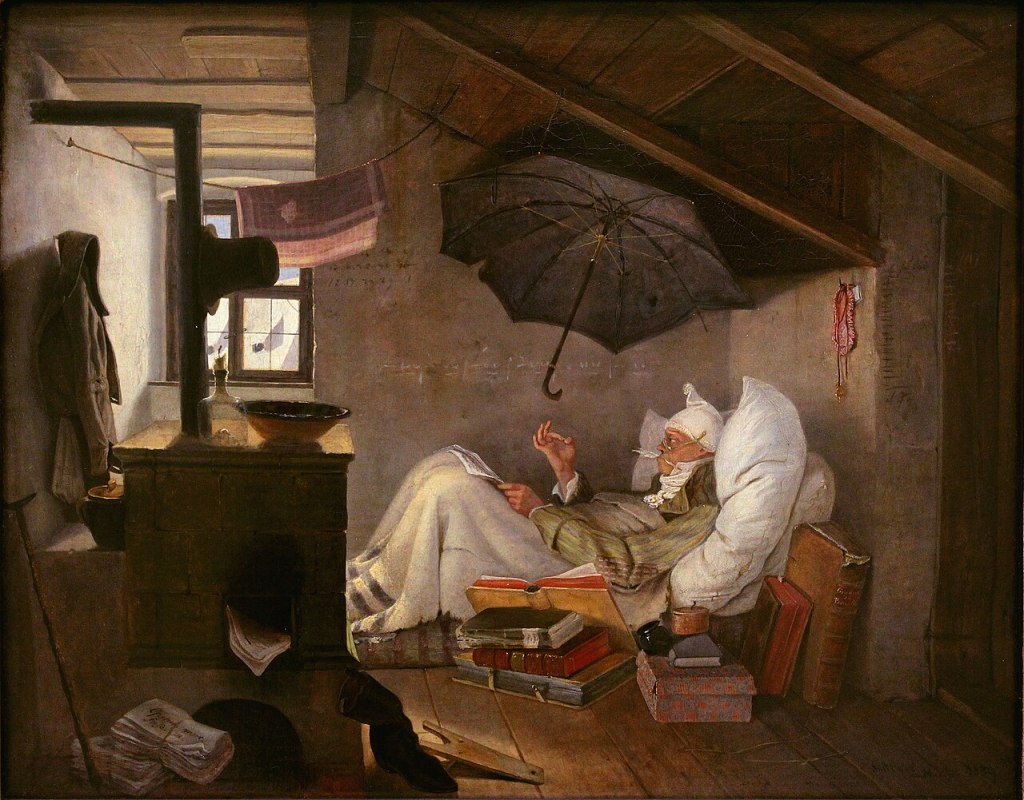
Der Arme Poet (best-known painting by Carl Spitzweg, 1839)
If only I can hatch a heartfelt rhyme, (with thought and frowns, it can’t be very hard), I’ll take my rightful place with the sublime.
O, gradus ad parnassum. One quick climb. I’ll be crème de la crème and avant-garde, if only I can hatch a heartfelt rhyme.
Top hat, cravat and walking stick meantime are ready—attributes to reap regard. I’ll take my rightful place with the sublime.
No more damp attic life; no fleas or grime. My poem will be perfection—a petard! If only I can hatch a heartfelt rhyme.
My peers will shout, “Alors, a paradigm! Such lofty wit, a wise camelopard.“ I’ll take my rightful place with the sublime.
I bite my quill: crime, slime, Mülheim, enzyme. The world will bow, salute and call me bard. If only I can hatch a heartfelt rhyme, I’ll take my rightful place with the sublime.
*****
Janice D.Soderling writes: “This poem is ekphrastic, generated from a preceding work of art. “About the mysterious motor that generates, I can say little. But no composer, artist, poet, sculptor works ex nihilo. Earliest man, woman, looked at their handprint, their footprint, and a thought rose, an urge to express what they felt – a primitive fear of death perhaps – and off they went to the caves to imprint their hand, or to carve a footprint on the rockface by the sea. A shout-out that Kilroy was here. “We hear music in the babbling brook, in the sighing wind, in the raindrop falling from leaf to leaf and plopping into the puddle below. There is poetry in the emotive sounds we make and hear: tinkling laughter, cooing seduction, growling rage, keening sorrow, barking grief. Of such, language is made; of language Shakespeare made Sonnet 73. “All art is imitation, from birdsong to a symphony orchestra, from the walking stride to the metrical verse. All art is a denial of death. Even the comic art.“
Janice D. Soderling is an American–Swedish writer who lives in a small Swedish village. Over the years, she has published hundreds of poems, flash and fiction, most recently at Mezzo Cammin, Eclectica, Lothlorien Poetry Journal and Tipton Poetry Journal. Collections issued in 2025 are The Women Come and Go, Talking (poems) and Our Lives Were Supposed to Be Different (short stories).
‘The Poor Poet’ was originally published in American Arts Quarterly, and republished in the current Well Met, where links at the bottom will take you to other poets in the issue.
Pic credit: Carl Spitzweg, The Poor Poet (via Wikipedia)
Just ask the poet, life’s a dumb thing. Button, button, eating, swilling. Life isn’t much but, still, it’s something.
Existence is a rule-of-thumb thing. Buying now with later billing. Just ask the poet, life’s a dumb thing.
To dream, to sleep, a ho-and-hum thing. Boring, boring, mulling, milling. Life isn’t much but, still, it’s something.
Mum’s the word, the word’s a mum thing. Button lips and no bean spilling. Just ask the poet, life’s a dumb thing.
Life, of course–the known-outcome thing. Death and taxes. God is willing. Life isn’t much but, still, it’s something.
Life is short, a bit-of-crumb thing. Dormouse summer, daddies grilling. Just ask the poet, life’s a dumb thing. Life isn’t much but, still, it’s something.
*****
In his 2021 collection ‘That Shakespeherian Rag‘, Ed Conti threads poetic references throughout (the title is from Eliot); ‘Button, Button’ appropriately begins with:
When one subtracts from life infancy (which is vegetation),–sleep, eating and swilling, buttoning and unbuttoning–how much remains of downright existence? – The Summer of a Dormouse, Byron’s Journals.
Much of ‘That Shakespeherian Rag’ (including Button, Button) was first published in Light. The collection is divided into 11 sections, organised from youth through adulthood to the prospect of mortality, and each prefaced with a quote from Shakespeare. The preface for the final Section reads:
Make no noise. Make no noise. Draw the curtains– – King Lear, Act II Scene 6
There is no poem after it.
The charming, delightful, witty and tolerant Edmund Conti died on November 12th, aged 96.
Everyone wants peace, but votes for hawks. A senator holds forth to an empty chamber. No one listens. Everybody talks
conspiracies and outrage. Voting blocs preserve their seamless fronts, and by November, everyone wants peace, but votes for hawks.
I shoot my mouth off, and you shoot your Glocks. Statesmen make deals they later can’t remember. No one listens. Everybody talks
in slogans sold on T-shirts. Hackers doxx judges whose moral codes are less than limber. Everyone wants peace, but votes for hawks.
Act your rage, they tell you. Ragnarok’s coming your way, to light you up like timber. No one listens. Everybody talks
as midnight’s ticking closer on the clocks. We’re parties of one, and one’s a lonely number. Everyone wants peace, but votes for hawks. No one listens. Everybody talks.
Susan McLean writes: “The original idea for the poem came when I heard about a senator addressing an empty chamber in Congress. I commented “No one listens. Everybody talks.” It occurred to me then that that would make a good repetend in a villanelle. As I worked on writing it, my feelings about other recent events influenced the direction the poem took. As I wrote in Poets Respond, “It wasn’t one story this week that inspired this poem, but a confluence of events: the proposed invasion of Gaza by Israel, the wildfires all over the U.S. and Canada, the lone shooter trying to register his outrage by killing people at the CDC, the Democrats fleeing Texas in an effort to prevent redistricting. It all felt apocalyptic and Wagnerian to me.”
Susan McLean has two books of poetry, The Best Disguise and The Whetstone Misses the Knife, and one book of translations of Martial, Selected Epigrams. Her poems have appeared in Light, Lighten Up Online, Measure, Able Muse, and elsewhere. She lives in Iowa City, Iowa. https://www.pw.org/content/susan_mclean
I thought I’d go and get my MFA since college never taught me how to write. It’s not that I had anything to say;
I needed somehow, though, to spend the day and, existentially I guess, the night as well. So I went for an MFA
in Creative Writing. I did OK, creatively. My grammar was a fright, and there was nothing that I had to say,
but you got extra points for this. The way you said squat was what mattered. Outasite, I thought, which, when I got my MFA,
I didn’t know was not a word. But stay, they’d said, you can’t create if you’re uptight. There is no wrong or right. And who’s to say
that parts of speech,or lie in lieu of lay, or topic sentences, are not a blight on Creativity? What could I say? I’d paid a lot to get my MFA.
*****
James B. Nicola writes: “Purists take note. ‘My MFA‘ is not quite a villanelle, since the repeated lines vary so much. I suppose Elizabeth Bishop started the ball rolling with ‘(Write it!)’ in the last line of her now-famous villanelle (or is it?) ‘One Art.’ Like her, I am originally from Worcester, Massachusetts; perhaps that explains our consaguinity.”
James B. Nicola’s poetry has appeared internationally in Acumen, erbacce, Cannon’s Mouth, Recusant, Snakeskin, The South,Orbis, and Poetry Wales (UK); Innisfree and Interpreter’s House (Ireland); Poetry Salzburg (Austria), mgversion2>datura (France); Gradiva (Italy); EgoPHobia (Romania); the Istanbul Review (Turkey); Sand and The Transnational (Germany), in the latter of which his work appears in German translation; Harvests of the New Millennium (India); Kathmandu Tribune (Nepal); and Samjoko (Korea). His eight full-length collections (2014-2023) include most recently Fires of Heaven: Poems of Faith and Sense,Turns & Twists, and Natural Tendencies. His nonfiction book Playing the Audience won a Choice magazine award.
However cool X may have thought he was made very little difference in the end. We are transformed as we approach the close.
Everyone is subject to these laws. Ozymandias collapsed in sand, however cool he may have thought he was.
We live in structures—marriage, job, or house— steered steadily toward an unknown land, slyly transfigured as we near the close,
additions and subtractions dealt by whose enormous unseen hand? However cool Y may have thought Z was,
her freshness faded like a poet’s rose, malady no medicine can mend disguising her before she reached the close.
Think of it as time; a veiled command; a principle: I do not give. I lend. However cool we might have thought A was, we all are changed as we approach the close.
Rachel Hadas writes: “The villanelle ‘However Cool’ was occasioned by a conversation with a friend; she and I were talking about a mutual acquaintance who was ill, and my friend uttered a perfect iambic pentameter line which became the first line of the poem, as well as, with variation, one of the repeated lines. It was fun to keep switching initials – the “however cool…” downward arc applies in different ways to so many people.
“A.E. Stallings has commented that villanelles are more fun to write than to read, and she may have a point. At this point in life, I certainly find them easier to write than sonnets. But I hope there’s a bit of rueful fun to be had in ‘However Cool’.”
Rachel Hadas’s recent books include Love and Dread, Pandemic Almanac, and Ghost Guest. Her translations include Euripides’s Iphigenia plays and a portion of Nonnus’s Tales of Dionysus. Professor Emerita at Rutgers-Newark, where she taught for many years, she now teaches at 92Y in New York City and serves as poetry editor of Classical Outlook. Her honors include a Guggenheim fellowship and an award from the American Academy-Institute of Arts and Letters.
Sandro Botticelli. (Alessandro di Mariano di Vanni Filipepi) 1444-1510.Florence. La Naissance de V?nus. Florence. Le Printemps. 1480. Florence. Mus?e des Offices.
Plants flower, swallows sing, and bunnies boff. All nature gleams with joy. But time’s a sprinter. When spring arrives, can winter be far off?
Take care. The festive glass from which you quaff– at least half empty–soon will freeze and splinter, though tulips bloom, swifts fly, and bunnies boff.
I glance away, then clear my throat and cough to see you celebrating spring, that minter of tender babes whose end is not far off.
You’ll soon require that heavy coat you doff, eyes glinting so. Each year I see that glint err as pansies flare, doves coo, and bunnies boff.
A peak makes more acute the coming trough. Life’s script is not by Disney; it’s by Pinter: one knows a heavy pause is not far off.
This bitter wisdom’s scorned, but, though you scoff, each spring remains a harbinger of winter. The primrose shines, wrens chirp, and bunnies boff, all certain signs that winter’s not far off.
*****
Max Gutmann writes: “In this one, I tried to balance newness and repetition, like spring.”
‘Spring Villanelle’ was originally published in Light.
Max Gutmann has contributed to New Statesman, Able Muse, Cricket, and other publications. His plays have appeared throughout the U.S. (see maxgutmann.com). His book There Was a Young Girl from Verona sold several copies.
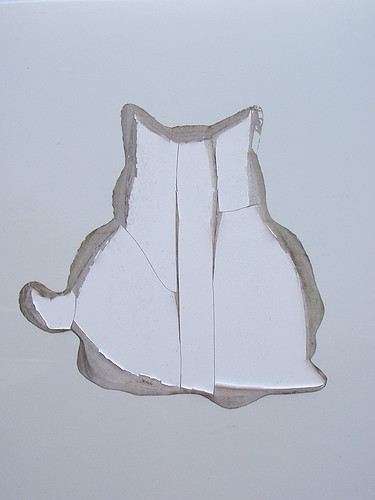
Darcy the diabetic cat has died His fans were told by email recently, A life remembered with no little pride.
The Fiat-driver now feels mortified To think because he simply failed to see Darcy, the diabetic cat has died.
Was this the fatal ninth and last he’d tried? Whichever, it will surely prove to be A life remembered with no little pride.
His poor squashed frame has been discreetly fried With all involved expressing sympathy; Darcy the diabetic cat has died.
The people in his road could not abide The flattening of such fine felinity, A life remembered with no little pride.
So, some of them sent cards, and others cried And stuck a sign upon his favourite tree: Darcy the diabetic cat has died, A life remembered with no little pride.
*****
Jerome Betts writes: “It’s always interesting when a line you read sparks off a quite unexpected result. In this case the line was in a friend’s email from Cambridge which mentioned in passing, as an item of local news, that Jasper the diabetic cat has died. Further details followed about one of those neighbourhood favourites known to many more people than its owners. Eventually, with Darcy substituted for Jasper (partly to secure a run of Ds and partly as I was at odds with a garden-molester of that name at the time) a villanelle took shape which was published inSnakeskinand subsequently in the anthology Love Affairs At The Villa Nelle (Kelsay Books, 2018) edited by Marilyn L. Taylor and James P. Roberts.”
Jerome Betts lives in Devon, England, where he edits the quarterly Lighten Up Online. Pushcart-nominated twice, his verse has appeared in a wide variety of UK publications and in anthologies such as Love Affairs At The Villa Nelle, Limerick Nation, The Potcake Chapbooks 1, 2 and 12, and Beth Houston’s three Extreme collections. British, European, and North American web venues include Amsterdam Quarterly, Better Than Starbucks, Light, The Asses of Parnassus, The Hypertexts, The New Verse News, and Snakeskin.
I Because I do not do the limerick line Because I do not do Because I do not do the limerick Desiring this man’s schtick or that man’s joke I will stick to knocking out free verse (If here and there a rhyme so much the worse) In mournful moans Presented ragged-right upon the page.
II There once was a Lady with three White leopards, a juniper tree, And a bag full of bones That sang their sad moans Of what they had once hoped to be.
III At every turning of the turning stair, Your breathing hard, your eyesight edged with dark, You see the face of hope and of despair.
You breathe the vapor of the fetid air And toil as if some atmospheric shark At every turning of the turning stair
Was hunting through the gathering darkness there, While back and forth across the narrative arc You see the face of hope and of despair.
At every turning there’s a window where You contemplate a drop that’s still more stark At every turning of the turning stair.
Instead you circle upward as you swear Like you are looking for a place to park. You see the face of hope and of despair.
You can’t endure the future’s dismal dare Nor drag yourself to put out your own spark At every turning of the turning stair.
You’re learning how to care and not to care And whether you will make or be a mark. You see the face of hope and of despair At every turning of the turning stair.
IV Higgledy piggledy Here we are all of us Trudging along where some Billions have trod
Smelling the flowers and Trusting religionists’ Tergiversational Rodomontade.
V If the word that is lost isn’t lost, And the word that is spent isn’t spent Then silence is actually speaking, And meaning is something unmeant.
If the meaning is what is unheard And the word is the thing that’s unspoken Then how do you hear if a word Has a meaning that hasn’t been broken.
If the unspoken word must be still And the unheard is what it’s about To have heard the unhearable meaning The inside has got to be out.
If the unheard were out of this world And the light shone in darkness were dark Then the unlit unheard would be meaning If the snuffer provided the spark.
If the yadda can yadda its yadda And the pocus was what hocus took Then gobble must surely be gobble Though dee separates it from gook.
VI Awake! Your hope to turn or not to turn Is wasting time – but go ahead and yearn To see the light or hear the word to know A heaven human beings can’t discern.
There’s nothing there for such as you and me; We make our meaning up from what we see And hear and touch and taste and smell and think — But all there is is fragments and debris.
The steps are just the steps, the stairs the stairs, The rest is merely human hopes and prayers That do no more than hopes and prayers can do, And nothing’s chasing you except your heirs.
No unmoved mover writes upon some slate That mortals may abate or not abate; No hope and no despairing of that hope Reveals what nothing states, or doesn’t state.
Whatever happens happens because of us We get a muss when we don’t make a fuss Demanding right from wrong not mere convenience: We’re all complicit underneath this bus.
Awake! Don’t hope to turn or not to turn, Don’t pray that this is none of your concern. Awake! What will it take for you to learn That if it all burns down you, too, will burn?
*****
Marcus Bales has produced this wonderful set of parodies of the long T.S. Eliot poem ‘Ash Wednesday‘, beginning with a piece in the poem’s style for Part I, Because I do not hope to turn again Because I do not hope Because I do not hope to turn Desiring this man’s gift and that man’s scope
but then moving into a limerick for Part II’s Lady, three white leopards sat under a juniper-tree
and a 22-line villanelle for Part III’s At the first turning of the second stair
and a double dactyl for Part IV’s Who walked between the violet and the violet
and quatrains for Part V’s If the lost word is lost, if the spent word is spent If the unheard, unspoken Word is unspoken, unheard;
and finally rubaiyat with a strong flavour of FitzGerald’s Omar Khayyam for Part VI’s Although I do not hope to turn again Although I do not hope Although I do not hope to turn
‘Ash Wednesday‘ has proved one of Eliot’s best-known and most quoted poems, with its signature mixture of Christian mysticism, personal emotion, loose form and scattered rhyme, rich imagery and memorable wordplay. Bales’ ‘Slash Wednesday‘ is an appropriate tour de force of a back-handed homage, mocking Eliot’s ragged rambling with a sampling of forms that could have been used (inappropriately) instead.
Not much is known about Marcus Bales except that he lives and works in Cleveland, Ohio, and that his work has not been published in Poetry or The New Yorker. However his ’51 Poems’ is available from Amazon. He has been published in several of the Potcake Chapbooks (‘form in formless times’).
This is being posted a couple of days late for Ash Wednesday, but as it’s for the already late T.S. Eliot that shouldn’t matter too much…
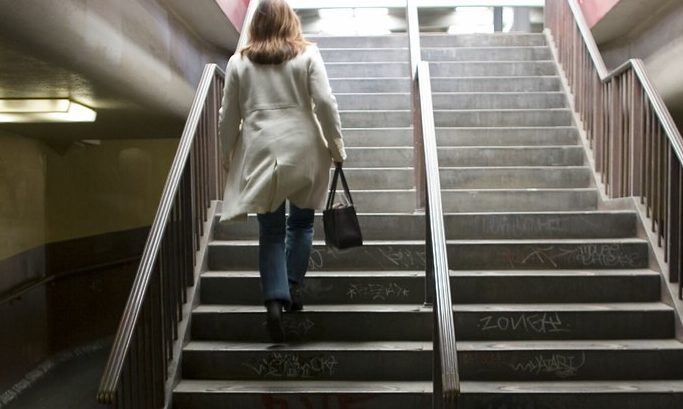
Good foot goes to heaven; bad foot goes to hell. When every step torments and pain is chronic, you can’t do as you did before you fell
and sprained your ankle. As the tendons swell, don’t make things even worse. Learn this mnemonic: good foot goes to heaven; bad foot goes to hell.
Take one step at a time. Do not rebel or grumble that restrictions are moronic. You can’t do as you did. Before you fell,
you bounded up the stairs like a gazelle, but now your gait is nearly catatonic: good foot goes to heaven; bad foot goes to hell.
You’ve always known it doesn’t help to dwell on loss. You should let go, but (how ironic!) you can’t. Do as you did before you fell,
but try to play it safe while getting well. The best advice is simple, yet Miltonic: good foot goes to heaven; bad foot goes to hell. You can’t do as you did before. You fell.
*****
Susan McLean writes: “I love villanelles. I like them partly because they are songlike and partly because they present interesting challenges for rhyming and for varying the repeating lines, known as repetends. I thought at first that I had set myself an impossible task with my “-onic” rhymes, but they kept surprising me and leading me in new directions. I was not planning to refer to Milton when I started, for example, but when I stumbled on “Miltonic,” it fit perfectly with the metaphors in the first line. When I started, I also didn’t realize how many ways the second repetend could be varied while still making literal sense. “The idea behind the poem came from real-life experiences. I had sprained my right ankle once, and after I wrote this poem, I broke it twice. However, the first line, which is literally the mnemonic device offered by a physical therapist as a reminder of which foot to step on when going up or down stairs, was one I heard secondhand. My partner John was told it by his therapist when he had a painful foot. The rest of the poem is in lines with five beats (iambic pentameter), but that line has six. I decided to use it, nevertheless, because the extra beat in that repetend slows the line down, mimicking the slow gait of the person with the sprain. It also makes the line itself seem to limp. The poem was originally published in First Things and later appeared in my second poetry book, The Whetstone Misses the Knife.”
Susan McLean has two books of poetry, The Best Disguise and The Whetstone Misses the Knife, and one book of translations of Martial, Selected Epigrams. Her poems have appeared in Light, Lighten Up Online, Measure, Able Muse, and elsewhere. She lives in Iowa City, Iowa. https://www.pw.org/content/susan_mclean




 Form in Formless Times