Category Archives: Poetry

Using form: Odd Sonnet: Brian Bilston, ‘Neither Rhyme Nor Reason’

To make poems rhyme can sometimes be tough
as words can seem to be from the same bough,
yet each line’s ending sounds different, though,
best covered up with a hiccough or cough.

Was this upsetting to Byron or Yeats?
Dickinson, Wordsworth, Larkin or Keats?
Did they see these words as auditory threats?
Could they write their lines without caveats?

What does it matter when all’s said and done
if you read this as scone when I meant scone?
It’s hardly a crime. There’s no need to atone:
language is a bowl of thick minestrone.

So mumble these endings into your beard –
this poem should be seen, rather than heard.

*****

Brian Bilston is a poet who knows it. He writes about the human condition, relationships, and buses. Agent: Jane Finigan (email: info@lutyensrubinstein.co.uk)

Photo: Brian Bilston, Facebook

Amit Majmudar, ‘Poem that Almost Rhymed’

Sometimes I visit bodies where I almost roamed
and the curves are made of clouds I almost dreamed,

a consummation missed by just a touch,
an air-to-air refueling broken off,

the hose retracted and the thirst abandoned
as both planes bank in opposite directions.

I hold my almosts in a contact list
of hands I never held, and never lost,

my store of acorns, little lids on ache,
my unmates boarding, one by one, an ark

that sails them, as it must, away from this life,
where I have these three kids, this house, and this wife,

although it could have been somebody else,
a past I passed on quickening my pulse.

When I pull my present closer by the waist,
almost wears the skin of never was.

*****

Amit Majmudar writes: “Poem That Almost Rhymed operates by slant rhymes, mimicking phonetically the speaker’s romantic near-matches that ended up being near-misses. “Close but no cigar,” as the saying goes: the  speaker reflects on friends who almost made love using words that almost chime in melodiously coupling couplets. Incomplete. The sexual imagery is clear but hopefully sophisticated enough not to seem vulgar–particularly the coitus interruptus implicit in the image of mid-air refueling. The last slant rhyme “waist” almost consummates with “was”–two more letters, and the rhyme would fulfil itself as “waste,” the word that epitomizes the underlying regret of the speaker, who acknowledges his happiness but knows, too, that his happiness could have taken another form, perhaps (sigh) one that would have been an ever-so-slightly better match….”

Amit Majmudar is a poet, novelist, essayist, and translator. He works as a diagnostic nuclear radiologist in Westerville, Ohio, where he lives with his wife and three children. Recent books include Twin A: A Memoir (Slant Books, 2023), The Great Game: Essays on Poetics (Acre Books, 2024), and the hybrid work Three Metamorphoses (Orison Books, 2025). “Poem That Almost Rhymed” was first published in Bad Lilies. Majmudar’s next collection, Things My Grandmother Said, is scheduled for early 2026. 
More information at www.amitmajmudar.com

Missed Connection [day 111 of 366]” by Wondermonkey2k is licensed under CC BY-NC-ND 2.0.

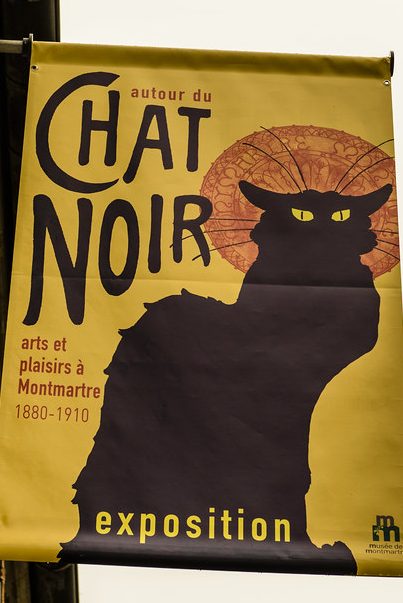
Weekend read: Daniel Galef, ‘Auriol to a Patron at Le Chat Noir’

For it was Auriol who concocted the Chat Noir-Guide toward the end of the nineteenth century. The Guide provides, for every objet d’art and knick-knack purportedly on display in the bar, fantastical tales of provenance.
From Cabaret to Concert Hall, Steven Moore Whiting


Come in, come in! Here, have a glass of beer—
The best in Paris! Whence derives such praise?
The Comte du Saint-Clement, when he drinks here,
And several other lumières Françaises
All say so. (Rimbaud swore “the best in France!”)
Perhaps you have been eyeing some of our
Objets and esoterica? Perchance
You’d like to hear their provenance? Le Soir
Has called the Chat’s decor the greatest work
Of art collection since the Louvre. These darts
Were thrown by Pippi Pavlo of Le Cirque.
This mirror-frame once held a Queen of Hearts
Played by the Duke of Sandwich in the game
At which he famously invented soup.
That specimen was lost before it came
To us—pinched by a croupier with the croup.
The mirror, too, is memorable—this crack
Imparted by a blow from cannon fire.
The cannoneer collapsed. Upon his back
They found the selfsame mark. Since then, each buyer
Has met a grisly fate—until bought by
A suicidal poet named Pierre.
It didn’t work. He gave it to Le Chat
In payment for a shot. We hung it there.
The timepiece on the mantle was a gift
From Pope Immaculate to me. Of course,
At that time, I had left the church. A rift
Arose when I ordained a bishop’s horse.
Ignore the wireless just beside—the news
Is so depressing, no? So . . . uninspired.
The mud, the blood, the bombs, the flu, the coups,
Enough to make Scheherazade tired.
But here! This silhouette is me—back then
I had a beard. I lost it in a duel
With three mad Turkish painters in Ardennes.
The third defaulted. Still I shot. It’s cruel
To leave a loser living. I was called
“The Caesar of Sargasso”—naturally
There wasn’t a resemblance. He was bald
While, under wraps as “Cleopatra Lee”
I worked with Pasteur researching a cure
To hair loss. Though the lab sank in a storm,
I drank the last drop as I swam to shore,
And thus my coiffure’s never lost its form.
This bronze, by Claus of Innsbruck, is a hoot—
So said the critic who is sealed inside
Its twin, the Triton by the stairs. Poor brute!
He knocked for half a week before he died.
It’s best not to insult these artist types.
I have the Gift myself, but can’t unearth it.
To catch the Muse is much like hunting snipes:
They bite, and taste too gamey to be worth it.
Each crystal on that chandelier’s a shard
From Louie Something’s windows at Versailles.
They say there came a witch, old, hunched, and scarred,
One night at midnight. With her one bright eye
She sneered once through the pane, and then departed.
Within a week, the king went mad and smashed
The lot of them, while mumbling “It has started!”
It’s cursed, of course. Too pretty to be trashed.
The candles are of beeswax. And what bees!
They live like princes. Endless fields of flowers
Are tended by the gardeners at Nice
And watered by a set of special showers
Constructed for the grounds by Lord Brunel.
We light them only rarely. For a guest
Such as yourself, I’ll gladly burn one. Well,
Just half. Come back someday, we’ll burn the rest.
These coasters? Quite mundane. They’re bits of planks
I salvaged from the Hesperus. Oh yes,
I once was quite the soldier. Only blanks
I ever loaded in my gun. The rest
Must have a chance, you know. It isn’t fair
To pit them up against whom Nelson dubbed
“The finest shot in Europe.” On a dare,
I handed him my pistol once. He clubbed
Me with his wooden leg. What’s that? His arm?
Oh no, that’s merely what the papers said.
In fact, it was his leg. It does no harm
To stretch the truth a little. Nelson plead
For them (the press) to print it right, but they
Insisted that an arm read better. He,
Of course, cried “What a silly thing to say!
An arm can’t read! Perhaps an eye?” You see,
They listened—Nelson loved Le Chat. You’ll find,
If you direct attention here, I’ll show
You where he signed the bar. Just why he signed
As “Ferdinando Smitty,” I don’t know.
That stool you’re sitting on I carved myself
With a pocketknife from one great slab of teak
When, hounded through a forest by some elf
I climbed a tree and hid there for a week.
That tree was this: The chair. The table, too,
Unless that one’s the Pharaoh’s table—no,
But come along, I’ll show that one to you,
Just past these poker-playing dogs (Van Gogh).
Don’t touch, the paint is fresh! I knew the model,
Lovely gal. Alsatian, I recall.
Her only vice, a weakness for the bottle;
Poor dear! Not drink—the bottle, that was all.
Our barman is a secret Count, a bastard
Practicing the rapier to reclaim
His stolen birthright. So far, he has mastered
Fourteen styles of swordplay. Soon his name
Will grace kings’ lips. For now, he’s just our skinker.
The chambermaid, as well, has quite a story.
A moron, yes? Wrong! Why, that genius thinker
Solved the famous Kjotz Conjecture. Glory
Is nought to her. She labors for mankind,
And for her god (the Devil). The Sorbonne
Has offered her a chair. But she declined.
(They say her mother was Napoleon’s son.)
That busboy? Oh, don’t heed him. He is lame
Not from trench foot, as some (and he) insist,
But—let me see—oh, yes!—a goon whose name
Was “Olaf” chopped his toes off at the wrist,
And now he’s quite—But pray, don’t touch that curtain!
The outside light must never be allowed
To touch these treasures. They’ll tarnish, I am certain.
(Besides, those drapes were Victor Hugo’s shroud.)
Our rum’s supplied by pirates. These fine cups
Looted from the Louvre. These splendid spoons
Are those with which the Mongol chieftain sups.
The silver forks are forged from gold doubloons.
Our beer, which I can see you quite enjoy,
Is brewed by tight-lipped monks who take a vow
Never to speak a lie—I, as a boy
Was in the order. (I have left it now.)

*****

Daniel Galef writes: “A few years ago when I was learning the Gymnopedies and Gnossiennes on piano I also tried reading up on Erik Satie, whose circle was full of interesting eccentrics, especially those frequenting Rodolphe Salis’s famous fin-de-siecle cabaret in Montmartre the Chat Noir: George Auriol, Vital Hocquet, Alphonse Allais, &c. As a fiction writer, I am fascinated by lies and liars and what drives them, and was particularly taken by the fact, mentioned in passing, that Auriol had written and published a fake guidebook for the Chat Noir. I’ve since read more about Auriol, and even tracked down and read (with the help of Google Translate) a scan of the Guide itself (and highly recommend it, if it’s still to be found online), but when it was the only thing I knew about him that line alone in Whiting’s book was enough to serve as springboard for this weird, sort of Browning-y monologue poem, which is one of my favorite things I’ve ever written. The long version was written first even though it was published second; it appeared in 2022 in Bad Lilies, and later I snipped a sonnet out of it, which was published in 2020 in Light (and then in a slightly different form in my first book Imaginary Sonnets).

Daniel Galef’s poetry, half-serious and half-non-, has been published in a variety of venues themselves both serious and non-. His first book, Imaginary Sonnets, collects 70 persona poems from the point of view of various historical figures and literary characters, including Lucrezia Borgia, Christopher Smart’s cat, and a taco. “A Nightingale to a Sad Poet” first appeared in the Spring/Summer 2025 issue of Sein und Werden. Other recent writing can be found in the Indiana Review, the Best Small Fictions anthology, and Scientific American.

Photo: “Le Chat Noir” by Son of Groucho is licensed under CC BY 2.0.

Short poem: RHL, ‘Heart Attack’

Lust –
Thrust –
Bust –
Dust.

*****

One of the things that intrigues me is the way certain word endings fall into groups, evoke a common mood, sometimes seem to tell their own story. Some of these groups seem natural with overall positive “light, bright, flight, height, white” or negative “dusty, musty, fusty, gusty”; “bumble, crumble, grumble, fumble, stumble, tumble” connotations… but I acknowledge that with the first set I’m ignoring “blight, night, shite” and so on. Some seem random, especially perhaps when the different spellings suggest unrelated origins: “beauty, duty, fruity, snooty,” but still lead to a story.

Happily, I’m not alone in these idle thoughts. Melissa Balmain’s Tale of a Relationship in Four Parts comes to mind… and from Maz (Margaret Ann Griffiths) we have ‘The Drowning Gypsy’:

Flamboyant
Clairvoyant
Unbuo
o
o
o
o
y
a
n
t

Maz’s work is collected in ‘Grasshopper‘; Melissa Balmain’s poem is collected in ‘Walking in on People‘ from Able Muse Press; ‘Heart Attack’ was recently in The Asses of Parnassus.

Photo: “heart-attack” by Pixeljuice23 is licensed under CC BY-SA 2.0.

Weekend read: Stephen Edgar, ‘Murray Dreaming’

It’s not the sharks
Sliding mere inches from his upturned face
Through warps of water where the tunnel arcs
Transparent overhead,
Their lipless jaws clamped shut, extruding teeth,
Their eyes that stare at nothing, like the dead,
Staring at him; it’s not the eerie grace
Of rays he stood beneath,
Gaping at their entranced slow-motion chase

That is unending;
It’s not the ultra-auditory hum
Of ET cuttlefish superintending
The iridescent craft
Of their lit selves, as messages were sent,
Turning the sight of him they photographed
To code: it is not this that left him dumb
With schoolboy wonderment
Those hours he wandered the aquarium.

It is that room,
That room of Murray River they had walled
In glass and, deep within the shifting gloom
And subtle drifts of sky
That filtered down, it seemed, from the real day
Of trees and bird light many fathoms high,
The giant Murray cod that was installed
In stillness to delay
All that would pass. The boy stood there enthralled.

Out in the day
Again, he saw the famous streets expound
Their theories about speed, the cars obey,
Racing to catch the sun,
The loud fast-forward crowds, and thought it odd
That in the multitudes not everyone
Should understand as he did the profound
Profession of the cod,
That held time, motionless, unknown to sound.

In bed at night,
Are his eyes open or is this a dream?
The room is all dark water, ghosted light,
And midway to the ceiling
The great fish with its working fins and gills
Suspended, while before it glide the reeling
And see-through scenes of day, faintly agleam,
Until their passage stills
And merges with the deep unmoving stream.

*****

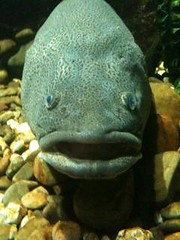
Stephen Edgar writes: “As the reader may guess, although the poem is cast in the third person, in the figure of a young boy, it describes a visit to an aquarium that I made myself, and as an adult. And on the occasion of this visit I was struck, and deeply impressed, by the single large Murray cod, seemingly floating motionless in its large room-sized tank of water, designed to mimic a section of the Murray River. Impressed in what way? Well, it is hard to say, but there seemed to be a certain mystery and power embodied in this fish, which was sealed off from me, inaccessible. The image stayed with me. However, it was only when I revisited the aquarium some years later that this original mood was reawakened and prompted me to write a poem about it. 

“The challenge was to find the right way to express it.  I didn’t want the poem to seem too portentous and self-important, so I thought that by seeing it through the eyes of a young boy I could give it a certain lightness of touch. But also the young are often considered to be more in touch with the natural world than adults, with their worldly preoccupations. In the midst of all the other superficially more attractive and appealing creatures in the aquarium, this particular boy is transfixed by this large fish. He has, I suppose you could say, a vision. What of? Well, some kind of vision of timelessness and continuity represented in nature, in comparison with which the speed and hubbub of daily life—represented by the city traffic and crowds—seem trivial and unimportant.

“In a way, the poem is already over by the end of the fourth stanza. The main point has been made. But a poem has an aesthetic shape as well as a meaning and I felt the need to round it off in some emotionally satisfying way. So I placed the boy, after the day was over and he was home again, lying in bed reliving his vision. Maybe he is dreaming; maybe he is awake and having a waking dream: either way he sees the fish in the midst of his ordinary everyday room, and overlaid on this he sees the city scenes, which are gradually absorbed by the dream river and dream fish. 

“The word “dreaming” in the poem’s title, while it can refer to this last stanza, is also meant to imply the use of the word in indigenous Australian culture, signifying a body of lore connected to a totemic animal or sacred place.

“The poem is written in a nonce stanza form of my own devising, with nine lines rhyming ABACDCBDB, in pentameter, apart from line one in dimeter, and lines four and eight in trimeter.

“The poem first appeared in Poetry (Chicago). It then appeared in The Red Sea: New and Selected Poems (Fort Worth, Baskerville Publishers, 2012), now out of print; then in my ninth book, Eldershaw; and also in The Strangest Place.”

*****

Stephen Edgar was born in 1951 in Sydney, where he grew up. From 1971 to 1974 he lived in London and travelled in Europe. On returning to Australia he moved with his then partner to Hobart, Tasmania, where he attended university, reading Classics, and later working in libraries. Although he had begun writing poetry while still at high school, it was in Hobart that he first began writing publishable poems and found his distinctive voice. He became poetry editor of Island Magazine from 1989 to 2004. He returned to Sydney in 2005. He is married to the poet Judith Beveridge.

He has published thirteen full collections: Queuing for the Mudd Club (1985), Ancient Music (1988), Corrupted Treasures (1995), Where the Trees Were (1999), Lost in the Foreground(2003), Other Summers (2006), History of the Day (2006), The Red Sea: New and Selected Poems (2012), Eldershaw (2013), Exhibits of the Sun (2014), Transparencies (2017), The Strangest Place: New and Selected Poems (2020) and Ghosts of Paradise (2023). A small chapbook, Midnight to Dawn, came out in 2025, and a new collection, Imaginary Archive,will be published in late 2025. His website is www.stephenedgar.com.au, on which publication details of his books, and where they can be purchased, are given.

He was awarded the Australian Prime Minister’s Award for Poetry in 2021 for The Strangest Place.

Photo: “Murray Cod at Melbourne Aquarium” by brittgow is licensed under CC BY-NC 2.0.

Rachel Hadas, ‘Rag Rug’

It has arrived—the long rag rug
multiply folded. On top, one alien hair.
I put my face to the folds and smell despair
palpable as salt air
in all those rooms and houses, small and smug—
enclosures I passed through on my way where?

Whoever did the weaving appears old
in my mind’s eye. I can’t make out her face,
can only conjure up the faintest trace
of an abstracted grace,
clack of the loom. Does she know they’ll be sold
these precious things, in some unheard-of place?

I perch her on a hill, precariously
beyond the reach of waves’ daily boom.
Sun blazes overhead, but her dim room
(no bigger than the loom)
is proof against the violence of the sky
From it I further spin what I once called my home:

Endless horizons fading into haze,
the mornings dawn came up so rosy clear;
snails in the garden, sheep bells everywhere,
the brightness of the air,
terraces, valleys organizing space
and time’s cessation. So this package here

I’m now unwrapping, in New York, today
(rugs like rainbows, woven with a grace
my strands of language barely can express;
dishrags of dailiness
dispersed and recombined and freshly gay)
comes to me imbued with images,

slowly and faithfully across the water,
across the world. It represents a time
I myself snipped and recombined as rhyme
as soon as I went home,
if that is where I am. These rugs recover
the sense of stepping twice into a single river.

*****

Rachel Hadas writes: “Rag Rug, written probably around 1980 or sometime in the early Eighties, describes my experience opening packages of rag rugs handwoven by a woman or women in Samos, the Greek island where I’d lived between 1971 and 1974. The rags in question were blue jeans, pajamas, tablecloths, you name it – I’d cut these into narrow strips which I sewed together and rolled into a ball, and when I had enough such balls I mailed them to my former mother-in-law in Samos; she eventually sent me the finished project, long rag rugs perhaps eighteen inches wide, colorful, washable, which eventually faded and blended as madras does. The evocative smell of the cloth; the memories of the island and my life there; the fact that poetry, like the making  of these rugs, like quilting, is a piecing together, recombining and recycling of fragments – reading the poem now brings all this back.”

Rachel Hadas’s recent books include Love and Dread, Pandemic Almanac, and Ghost Guest. Her translations include Euripides’s Iphigenia plays and a portion of Nonnus’s Tales of Dionysus. Professor Emerita at Rutgers-Newark, where she taught for many years, she now teaches at 92Y in New York City and serves as poetry editor of Classical Outlook. Her honors include a Guggenheim fellowship and an award from the American Academy-Institute of Arts and Letters.

Photo: “Colourful rag rug” by theihno is licensed under CC BY-ND 2.0.

Simon MacCulloch, ‘Mouth Harp’


The doctor raised an eyebrow. He’d pronounced the sentence (death)
And expected her to die now; yet the patient still drew breath.
The woman was a smoker, and the cancer had a hold
That was strong enough to choke her. She was ninety-three years old.
Her lungs must be a sump, awash with nicotine and tar,
And with a clogged-up pump like that she wasn’t going far.

Well, any trouble breathing? Not at all, I just can’t walk!
(I see her, thick smoke wreathing, still unpausing in her talk.)
A cough, perhaps? Not really – nothing wrong that I’m aware.
The doctor starts to feel she must be using different air.
There’s nothing more to say, his grim prognosis is complete;
The science of today must now acknowledge its defeat.

Back home, I watch my mother as she settles in her chair,
Sips coffee, lights another and inhales without a care.
I pass her the harmonica, she takes it, has a blow,
And jaunty and euphonic her recital starts to flow.
The angels have their harps but death’s a word they never knew;
Down here it’s flats and sharps and death’s a song on air turned blue.

*****

Simon MacCulloch writes: “A largely true account of the somewhat surreal day on which my uncomprehending late mother was diagnosed with terminal lung cancer. I’m still quite proud of having rhymed “harmonica” without anyone called Veronica to help out.”

‘Mouth Harp’ was originally published in The Cannon’s Mouth 92.

Simon MacCulloch lives in London and contributes poetry to a variety of print and online publications, including Reach Poetry, View from Atlantis, Pulsebeat Poetry Journal, Spectral Realms, Black Petals and others.

Photo: “Music Maker” by darkday. is licensed under CC BY 2.0.

Villanelle variation: James B. Nicola, ‘My MFA’

I thought I’d go and get my MFA
since college never taught me how to write.
It’s not that I had anything to say;
 
I needed somehow, though, to spend the day
and, existentially I guess, the night
as well. So I went for an MFA
 
in Creative Writing. I did OK,
creatively. My grammar was a fright,
and there was nothing that I had to say,
 
but you got extra points for this. The way
you said squat was what mattered. Outasite, 
I thought, which, when I got my MFA,
 
I didn’t know was not a word. But stay,
they’d said, you can’t create if you’re uptight.
There is no wrong or right. And who’s to say
 
that parts of speech, or lie in lieu of lay,
or topic sentences, are not a blight
on Creativity? What could I say?
I’d paid a lot to get my MFA.

*****

James B. Nicola writes: “Purists take note. ‘My MFA‘ is not quite a villanelle, since the repeated lines vary so much. I suppose Elizabeth Bishop started the ball rolling with ‘(Write it!)’ in the last line of her now-famous villanelle (or is it?) ‘One Art.’ Like her, I am originally from Worcester, Massachusetts; perhaps that explains our consaguinity.”

James B. Nicola’s poetry has appeared internationally in Acumen, erbacce, Cannon’s  Mouth, RecusantSnakeskinThe South, Orbis, and Poetry Wales (UK);  Innisfree and  Interpreter’s House (Ireland); Poetry Salzburg (Austria), mgversion2>datura (France);  Gradiva (Italy); EgoPHobia (Romania); the Istanbul Review (Turkey); Sand and The Transnational (Germany), in the latter of which his work appears in German translation;  Harvests of the New Millennium (India); Kathmandu Tribune (Nepal); and Samjoko (Korea). His eight full-length collections (2014-2023) include most recently Fires of Heaven: Poems of Faith and Sense, Turns & Twists, and Natural Tendencies. His nonfiction book Playing the Audience won a Choice magazine award.

‘My MFA’ was originally published in the current Lighten Up Online

Photo: “creative-writing-ideas Atlanta GA” by agilemktg1 is licensed under CC BY 2.0.

RHL, ‘On a Modern “Poem”’

The thoughts are fresh, the images are good;
the style is clean, the tone both wise and terse;
the whole thing would be memorable, it would…
if only it had been expressed in verse.

*****

I’m always embarrassed if I have an idea for a poem, and I fail to find an expression of it in rhyme as well as rhythm. That’s because, of the hundreds of poems or pieces of poems in my head, all but a tiny handful are remembered because they are expressed in verse. You can remember the gist of an idea on the strength of the idea; but if you want to remember its exact expression, word for word, it’s far easier if it’s in verse. For this purpose, blank verse is better than prose; but rhymed verse is superior.

You may have lots of partial memories of Winnie the Pooh from childhood – the Hundred Acre Wood, Eeyore’s moans and groans – but actual word-for-word memory is likely to attach to the few snippets of verse in the book, such as:
Isn’t it funny
How a bear likes honey.
Buzz! Buzz! Buzz!
I wonder why he does?

My little gripe above was originally published in Light earlier this year.

Photo: “Al declaims” by jovike is licensed under CC BY-NC 2.0.

Julia Griffin: Translation: ‘C.P. Cavafy’s Waiting For The Barbarians’

Why are we here in the agora, say?

We’ve got the Barbarians coming today.

Why are the senators resting their jaws?
Why don’t they legislate?  What about laws?

We’ve got the Barbarians coming today.
Nobody knows how it’s going to play;
If any legislate, it will be they.

Why is our Emperor out of his bed,
Sitting in state at the gate there instead,
Wearing a gorgeous great crown on his head?

We’ve got the Barbarians coming today.
They must be met in an elegant way:
Greeting their chieftain, the Emperor’s goal
Is to award him an exquisite scroll,
Giving him titles to make his eyes roll.

Why do our consuls and praetors appear
Dressed to the nines in their purplest gear?
Why are there amethysts all up their arms,
Emeralds everywhere, greener than palms?
What are those fabulous sceptres they hold,
Fancily fashioned in silver and gold?

We’ve got the Barbarians coming today.
This sort of thing’s their idea of cachet.

Why are our orators keeping us waiting,
Not, as per usual, loudly orating?

We’ve got the Barbarians coming today.
Oratory bores them.  They like a display.

Why does it suddenly seem such a mess?
Why the confusion, the seriousness?
Why is there emptiness now in the square?
Why the pervasively secretive air?

Not one of them came, and the day is now done.
People are saying the war has been won;
Hence there are no more Barbarians.  None.

No more Barbarians – what shall we do?
I’ve not come up with an answer yet.  
                                                         You?

*****

Julia Griffin writes: “I’ve always loved Cavafy’s ‘Waiting for the Barbarians’ and had the thought that it would go well into rhyme.  This somehow necessitated changing the ending a little…” Her translation appears in the current Lighten Up Online.

See also the Wikipedia article, https://en.wikipedia.org/wiki/Waiting_for_the_Barbarians_(poem)

Julia Griffin lives in south-east Georgia/ south-east England. She has published in Light, LUPO, Mezzo Cammin, and some other places, though Poetry and The New Yorker indicate that they would rather publish Marcus Bales than her. Much more of her poetry can be found through this link in Light.

Photo: “Barbarian looking but a real cool dude (8197985443)” by Frank Kovalchek from Anchorage, Alaska, USA is licensed under CC BY 2.0.