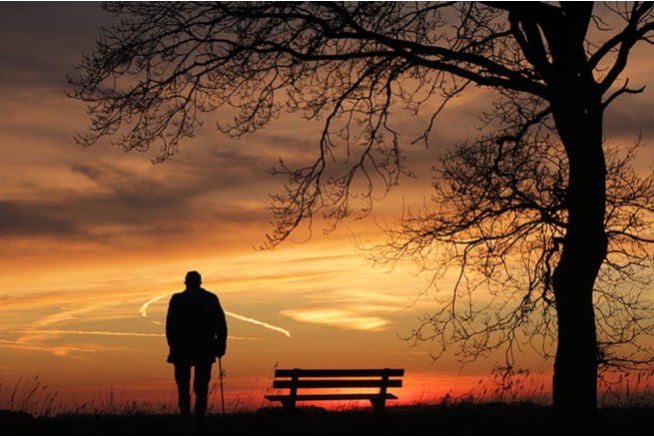
At sunset he ascends the crooked hill to ruminate on times past and to weep for friends long dead and lost friends living still. Each time he climbs this hill it grows more steep.
A day’s end is somehow akin to death as time bleeds out and cannot be revived. He stands on the hill’s summit, out of breath and wonders how on earth he has contrived
to be the last survivor of his peers, avoided heart attack or foul disease. The red sky is a bonfire of his years. Pure luck, the answer whispers in the breeze.
*****
Richard Fleming is an Irish-born poet (and humorist) currently living in Guernsey, a small island midway between Britain and France. His work has appeared in various magazines, most recently Snakeskin, Bewildering Stories, Lighten Up Online, the Taj Mahal Review and the Potcake Chapbook ‘Lost Love’, and has been broadcast on BBC radio. He has performed at several literary festivals and his latest collection of verse, Stone Witness, features the titular poem commissioned by the BBC for National Poetry Day. He writes in various genres and can be found at www.redhandwriter.blogspot.com or Facebook https://www.facebook.com/richard.fleming.92102564/
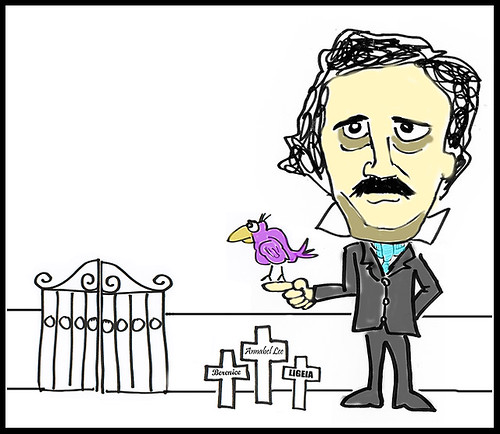
Late at night, I saw a glowing, as if realms beyond our knowing kindly solace were bestowing. Could this phantom be my wife?
But the gleam, as I drew nearer, taking form and growing clearer, was my visage in the mirror, and the figure held a knife.
“Fool,” said I, “your idle dreaming on some insubstantial seeming is some demon’s way of scheming to mislead your soul to hell.
“Melancholy, doom-and-glooming, pining, horror, guilt, exhuming, Nevermore and Ulalume-ing – write your angst out: that could sell.”
*****
Susan McLean writes: “This poem was inspired by a 2019 competition at The Spectator to write a poem in the style of a famous author and to have its title be an anagram of the poet’s name. I was a big fan of the poetry and short stories of Edgar Allan Poe when I was a teen, so I investigated words that I could draw from his name that would have strong associations with his work. Poe married his thirteen-year-old cousin, Virginia Clemm, who died of tuberculosis eleven years later. Many of his poems and stories concern mourning for the death of a beautiful woman, including his most famous poem, “The Raven.” This poem borrows the trochaic meter and some elements of the rhyme scheme of that poem. It also alludes to a number of Poe’s favorite themes, and echoes some of his lines. It was not among the winners at The Spectator, but I later reworked it, and it recently appeared in Lighten Up Online.”
Susan McLean has two books of poetry, The Best Disguise and The Whetstone Misses the Knife, and one book of translations of Martial, Selected Epigrams. Her poems have appeared in Light, Lighten Up Online, Measure, Able Muse, and elsewhere. She lives in Iowa City, Iowa. https://www.pw.org/content/susan_mclean
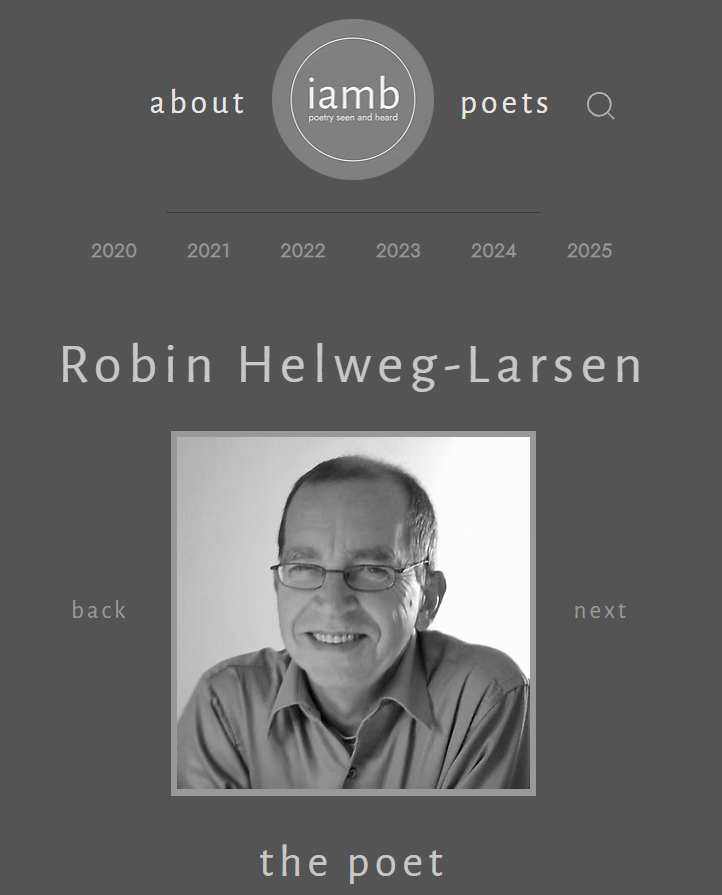
“iamb – poetry seen and heard” is the creation of Mark Antony Owen, showcasing poets with their readings of three of their poems. Begun in 2021, Mark describes his project as “part library of poets, part quarterly journal, iamb is where established and emerging talents are showcased side by side. Not just their words, but their readings of them. Expect new poems, every three months, free to your device of choice.”
Accompanied by an out-of-date photograph, three of my poems are available here. They are not among my most recent work, but they are favourites and I chose them for their very different moods, themes, and forms: ‘Camelot at Dusk’, ‘Old Sailors’, and ‘This Ape I Am’. And their use of form sets them apart from all the other poems in this 21st ‘wave’ of iamb. I can’t decide if I am stuck in the past, or write in the style of the only verse that has a chance of being remembered in 100 years. But maybe that’s not an either/or – maybe only verse that is rooted in the historical rhythms of the language will last. So I suspect.
Auditions will reopen in September for next year’s waves.
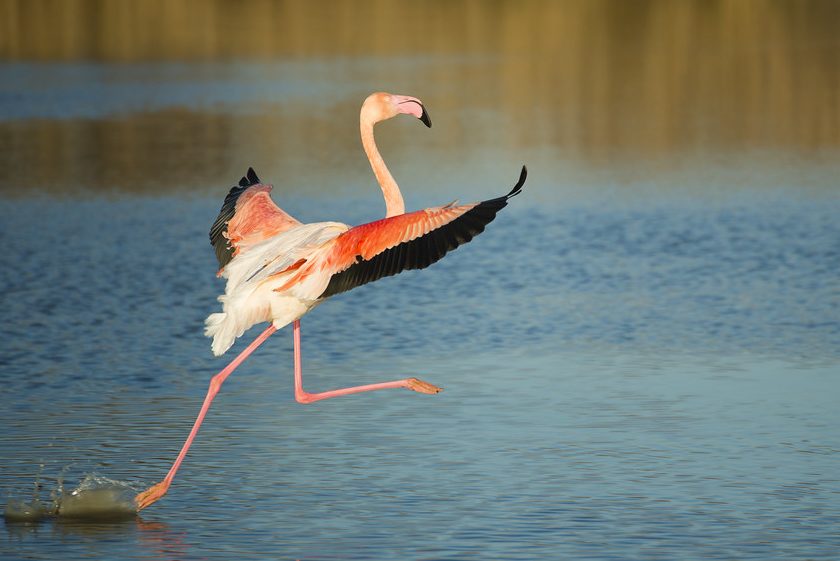
As annuals at their lives’ ends flower in beds, blossom and ripen into yellows and reds as Earth throws scarlet to the day’s end skies – so the flamingo trying to fly, pounding along the surface of the water, pink wings flapping, pink feet slapping, ungainly straining desperate, then sudden rise, its work rewarded: scarlet, pink, black, strong, suddenly graceful, airborne . . . and then gone.
*****
This short poem was recently published in Lighten Up Online after the editor’s careful query “Could I just check that Ls 5 and 6, which seem to have six beats unlike the others, are intentionally reflecting the awkwardness of the flamingo’s take-off?” Indeed, and I’m glad that it came across that way – thanks, Jerome Betts!
The current Lighten Up Online is a particularly good issue, with many poems far superior to my poor struggling flamingo.
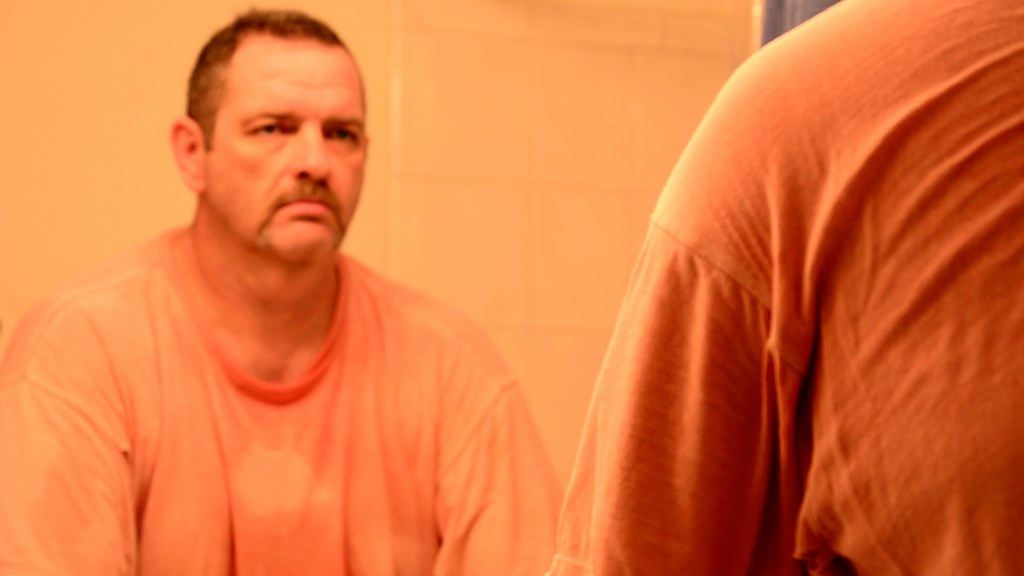
Y’know — it ain’t a lot of fun negotiating one-on-one with the person in the mirror who is staring blankly back at you with hollow, soporific eyes — but you penetrate his deep disguise, and then it is you realize that you’re in for loads of gloom and doom cooped up within this little room all by your empty, woeful self, all, all alone, with no one else — and the guileful guy you’re talking to isn’t talking back at you — ’cause he knows there’s nothing left to say. But the sonvabitch won’t go away.
*****
This poem was originally published in Better Than Starbucks. I have been unable to find Oliver Butterfield, I only know he retired and closed his law practice in Kelowna, British Columbia. I’d be interested in seeing more of his poetry.
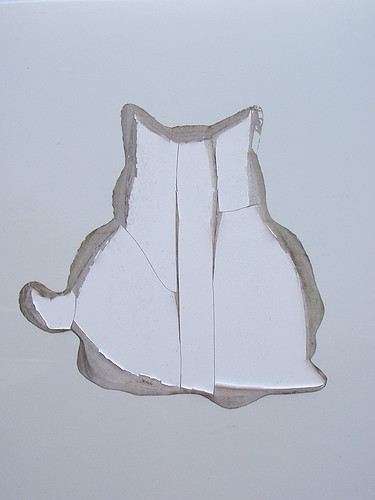
Darcy the diabetic cat has died His fans were told by email recently, A life remembered with no little pride.
The Fiat-driver now feels mortified To think because he simply failed to see Darcy, the diabetic cat has died.
Was this the fatal ninth and last he’d tried? Whichever, it will surely prove to be A life remembered with no little pride.
His poor squashed frame has been discreetly fried With all involved expressing sympathy; Darcy the diabetic cat has died.
The people in his road could not abide The flattening of such fine felinity, A life remembered with no little pride.
So, some of them sent cards, and others cried And stuck a sign upon his favourite tree: Darcy the diabetic cat has died, A life remembered with no little pride.
*****
Jerome Betts writes: “It’s always interesting when a line you read sparks off a quite unexpected result. In this case the line was in a friend’s email from Cambridge which mentioned in passing, as an item of local news, that Jasper the diabetic cat has died. Further details followed about one of those neighbourhood favourites known to many more people than its owners. Eventually, with Darcy substituted for Jasper (partly to secure a run of Ds and partly as I was at odds with a garden-molester of that name at the time) a villanelle took shape which was published inSnakeskinand subsequently in the anthology Love Affairs At The Villa Nelle (Kelsay Books, 2018) edited by Marilyn L. Taylor and James P. Roberts.”
Jerome Betts lives in Devon, England, where he edits the quarterly Lighten Up Online. Pushcart-nominated twice, his verse has appeared in a wide variety of UK publications and in anthologies such as Love Affairs At The Villa Nelle, Limerick Nation, The Potcake Chapbooks 1, 2 and 12, and Beth Houston’s three Extreme collections. British, European, and North American web venues include Amsterdam Quarterly, Better Than Starbucks, Light, The Asses of Parnassus, The Hypertexts, The New Verse News, and Snakeskin.
I Because I do not do the limerick line Because I do not do Because I do not do the limerick Desiring this man’s schtick or that man’s joke I will stick to knocking out free verse (If here and there a rhyme so much the worse) In mournful moans Presented ragged-right upon the page.
II There once was a Lady with three White leopards, a juniper tree, And a bag full of bones That sang their sad moans Of what they had once hoped to be.
III At every turning of the turning stair, Your breathing hard, your eyesight edged with dark, You see the face of hope and of despair.
You breathe the vapor of the fetid air And toil as if some atmospheric shark At every turning of the turning stair
Was hunting through the gathering darkness there, While back and forth across the narrative arc You see the face of hope and of despair.
At every turning there’s a window where You contemplate a drop that’s still more stark At every turning of the turning stair.
Instead you circle upward as you swear Like you are looking for a place to park. You see the face of hope and of despair.
You can’t endure the future’s dismal dare Nor drag yourself to put out your own spark At every turning of the turning stair.
You’re learning how to care and not to care And whether you will make or be a mark. You see the face of hope and of despair At every turning of the turning stair.
IV Higgledy piggledy Here we are all of us Trudging along where some Billions have trod
Smelling the flowers and Trusting religionists’ Tergiversational Rodomontade.
V If the word that is lost isn’t lost, And the word that is spent isn’t spent Then silence is actually speaking, And meaning is something unmeant.
If the meaning is what is unheard And the word is the thing that’s unspoken Then how do you hear if a word Has a meaning that hasn’t been broken.
If the unspoken word must be still And the unheard is what it’s about To have heard the unhearable meaning The inside has got to be out.
If the unheard were out of this world And the light shone in darkness were dark Then the unlit unheard would be meaning If the snuffer provided the spark.
If the yadda can yadda its yadda And the pocus was what hocus took Then gobble must surely be gobble Though dee separates it from gook.
VI Awake! Your hope to turn or not to turn Is wasting time – but go ahead and yearn To see the light or hear the word to know A heaven human beings can’t discern.
There’s nothing there for such as you and me; We make our meaning up from what we see And hear and touch and taste and smell and think — But all there is is fragments and debris.
The steps are just the steps, the stairs the stairs, The rest is merely human hopes and prayers That do no more than hopes and prayers can do, And nothing’s chasing you except your heirs.
No unmoved mover writes upon some slate That mortals may abate or not abate; No hope and no despairing of that hope Reveals what nothing states, or doesn’t state.
Whatever happens happens because of us We get a muss when we don’t make a fuss Demanding right from wrong not mere convenience: We’re all complicit underneath this bus.
Awake! Don’t hope to turn or not to turn, Don’t pray that this is none of your concern. Awake! What will it take for you to learn That if it all burns down you, too, will burn?
*****
Marcus Bales has produced this wonderful set of parodies of the long T.S. Eliot poem ‘Ash Wednesday‘, beginning with a piece in the poem’s style for Part I, Because I do not hope to turn again Because I do not hope Because I do not hope to turn Desiring this man’s gift and that man’s scope
but then moving into a limerick for Part II’s Lady, three white leopards sat under a juniper-tree
and a 22-line villanelle for Part III’s At the first turning of the second stair
and a double dactyl for Part IV’s Who walked between the violet and the violet
and quatrains for Part V’s If the lost word is lost, if the spent word is spent If the unheard, unspoken Word is unspoken, unheard;
and finally rubaiyat with a strong flavour of FitzGerald’s Omar Khayyam for Part VI’s Although I do not hope to turn again Although I do not hope Although I do not hope to turn
‘Ash Wednesday‘ has proved one of Eliot’s best-known and most quoted poems, with its signature mixture of Christian mysticism, personal emotion, loose form and scattered rhyme, rich imagery and memorable wordplay. Bales’ ‘Slash Wednesday‘ is an appropriate tour de force of a back-handed homage, mocking Eliot’s ragged rambling with a sampling of forms that could have been used (inappropriately) instead.
Not much is known about Marcus Bales except that he lives and works in Cleveland, Ohio, and that his work has not been published in Poetry or The New Yorker. However his ’51 Poems’ is available from Amazon. He has been published in several of the Potcake Chapbooks (‘form in formless times’).
This is being posted a couple of days late for Ash Wednesday, but as it’s for the already late T.S. Eliot that shouldn’t matter too much…
Under the midnight moon, the high garden’s outlined palms Wait. The sky round the white moon Is blue. And the clouds in the blue sky Are white. And the shadows in the white clouds Are blue. Below, offshore, Where three green islands lay in daylight’s blue sea, Tonight in the moon’s silver sea lie four black islands And one, gliding imperceptibly north, Is the black shadow of a white cloud in the blue sky. Gone are the golden butterflies from the pink hibiscus, Gone are the orange Monarchs from the purple bougainvillaea; Black lizards hunt black insects through black flowers of black bushes. The palms are black against the blue, Complex silhouettes of simple forms, Bending bowed fronds towards the moon – To the white Moon in her blue sky.
*****
I’m always embarrassed in writing or sharing “poetry” that lacks form. But oh well. There are still things in it I enjoy. This one was published in Abraxas.
Year after year the very best in golf head to Augusta. Fans come, too, and those who live and work here either take time off to travel or adopt a Masters’ pose. One local woman hosts a party for alumni of our alma mater. I attended with my husband once. The hors d’oeuvres were delicious, drinks well worth a try. Invitees wandered through the house into the garden, where the talk had lots of fizz. One liquored man when asked “What do you do?” replied: “I fly for Delta—soon to Rome.” My husband looked my way as I looked his; we both were more than glad to stay at home.
*****
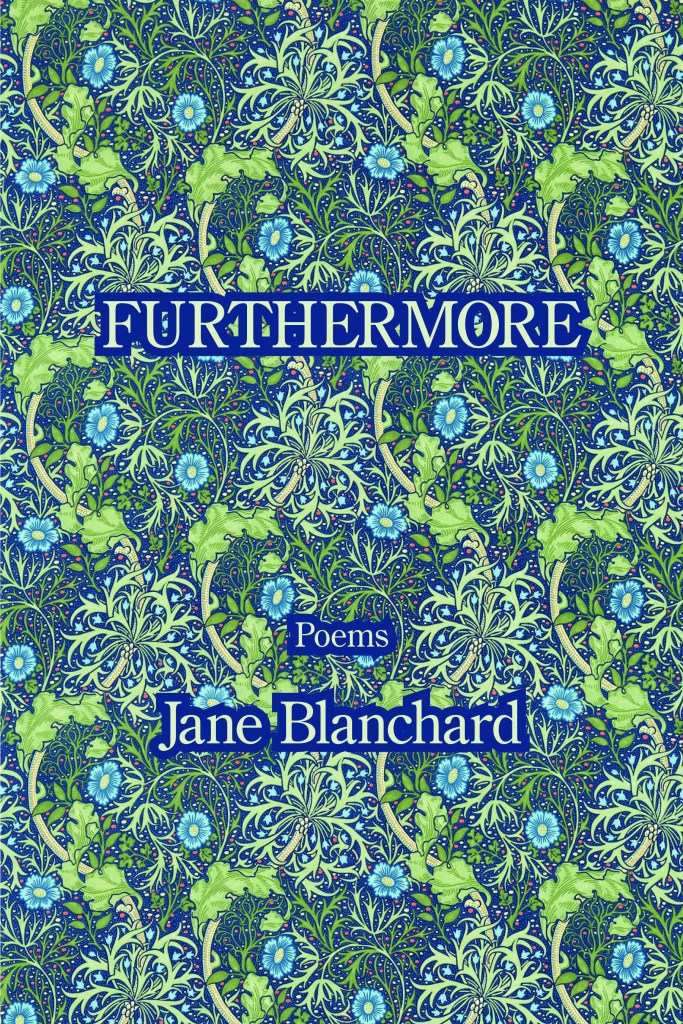
Congratulations to Jane Blanchard, who has just had her collection ‘Furthermore’ published by Kelsay Books. (Blurbs by Steve Knepper among others can be found at her Amazon listing.) I asked her for a favourite poem to represent the book, and she sent me ‘Between Rounds’, originally published in Valley Voices: A Literary Review.
A native Virginian, Jane Blanchard lives and writes in Georgia. Her collections with Kelsay Books include Metes and Bounds (2023) and Furthermore (2025).
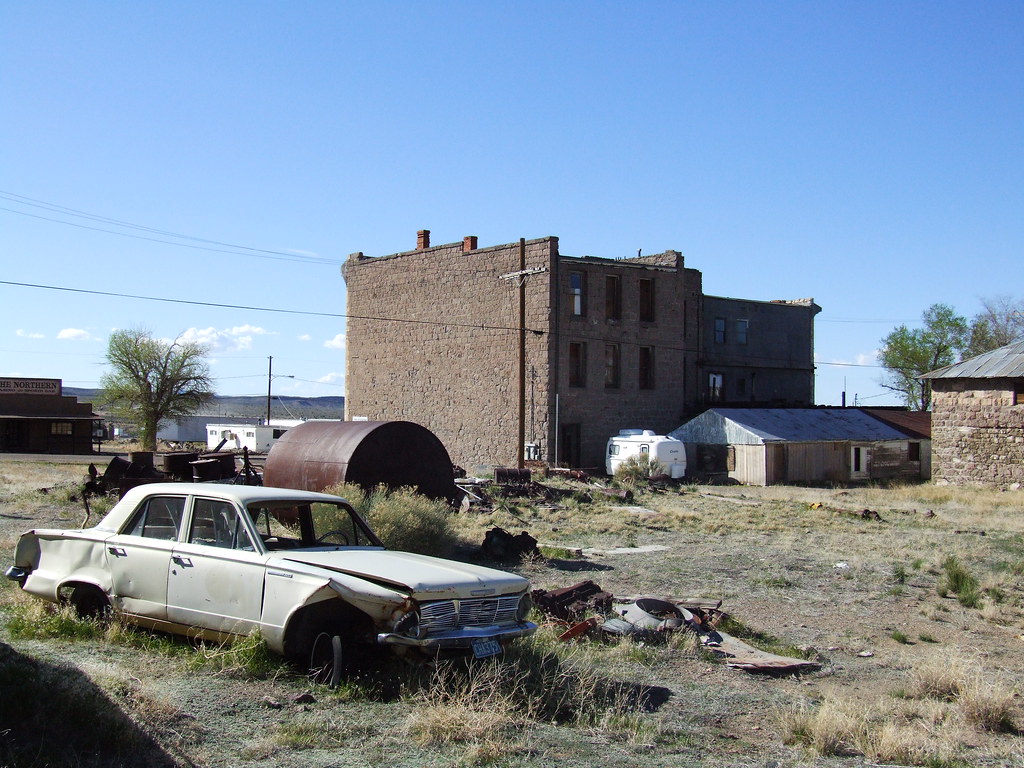
Just past the new development’s array, beyond the parking lot, the flowers, the fence, the land becomes uneven, falls away into an area of no pretence, abandoned cars, some rocks, some weeds, a bog. Here are drawn children and eccentrics both, searching for wild flowers, or a snake, a frog, to nature lurking in the undergrowth, beyond the ordered asphalt, lineal law; drawn by our lower brain of hunter, ape, where food is found or killed and eaten raw, life is survival, and sex may mean rape. Bricks, debris, rubble, condoms, empty beer… yet, strangely, life-long loves have started here.
*****
I subscribe to the Nietzschean view of humans as a rope stretched over an abyss, animal on the one side, posthuman on the other. I think the ape is very alive within us, as is the drive to reach beyond ourselves to something vastly greater.
This sonnet was originally published in Rat’s Ass Review (thanks, Roderick Bates) but I’ve modified one line here to match the photo I found for illustration.


 Form in Formless Times