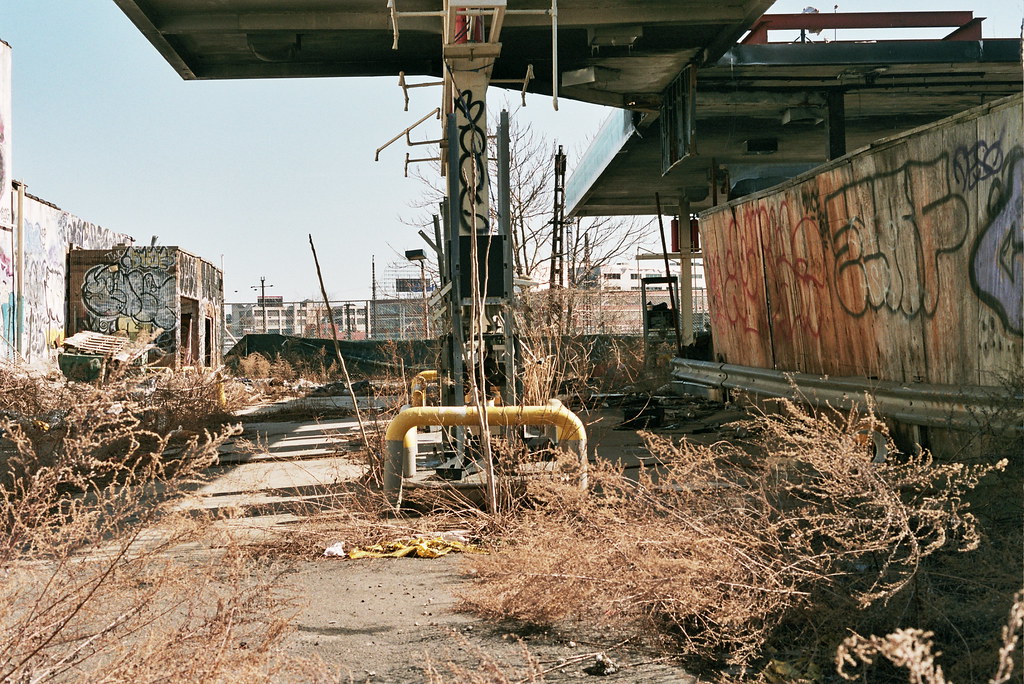
Kelly Scott Franklin, ‘Shell Station, Tennessee’

It was the ravage of the scene that shocked:
the concrete torn by trees and ragged grass,
red guts of fuel pumps over splintered glass,
the wreckage clawed by climbing vines and mocked
by moth and rust. There in concentric rings
obscene graffiti spelled out every sin.
(The smell of something even worse within.)
It’s like we saw into the death of things.
But what about the ruins I can claim?
What of the loves that I have let decay,
the hand withheld, the times I didn’t say
I’m sorry, didn’t pray for you by name?
We leave shell stations, call them what you will.
Neglect is the unkindest way to kill.

*****

Kelly Scott Franklin writes: “Originally sparked by an ekphrastic prompt over at Rattle Magazine (declined; first published in Ekstasis Magazine), this poem was ALSO inspired by a real abandoned gas station somewhere along the highway through the mountains on the way to Knoxville, TN. But I think it had been cooking in me for a while. I took a trip across the American heartland, from Southern Michigan to Central Kansas, and was absolutely depressed by the neglect and decrepitude. I stopped at a rest stop to use the restroom somewhere along the way. The restroom had a sign that said, “We take pride in the quality of our service. If anything in this restroom is not up to your satisfaction, please contact the management.” I looked around the restroom and there was garbage everywhere. Everywhere. It’s like people have stopped living the basic human things. The poem was also inspired by my troubled relationship with my late mother.”

Kelly Scott Franklin lives in Michigan with his wife and daughters. He teaches American Literature and the Great Books at Hillsdale College. His poems and translations have appeared in AbleMuse Review, Literary Matters, Driftwood Literary Magazine, Iowa City Poetry in Public, National Review, Thimble Literary Magazine, Ekstasis, and elsewhere. His essays and reviews can be found in Commonweal, The Wall Street Journal, The New Criterion, Local Culture, and elsewhere. 
https://www.hillsdale.edu/faculty/kelly-scott-franklin/

Abandoned Gas Station, 2013” by Genial23 is licensed under CC BY-NC-ND 2.0.

SF Poem: RHL, ‘Out Of Many…’

Two hundred million sperm
in one ejaculation;
and we are standing firm
and spouting with elation,
though but a single germ
survives to incarnation.

And much in nature throws
vast clouds into the ocean,
where myriad embryos
become a magic potion
consumed by all that goes
with food its only notion;

yet one or two survive
to adulthood and, later,
will make the species thrive
and serve up like a waiter
new young crowds that arrive
like cargo crammed on freighter.

This is how nature lives;
we should not think it foolish
eight billion of us gives
but forty fierce and mulish
posthuman narratives,
godlike as much as ghoulish,

in retrospect appearing nature’s plan
for how we cross to Nietzsche’s Superman.

*****

This poem was originally published in the Amsterdam Quarterly, although without the final couplet. I usually allow editors to make changes if they suggest them, and often the changes are an improvement that I retain. But in this case I’m afraid the science fiction speculation may be lost without those last lines: the idea that the present billions of us are on the point of being superseded by the first handful among us who achieve a godlike state of posthumanity… and that this ratio of 200,000,000 seeds being sacrificed to achieve one mature adult in the next generation is not unusual in nature.

Photo: “Stinging nettle stem with +/-15 billion seeds” by esagor is licensed under CC BY-NC 2.0.

Marcus Bales, ‘This Be The Verse’

Post this, post that, post-modernists –
   Denying narrative’s cabal.
The story that they tell insists
   It’s not a story after all.

New Criticism made them see
   That reading closely what was said
Meant cutting off biography,  
   And authors might as well be dead.

Like raisin oatmeal cookies, picked
   In hopes of chocolate chip, they bust
Your faith in how things seem. You’re tricked
   To only trust in doubting trust.

Without the person or the text,
   No human mind, no human heart,
I guess we know what’s coming next:
   Let the AIs do the art.

*****

Marcus Bales writes: “This is one of what I call my habitual poems. I have a perfectly good stand-alone idea, and start to work on it, but the parody turntable in my head takes over and the needle slides down into the groove and instead of stealing only the world-weary and faintly snarky Larkin tone it turns out I steal the whole poem. 

I have a file of these to be revised away from parody and into something that is less parodic, or at least less immediately noticeable as theft. 

The problem is I’m lazy about this stuff. There is a straightforward tradition of doing these kinds of parodicish things in song, called ‘filks’, and I’ve done some of them. It’s carried over into the same sort of thing in poems. The groove is there, the tonality is familiar, the original is familiar, and like the soap coming out of your hand in the shower, clunk, it hits the floor. 

So, since Robin asked me to write this, I’ve got a revised version for you. It loses some of the immediacy of Larkin’s opening, of course, but I’ll bet if you hadn’t got that in your head associated with this one first, this second version would only have marked a faint echo — and you might not of noticed how Larkinesque it is at all.”

Editor’s note: Bales revised the first and fifth lines; the originals read:
They fuck you up, post-modernists,
(…)
But others fucked them up to see

Hence his Larkin references.

Not much is known about Marcus Bales except that he lives and works in Cleveland, Ohio, and that his work has not been published in Poetry or The New Yorker. However his ‘51 Poems‘ is available from Amazon. He has been published in several of the Potcake Chapbooks (‘Form in Formless Times’).

Photo: “Post-Modern Urinal” by ~MVI~ (warped) is licensed under CC BY 2.0.

Using form: Ottava Rima: Max Gutmann, ‘Conscious Agents’ (from Don Juan Finish’d)

You sages aren’t surpris’d to learn that cowardice
Is courage. Truths illumine and conceal.
The dulcet affirmation and the sour diss
Can equally be true. That’s no big deal.
The world is full of paradox — and now word is
That even space and time may not be real.
We only think we see and smell and touch things.
The “world” is like, say, Donkey Kong and such things.

It’s all just icons on an interface:
The sound of rain, that contract you just sign’d,
The microbe on a slide, the feel of lace,
The smell of skunks, the corner you were fined
For parking at, your arm, the very space
You (think you) move through — products of your mind.
And even little quarks, atomic particles,
Are not, as thought, the fundamental articles.

No, “conscious agents” are what’s fundamental.
The theory says it’s they and they alone
We’re sure of. Space? Time? Objects? Incidental.
They hint at some reality unknown.
The dawn, the dung, the breeze, the brain, the lentil:
In all of these, our faith is overblown.
Those conscious agents compass us and we
Create those things — though not, um, consciously.

*****

Max Gutmann writes: “Don Juan Finish’d fancifully completes Lord Byron’s unfinished comic epic. Excerpts have been contributed to LightLighten Up Online, Orbis, Slant, Think, the website of the Byron Society, and Pulsebeat, where ‘Conscious Agents’ is among the excerpts to have appeared. Formalverse has also reprinted another excerpt. ‘Conscious Agents’ is part of a digression from the plot, digression being an aspect of Byron’s epic mimicked in Don Juan Finish’d.”

Max Gutmann has contributed to dozens of publications including New StatesmanAble Muse, and Cricket. His plays have appeared throughout the U.S. and have been well-reviewed (see maxgutmann.com). His book There Was a Young Girl from Verona sold several copies.

Photo: “Consciousness Awakening on Vimeo by Ralph Buckley” by Ralph Buckley is licensed under CC BY-SA 2.0.

RHL, ‘In Praise of Pride’

Why do the humble always bumble?
They stumble and their projects tumble,
their thoughts a jumble. So they mumble
and grumble, while their drear works crumble.
Why can’t they stand, speak, be unbowed?
Say it aloud. Be proud! 

*****

Gay Pride” by Dave Pitt is licensed under CC BY-NC-ND 2.0.
Sonnet: Gail White, ‘Why I Failed to Attend My High School Reunion’

Because it would have gone like this: Hello,
hello, hello. (You never like me, did you?
Where was this friendship 15 years ago?)

You’re looking wonderful. I wouldn’t kid you
about it – you look great. (You hefty cat.)
And Jeffrey – are you married? Oh, you are!
Three kids? However did you manage that?
(For God’s sake, someone point me to the bar.)
Me? I’ve just spent the summer in Tibet
learning some basics from a Buddhist nun.
It’s an experience I won’t forget.
(As if you cared.) More crab dip, anyone?
(And here’s the Great Class Bore. You’re still the same.)
Forgive me. I can’t quite recall your name.

*****

Gail White writes: ” ‘Why I Failed to Attend My High School Reunion’ is humor based on truth. I’m now 78 and have never been to a class reunion. Nobody who likes me would be there. I didn’t make real friends until I went to college and started meeting people who read books.”

Gail White is the resident poet and cat lady of Breaux Bridge, Louisiana. Her books ASPERITY STREET and CATECHISM are available on Amazon. She is a contributing editor to Light Poetry Magazine. “Tourist in India” won the Howard Nemerov Sonnet Award for 2013. Her poems have appeared in the Potcake Chapbooks ‘Tourists and Cannibals’, ‘Rogues and Roses’, ‘Families and Other Fiascoes’, ‘Strip Down’ and ‘Lost Love’. ‘Why I Failed to Attend My High School Reunion’ was first published in Light Poetry Magazine and is collected in her chapbook, ‘Sonnets in a Hostile World‘, also available on Amazon.

Photo: “High School 5 Year Reunion” by Oliver Mayor is licensed under CC BY-SA 2.0.

Odd poem: Couplet wordplay: Daniel Galef, ‘Letters to an Editor’

When I was in the printing biz,
in magazines (I worked at MS),
under my office door was slipped
a neatly-typed-out MS,
its cover letter curt and snippy,
return address in MS.
And what a scoop! New drug (its doses
prescribed for MS)
a fraud! The source, in bold defiance,
a chemist with a MS.
I showed my boss. “Yeah, right!” she reckoned,
and canned me in a MS.

*****

Daniel Galef provides this key to the various standard meanings of the abbreviation:
“Ms. Magazine; manuscript; Mississippi; multiple sclerosis; Master of Science degree; millisecond.”

Daniel Galef’s first book, Imaginary Sonnets, was published last year. ‘Letters to an Editor’ was published as part of his being the Featured Poet in Light Poetry Magazine. He is currently working on a book of comic poetry and wordplay, as well as on a PhD from the University of Cincinnati.

Photo: “Ms. magazine Cover – Winter 2015” by Liberty Media for Women, LLC is licensed under CC BY-SA 4.0.

RHL, ‘The Sun is Always Setting’

The sun is always setting, always setting on your day;
you sense the dark approaching, wish that it would stay away.
Do you want a life unchanging? Wish to still be a newborn?
Don’t you know life’s not a rosebud, but has root and leaf and thorn?

The sun is always setting and the black drapes are unfurled;
but notice that the sun sets on your world, not on the world:
it’s rolling into brightness in another’s happy land,
and the dark is evanescent and the brightening is grand.

The sun is always setting on the dinosaurs, but birds
are flocking into being, as are Serengeti herds;
and the sun that lights humanity? Of course it’s going to set,
and elsewhere light new tales of which we’ll just be a vignette.

The sun is always setting, but that view is just your choice;
I say the world is turning and evolving; I rejoice.

*****

Sometimes I’m told that my poetry is too bleak. But I think that’s only so if you want everything to stay as it is now. If, on the other hand, you expect change, and that change will ultimately provide more benefit than loss to the universe as a whole, then <shrug>… so it goes.

This poem has 14 lines but is hardly a sonnet. It was recently published in Pulsebeat Poetry Journal. Thanks, David Stephenson!

Photo: “Sunset Sadness” by BaboMike is licensed under CC BY-NC 2.0.

Annie Fisher: ‘Grumpy Grandad’s Nursery Rhyme’

Cock a buggery doodle doo!
I’m bending to lace up this buggery shoe!
You’d be buggery bad-tempered too
If the buggery cock
Woke you buggery up
At buggery, buggery five twenty two!

*****

Annie Fisher writes: “When our grandchildren were very small, we would sometimes visit to help with child care. The children would often burst into our bedroom early in the morning yelling ‘Cock-a-doodle-doo!’ (Probably encouraged by their parents). On one occasion my husband was staying with them for a few days without me. On the second day he sent me a text at the crack of dawn. The text read ‘Cockabuggerydoodledoo!’ and so I understood that his day had already begun! I thought ‘cockabuggerydoodledoo’ (a case of ‘expletive infixation’, Google tells me) had irresistible rhythmic force.
My poem is, of course, based on the traditional nursery rhyme:
Cock a doodle doo!
My dame has lost her shoe,
My master’s lost his fiddling stick
And knows not what to do.

Annie Fisher’s background is in primary education, initially as a teacher and later as an English adviser. Now semi-retired she writes poetry (this one appeared in Snakeskin) for both adults and children and sometimes works as a storyteller in schools. She has had two pamphlets published with HappenStance Press: (2016) and (2020), and is due to have another pamphlet published in the next couple of months with Mariscat Press. It will be called ‘Missing the Man Next Door’. She is a member of Fire River Poets in Taunton, Somerset and a regular contributor to The Friday Poem https://thefridaypoem.com/annie-fisher/

Photo: “cock-a-doodle-doo.” by alyssaBLACK. is licensed under CC BY-SA 2.0.

Shamik Banerjee, ‘In a Family Gathering’

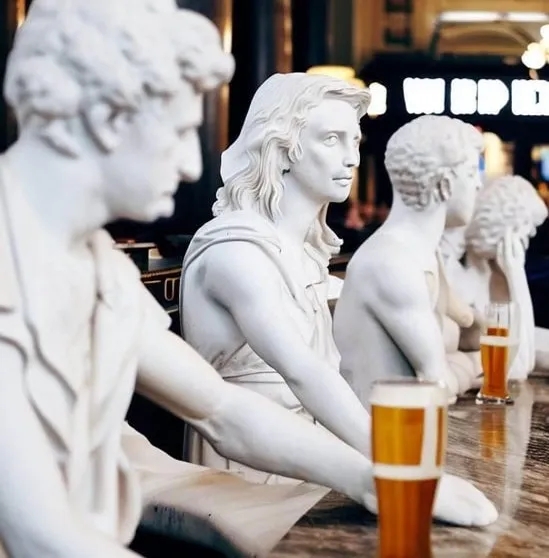
Before the booze-up session, all are statues.
Their prior falling-outs lodge doggedly
Upon their mouths like pillars of a building.
The visit’s just a plain formality.
But when the drinks are served, all lips begin
To open slow like rusty dungeon doors.
A glow of cheer unfolds upon their cheeks
Like dawn illuminates night-darkened shores.
Once they have reached the point of being swacked,
Then one by one they clear the awful air
Infected with self-pride, distaste, and spite.
The daftest cousin turns into Voltaire.
The silent uncle starts to sing his praises
Of how he’d saved three bullocks in a flood.
The two-faced aunt becomes a freedom fighter:
I’ll kill and die for us! We are one blood!
And I, the teetotaller, sit and weigh
If they’ll return to stone the coming day.

*****

Shamik Banerjee writes: “The absurd, ridiculous, and perennial drama between my relatives’ families inspired me to write this poem.”

Shamik Banerjee is a poet from India. He resides in Assam with his parents. Some of his recent works will appear in York Literary Review, Willow Review, Thimble Lit, and Modern Reformation, to name a few.

Photo: from original publication of the poem in Dear Booze: https://dearbooze.com/cocktales/f/in-a-family-gathering