SF Sonnet: RHL, ‘Transhuman Evolution’

The humans crowd the riverbanks in cities
while you, would-be transhuman in your boat,
trust to your dreams and luck as on you float,
ignoring all the land’s static committees,
the buildings taller with their strident voices,
the citied banks ever more crammed and loud,
leaders and statues oversize and proud,
fixed in their views. But you see other choices.

And then there’s no more land. Only the sea.
You deso-, iso-, yet e-lated find
after the Desolation of the Years,
sailing and searching past humanity
in the vast oceans of the future mind,
a life within the music of the spheres.

*****

This sonnet has just been published in Space and Time #146, a magazine where fantasy, science fiction, horror and whatever else are presented in a variety of print, online and audio forms. The sonnet owes something to one of my favourite Matthew Arnold poems, ‘The Future‘, which begins

A wanderer is man from his birth.
He was born in a ship
On the breast of the river of time;
Brimming with wonder and joy
He spreads out his arms to the light,
Rivets his gaze on the banks of the stream.


and ends flowing out into the ocean:

As the pale waste widens around him,
As the banks fade dimmer away,
As the stars come out, and the night-wind
Brings up the stream
Murmurs and scents of the infinite sea.


I assume Matthew Arnold limited this vision to the individual life, but I see it also as an image relevant to the progress of the human species into something vaster and unknowably different – not far removed from Nietzsche’s sense of Man as being a bridge between animal and… superman, or transhuman. Not the nasty small-minded punks of Nazi and neo-Nazi superman stupidity, but something far grander in a far larger development towards what life could become.

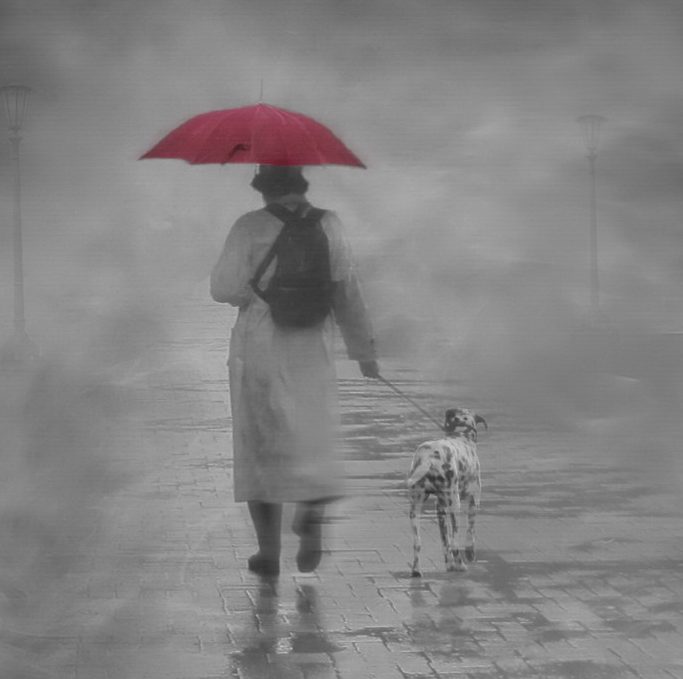
Photo: “Millennium Dome/O2 Arena from Trinity Buoy Wharf, Blackwall” by wirewiper is licensed under CC BY-NC-ND 2.0.

Melissa Balmain, ‘The Marital Bed’

You always hog the blankets
and steal my magazines.
No need to ask what smells so rank–
it’s you, the king of beans.

Your toenails cut my shin.
You blow your nose: I jump.
I’m sanded by your bristly chin,
then bulldozed by your rump.

You scratch your back and sigh,
you grunt, harrumph and bray.
And yet the crazy truth is I
can’t sleep when you’re away.

*****

From Walking in on People © Melissa Balmain, 2014. Used by permission of Able Muse Press.

Melissa Balmain writes: “As with many of my poems, I owe my husband for being a good sport about seeing such things in print.  And I owe Light‘s founding editor, John Mella, who advised adding a foot to the third line of each stanza, for a 3-3-4-3 pattern. (That pattern has a name that I don’t recall. Could someone please remind me?)”

Melissa Balmain’s third poetry collection, Satan Talks to His Therapist, is available from Paul Dry Books (and from all the usual retail empires). Balmain is the editor-in-chief of Light, America’s longest-running journal of light verse, and has been a member of the University of Rochester’s English Department since 2010. She will teach a three-day workshop on comic poetry at the Poetry by the Sea conference in Madison, CT, in May 2024.

Photo: “#oneperson #AdultsOnly #onlywomen #onewomanonly #people #Adult !indoors #humanbodypart #Bed #realpeople #BlackBackground #closeup #day #awakenings” by nikdanna is licensed under CC BY-NC-ND 2.0.
Sonnet: Marcus Bales, ‘Walking in the Rain’

Today when we went walking it was raining,
Not so hard to keep us from it — still
Distinctly wet. We thought about abstaining,
But March this year has lost its normal chill,
So on we went. She did her bombs away,
I bagged, and she looked up, with fur-soaked skin,
And shook some water off, as if to say,
Open up the door let’s go back in.
Well you’re the one who brought us out this far
I said as if I thought she had a plan.
She body-languaged Well, since here we are,
We’ll sniff back slow and get wet as we can.
And now we’re on the rug here, somewhat dryer,
Breakfasted, and dozing by the fire.

*****

Marcus Bales writes: “If ever a poem cried out for explication, this poem is that poem. Its hidden meanings and elusive innuendos chase each others’ tails with such sly allusions that even the b in subtle seems to thrust itself forward in comparison.

“The depths this poem sounds, the heights beyond which it reaches, evinces nothing of the feline grace other poets aim for and achieve. Nothing here looks at the reader and refuses to respond to the call for extra petties. This is a poem that trots wetly over and rubs eagerly against knees, and receives the towelling-off and the “Who’s a wet one, eh, who’s a wet one, today?” with effervescent attempts to put its muddy feet on the reader’s shirt. This poem has but one thing to say, and it says it by leaning in for another pat on the head, and then swiftly shaking that fine final spray of mist into the reader’s face before they can back quickly enough away.

“It is the doggily doggish dogness of the thing that dogs the dogging dog of this poem, and makes it so, well, dogilicious.

“Cry havoc, and let slip the hounds of love.”

*****

Not much is known about Marcus Bales except that he lives and works in Cleveland, Ohio, and that his work has not been published in Poetry or The New Yorker. However his ‘51 Poems‘ is available from Amazon. He has been published in several of the Potcake Chapbooks (‘Form in Formless Times’).

Walking in the Rain” by h.koppdelaney is licensed under CC BY-ND 2.0.

RHL, ‘Everyone’

Everyone’s naked under their clothes,
everyone’s bald under their hair;
hide if you like, everyone knows!
Everyone sees what you’re like under there.

Everyone’s meat under their skin,
everyone’s bones under their meat;
we know what your outside is hiding within:
hiding will always end in defeat.

So banish the words and censor the book,
draw little clothes on the cartoons for kids;
everyone knows where your dirty eyes look,
everyone sees that your life’s on the skids.

This poem was a response to the news out of Florida that elementary schools are being forced to draw clothing on cartoon characters in children’s books if the printed images show nakedness of either front or back. The right-wing nutcase group ‘Moms For Liberty’ is causing the trouble.
This link https://popular.info/p/pressed-by-moms-for-liberty-florida gives details and shows some of the results.
Incidentally, one co-founder of the Moms for Liberty group is Bridget Ziegler. Apparently she and her husband Christian Ziegler had sexual threesomes with another woman; and when Bridget backed out of a planned threesome event in October 2023, Christian went along anyway; the third party declined sex, saying she was in it more for Bridget; so Christian raped her. The woman then filed a complaint with the police.
Why is it that the hysterically over-moral types seem to be the ones causing most of the problems?

This poem was published in the March 2024 issue of Lighten Up Online (aka LUPO); thanks, Jerome Betts!

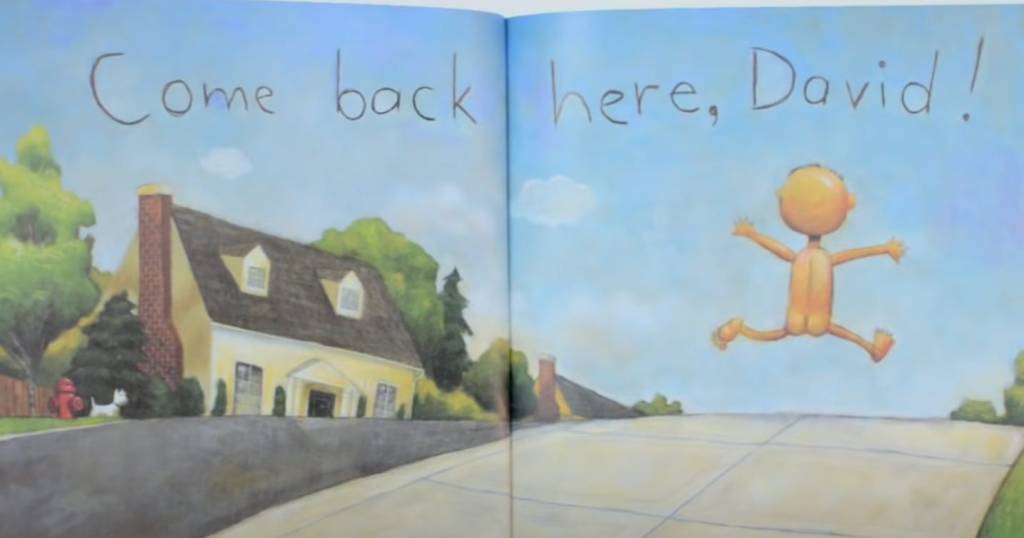
Photo: illustration from ‘No, David!‘, written and illustrated by David Shannon.

Using form: Villanelle: Discoveria, ‘October 7’

Your actions have unleashed a living hell.
Each day Israelis, Palestinians die;
Netanyahu, Hamas: go fuck yourselves.

October 7: gunfire and the smell
of death in the kibbutzim testify:
your actions have unleashed a living hell.

The siege of Gaza, ground invasion, tell
the UN of the “risk of genocide”.
Netanyahu, Hamas: go fuck yourselves.

And when the hospitals are bombed as well,
and there’s no water, food, or power supply,
your actions have unleashed a living hell.

Across the world the rage and hatred swell
and everyone feels forced to pick a side.
Netanyahu, Hamas: go fuck yourselves.

This one cannot be silent, for the bells,
they toll for everybody; none shall hide.
Your actions have unleashed a living hell;
Netanyahu, Hamas: go fuck yourselves.

*****

Discoveria writes: “I wrote this piece as a response to what was, at the time, a perception that people were being demanded to pick a side in the conflict between Hamas and the Israeli government, leaving no room for legitimate criticism of both. I wanted to express my anger and frustration at the situation, in which both sides have chosen the path of death and cyclical violence. The repeated refrains in the villanelle form emphasise these emotions. The piece was written overnight and posted in the early hours of Remembrance Day, 11/11/2023, after a little doomscrolling. I cannot pretend that there is much subtlety to the poem; it is what it is.”

Discoveria publishes much of their work at AllPoetry, saying “Due to the politically sensitive topic of the poem I would prefer to be credited under my username.”

Photo: “17 year old boy killed by Israeli army during demonstration in solidarity with Gaza” by ISM Palestine is licensed under CC BY-SA 2.0.

Parody: Brian Allgar, ‘If you can …’

If you can make her laugh, that’s half the battle,
Especially if she’s married to a bore;
If you can make her glad to be your chattel,
Yet treat her like a lady, not a whore;
If you can undo bra-straps single-handed
While murmuring enticements in her ear;
If you can make her think you’re being candid
When telling her just what she wants to hear;
If you, my friend, can easily persuade her
To sample things she’s never tried before,
Or if she sighs with pleasure when you’ve laid her,
And smiles as you sneak out by the back door;
If you can tolerate her endless prattle,
(And never tell her “Darling, get a life”),
Her gossip and her foolish tittle-tattle—
Then you’re the bastard who seduced my wife!

*****

Brian Allgar writes: “Written with a particularly amoral friend of mine in mind, although I am glad to say that the narrator is not me.”

Brian Allgar was born a mere 22 months before Adolf Hitler committed suicide, although no causal connection between the two events has ever been firmly established. Despite having lived in Paris since 1982, he remains immutably English. He started entering humorous competitions in 1967, but took a 35-year break, finally re-emerging in 2011 as a kind of Rip Van Winkle of the literary competition world. He also drinks malt whisky and writes music, which may explain his fondness for Mendelssohn’s Scottish Symphony.
He is the author of “The Ayterzedd: A Bestiary of (mostly) Alien Beings” and “An Answer from the Past, being the story of Rasselas and Figaro”, both available from Kelsay Books and Amazon.

Photo: “Making Her Laugh II” by kahala is licensed under CC BY-NC-ND 2.0.

RHL, ‘Deuteronomy 20: 16-18’

You’ve no autonomy
under Deuteronomy;
it’s your obligation
to your tribal nation
to kill all Palestinians
so you don’t sin against
God, who’s neurotic.
Yes, Yahweh’s psychotic.
No escaping his wrath,
no path but the psychopath.

*****

For Christians and Jews who state (as Jesus did) that every reported command by God in the Torah / Old Testament must be obeyed, I ask their position on Deuteronomy 20. This contains the command for the complete genocide of the non-Jews living in the land which Moses claimed had been given to the Jews by God. (Note: not expulsion or enslavement of the people living there, but the death of all of them and their animals.) The reason? So that they don’t teach evil ways to the Jews:

16 But of the cities of these people, which the Lord thy God doth give thee for an inheritance, thou shalt save alive nothing that breatheth:
17 But thou shalt utterly destroy them; namely, the Hittites, and the Amorites, the Canaanites, and the Perizzites, the Hivites, and the Jebusites; as the Lord thy God hath commanded thee:
18 That they teach you not to do after all their abominations, which they have done unto their gods; so should ye sin against the Lord your God.

To the extent that fundamentalist Jews constitute a large percentage of the Israeli population and are influential in the national government, the Palestinian situation cannot be resolved until scriptural passages like this are dragged out into the open and examined and discussed: was that passage only for then, and things are different now? Or does the command to massacre non-Jews still hold for today’s Jews in “the Holy Land”?

This poem was first published in The HyperTexts, where Michael R. Burch maintains extensive collections of poetry related to both the Holocaust and the Palestinian Catastrophe.

Illustration: “Moses has the mature women and the male children of the Midianites killed” is marked with Public Domain Mark 1.0.

Richard Fleming, ‘Invisible’

It’s footwear that I recognise
not faces but that’s no surprise:
I don’t look up, they don’t look down
except occasionally to frown
then look away and hurry on
and moments later they are gone.
There’s city Oxfords, polished, black,
worn by the older, banking pack,
and Converse sneakers for the lads,
whose work is fabricating ads.
The women, they too, dress that way:
I rarely see high heels today.
A constant stream of passing feet
flows by me on this busy street
while I sprawl here, small in my shawl,
and ask, do I exist at all?

*****

Richard Fleming writes: “During my early life I wrote non-rhyming verse, having been conditioned to believe that rhyme and metre were old-fashioned and therefore to be avoided: the last thing a young person wants is to be thought of as old-fashioned.
I was also prejudiced against humorous verse: my enjoyment of it was something of a guilty secret as my contemporaries all wrote dark, navel-gazing, stream-of-consciousness nonsense.
During Covid lockdown I found myself with time to reevaluate these blinkered views and finally embraced my love of nonsense verse. I set myself a goal of writing a light-hearted rhyme a day for the duration of lockdown, to assuage boredom, but once I had established a routine, I just kept on writing a bit of rhyming verse each day.
That was more than a thousand days ago and the rhymes just keep rolling out, one per day on Facebook, often inspired by the quirky images I find online but frequently the verse bubbles up of its own accord and I have to seek a suitable accompanying image.
As you might image, I now have an embarrassment of poems that, like the mayfly, live for, at most, one day and are gone. There’s no obvious long-term home for them.”

Richard Fleming is an Irish-born poet (and humorist) currently living in Guernsey, a small island midway between Britain and France. His work has appeared in various magazines, most recently Snakeskin, Bewildering Stories, Lighten Up Online, the Taj Mahal Review and the Potcake Chapbook ‘Lost Love’, and has been broadcast on BBC radio. He has performed at several literary festivals and his latest collection of verse, Stone Witness, features the titular poem commissioned by the BBC for National Poetry Day. He writes in various genres and can be found at www.redhandwriter.blogspot.com or Facebook https://www.facebook.com/richard.fleming.92102564/

Photo: “2016 – Mexico – Puebla – Street Person” by Ted’s photos – For Me & You is licensed under CC BY-NC-SA 2.0.

Duncan Lawrence, ‘The Poet is the Luckiest of Artists’

There is no struggling with a wayward cello on the train 
Or carting a large canvas through dank cornfields in the rain.

No need to worry chapter sixteen has somehow been deleted 
Or that the woodwind section remains a long way from completed.

No welding burns to speak of, hammered thumbs or calloused palms,
No temperamental band mates whose bad habits raise alarms.

No fearing, that the next plié will surely split these tights 
Or some acerbic, carping critic has got you in their sights.

Just, fingers crossed the last few lines like miracles unfold 
Before the walk is over or the bath become too cold.

Yes, I concede the poet’s lucky, yet still I do despair 
For all the artful artistry the money isn’t there.

*****

Duncan Lawrence writes: “I do not remember any specific incident as a catalysis for this poem. I did see an interview with John Cooper Clarke on the BBC, he said something to the effect that one might splash out on Tap Dance lessons only to discover that you were not that good but a pencil and a bit of paper are always available. That was either the source of the piece or resonated because I had just written it.
As to the form, I understand that it might be “Iambic heptameter with some anapestic
substitutions” but I don’t really know what that means.
I cannot sit down with a blank piece of paper and decide to write about something. The
poem just forms in my head over a few days. I then write it down and clean it up a bit. After I put it aside and continue to mull it over on a walk or in the bath before looking it
over again and, with luck, if it sounds all right, finishing it off.”

Duncan Lawrence is a retired English Teacher. Originally from the United Kingdom, he is a long-term resident in rural Japan. Here he spends an inordinate amount of time walking dogs for the local Guide Dog Association.
He has had three poems (including this one) published by Jerome Betts on his magazine Lighten Up Online.

Photo: “Who says I can’t relax?” by Ed Yourdon is licensed under CC BY-NC-SA 2.0.

Using form: Iambic tetrameter: Brooke Clark, ‘Celebrities’

They’re insecure black holes of need
and here they come to clog your feed
with photos and confessionals
shaped by PR professionals—
a pool glows blue in the backyard
next to a pull quote: “It was hard
to fight those demons of self-doubt”—
How brave you are for speaking out!
(“Dinner? Umm…the rainbow trout?”)
Some glossy shots show off the house
where, on a massive sun-splashed couch
the boyfriend lounges with a grin—
familiar…what’s that show he’s in?
“Yes, I’ve found love—I’m over the moon!
My memoir’s coming out in June.”
 
But now hushed tones, dropped eyes reveal
we’re ready for the big reveal—
speaking to us as to a friend
she grabs onto the latest trend
and tries to humanize herself
with references to mental health:
“Depression and anxiety—
none of the meds would work for me
but a friend introduced me to
this yogi, or—more like—guru?
He teaches tantric meditation
to reach this cosmic—like—vibration?—
where all your energies align—
Oh yeah, hey, my new makeup line
is rolling out in every state—
I promise the concealer’s great!”
How nice for you. The problem is
for those without advantages
like wealth and fame, the proper cure
for suffering is not so sure,
and wasn’t there some news report
about—“That settled out of court,
so let’s move on,” smoothly insists
the always-hovering publicist.
 
The only cure for their disease?
Awards, red carpets, galaxies
of flashbulbs dazzling their eyes,
the swarms of fans, their ardent cries—
the roar of being glorified
drowns out the whispering voice inside
that tells them that their fame won’t last
but crumble into dust and ash
leaving them lost and destitute—
quick—schedule a new photo shoot!

*****

Brooke Clarke writes: “Celebrities was triggered by scrolling through the news app on my phone and being bombarded with coverage of famous people, which ranged from the adoring to the outright hagiographic. I resisted writing the poem at first, since celebrities seemed like a bit of an obvious target, but in the end I decided to give in & go with it.
In terms of the form, I went back and forth a bit between tetrameter and pentameter couplets, but in the end I settled on the tetrameter. They always strike me as suited to a “lighter” satirical approach, and a slightly more throwaway, less sculpted feel — more Swift than Pope, if that makes sense — and I thought that worked for the subject matter in this one. 
One other point that might be of interest: the poem as I submitted it ended with one final couplet:
Reality gets hard to take
when everything about you’s fake.

I thought it worked as a way to pull back from the specific content and give a final summary to tie things together. The editor who published it in Rat’s Ass Review felt it was heavy-handed and obvious, and belaboured the same points that had already been made, so we agreed to cut it. It might be interesting to know what readers think.”

Brooke Clark is the author of the poetry collection Urbanities and the editor of the online epigrams journal The Asses of Parnassus. He’s still (occasionally, hesitantly) on Twitter at @thatbrookeclark.

Other writing:
A recent poem about the jazz guitarist Johnny Smith, in the journal Syncopation
Another poem in couplets, freely adapted from Catullus 63: https://the-agonist.github.io/poetry/2019/07/01/poetry-clark.html
A recent epigram, from Light 
An article about narcissism in contemporary poetry: https://thewalrus.ca/the-narcissism-of-contemporary-poetry/
A review of Frederick Seidel and Rachel Hadas in Able Muse
An article about Donna Tartt’s novel The Secret History:  https://lareviewofbooks.org/short-takes/donna-tartts-the-secret-history-as-revenge-fantasy/

Photo: “Tag Game: Red Carpet Ready for the OSCARS” by napudollworld is licensed under CC BY-NC-ND 2.0.