
Tag Archives: dementia

Richard Fleming, ‘In Grace’

The present is arcane and strange
and any recollection left
of what has happened in the past
is vague and liable to change.
Of future plans, he is bereft,
for nothing now is hard and fast.

They give him multicoloured pens
and paper, as one might a child.
Familiar voices interweave.
He sees, through a distorting lens,
people who wept, people who smiled,
that, one by one, stood up to leave.

He is content. He lives in grace.
What matter if the moments blur,
if his nocturnal thoughts are grim?
He has escaped himself: his face,
a kind of absence in the mirror,
comforts and somehow pleases him.

*****

Richard Fleming writes: “Getting old is like exploring new territory without a map: nothing prepares you for the subtle changes in body and mind. Is a moment of forgetfulness just that, or an early indication of approching dementia? We cannot know what strange highways a decaying brain takes us down but I like to think that they might lead to a place of contentment, where the burdens of age are laid down and replaced by some measure of contentment. That’s what I’ve tried to capture in this poem.”

Richard Fleming is an Irish-born poet (and humorist) currently living in Guernsey, a small island midway between Britain and France. His work has appeared in various magazines, most recently Snakeskin, Bewildering Stories, Lighten Up Online, the Taj Mahal Review and the Potcake Chapbook ‘Lost Love’, and has been broadcast on BBC radio. He has performed at several literary festivals and his latest collection of verse, Stone Witness, features the titular poem commissioned by the BBC for National Poetry Day. He writes in various genres and can be found at www.redhandwriter.blogspot.com or Facebook https://www.facebook.com/richard.fleming.92102564/

Photo: Richard Fleming post
Using form: John Beaton, ‘Stillbirth’

I.

The day I left for Canada my mother
and father quelled their tears. We held and hugged.
He said, “We three may never see each other
alive again.” That leaving
hooked my gut and tugged.

We never did. He died and left her widowed
so next time we three met was at his tomb.
Our parting afterwards had been foreshadowed–
the breakage of the cord
that fed me from her womb.

We rode on gondolas to summits she
had never dreamed of. Mountains could not buy
her heart from where they’d raised the family–
we shared reunions linked
by contrails in the sky.

II.

Hi, Mum. It’s me, from Canada, your John.
Och, John! You’ve caught me in an awful state!
I know. I’m sad to hear that Henry’s gone.
The one that was my brother?
My memory’s not great.


He’s back now, from the War. Oh dear, they’re here.
Who? They’re all against me. Who? The clique.
They’ve done such nasty things. They think I’m queer.
I think I’ll kill myself.

So how’s the house this week?

Och this one’s grand. I moved two days ago.
And Johnny helped. I think he’s at the door.
I’ll have to run now, Henry. Cheerio.

Don’t go. The phone is dead.
The cord exists no more.

III.

A winter storm comes sweeping down the hills
and, gusting, blasts umbrellas inside-out.
They ring the grave like blighted daffodils
and rain-black mourners hold,
like buffeted peat-burn trout.

I take the tasselled pall rope, let it slide,
and with my brothers ease the coffin down;
it slips across the lip of a great divide
and sinks what was my mother–
a shuck, a wrinkled gown.

Gales carry off the prayer as it is spoken.
I cast the rope adrift. The rains of Skye
slap my back. Again, a cord has broken–
this time my lungs won’t fill.
I try but cannot cry.

*****

John Beaton writes: ” This one is autobiographical. Using the metaphor of an umbilical cord, it tells how emigration stretches and breaks family connections. The title refers to the old practice alluded to in the last stanza of holding the newborn upside down and slapping it on the back till a cry indicates its lungs have started to work and it is breathing on its own. At the end of the poem, grief prevents such a cry. 
The dementia dialog is taken pretty much verbatim from an international phone call to my mother. That’s the part that crystallized the abacb rhyme scheme and 55533 meter. The dialog fell into place with that pattern and I felt it worked for the rest of the poem too. I think the last two lines of each stanza, with the first being unrhymed and the second linking through masculine rhyme with line two, act like an alexandrine and combine to give a closure effect.
The three-part structure represents three stages of escalating disconnection.”

John Beaton’s metrical poetry has been widely published and has won numerous awards. He recites from memory as a spoken word performer and is author of Leaving Camustianavaig published by Word Galaxy Press, which includes this poem. Raised in the Scottish Highlands, John lives in Qualicum Beach on Vancouver Island.
https://www.john-beaton.com/

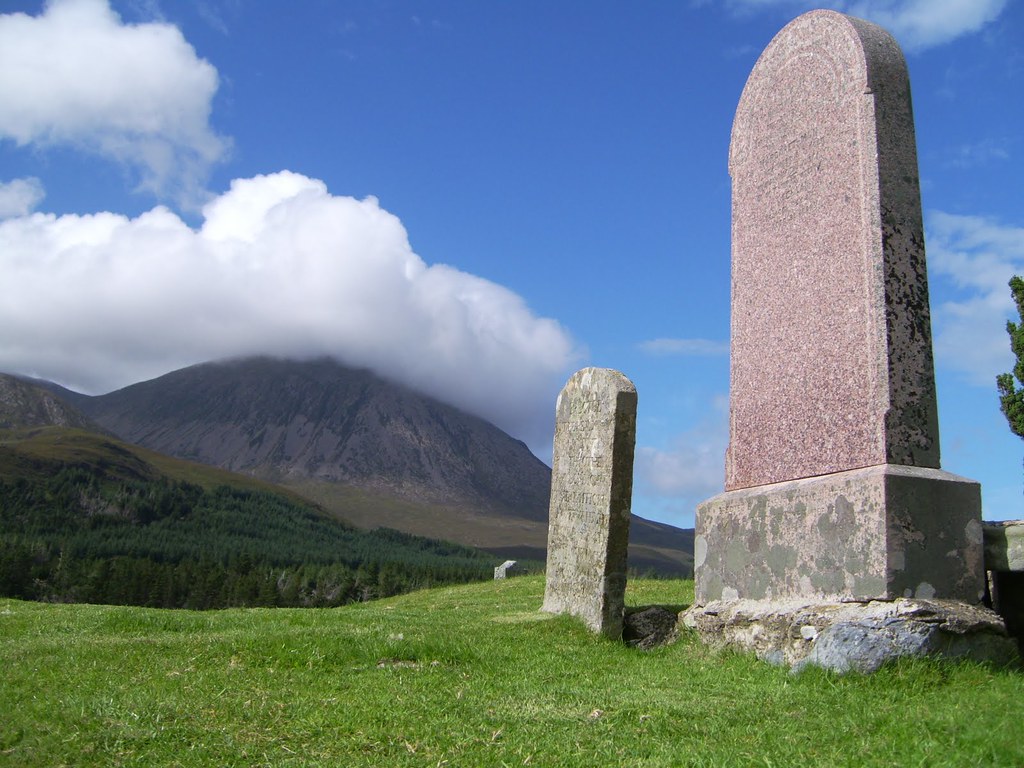
Cill Chriosd Graveyard Isle of Skye Scotland” by Tour Scotland Photographs is licensed under CC BY-NC-ND 2.0.

Potcake Poet’s Choice: Chris O’Carroll, “Ode to Old Age”

Chris O'Carroll

Chris O’Carroll

Ode to Old Age

I walk into a room and suddenly
I’m at a loss. What did I want in here?
That puckish brain-tweaker, reality,
Has learned to shift its shape or disappear.
I used to have to smoke expensive weed
To tune in to this zoned-out paradigm.
Today my skull packs all the buzz I need.
I’m high on failing cells and passing time.

Each friend or relative that I outlive
Is one less witness to my foolish youth.
Now any version of the past I give
Is more or less the undisputed truth.
What names and numbers I may have forgotten
Are obligations I’ve been glad to shed.
Untangled from the past I once was caught in,
I rest in peace before I’m even dead.

Chris O’Carroll writes: “When my late mother was in her early 80s, and could still notice and comment on the progress of her dementia, “losing my marbles” was her term of choice for the experience. I gave some thought to titling this poem “Ode to Lost Marbles” in her honor. Laughter can’t make decline and death any less terrible, but it sure does make life more fun in the meantime.”

Chris O’Carroll is the author of The Joke’s on Me (White Violet Press, 2019).  He has been Light magazine’s featured poet, and his poems have appeared in Literary ReviewThe New StatesmanThe SpectatorLove Affairs at the Villa Nelle, and The Great American Wise Ass Poetry Anthology. “Ode to Old Age” was originally published in Light.