Tag Archives: Edmund Conti

Edmund Conti, ‘Class Action’

Forty farty arty asses
Taking “Art and Humor” classes.
We can easily dispense of
Ten of those who have no sense of
Why they’re spending time in class.
Perhaps they hope the time will pass.

Thirty dirty-thinking students
Driving cars with one or two dents
All with New York license plates
(no one comes from other states).
None of them are Trappist Monks.
Three of them are from the Bronx.

Twenty seven, several standing
All of them aloud demanding
Knowledge and some satisfaction
Looking for a little action.
Which brings in play some other factors:
Like, the class has fourteen actors.

Thirteen thirsty knowledge seekers
Most of them in hi-tech sneakers
Fast-lane Yuppies causing sparks
Passing Jeffs and passing Marks,
Easily outclassing Freds
Four of them are wearing Keds.

Nine no-nonsense neophytes
New to Art and its delights
Also new to thoughts of Humor
Each of them a Baby Boomer.
Mostly what they make is money.
Eight don’t think that humor’s funny.

One remaining arty ass
Thirty nine aren’t in his class.
He has a strong artistic bent
A witty and amusing gent
But he (who is the poet) copped out,
Fell between the cracks and dropped out.

*****

Edmund Conti writes: “I think was inspired by a reference somewhere to an “Art and Humor” class. And naturally I had to have students dropping out, one by one, or two by two or more. The poem immediately became a lab for rhymes and puns and whatever could go under the banner of art and humor. Just riffing mostly.”

Edmund Conti has recent poems published in Light, Lighten-Up Online, The Lyric, The Asses of Parnassus, newversenews, Verse-Virtual and Open Arts Forum. His book of poems, Just So You Know, is published by Kelsay Books,
https://www.amazon.com/Just-You-Know-Edmund-Conti/dp/1947465899/
and was followed by That Shakespeherian Rag, also from Kelsay
https://kelsaybooks.com/products/that-shakespeherian-rag

Students in class, Pitzer College” by Claremont Colleges Digital Library is licensed under CC BY-NC 2.0.
Using form: Experimental: Edmund Conti, ‘Solace’

I know, I know it’s tough.
I know. It’s tough. I know.
It’s tough. I know it’s tough.
I know. I know. It’s tough.
I know it’s tough. I know.

It’s tough.

I know.

*****

Edmund Conti writes: “I guess I like because it uses just four words to say a lot.”

Edmund Conti has recent poems published in Light, Lighten-Up Online, The Lyric, The Asses of Parnassus, newversenews, Verse-Virtual and Open Arts Forum. His book of poems, Just So You Know, is published by Kelsay Books,
https://www.amazon.com/Just-You-Know-Edmund-Conti/dp/1947465899/
and was followed by That Shakespeherian Rag, also from Kelsay
https://kelsaybooks.com/products/that-shakespeherian-rag

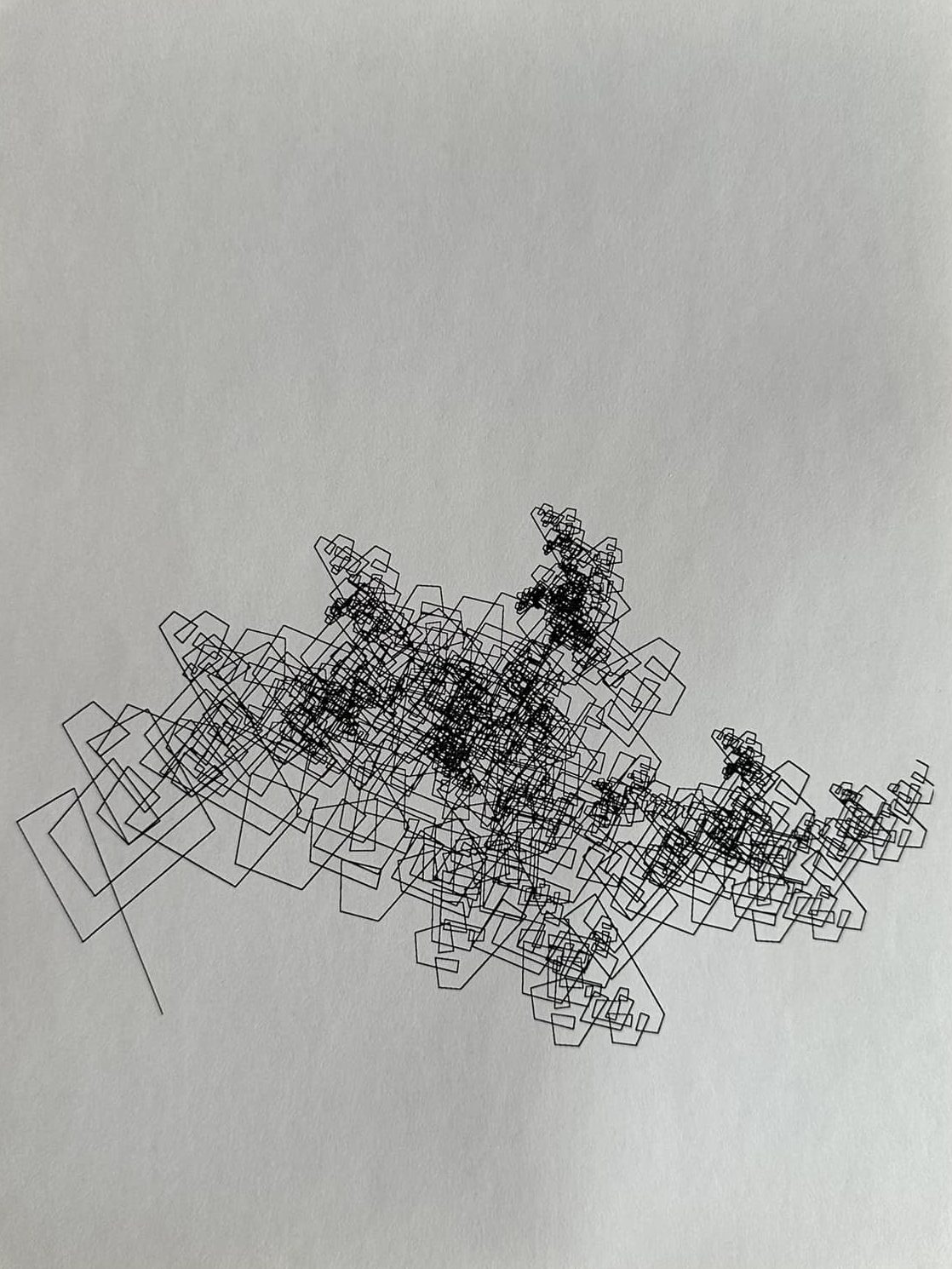
Photo: ‘Solace’ by Edmund Conti

Edmund Conti, ‘My Son the Critic’

Read me a bedtime poem, said my son.
So I read him this:

We say hippopotami
But not rhinoceri
A strange dichotomy
In nature’s glossary.

But we do say rhinoceri, he said. Look it up.
So I read him this:

Life is unfair
For most of us, therefore
Let’s have a fanfare
For those that it’s fair for.

I smell a slant rhyme, he said, sniffing.
So I read him this:

While trying to grapple
With gravity, Newton
Was helped by an apple
He didn’t compute on.

My teacher says that’s not poetry, he said.
So I read him this:

René Descartes, he thought
And therefore knew he was.
And since he was, he sought
To make us think. He does.

That made me think, he said. But not feel.
So I read him this:

My hair has a wonderful sheen.
My toenails, clipped, have regality.
It’s just all those things in between
That give me a sense of mortality.

Did the earth move? I asked. Anything?
Nothing moved. He was asleep.

*****

Edmund Conti writes: “This is one of my favorites today. Tomorrow I might have different ones. I like it because it makes me nostalgic for an event that never happened. (My persona has a better life than me.) It came about after I sent the following quatrain to John Mella of Light Magazine (with appropriate punning title, of course).

We say hippopotami
But not rhinoceri
A strange dichotomy
In nature’s glossary.

John liked it and accepted it. I few weeks later he wrote and said he couldn’t use. Talking to a fellow editor, he learned there is such a plural as ‘rhinoceri.’ But now I was in love with my little piece and wanted to salvage it. But how? All I could think of was to take advantage of the poem’s failing. I came up with the idea of showing several possibly flawed quatrains to my son and having him disparage each one. And lo, the poem! I have 2 sons and when either one questions the reality, I just say it was the other one.”

Edmund Conti has many reasons for wanting his poems published—Power! Fame! Money!—but not (as you can see) as a venue for his bio notes.

Edmund Conti has recent poems published in Light, Lighten-Up Online, The Lyric, The Asses of Parnassus, newversenews, Verse-Virtual and Open Arts Forum. His book of poems, Just So You Know, is published by Kelsay Books,
https://www.amazon.com/Just-You-Know-Edmund-Conti/dp/1947465899/
and was followed by That Shakespeherian Rag, also from Kelsay
https://kelsaybooks.com/products/that-shakespeherian-rag

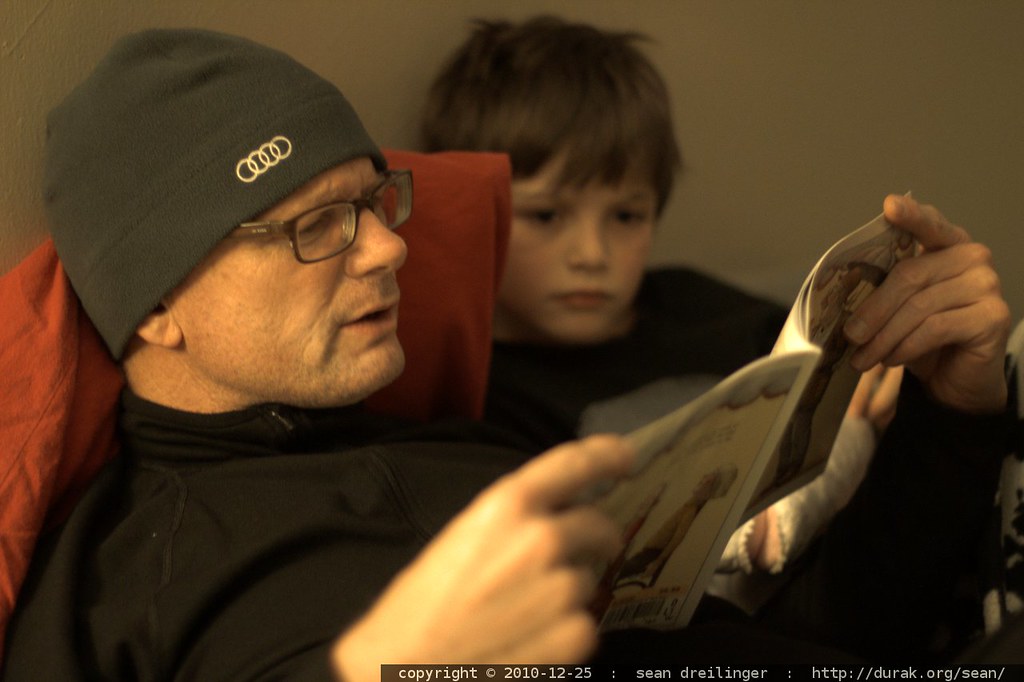
Photo: “grandpa reading nick a bedtime story – MG 6291.JPG” by sean dreilinger is licensed under CC BY-NC-SA 2.0.

Light verse: Edmund Conti, ‘Man O’ War’

The men of war
in the man o’ war
(and the many more)
who rode the ship’s bottom
where the admirals put ’em
would often think
this has to stink
If we ever sink
we’re sunk.

At least
that’s what
I think
they thunk.

*****

Edmund Conti writes: “I guess I was thinking if there is a Man O’ War, then there have to be Men O’ War. And where would they be put to be kept out of the way until called on. One idea led to another, one simple rhyme led to more, and voila!”

Edmund Conti has recent poems published in Light, Lighten-Up Online, The Lyric, The Asses of Parnassus, newversenews, Verse-Virtual and Open Arts Forum. His book of poems, Just So You Know, released by Kelsay Books
https://www.amazon.com/Just-You-Know-Edmund-Conti/dp/1947465899/
was followed by That Shakespeherian Rag, also from Kelsay
https://kelsaybooks.com/products/that-shakespeherian-rag

Photo: “The Battle of Trafalgar, 21 October 1805” by lluisribesmateᥩ is licensed under CC BY-NC 2.0.
Using form: Edmund Conti, ‘A Clutch of Clerihews’

Barack Obama
Doesn’t do drama.
The play’s not the thing
Wherein he’ll catch the conscience of Larry King.

Hillary Clinton
Likes to have a mint on
Her hotel pillow
Whether she’s in Islamabad or Amarillo.

Joe Biden
Can never decide on
Which words to use to ready us for the long haul.
So he uses them all.

Sean Hannity
Doesn’t think sanity
Should be one of the necessary talents
For reporting the news with fairness and balance.

Sarah Palin
Drives another nail in
Her chances for success
when she answers a question with anything but ‘No’ or ‘Yes’.

*****

Edmund Conti writes: “The problem with Clerihews is that when you start you can’t stop writing them. I don’t think Edmund Clerihew Bentley had any strict rules for them, except finding the fitting rhyme for the principal’s name. I was fortunate at that time to find five notable persons with easy rhymable names. Anyway, we Edmunds have to stick together.”

Edmund Conti has recent poems published in Light, Lighten-Up Online, The Lyric, The Asses of Parnassus, newversenews, Verse-Virtual and Open Arts Forum. His book of poems, Just So You Know, released by Kelsay Books
https://www.amazon.com/Just-You-Know-Edmund-Conti/dp/1947465899/
was followed by That Shakespeherian Rag, also from Kelsay
https://kelsaybooks.com/products/that-shakespeherian-rag

Photo detail of: “Holder, Napolitano, Baker, Biden, Obama, Clinton, Jones, Rice” by scriptingnews is licensed under CC BY-SA 2.0.

Edmund Conti, ‘Two’s Company’

Sweet are the uses of divinity
And sweeter yet in keeping us engrossed
Is the simple complex concept of the trinity
The Father, Son and Holy Ghost.

Is making sense of Them too much a bother?
Is there any way to master Three-in-One?
The son, the Holy Ghost and Father,
The Holy Ghost, the Father and the Son.

I use this ancient form, the cranky sonnet
To crank out my aberrant Dunciad
And what evolves from overthinking on it:
The Spook, the Kid and–dare I say it?–Dad.

It’s true that poems are made by fools like me
But only God can make himself a three.

*****

Edmund Conti writes: “I wasn’t going to get into any interpretations of the Trinity. Just noting that scholars writing about it don’t shed much light. So I decided to shed my own. Somewhere along the line I may have gone a little overboard. (Pray for me.) I think my cranky sonnet has its own rhyme scheme, not one from the books. Meanwhile I’ve forgotten what ”Dunciad” means except that it was a good rhyme word. Forgetting all that, I guess this whole thing was inspired by Joyce Kilmer’s memorable last line.”

Edmund Conti has recent poems published in Light, Lighten-Up Online, The Lyric, The Asses of Parnassus, newversenews, Verse-Virtual and Open Arts Forum. His book of poems, Just So You Know, released by Kelsay Books
https://www.amazon.com/Just-You-Know-Edmund-Conti/dp/1947465899/
was followed by That Shakespeherian Rag, also from Kelsay
https://kelsaybooks.com/products/that-shakespeherian-ragHis poems have appeared in several Potcake Chapbooks: Tourists and Cannibals
Rogues and Roses
Families and Other Fiascoes
Wordplayful
all available from Sampson Low Publishers

Photo: “Father, Son & Holy Ghost” by elston is licensed under CC BY-NC-ND 2.0.

Edmund Conti, ‘The Straight Skinny’

To say that only I am fat,
To say that I am only fat,
To say only that I am fat,
To only say that I am fat,
Is not to say, however, that
They equally are definitive.

One statement says fat’s mine alone,
One says no other trait I own,
One just has a plaintive tone,
And–overlooked and overblown–
One just splits the infinitive.

*****

Edmund Conti writes: “I guess this began with the observation that ‘only I am fat’ and ‘I am only fat’ have different meanings depending on the placement of one word. Which made me wonder if placing ‘only’ in other parts of the sentence would change it again. Which it did. Why did I use ‘fat’ as a trait? Well, it’s an easy rhyme and people can relate to it—in themselves or others. Also, it gave me a good excuse for the title.
I thought writing the second stanza would be trickier, but the rhymes just fell into place. And noticing the split infinitive and using it saved the poem. Assuming it was worth saving.”

Edmund Conti has recent poems published in Light, Lighten-Up Online, The Lyric, The Asses of Parnassus, newversenews, Verse-Virtual and Open Arts Forum. His book of poems, Just So You Know, released by Kelsay Books
https://www.amazon.com/Just-You-Know-Edmund-Conti/dp/1947465899/
was followed by That Shakespeherian Rag, also from Kelsay
https://kelsaybooks.com/products/that-shakespeherian-rag

His poems have appeared in several Potcake Chapbooks:

Tourists and Cannibals
Rogues and Roses
Families and Other Fiascoes
Wordplayful
all available from Sampson Low Publishers

Photo: “Why Am I So Fat?” by morroelsie is licensed under CC BY-NC 2.0.

Potcake Poet’s Choice: Edmund Conti, ‘In Memoriam’

John Betjeman cannot read his In Memoriam.  Not
Today
    Or ever.

So what’s the use of writing another jot.
    Why, pray,
    Endeavor?

For he who could best compose one is decomposing.  Rot!
    Away
    Forever.

His spirit lives in every ingle-nook where England claims the heart
    And soul.

That poet so lightly musical, so serious and straight (an art)
    And droll.

Whose lines were seen and heard in every church, in every mart.
    And knoll.

Muckby-cum-Sparrowby cum Sphinx, County Westmeath, Cheltenham;
    The set.

Henley-on-Thames, also Highgate, Bristol, Clifton, Mint-on-Lamb:
    Gazette.

Places etched forever in his poems, each one a Betje-gram.
    Je bet!

We remember chintzy cheeriohs in his brilliant combinations.
    Cheeribye.

Farewell, so long, bunghosky, too — Goodbye to all his permutations.
    Never grim.
    Never dry.

Well, it’s getting time for supper and we’ve had our ruminations.
    This is him.
    Dry your eye.

Edmund Conti writes: “I remember saying (to myself) in high school after writing a few verses, “I’m not a poet I don’t like poetry, I just like to rhyme and scan.” I had an image of who poets were and what poetry was, and it just didn’t fit my imagined profile. I stuck to my guns for a while even as I was sending out my verse and getting comments like, “Please, no more rhymes” and “How about sending your smug cloaca elsewhere?” But eventually some poems were accepted and published and I met more poets and I got married. Marilyn loved poetry (no, she didn’t say real poetry but I imagined her thinking it). She was a member of a woman’s poetry group that called themselves The Lady Blue Stockings. They would smack their lips over Amy Lowell (“Christ, what are patterns for?”) and E. E. Cummings (“How do you like your blue-eyed boy, Mister Death?”). Marilyn tolerated my poetry but didn’t appreciate any of my parodies of her favorites.

Meanwhile, I met other poets and joined two groups: The South Mountain Poets and the Bards Buffet. The former was a local group (in NJ) and met weekly and discussed each other’s poems. I was usually advised to have more gravitas. The Bards, all light versifiers, met in a penthouse dining room of an insurance company in Manhattan.  Among them Willard Espy, William Rossa Cole, inventor of River Rhymes and other well-published poets.

So, in spite of myself, I was becoming a poet and appreciating others. Among them, Wallace Stevens, Robert Wallace, Vachel Lindsay, Frank O’Hara, and Robert Southey. And more and more swam into view. Luckily Marilyn brought many poetry books to the marriage and I found myself one day leafing through “John Betjeman’s Collected Poems.” There I came across his poem titled (entirely) “I.M. Walter Ramsden, ob. March 26 1947, Pembroke College, Oxford”. I loved the poem, the rhyming and the place names. Of course, I had to write my own version, not as parody, but an appreciation.  It was fun playing with the format and making up some English place names. One of my two or three favorite poems.

This was originally published in Orphic Lute. Later I sent it to Lighten-Up Online. They accepted it, made some changes to the place names and changed some of the wording. It was republished in my book “Just So You Know” from Kelsay Books. There I had problems with line lengths, some lines longer than Kelsay’s book limits allowed. Here it is, back in its original format.

Edmund Conti has recent poems published in Light, Lighten-Up Online, The Lyric, The Asses of Parnassus, newversenews, Verse-Virtual and Open Arts Forum. His book of poems, Just So You Know, released by Kelsay Books
https://www.amazon.com/Just-You-Know-Edmund-Conti/dp/1947465899/
was followed by That Shakespeherian Rag, also from Kelsay
https://kelsaybooks.com/products/that-shakespeherian-rag

His poems have appeared in several Potcake Chapbooks:
Tourists and Cannibals
Rogues and Roses
Families and Other Fiascoes
Wordplayful
all available from Sampson Low Publishers

Review: ‘That Shakespeherian Rag’ by Edmund Conti

The problem of being
a 17-year
locust
is trying to stay
for 16 years
focused.

That poem is ‘Short Attention Span’ from Edmund Conti’s latest collection of verse. Originally the title was to be ‘O O O O’ in reference to T.S. Eliot’s lines from The Waste Land where the poet is being criticised by his wife:

“Are you alive, or not? Is there nothing in your head?”
But
O O O O that Shakespeherian rag—
It’s so elegant
So intelligent

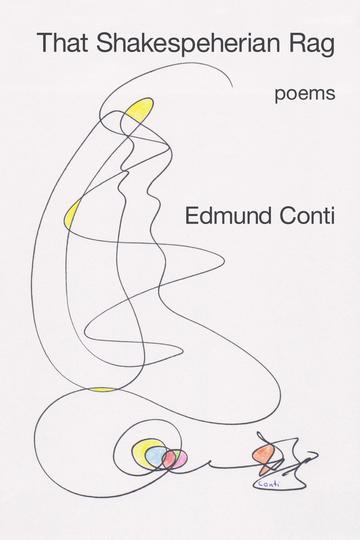
It seems that the publishers sensibly preferred a title that would be more comprehensible, without the confusions of O and 0. So the next part of the quote was chosen–still idiosyncratic, but more useful. And, yes, Conti seems to have poetry singing rhythms in his head all the time, and he produces beautiful jazz-like drawings as in the book’s cover.

Both titles for the collection are pure Conti–he has a playful, Zen-like approach to life, highly literate, constantly referencing other writers (and other writers referencing other writers), expecting a level of knowledge and engagement from the reader, and often reducing his expositions to the shortest possible. So this latest volume is full of memories and meditations, jokes and puns, and threaded through with the words of others. Conti divides the book into 11 Shakespearean sections, starting with memories of childhood and youth, and then weaving through reading and writing, books and poetry, his neighbors and family (and their views of his verse), into a closer and closer look at mortality: the last four pieces having respectively four lines, two lines, one line, and nothing.

Conti writes both formal and free verse, depending what kind of playfulness he’s up to. When he parodies Emily Dickinson, of course it’s in her standard ‘The Yellow Rose of Texas’ meter and rhymes ABAB. But he’s a lot more free when he just wants some snide commens and a punchline. Here’s ‘Losing Battle’:

In a final desperate attempt
at survival, the sun sets
fire to the western sky.
Overblown, say my poet friends.
Cute, say my non-poet friends.
What does it mean? asks my neighbor.
How much will you get paid for it?
That’s from my wife.

My father’s an astronaut,
my son lies.

Engaging, amusing, thought-provoking, with many short passages that stay in the memory. A fun book for all poets. Just published this month by Kelsay Books.

Potcake Poet’s Choice: Edmund Conti, “My Son the Critic”

Edmund Conti

Edmund Conti

Read me a bedtime poem, said my son.
So I read him this:

We say hippopotami
But not rhinoceri
A strange dichotomy
In nature’s glossary.

But we do say rhinoceri, he said.  Look it up.
So I read him this:

Life is unfair
For most of us, therefore
Let’s have a fanfare
For those that it’s fair for.

I smell a slant rhyme, he said, sniffing.
So I read him this:

While trying to grapple
With gravity, Newton
Was helped by an apple
He didn’t compute on.

My teacher says that’s not poetry, he said.
So I read him this:

René Descartes, he thought
And therefore knew he was.
And since he was, he sought
To make us think.  He does.

That made me think, he said.  But not feel.
So I read him this:

My hair has a wonderful sheen.
My toenails, clipped, have regality.
It’s just all those things in between
That give me a sense of mortality.

Did the earth move?  I asked.  Anything?
Nothing moved.  He was asleep.

Ed Conti writes: “I sent the following quatrain to John Mella at Light and he accepted it (those were the good old days).

We say hippopotami
But not rhinoceri
A strange dichotomy
In nature’s glossary.

I don’t remember what the title was but I’m sure it didn’t hurt the poem.  A few weeks later dis-accepted the poem.  He had consulted with a fellow editor (I didn’t know they did that!) and found out you do say ‘rhinoceri.’  Now what?  I didn’t want to trash the quatrain, not with ‘t those felicitous rhymes.  So how to keep the verse and note the error. That was it, link a whole bunch of poems with their shortcomings (and I have a lot of those) and do a learned dissertation on what their problems were.  And who better to do that than one of my two sons.  Which one? It wouldn’t matter, I wouldn’t name him.  That way if one of them said he didn’t remember that happening, I would say it was the other son. Besides they were too young to worry about personas (personae?) And I wasn’t sure if I actually knew what they were.

So what does the reader get out of this poem?  Probably nothing. I write for myself because it’s fun.  If the reader chooses to enjoy this poem, that’s his problem.”

Edmund Conti has recent poems published in Light, Lighten-Up Online, The Lyric, The Asses of Parnassus, newversenews, Verse-Virtual and Open Arts Forum. His book of poems, Just So You Know has been recently released by Kelsay Books.
https://www.amazon.com/Just-You-Know-Edmund-Conti/dp/1947465899/

http://www.short-humour.org.uk/10writersshowcase/10writersshowcase.htm#EDCO

https://www.facebook.com/edmund.conti/