Tag Archives: formal verse

Using form: Gwendolyn Brooks, ‘We Real Cool’

The Pool Players.
Seven at the Golden Shovel.

We real cool. We
Left school. We

Lurk late. We
Strike straight. We

Sing sin. We
Thin gin. We

Jazz June. We
Die soon.

*****

Gwendolyn Brooks was one of the greatest 20th century American poets: stylistically creative, with haunting imagery and themes, emotionally engaging, socially engaged. She wrote formal verse, free verse and loosely structured ballads – sometimes all in the same sequence, as in The Womanhood.

Appropriately, ‘We Real Cool’ is her best-known poem: simple, poignant, striking at the heart of America’s structural inequality and moral failures, and presented on the page with a bizarre twist that is both unnecessary and essential: unnecessary because the three-word lines rhyme correctly without having ‘We’ at the end… essential because the reader is forced to emphasize the ‘We’, so that the last line seems (like the youths’ lives) unnaturally shortened, prematurely ended.

A simple poem. Maybe not her greatest, but iconic.

Photo: “Pool Players” by Johnny Silvercloud is licensed under CC BY-SA 2.0.

My own favourites: Sonnet: RHL, ‘Death Will Be Harsher Now’

Death will be harsher now, as, year by year,
we solve the clues of immortality:
emotions sink to animality
as false hopes tighten screws of desperate fear.
Hormone control will make age disappear—
after false starts, most horrible to see—
but those already old must beg to be
frozen for the genetic engineer.
While war, starvation, pipe Earth’s gruesome jigs,
successful businessmen will fight to gain
some dead teen’s body, to transplant their brain,
the already-old beg to be guinea-pigs.
Children, look back, hear our despairing cry:
we bred immortals, but we had to die!

*****

I wrote this poem on 3 January 1982 – twenty years before I began to get poems published. (Formal verse was an almost absolute no-no in late 20th century magazines… although consistently taught and highly praised in schools and universities, of course.) It was finally published in Ambit in October 2007 – the magazine started and managed for 50 years by Martin Bax and the stomping ground of J.G. Ballard, Ralph Steadman, Carol Ann Duffy, etc.

In April 2018 the poem was reprinted in Bewildering Stories, an online weekly headquartered in Guelph, Ontario; and in 2024 I accepted Maryann Corbett‘s suggestion to change the title and first line and instead of “harder” use the word “harsher”… the earlier word incorrectly suggesting that we might be finding it more difficult to achieve death.

The ideas behind the poem were not new to science fiction, but were less common in formal verse. The ideas continue to inch their way towards reality; continue to be explored in popular culture (Piraro, Futurama…); and in the last 44 years I have continued to explore SF and existential themes in verse.


Cartoon: “piraro brain transplant” by Dreaming in the deep south is licensed under CC BY 2.0.

Using form: RHL, ‘Formal vs Free’

Look: formal verse can be china for tea,
a golden goblet, a mug made of clay.
Free verse is putting mouth to stream to drink.
Yes, you could cup your hands… but do you think
museums want to buy that to display
your “memorable skill”, your “artistry”?

*****

‘Formal vs Free’ is published in the current ‘Blue Unicorn‘, in a section loaded, as often, with verse about verse.

Photo: “Red-figured Greek Red-Figure Kantharos (Drinking Vessels) with Female Heads 320-310 BCE Terracotta” by mharrsch is licensed under CC BY-NC-SA 2.0.

Weekend read: Stephen Edgar, ‘Murray Dreaming’

It’s not the sharks
Sliding mere inches from his upturned face
Through warps of water where the tunnel arcs
Transparent overhead,
Their lipless jaws clamped shut, extruding teeth,
Their eyes that stare at nothing, like the dead,
Staring at him; it’s not the eerie grace
Of rays he stood beneath,
Gaping at their entranced slow-motion chase

That is unending;
It’s not the ultra-auditory hum
Of ET cuttlefish superintending
The iridescent craft
Of their lit selves, as messages were sent,
Turning the sight of him they photographed
To code: it is not this that left him dumb
With schoolboy wonderment
Those hours he wandered the aquarium.

It is that room,
That room of Murray River they had walled
In glass and, deep within the shifting gloom
And subtle drifts of sky
That filtered down, it seemed, from the real day
Of trees and bird light many fathoms high,
The giant Murray cod that was installed
In stillness to delay
All that would pass. The boy stood there enthralled.

Out in the day
Again, he saw the famous streets expound
Their theories about speed, the cars obey,
Racing to catch the sun,
The loud fast-forward crowds, and thought it odd
That in the multitudes not everyone
Should understand as he did the profound
Profession of the cod,
That held time, motionless, unknown to sound.

In bed at night,
Are his eyes open or is this a dream?
The room is all dark water, ghosted light,
And midway to the ceiling
The great fish with its working fins and gills
Suspended, while before it glide the reeling
And see-through scenes of day, faintly agleam,
Until their passage stills
And merges with the deep unmoving stream.

*****

Stephen Edgar writes: “As the reader may guess, although the poem is cast in the third person, in the figure of a young boy, it describes a visit to an aquarium that I made myself, and as an adult. And on the occasion of this visit I was struck, and deeply impressed, by the single large Murray cod, seemingly floating motionless in its large room-sized tank of water, designed to mimic a section of the Murray River. Impressed in what way? Well, it is hard to say, but there seemed to be a certain mystery and power embodied in this fish, which was sealed off from me, inaccessible. The image stayed with me. However, it was only when I revisited the aquarium some years later that this original mood was reawakened and prompted me to write a poem about it. 

“The challenge was to find the right way to express it.  I didn’t want the poem to seem too portentous and self-important, so I thought that by seeing it through the eyes of a young boy I could give it a certain lightness of touch. But also the young are often considered to be more in touch with the natural world than adults, with their worldly preoccupations. In the midst of all the other superficially more attractive and appealing creatures in the aquarium, this particular boy is transfixed by this large fish. He has, I suppose you could say, a vision. What of? Well, some kind of vision of timelessness and continuity represented in nature, in comparison with which the speed and hubbub of daily life—represented by the city traffic and crowds—seem trivial and unimportant.

“In a way, the poem is already over by the end of the fourth stanza. The main point has been made. But a poem has an aesthetic shape as well as a meaning and I felt the need to round it off in some emotionally satisfying way. So I placed the boy, after the day was over and he was home again, lying in bed reliving his vision. Maybe he is dreaming; maybe he is awake and having a waking dream: either way he sees the fish in the midst of his ordinary everyday room, and overlaid on this he sees the city scenes, which are gradually absorbed by the dream river and dream fish. 

“The word “dreaming” in the poem’s title, while it can refer to this last stanza, is also meant to imply the use of the word in indigenous Australian culture, signifying a body of lore connected to a totemic animal or sacred place.

“The poem is written in a nonce stanza form of my own devising, with nine lines rhyming ABACDCBDB, in pentameter, apart from line one in dimeter, and lines four and eight in trimeter.

“The poem first appeared in Poetry (Chicago). It then appeared in The Red Sea: New and Selected Poems (Fort Worth, Baskerville Publishers, 2012), now out of print; then in my ninth book, Eldershaw; and also in The Strangest Place.”

*****

Stephen Edgar was born in 1951 in Sydney, where he grew up. From 1971 to 1974 he lived in London and travelled in Europe. On returning to Australia he moved with his then partner to Hobart, Tasmania, where he attended university, reading Classics, and later working in libraries. Although he had begun writing poetry while still at high school, it was in Hobart that he first began writing publishable poems and found his distinctive voice. He became poetry editor of Island Magazine from 1989 to 2004. He returned to Sydney in 2005. He is married to the poet Judith Beveridge.

He has published thirteen full collections: Queuing for the Mudd Club (1985), Ancient Music (1988), Corrupted Treasures (1995), Where the Trees Were (1999), Lost in the Foreground(2003), Other Summers (2006), History of the Day (2006), The Red Sea: New and Selected Poems (2012), Eldershaw (2013), Exhibits of the Sun (2014), Transparencies (2017), The Strangest Place: New and Selected Poems (2020) and Ghosts of Paradise (2023). A small chapbook, Midnight to Dawn, came out in 2025, and a new collection, Imaginary Archive,will be published in late 2025. His website is www.stephenedgar.com.au, on which publication details of his books, and where they can be purchased, are given.

He was awarded the Australian Prime Minister’s Award for Poetry in 2021 for The Strangest Place.

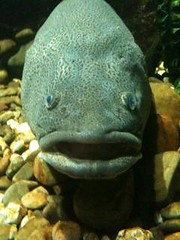
Photo: “Murray Cod at Melbourne Aquarium” by brittgow is licensed under CC BY-NC 2.0.

RHL, ‘On a Modern “Poem”’

The thoughts are fresh, the images are good;
the style is clean, the tone both wise and terse;
the whole thing would be memorable, it would…
if only it had been expressed in verse.

*****

I’m always embarrassed if I have an idea for a poem, and I fail to find an expression of it in rhyme as well as rhythm. That’s because, of the hundreds of poems or pieces of poems in my head, all but a tiny handful are remembered because they are expressed in verse. You can remember the gist of an idea on the strength of the idea; but if you want to remember its exact expression, word for word, it’s far easier if it’s in verse. For this purpose, blank verse is better than prose; but rhymed verse is superior.

You may have lots of partial memories of Winnie the Pooh from childhood – the Hundred Acre Wood, Eeyore’s moans and groans – but actual word-for-word memory is likely to attach to the few snippets of verse in the book, such as:
Isn’t it funny
How a bear likes honey.
Buzz! Buzz! Buzz!
I wonder why he does?

My little gripe above was originally published in Light earlier this year.

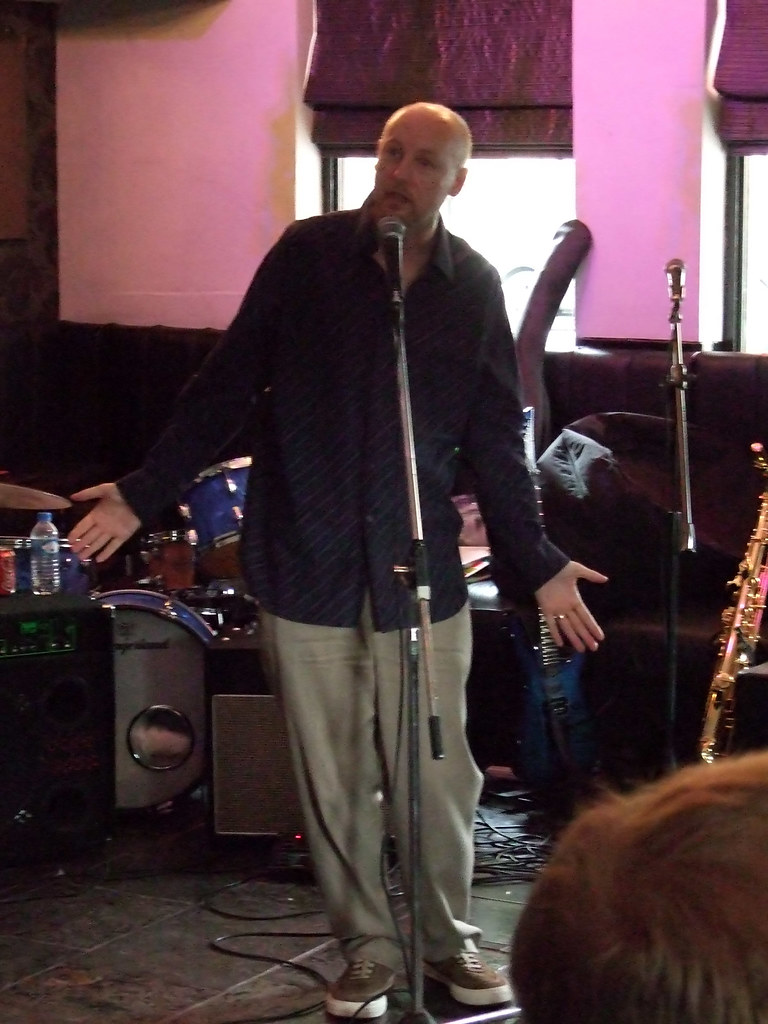
Photo: “Al declaims” by jovike is licensed under CC BY-NC 2.0.

Nonce form: Stephen Edgar, ‘In Search of Time to Come’

There’s not much noise above the sputtering fire.
They don’t speak much.
The children are settling to a private croon,
Though the baby whimpers, palping blindly to clutch
At a breast. Farther back, picked out by a
Final index finger of the sun, someone squats.
They’ll be changing their abode quite soon,
No doubt.
The time requires a tacit finishing touch,
From women working at rough pots
And men scraping a hide to peg it out.

This mood, this life, is like a circle, turning
Always back
On itself: expectation interlocking
Ritual; impulse to novelty, for lack
Of its not yet invented learning,
Subsiding again to things that they take pleasure from.
A hum. A mother’s body rocking,
They are, you would say, at home.

Only the cave mouth, that changeable screen,
Opens a gap
In the circumference; and when the light
Is gone, they have no words by which to trap,
Or the notions by which words could mean,
What that black window’s showing for them to detect,
As they look, perplexed, into the night
And stare,
Then turn towards each other’s bodies to tap
Their comfort. Someone, they suspect,
Is out there; and they’re right. We are out there.

*****

Stephen Edgar writes: “I can no longer remember the specific circumstances which gave rise to this poem, but it was possibly some television documentary about ancient hominins. As Philip Larkin said in a rather different context, “Truly, though our element is time,/ We are not suited to the long perspectives/ Open at each instant of our lives.” The vertiginous gulf of time between ourselves and our earliest ancestors is a subject that has always fascinated me, and I have written other poems dealing with it; indeed, my next book opens with a poem on a similar theme. The difference with In Search of Time to Come is the notion of these ancient humans attempting to peer forward into the deep future, rather than modern humans gazing back into the deep past.

“The poem is metrical with full rhyme. The stanza form, for stanzas one and three, is one of my own devising, with varying line lengths and complex rhyme scheme. Stanza two varies the pattern, breaking off after eight lines, with a slight adjustment to the rhyme scheme. Why? I can’t remember; it was a spontaneous idea that occurred to me in the writing.

As far as I can remember, this poem had no magazine publication and first appeared in my second book Ancient Music (Sydney, Angus & Robertson, 1988), which is out of print. It has been republished in The Strangest Place: New and Selected Poems (Melbourne, Black Pepper, 2020), which is available on the Black Pepper website.”

Stephen Edgar was born in 1951 in Sydney, where he grew up. From 1971 to 1974 he lived in London and travelled in Europe. On returning to Australia he moved with his then partner to Hobart, Tasmania, where he attended university, reading Classics, and later working in libraries. Although he had begun writing poetry while still at high school, it was in Hobart that he first began writing publishable poems and found his distinctive voice. He became poetry editor of Island Magazine from 1989 to 2004. He returned to Sydney in 2005. He is married to the poet Judith Beveridge.

He has published thirteen full collections: Queuing for the Mudd Club (1985), Ancient Music (1988), Corrupted Treasures (1995), Where the Trees Were (1999), Lost in the Foreground(2003), Other Summers (2006), History of the Day (2006), The Red Sea: New and Selected Poems (2012), Eldershaw (2013), Exhibits of the Sun (2014), Transparencies (2017), The Strangest Place: New and Selected Poems (2020) and Ghosts of Paradise (2023). A small chapbook, Midnight to Dawn, came out in 2025, and a new collection, Imaginary Archive,will be published in late 2025. His website is www.stephenedgar.com.au, on which publication details of his books, and where they can be purchased, are given.

He was awarded the Australian Prime Minister’s Award for Poetry in 2021 for The Strangest Place.

Photo: “Leave the door open!” by In Memoriam: VernsPics is licensed under CC BY-NC-ND 2.0.

Sonnet Crown: Amit Majmudar, ‘Recourse’

1.

Time, like love, is cyclic. Please come back
to me. I’ll stand here waiting, wanting while
the mare without her rider rounds the track.
I want to weave a crown for you, design
a daisy chain whose threaded stems become
a bracelet that handcuffs your wrist to mine.
My shadow’s gnomon tilts like a sun dial’s.
I know you’re somewhere close. I feel a thrum,
a thrill beneath the stillness of the earth,
the way a woman, days before the birth,
places her husband’s hand on the sea swell
that rises out of her and passes through her,
and, touching so much vastness, he can tell
for all their time as one, he never knew her.

2.

For all our time as one, I never knew you—
but doesn’t learning come from repetition?
I’ll do this better if I do it over.
I’ll know your every need by heart, pursue you
like truth. I’ll learn to be a truthful lover.
I’ll circle back to freshman year and woo you.
No song’s recorded in a single session.
No sinner’s shriven after one confession.
It’s time that grows the pearl. Nacre layers
the sand grain, like a secret in the mouth.
Repentance grows, too—grows by daily prayers
into a faith whose trigger seed was doubt.
I am a pearl diver in your depth.
I never left. I just came up for breath.

3.

I never left, I just came up for breath,
but now I am ready to follow you all the way down.
I’ve read we get euphoric as we drown.
Samsara swirls us under. When we break
the whitecaps for an instant, that is death.
Don’t make us wait to be reborn before
we love again. You know me—I’ll just make
the same mistakes. Or make things even worse.
So what if time’s a circle? Doesn’t mean
we have enough of it. The now we’re in
will never come again. So come again
into my life, and love me sight unseen.
We’re both at sea, and no good at dead reckoning.
A burning town’s the only lighthouse beckoning

4.

Our house of light is burning down. It beckons in
the gloaming. The road I’m roaming is a ring.
All time is circular. We’re only seconds in.
All reasoning is circular. I sing
the seasons all the way around the year.
There was a chemist once whose dream disclosed
benzene’s atomic structure. What appeared
before him was a serpent swallowing
its tail—aroma’s O, ouroboros.
I’m wise at last to what the image knows.
I see my answer now, my big mistake.
A ring! Why couldn’t it have been this clear
back then? I see it best when I’m awake.
I’ve circled back. But there is no one here.

5.

I’ve circled back, but there is no one where
the ring road ends. It ends in newfound ruins,
a shell-flecked nest, a rain-worn blade that bears
a message for us. Who can read the runes?
Nietzsche proclaimed the eternal return
and threw his arms around a bleeding horse
to feel the centuries reversing course.
His gooseflesh rose like spores that pock a fern.
Let vultures circle, only widdershins
above the ring road where I wait alone,
knifing in bark a promise of my own.
I know the ring road ends where it begins.
Time is a circle I can put to use:
a wheel to roll things back, a crown, a noose.

6.

A wheel to roll things back, a crown, a noose:
My own Venn diagram of rings to choose
from. Fill its center up with hourglass sand,
and that’s where Archimedes, kneeling, draws.
This is the Roman siege of Syracuse;
he’s hard at work on time, its shape and laws.
He looks up from a boot. A soldier stands
above him, dripping gladius in hand.
Do not disturb my circles, says the Greek.
The soldier studies them, then runs him through—
and so reveals what Archimedes seeks,
the circle, like a circuit, broken, weeks
and months and centuries and aeons spilling
in slow, concentric circles from the killing.

7.

In slow, concentric circles from the still-pink
narcotic kiss print of the cupping glass,
let your memories ripple outward, killing
the pain I’ve caused you. We are not our past,
though time is cyclic. Cycles can be broken,
souls reborn in this life, sleepers woken.
Not that I can sleep beneath this star.
Horizon, magic circle, boxing ring—
time is the space, the spell, the place we spar,
the dome in which your name is echoing.
It’s where I pray the theory into fact
that love, like time, is cyclic. Please come back.

*****

Amit Majmudar writes: “The sonnet crown is a naturally recursive form of forms. The beginning of each sonnet is also an ending, and vice versa. A candle tilts to light a candle that tilts to light a candle, until the occult circle of flame is complete, and the poet sits inside it, meditating the next line, which may well be the line just written.

“This sonnet crown took, as its subject, the tendency of lovers, or at least their memories, to relapse. “Relapse” means to fall back, etymologically. To fall back in love; to fall back out of love. The sonnets enact through form and content alike the recrudescence of the past. The last line of the overall crown matches the first line of the overall crown. The reappearance of the old pain makes it a crown of thorns.

“I wrote this sonnet crown first line to last. I had never even attempted one before, but I relinquished myself to the music-making. I could do that because I circled around a theme–recursion in love–rather than trying to tell a story or present a philosophical argument or any such prosaic thing. Just pure pursuit of the right sounds. This crown came at the end of a sonnet-writing tear so my hand was in practice, as it were.

“Close readers will notice that the crown is imperfect, however. In the final, truncated sonnet, the speaker makes haste to return to the beginning, to break the process of endless recursion. Accordingly, the rhyme word of the line where the deviation begins is “broken”–and it’s there that the formal pattern–the “cycle”–itself is broken. Broken/woken collapses the separated rhyme sounds into a couplet, with a second couplet to conclude the 12-line ending–a couplet of couplets, the original pair formation and the hoped-for repeat pair formation, embodied in the music of the ending that is, at last, a new beginning. “

*****

Amit Majmudar is a poet, novelist, essayist, and translator. He works as a diagnostic nuclear radiologist in Westerville, Ohio, where he lives with his wife and three children. Recent books include Twin A: A Memoir (Slant Books, 2023), The Great Game: Essays on Poetics (Acre Books, 2024), and the hybrid work Three Metamorphoses (Orison Books, 2025). “Recourse” was first published in Plume Poetry, and will be appearing in Majmudar’s forthcoming collection, Things My Grandmother Said, in early 2026. 
More information at www.amitmajmudar.com

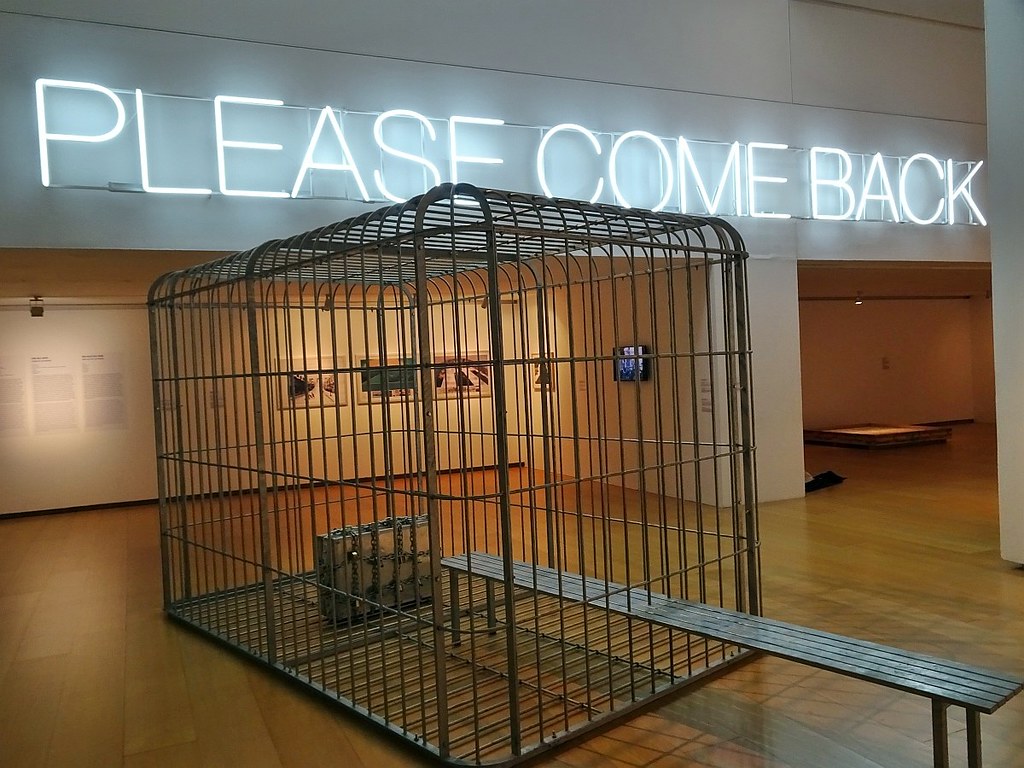
Photo: “0103-IVAM – Please Come Back 05” by gibbix1 is licensed under CC BY-NC 2.0.

Sonnet: ‘Maz’ Griffiths, ‘Internal Memo’

Dear Stomach,
… Look, we’ve really had enough.
Your job is simply to digest the stuff
supplied by Hands and Tongue, to move it through,
not chuck it up. Spurned food is déjà vu
and hurts Oesophagus; she’s frankly pissed,
and Face says please forget The Exorcist,
because projectile vomits are not fun
and bloody heartburn hacks off everyone.
Lungs say they’re worried by a niggling cough
and Guts say if you won’t perform: Sod off!
That’s not my phrase–I’m mediating here,
but want to stress the general atmosphere.

Please see these hiccups don’t occur again.
I sign myself, sincerely,
… Upper Brain

*****

Margaret Ann “Maz” Griffiths, born in 1947, suffered for years from a stomach ailment which finally killed her in 2009. Her frankness, good humour, range of interests and insights and her technical skill make her one of the very best English language poets of the early 21st century.

I recommend ‘Grasshopper‘, the 350-page compilation of her known verse, to anyone interested in modern poetry. It is one of those rare books that I reread every couple of years. I would be glad to hear of any more of her verse that has turned up since 2011.

Photo: By David Adkins – Scanned photo provided by David Adkins with permission for reuse, CC0, https://commons.wikimedia.org/w/index.php?curid=16997441

Jerome Betts, ‘Lines On A Lady In Bronze’

(The statue of Boadicea and her Daughters by Thomas Thornycroft was erected in 1902 near Westminster Bridge London.)

Set up, the civic skyline Shardless,
A proxy late Victoria then,
She charges, rein-free, grim, regardless,
Towards the Gothic giant, Big Ben.

Just what is known about this fiery
And long ago wronged ruler’s life?
Such fields for scholarly enquiry
Are now churned up by toxic strife.

For some, her Roman power rejection
Makes for a memory well kept green,
While others mock as myth-confection
Their proto-Brexit British queen.

Remainers, Leavers, play Have at you!
That chariot and rearing pair
Of  horses make a super statue.
Whoever wins, she’ll still be there.

*****

Jerome Betts writes: “I find statues fascinating with their largely unchanging nature as the people and scenes around them change and they make an obvious target for revolutionaries, rowdies and rhymers. Boadicea, unveiled without ceremony in 1902 because of Edward the 7th’s appendicitis, strikes me as a splendid piece of slightly unhistorical sculpture and useful landmark for visitors. Amusement at her lack of reins and apparent charge towards the Palace of Westminster blended with the Brexit debate when the piece was published in Better Than Starbucks. Whether this dooms the last two stanzas to the archives remains to be seen.”

Jerome Betts lives in Devon, England, where he edits the quarterly Lighten Up Online. Pushcart-nominated twice, his verse has appeared in a wide variety of UK publications and in anthologies such as Love Affairs At The Villa NelleLimerick Nation, The Potcake Chapbooks 1, 2 and 12, and Beth Houston’s three Extreme collections. British, European, and North American web venues include Amsterdam QuarterlyBetter Than StarbucksLightThe Asses of ParnassusThe HypertextsThe New Verse News, and Snakeskin.

Photo: “Boadicea Statuary Group” by Rafesmar is licensed under CC BY-SA 3.0.

Weekend read: Odd poem: French President Emmanuel Macron, ‘Pour Sophie’

On a trip to Paris one day, little Sophie
Met a giant lady lighting up the night sky.
“What’s your name, you magical monster?”
“My many visitors call me the Eiffel Tower.”
“In all your attire, don’t you sometimes tire
Of being seen only as a humdrum tower?
You, a dragon, a fairy watching over Paris,
An Olympic torch held aloft in grey skies?”
“How you flatter me! So few poets these days
Ever sing the praises of my Parisian soul,
As did Cocteau, Aragon, Cendrars,
Trénet and Apollinaire… Since you’re so good
At seeing beneath the surface, you could
– If you like, when you’re back from France –
Take up your pen and write down
Why you like me – it would be nice and fun!”
“You can count on me! There’s so much to say!
I’ll write twenty lines… but who will read them?”
“Well, I know a man who’ll read your verse.”
“Really? Who?”
“The President of France.”

En voyage à Paris, la petite Sophie
Croisa une géante illuminant la nuit.
“Comment t’appelles-tu, monstre surnaturel?”
“Mes nombreux visiteurs m’appellent Tour Eiffel.”
“N’es-tu pas parfois lasse, avec tes mille atours
Que l’on ne voie en toi qu’une banale tour?
Toi le dragon, la fée, qui veille sur Paris,
Toi, immense flambeau planté dans le ciel gris!”
“Quel plaisir tu me fais! Ils sont devenus rares
Ceux qui comme Cocteau, Aragon ou Cendrars,
Trenet, Apollinaire, avaient su célébrer
Mon âme parisienne aux charmes singuliers.
Puisque tu sais si bien percer les apparences,
Tu pourrais, si tu veux, à ton retour de France,
Prendre à ton tour la plume et conter en anglais
(It would be nice and fun) ce qui chez moi te plaît!”
“Tu peux compter sur moi! Il y a tant à dire!
Je t’écrirai vingt vers… Mais qui voudra les lire?”
“Oh, moi j’en connais un qui lira ton cantique.”
“C’est?”
“Monsieur le président de la République.”

*****

This poem by French President Emmanuel Macron is in French alexandrine: 12 syllable lines, rhyming couplets. The translation is either by him (he is fluent in English) or by the French Embassy in London, as the poem was written for the English girl Sophie’s 13th birthday. She herself had initiated everything with the poem below, which she had sent in April 2017 to the French President… at that time the President was François Hollande, but Macron won the presidency later that year, and responded for Sophie’s birthday on November 1st. Her poem was 20 lines long, written out on her drawing of the Eiffel Tower; his response is also 20 lines long (counting the final question and answer as a single line, which it clearly is by metre and rhyme).

Here is 12-year-old Sophie’s ‘Centre of Attention’:

She has four beautiful legs,
Which help her stand proud,
She looks over everyone,
With her head in the clouds,
She is elegant and tall,
Wears a pretty, lacy skirt,
Whilst staring at her in awe,
Your eyes will not avert,
Her spine is amazingly straight,
Whilst her head touches the sky,
People look up and take pictures of her,
As they are passing on by,
You need to tilt your head up,
To be able to see all of her,
But when you do,
She is as pretty as a picture,
She is the centre of attention,
Noticed by everyone.
She is the Eiffel Tower,
She is second to none.

Macron created a nice circularity with his response to Sophie’s poem, by pretending it was written first and caused Sophie’s poem, rather than the other way round. All very playful.

Photo: “170714-D-PB383-151” by Chairman of the Joint Chiefs of Staff is licensed under CC BY 2.0.