I am God– Without one friend, Alone in my purity World without end.
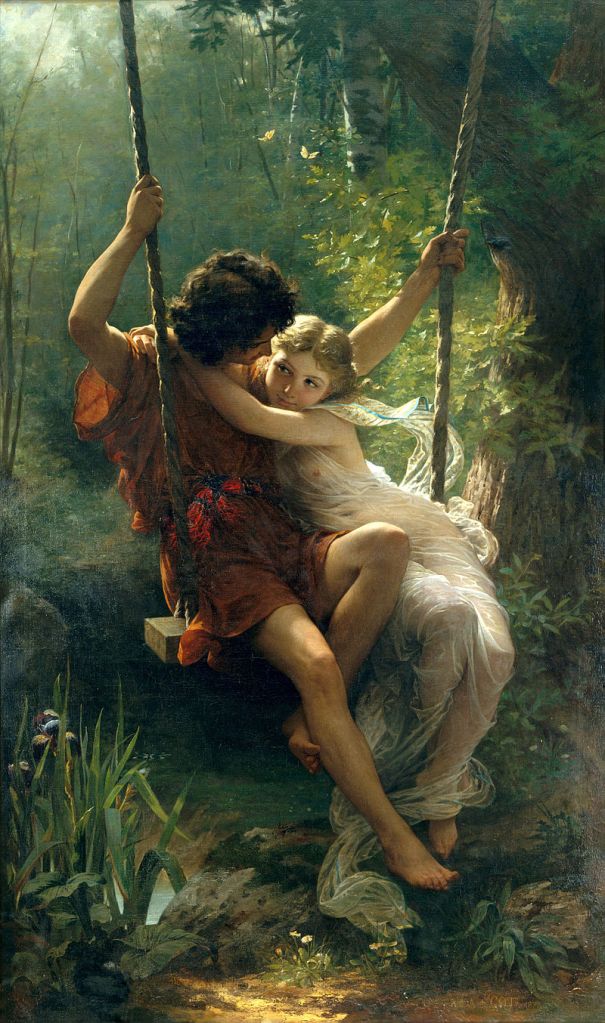
Below me young lovers Tread the sweet ground– But I am God– I cannot come down.
Spring! Life is love! Love is life only! Better to be human Than God–and lonely.
*****
Langston Hughes, key figure in the Harlem Renaissance, published his short poem ‘God’ in the October 1931 issue of Poetry. Despite the illustration I have chosen for his poem, Hughes was neither straight nor white… but I’m sure he would forgive my choice, as he was a very tolerant individual.
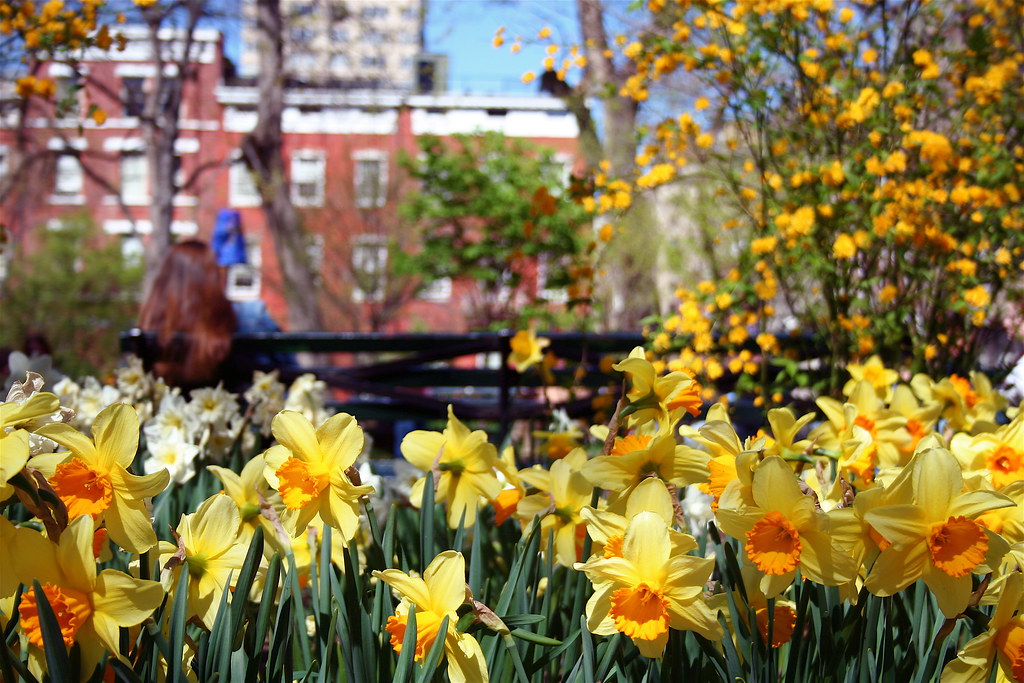
Those daffodils that I recall While lying on a bed settee Are faded now, their petals fall In nature and in memory.
It’s time to rise, to go outside And head off for a subway ride. I’m in New York’s YMCA Undressing for a midday swim;
A poet could not but be gay With bodies toned up in the gym. But I am getting no cheap thrills From dongs like dangling daffodils.
I twinkled at the twinkies there Tossing their heads in sprightly dance Or heading for the sauna where I might get lucky if, by chance,
One of the bronzed and buffed young men Is eager for my fountain pen. But, sadly, no one needs to hear This exiled poet strut his stuff.
I am an old Romantic queer, Ignored, unloved. I’ve had enough. I join the hustling New York crowd And wander lonely as a cloud.
*****
Conor Kelly writes: “Daffodils was submitted as a prompt poem to Rattle (https://www.rattle.com) and was printed in the Summer 2024 issue of the magazine. The prompt was to continue where another poem left off. So I disturbed Wordsworth on the couch where he lay remembering daffodils and sent him on his gay way to modern New York where he had some dubious adventures. I kept the stanzaic form, the metre, the rhyme scheme and even some of the original lines. I left him where he began, wandering lonely as that singular cloud.”
Conor Kelly was born in Dublin and spent his adult life teaching in a school in the city. He now lives in Western Shore, Nova Scotia from where he runs his twitter (X) site, @poemtoday, dedicated to the short poem. He has had poems printed in Irish, British, American, Canadian and Mexican magazines. He was shortlisted for a Hennessy New Irish Writers award. At the ceremony one of the judges, Fay Weldon, asked him, “Where are you in these poems?” He is still asking himself that same question.
The poet drinks, he stinks, he pees in sinks. The audience, superior as shrinks, Appraise a life amusingly in tatters.
How they appreciate a play that flatters Their minds with chat about artistic matters! And how much more they savour nods and winks And saucy homosexual high-jinks!
They go home thinking: ‘Poets? Mad as hatters! They drink, you know! They stink! They pee in sinks!’
*****
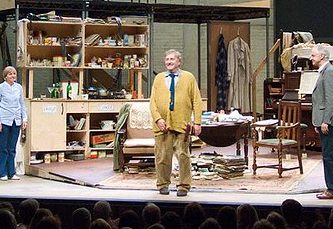
George Simmers writes: “Alan Bennett’s 2009 play The Habit of Art deals with the later life of W.H. Auden, and deals frankly with Auden’s sexual and hygenic peculiarities, as well as giving a sense of the poet’s talent. Looking back on his poem, written soon after seeing a performance at the National Theatre, I was more annoyed by the sniggering audience of London sophisticates than by Bennett’s play, which has interesting things to say about the relationship between poetry and the fallible humans who create it.”
George Simmers used to be a teacher; now he spends much of his time researching literature written during and after the First World War. He has edited Snakeskin since 1995. It is probably the oldest-established poetry zine on the Internet. His work appears in several Potcake Chapbooks, and his recent diverse collection is ‘Old and Bookish’.
FitzGerald’s version of Omar Khayyam’s Rubaiyat is one of the glories of English poetry. It has contributed more phrases and common quotations to the language, relative to its size, than any other piece of literature – including the Bible and Shakespeare. “A flask of wine, a book of verse, and thou”… “The Moving Finger writes; and having writ // Moves on”… and so on.
FitzGerald came out with five editions of the Rubaiyat (the fifth being posthumous), with 75 four-line stanzas in the first edition, then tinkering with it for the rest of his life: adding another 30 stanzas, subtracting again, and constantly modifying words, phrases and punctuation. The first edition has several things in its favour: succinctness, and the fire and integrity of the original effort.
Edward FitzGerald was a strange character. His personal life was a long search for friendship of two types: intellectuals with a passion for literature (Tennyson, Thackeray, Carlyle), and unintellectual men much younger than himself who were noted for their “manly” looks. His life and search were difficult, as Victorian England didn’t make life easy for homosexuals.
On the creative side, this search for friendship showed up as a need to be a co-creator: showed up in art, where he had a lifelong habit of buying paintings and cutting them down to a better composition and touching up the work to improve it; in music, where he arranged the works of others for his friends to sing; and in literature, where he found his genius in the works of others, translating Aeschylus, Calderon and Khayyam from the original Greek, Spanish and Persian, striving to identify with the original author and replicate in English not their exact words but the thrust of their thought and emotion. And with the Rubaiyat he appears to have been successful in every way. The five versions published between 1859 and 1889 constitute the single best-selling book of poetry in English.
Of the hundreds of editions that have been published since FitzGerald’s death, my two favourites are: for the lushness, the one illustrated by Edmund Dulac; and, for the background and insights, the one with an introduction by Dick Davis and published by Penguin in 1989.
In this particular Penguin edition (there have been several others), FitzGerald’s first edition and fifth edition are given in full, together with a complete listing of all the other variations found in the intervening versions. But – FitzGerald’s Rubaiyat only being 300 or 400 lines, depending on the version – all of that barely takes up 50 pages. Dick Davis’ introduction, almost as long, was presumably commissioned to make this a saleable book. And it is his introduction that gives it its full value.
Davis covers the life and what can be known of the personality of Omar Khayyam and – in conjunction with a review of FitzGerald’s life, personality, agnosticism and guarded homosexuality – the attraction, almost identity, that FitzGerald felt for him. He also investigates and approves the depth of FitzGerald’s translation skills, and analyses his use of rhyme scheme and meter. FitzGerald originally started translating Khayyam into paired couplets (aabb) before seeing the benefit of Khayyam’s rubaiyat (aaba) – given the epigrammatic nature of the verses, each quatrain is a stand-alone philosophic proposition and the return in the fourth line to the rhyme of the first two lines tends to heighten the sense of inevitability in each stanza.
Perhaps the most intriguing thought to come from Davis’ Introduction is that the sensual illustrations of half-naked women, so common in our collection of Rubaiyats, are all wrong. From linguistic and cultural clues in both the Persian and the English, it appears that the Saki, the young cup-bearer, the Thou of the flask of wine and book of verse, should be an attractive young male with his first moustache starting to grow in. In other words, and despite my preference for Dulac, FitzGerald’s version of the Rubaiyat of Omar Khayyam would perfectly support lush, ornate, gay illustrations; and that is likely what FitzGerald – and Khayyam himself – would have preferred.
Les sanglots longs Des violons De l’automne Blessent mon cœur D’une langueur Monotone.
Tout suffocant Et blême, quand Sonne l’heure, Je me souviens Des jours anciens Et je pleure;
Et je m’en vais Au vent mauvais Qui m’emporte Deçà, delà, Pareil à la Feuille morte.
English translation: Autumn Song
The long sobs Of the violins Of autumn Wound my heart With a monotonous Languor.
All breathless And pale, when The clock strikes, I remember The old days And I cry;
And I go In the ill wind Which carries me Here, there, Like the Dead leaf.
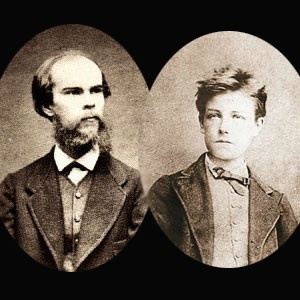
Published as part of his first collection ‘Poèmes saturniens’ in his early 20s, ‘Chanson d’automne’ has always been one of Paul Verlaine’s most popular poems. Even if a very young man saying “I remember the old days, and I cry” seems as questionable as the teenage Mary Hopkin singing “Those were the days, my friend”, the poem rings true. And Verlaine was certainly unsettled. Attracted to men, he soon married a young woman to try to “heal himself of the disease”. But then came Rimbaud.
Le Bateau ivre
Comme je descendais des Fleuves impassibles, Je ne me sentis plus guidé par les haleurs : Des Peaux-Rouges criards les avaient pris pour cibles Les ayant cloués nus aux poteaux de couleurs.
English translation: The Drunken Boat
As I went down impassive rivers, I no longer felt myself guided by the haulers: Yelling Redskins used them as targets Having nailed them naked to coloured stakes.
This is the first quatrain of Arthur Rimbaud’s 100-line poem The Drunken Boat, one of his very best, written when he was 16. It is technically traditional, written in alexandrine quatrains rhyming abab. Told in the voice of the boat itself on a river, the drunken boat is throwing off the restrictions and requirements of its old life, feeling an inescapable desire to follow the natural flow to its destiny, the sea. Some of the sights are appalling (like a dead whale rotting), some ecstatic (like phosphorescent waters), as the boat fills with water and the desire to be completely absorbed.
Earlier that year Rimbaud had explained his approach to poetry in a letter: “I’m now making myself as scummy as I can. Why? I want to be a poet, and I’m working at turning myself into a seer. You won’t understand any of this, and I’m almost incapable of explaining it to you. The idea is to reach the unknown by the derangement of all the senses. It involves enormous suffering, but one must be strong and be a born poet. It’s really not my fault.”
He then introduced himself to Verlaine by letter with various poems including The Drunken Boat. Verlaine, 11 years older than him, invited him to stay and fell for him completely. Rimbaud moved in, behaved scummily (belching and spitting at the table, talking with his mouth full) and made an immediate enemy of Mrs Verlaine who he only ever referred to as “the rat”. He had to leave. None of Verlaine’s friends could put up with him, so Verlaine rented rooms for him. Within a year Verlaine had effectively abandoned wife and young son, moving in with Rimbaud, and so together to London, then Brussels. Having fired a couple of pistol shots at Rimbaud in a fit of drunken jealousy, Verlaine was imprisoned for 18 months. Rimbaud moved on to new lovers and new countries–Java, Aden, Ethiopia, writing ever more experimental poetry, before returning to die in France at age 37. Verlaine taught in England for a few years, then taught English in France; he fell in love with one of his pupils, but lost him to typhus. He wrote increasingly symbolist poetry and sank into drug addiction, alcoholism (absinthe, of course) and poverty. He died five years after Rimbaud, aged 51.
And now the French government is grappling with a petition to relocate both poets from their comparatively obscure burial places to the Pantheon, “alongside other great literary figures like Voltaire, Rousseau, Dumas, Hugo and Malraux”. The Culture Minister is in favour of the idea, but there is an angry backlash. There is a BBC story here.
But there is no argument that the poetry itself is among the best produced by France.

 Form in Formless Times