Tag Archives: J.D. Smith

Rondeau: Political Poem: J.D. Smith, ‘Citizen Vain’

Who burned his sled? That would explain
The wisps of hair coiffed like a mane,
The name writ large on thrusting towers,
His rating of his works and powers.
Who wouldn’t take up his refrain?

A loser, say, without a brain
And envious he can’t obtain
Fresh wives imported like cut flowers.
(Who burned his sled?)

A nation may endure a reign
Of fire once tended with some pain
Outlasting its appointed hours
Yet starved, for all that it devours.
The question holds fast like a stain–
Who burned his sled?

*****

J.D. Smith writes: “I try not to say or write the name of the moral homunculus who is currently the 47th President of my country, lest my words get entangled in his omnipresent branding. That said, in verse I have occasionally renounced him and all his works. This poem was first published during the 2016 primary season, when speculating on how that troubled and troubling man became that way was still an interesting parlor game with low stakes. While others with credentials in psychology have discussed his origin story, perhaps most notably in this book, as a poet I gravitated toward metaphor. As some will ask a badly behaved person “Who broke you?” or “Who hurt you?”, I began to wonder ” Who burned his sled?” in the sense of some analog to the loss of Charles Foster Kane’s sled Rosebud in Citizen Kane. What early personal trauma made the current collective trauma possible?”

J.D. Smith’s seventh collection of poetry, The Place That Is Coming to Us, was published in September by Broadstone Books. His first fiction collection, Transit, is available from Unsolicited Press. Further information and occasional updates are available at www.jdsmithwriter.com.

Photo: screenshot from that unbelievably offensive AI-generated video that Trump posted of himself as King Trump in a King Trump fighter-jet, bombing American protesters with his diarrhoea.

J.D. Smith, ‘Eulogies’

Eulogy, First Draft
The bastard’s dead,
That much is true.
What can be said?
It sounds ill-bred
To say, “He’s through.
The bastard’s dead.”
Perhaps, instead,
“We mourn.” Few do.
What can be said?
“He shared no bread.
He slurred the Jew.”
The bastard’s dead.
He often wed
And wandered, too.
What can be said
That will not spread
The truth we knew?
The bastard’s dead.
Much will be said.

Eulogy, Second Draft
He never killed a man.
I think he paid his taxes.
He didn’t join the Klan
And didn’t send junk faxes.
I once heard him say please,
Perhaps a muffled thanks.
On drunken weekend sprees
He shot off only blanks.
On principle, I guess,
I’m sorry that he’s dead,
As most here would profess.
I’ll quit while we’re ahead.

Eulogy, Revised
I think this is the final text.
I’ve got nothing, friends. Who’s next?

*****

J.D. Smith writes: “We are told not to speak ill of the dead. Fair enough, in some ways. It isn’t sporting to assail those who aren’t present to defend themselves, and even the most skeptical can still feel the fear of summoning an angry spirit.
And yet. We can all think of instances where the world was improved by someone’s leaving it. Similarly, the removal of a troublesome athlete from a team is called “addition by subtraction.” We again come face to face with Clarence Darrow‘s most famous quotation: ‘I’ve never wished a man dead, but I have read some obituaries with great pleasure.
Obituaries themselves, particularly of public figures, are often couched in positive or no worse than neutral terms. A multitude of sins is covered by words such as “controversial.” At the same time, a dialectic obtains. I am under the impression that negative if not excoriating obituaries of public figures have grown more common in the British press, and that practice has occasionally migrated to my country, the United States. The example that comes to mind is a scathing review of the life of tycoon Walter Annenberg. We now and again see similar takedowns of not-so-dearly-departed private citizens in local newspapers.
The same issues present themselves in eulogies. I’ve never been presented with a situation where I could take the podium and slag the deceased, and if the opportunity ever does arrive I almost certainly lack the spine and other parts to take advantage of it. My Jungian shadow and I keep in touch, though, and various thoughts arise. Hence this little suite of poems. There are some we come not to praise but to bury, and as soon as possible.”

This poem was collected in Catalogs for Food Lovers.

J.D. Smith’s seventh collection of poetry, The Place That Is Coming to Us, will be published later this year by Broadstone Books. His first fiction collection, Transit, is available from Unsolicited Press. Further information and occasional updates are available at www.jdsmithwriter.com.

Photo: “Good Riddance” by dgansen is licensed under CC BY-NC-SA 2.0.

J.D. Smith, ‘Monday in Las Vegas’

The skirts are off the tables.
A bucket’s on the floor
Until the plumber shows up.
In comped rooms, whales still snore.

An escort takes the day off
For visitation rights.
McCarran’s slots are ringing
With scores of outbound flights.

Housekeeping finds stray bits of
What happens and stays here:
Pawn tickets and a red chip,
Three shoes and one brassiere.

Booms or busts in housing
Roll through the neighborhoods,
And long-haul trucks deliver
All necessary goods.

Lit hard against the evening,
Severe and even grand,
The Luxor’s daytime profile
Recedes into the sand.

*****

J.D. Smith writes: “What happens behind the scenes—backstage, in the restaurant kitchen, under the metaphorical hood, what have you—has long fascinated me. Most of the time we don’t get to see the mechanics, the furious underwater paddling of the duck.
“In my experience, nowhere is the gap between the making and the made more pronounced than in Las Vegas. In the previous century a town of about five thousand people has grown to a metropolitan area of a million or so and well beyond its ecological carrying capacity, now accommodating a major airport with slot machines at the gates. Entertainment of all kinds depends on relatively low-paid labor, and pawn shops can be found off the Strip but conveniently close to it.   
“The city’s artifice if not hubris arguably culminates in the Luxor Hotel, which my friend the writer and editor Henry Perez has called “the world’s largest piece of kitsch.” I would also call it an embodied non sequitur. A glass pyramid with a massive Sphinx, it imitates the most famous structures of a civilization based on floodplain agriculture, generally not a viable option in Nevada. The Luxor is part of a small break in the desert, and my money is on the latter.”

This poem was collected in The Killing Tree.

J.D. Smith’s seventh collection of poetry, The Place That Is Coming to Us, will be published in September by Broadstone Books. His first fiction collection, Transit, is available from Unsolicited Press. Further information and occasional updates are available at www.jdsmithwriter.com.

Photo: “Why I hate Las Vegas” by mayhem is licensed under CC BY-NC-SA 2.0.

Sonnet: J.D. Smith, ‘Behind the Epic’


The people’s greatest men go forth for years
By land or sea, depending on the foe,
Arrayed with shining swords, shields, helmets, spears
And dazzling banners raised again to show
 
Who holds dominion over flocks and fields,
Who levies tribute and is far renowned
For showing mercy to the town that yields,
That isn’t burned or leveled to the ground.
 
The singer of the tribe, near-sighted, lame,
Stays with the women and shares in their chores
Until he’s asked to lend a lasting fame
To heroes’ actions in their latest wars.
 
A traveler who visits on a whim
Might note how many children look like him.

*****

J.D. Smith writes: “This poem is rooted perhaps as much in popular culture as in the long narratives of the past. Readers of a certain age will recognize the title as a variation on the VH-1 series Behind the Music, which documented the frequently seamy and hedonistic underside of bands’ and artists’ careers. I am also having a bit of fun with highly gendered work roles; this consideration strikes me as increasingly relevant given the rise and metastasis of the “manosphere” and its conflation of masculinity and predation. As for the final couplet, somewhere in the back of my mind was a running gag from King of the Hill. Hank Hill’s friend Dale, while obsessed with conspiracy theories, never quite figures out why his son bears a more than passing resemblance to another character on the program.”

J.D. Smith’s seventh collection of poetry, The Place That Is Coming to Us, will be published in September by Broadstone Books. His first fiction collection, Transit, is available from Unsolicited Press. Further information and occasional updates are available at www.jdsmithwriter.com.

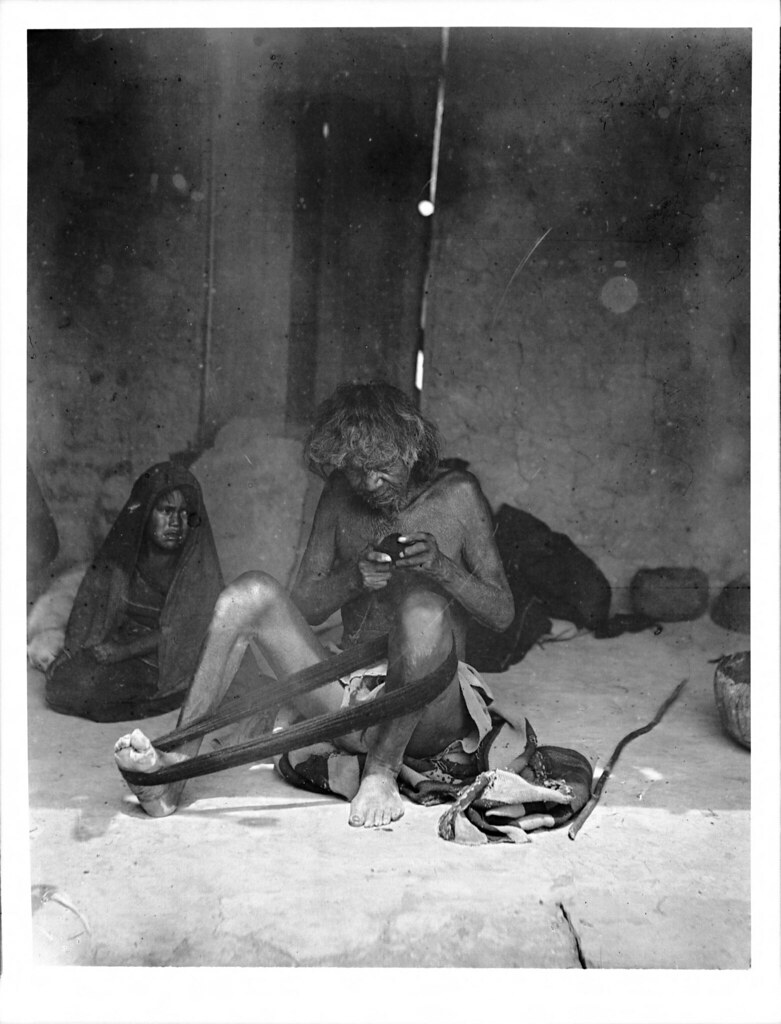
Photo: “Old blind man winding yarn with a young girl watching, Arizona, ca.1898 (CHS-4572)” by  is licensed under CC BY 2.0.

Shakespearean Sonnet: J.D. Smith, ‘Drunkard Watched from an Upper Floor’

His weaving adds up to a hapless cloth
on both sides of the street: just short of falling,
he staggers, with a stop to vomit froth.
He’d go far safer if he took to crawling.
A brace of cans, though, and a paper sack
are taking up the hands his legs could use,
as gales inside his head tell him to tack
and sway but hold his cargo fast, to choose
the service of his thirst above all pride
or fear that he might offer easy prey.
The spirits he has taken as his guide
make him loop back to take another way.

Ten minutes pass. He’s near where he began,
reminding me of when I’ve been that man.

*****

J.D. Smith writes: “Between typical youthful indiscretions and self-medicating for untreated depression in earlier life, I have had some tipsy times. The obvious negatives aside, recalling those experiences has made me more sympathetic than I would naturally be in contemplating others’ frailty. The rhetoric of the Elizabethan sonnet structure, moreover, compelled me to bring precision to the experience of seeing oneself in another.”

J.D. Smith has published six books of poetry, most recently the light verse collection Catalogs for Food Loversand he has received a Fellowship in Poetry from the United States National Endowment for the Arts. This poem is from The Killing Tree (Finishing Line Press, 2016). Smith’s first fiction collection, Transit, was published in December 2022. His other books include the essay collection Dowsing and Science, and his seventh collection, The Place That Is Coming to Us, will be published by Broadstone Books in 2025. Smith works in Washington, DC, where he lives with his wife Paula Van Lare and their rescue animals.
X: @Smitroverse

Photo: “Onward Ever Downwards” by Stephan Geyer is licensed under CC BY-NC-ND 2.0.


Using form: Rondeau: J.D. Smith, ‘Sans Issue’

What ends with me? A set of genes,
The notion that my slender means
Might turn into a son’s estate,
The hope that, at some distant date,
Beside my grave, my line convenes

To recollect my days’ routines,
My counsels, and the vanished scenes
Whose witnesses would recreate
What ends with me:

The consciousness that struts and preens
In holding that its passing means
An altering of our species’ fate,
My thought possessed of untold weight.
Yet, on that thought, the question leans–
What ends with me?

*****

J.D. Smith writes: “After reaching a certain age and making certain commitments, I found myself coming to grips with never being a parent. As in other instances of following form, the repetitions of the rondeau gave me a way to enclose and develop my response to the situation.”

J.D. Smith has published six books of poetry, most recently the light verse collection Catalogs for Food Loversand he has received a Fellowship in Poetry from the United States National Endowment for the Arts. This poem is from The Killing Tree (Finishing Line Press, 2016). Smith’s first fiction collection, Transit, was published in December 2022. His other books include the essay collection Dowsing and Science, and his seventh collection, The Place That Is Coming to Us, will be published by Broadstone Books in 2025. Smith works in Washington, DC, where he lives with his wife Paula Van Lare and their rescue animals.
X: @Smitroverse

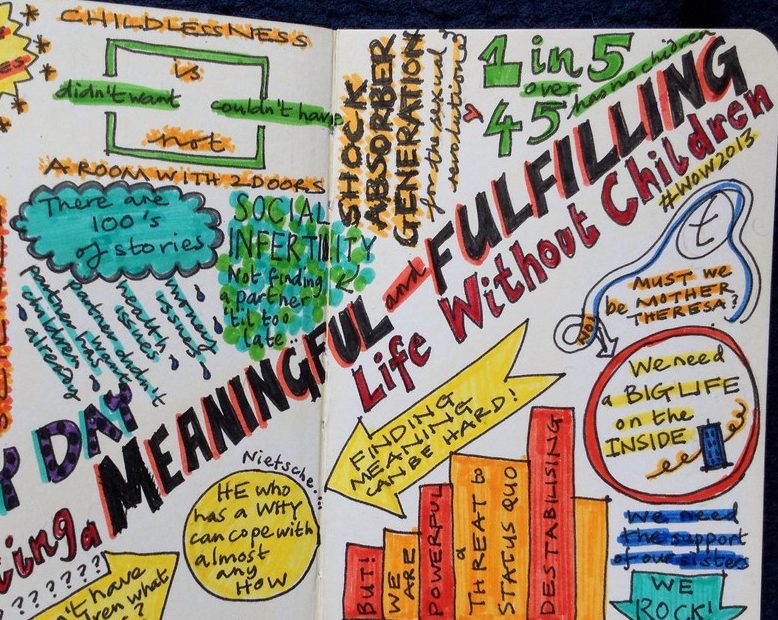
Photo: “Creating a meaningful and fulfilling life without children #sketchnotes #gatewaywomen #jodyday” by etcher67 is licensed under CC BY-NC-ND 2.0.

Sonnet variation: J.D. Smith, ‘Lullaby for the Bereaved’

Your hours of tears won’t let you follow
Those who’ve left you alone.
Tonight your head lies on a pillow,
Not beneath earth and stone.

The dead won’t be returning,
Not for all of your pleas,
Not for all your candles burning.
Get up off your knees.

The deceased, removed from their rest
Can take up all your hours
Until your mind, denied a fair rest,
Is deprived of its powers.

The road set before you is rocky and steep,
So seize the night’s respite and drift off to sleep.

*****

J.D. Smith writes: “Though I do not sing, play an instrument or read music, I had Brahms’ Lullaby in the back of my mind while attempting to deal with various losses, and the poem roughly follows its tune. In adjusting to a new reality (I hesitate to say “move on” or “get over,” phrases that smack of empathic failure), sometimes all one can do is rest.”

J.D. Smith has published six books of poetry, most recently the light verse collection Catalogs for Food Loversand he has received a Fellowship in Poetry from the United States National Endowment for the Arts. This poem is from The Killing Tree (Finishing Line Press, 2016). Smith’s first fiction collection, Transit, was published in December 2022. His other books include the essay collection Dowsing and Science, and his seventh collection, The Place That Is Coming to Us, will be published by Broadstone Books in 2025. Smith works in Washington, DC, where he lives with his wife Paula Van Lare and their rescue animals.
X: @Smitroverse

Photo: “Grief” by That One Chick Mary is licensed under CC BY-NC-ND 2.0.

The Two-State Dissolution (3): Smith, Burch, Foster, McCarthy, Helweg-Larsen, Bales

J.D. Smith, ‘Apology in Siege’

I hope you will forgive me
for having given you hope—
Too late for youthful indiscretion, though
I believed my story and felt young in it
until the metal facts fell.

I’d still like to imagine some god
would help, but that line looks broken
like the water, the gas and electricity.

What we have is hours, and in them
you should have the bread and fruit
before they feed the rats.
I am keeping the wine for myself.
It is piss-poor, anyway, and I have
far more to forget.

J.D. Smith, ‘Slant Psalm’

My right hand has never known cunning,
yet I remember thee, O Jerusalem,
not as others’ sacred city
but capital and emblem of loss,
origin of far wandering
without prophecy of return.

My right hand has never known cunning.
May I have, as recompense, forgetting.

Michael R. Burch, ‘Starting from Scratch with Ol’ Scratch’
for the Religious Right

Love, with a small, fatalistic sigh
went to the ovens. Please don’t bother to cry.
You could have saved her, but you were all tied up
complaining about the Jews to Reichmeister Grupp.

Scratch that. You were born after World War II.
You had something more important to do:
while the children of the Nakba were perishing in Gaza
with the complicity of your government, you had a noble cause (a
religious tract against homosexual marriage
and various things gods and evangelists disparage.)

Jesus will grok you? Ah, yes, I’m quite sure!
Your intentions were noble and ineluctably pure.
And what the hell does THE LORD care about Palestinians?
Certainly, Christians were right about serfs, slaves and Indians.
Scratch that. You’re one of the Devil’s minions.

Gail Foster, ‘On The Heights Above Jezreel’

War’s harvest then is of these bitter fruits
Hot shards of shrapnel buried in the flesh
Of children, olives ripped up from the roots
The horrid cries that fly from the nephesh
And blinded eyes. Who benefits from this?
Warmongers, metal forgers, men who plan
Whole cities while still smoking ruins hiss
Black marketeers and strategists. Who can
Sleep peacefully while others have to hide
Their families beneath their mothers’ skirts
And bury them before their tears have dried?
When will this harvest of these bitter hurts
Be over? On the heights above Jezreel
The storm clouds gather. Over soon I feel

Martin McCarthy, ‘The Unkillables’

There’s no great reason here to sing,
but still they sing and play once more …
the filthy, ragged children of the poor,
who shall, as always, inherit nothing.

There’s no beckoning paradise
beyond these war-torn streets of dirt,
where chalked slogans outline their hurt,
and yet, the unkillables rejoice!

Robin Helweg-Larsen, ‘Photo of a Dead Palestinian’

Hard to describe blown-off-ness of a head:
no head, neck, shoulder – only flopping flesh,
unfinished ending of a smooth-limbed, fresh,
strong, naked body on white-sheeted bed;
a tangled, mangled churning; then, instead
of the anticipated face (serene
as marble statue, Christmas figurine)
instead, disorganised meat, spilling red.

No face or brains or hair. We’re sick, confused.
The torn-off torso seems to have the calm
proportions of an adult – look again:
the genitalia of a boy of ten.
“Collateral damage” is the term that’s used.
Beside the body, on the sheet, an arm.

Marcus Bales: Right-Wing Semite-Murderer’s Song

Netanyahu:
I am the very model of a right-wing Semite-murderer,
Since I’m a Semite, too, the thing cannot get much absurderer.
My people were abused by every tribe and nationality,
So I, instead of empathy, embraced provinciality.
Because we were oppressed I’m now oppressing weaker other folks,
It gives me cover that we’re killing our Semitic brother-folks.
It isn’t ethnic cleansing if I swear that in my piety
I’m killing and I’m maiming only folks of my variety.

Nazi Chorus:
It isn’t ethnic cleansing if we swear that in our piety
We’re killing and we’re maiming only folks of our variety.
We’re killing and we’re maiming only folks of our varie- riety.

Netanyahu:
The same way each religion has its zealots kill for true-ishness
Islamic zealots have declared that they’ll erase all Jewishness,
And we have trained our own to act with criminal lethality
To counterbalance enemies of lethal criminality.

Nazi Chorus:
And we have trained our own to act with criminal lethality
To counterbalance enemies of lethal criminality.
To counterbalance enemies of lethal criminali- nality.

Netanyahu:
I play the left against the right. My politics are strenuous.
I say “If you hate one Jew …” Well, the rest is disingenuous.
That propaganda works so well is not much of a mystery
By pointing out how badly Jews were treated throughout history.
We’ve rarely had an easy time, with ghettos, rape, and slavery,
Our holidays still celebrate the mass of unmarked gravery.
But we survived because we had our own ulteriority —
And now we’re in a place at last where I am the authority.

Nazi Chorus:
But we survived because we had our own ulteriority,
And now we’re in a place at last where we are the authority.
And now we’re in a place at last where we are the authori- thority.

Netanyahu:
The Stern Gang and the Irgun were the Hamas of their day and time
They killed and maimed the British, and they justified dismaying crime,
And now my brave Israeli right-wing zealots take that bow for theirs,
And use exactly those excuses Hamas uses now for theirs.

Nazi Chorus:
And now our brave Israeli right-wing zealots take that bow for theirs,
Exactly with the same excuses Hamas uses now for theirs.
Exactly with the same excuses Hamas uses now for now for theirs.

Netanyahu:
When everyone is furious that everyone is furious,
And injury is contemplating things yet more injurious;
When money spent on arms and planning how to break the breakerage
Could buy opponents whole, including buildings, stock, and acreage;
When every group is cheering zealots’ grim religiosity
And everyone is trembling with the fear of new atrocity,
I stay in office by appealing to the prejudicial dumb —
While filling my Swiss bank accounts just like Hamas officialdom.

Nazi Chorus:
I stay in office by appealing to the prejudicial dumb —
While filling my Swiss bank accounts just like Hamas officialdom.
While filling my Swiss bank accounts just like Hamas official- licialdom.

Netanyahu:
No policy’s absurd enough that mine is not absurderer.
I am the very model of a right-wing Semite-murderer.
It isn’t ethnic cleansing if I say that in my piety
I’m killing and I’m maiming only folks of my variety.

Nazi Chorus:
It isn’t ethnic cleansing if we say that in our piety
We’re killing and we’re maiming only folks of our variety.
We’re killing and we’re maiming only folks of our vari- variety.

Robin Helweg-Larsen, ‘Roots of Terrorism’

Step back a moment, and reflect:
not saying that it’s good or right
that chained, starved, beaten dogs would bite–
but what did you expect?

*****

Michael R. Burch, ‘Starting from Scratch with Ol’ Scratch’, first published in The HyperTexts
Martin McCarthy, ‘The Unkillables’, first published in The HyperTexts

Robin Helweg-Larsen, ‘Photo of a Dead Palestinian’ and ‘Roots of Terrorism’ first published in The HyperTexts

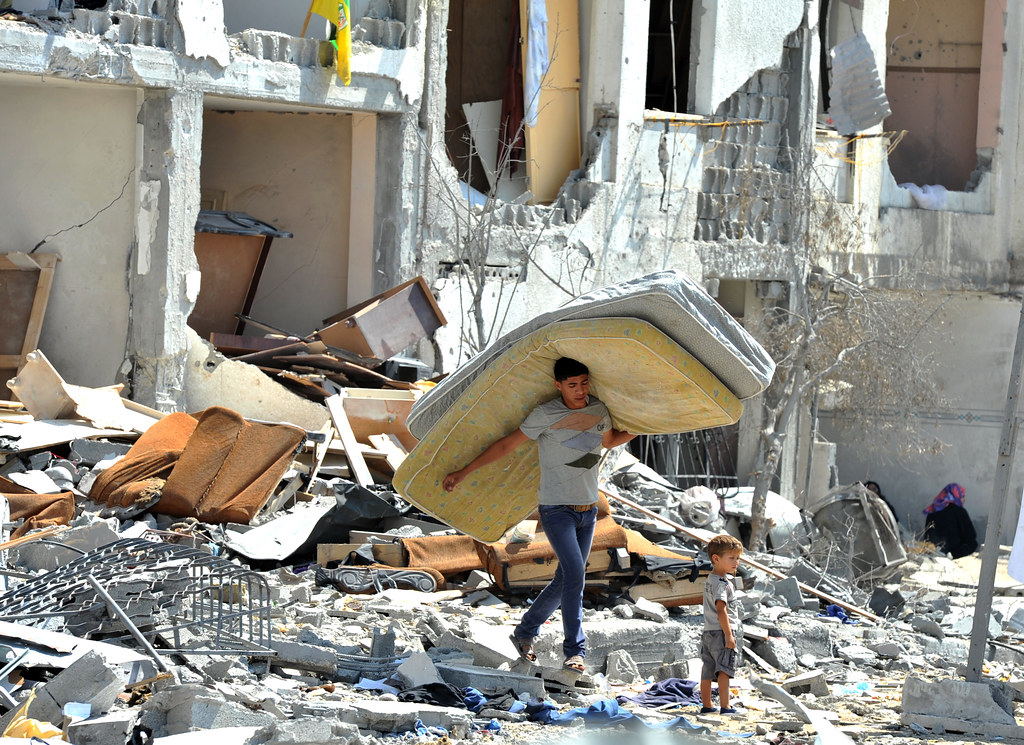
Photo: Anadolu Agency photographer Ali Jadallah – Gaza https://x.com/alijadallah66?lang=en
https://www.theguardian.com/world/2024/oct/05/one-year-in-gaza-since-the-7-october-attack-photo-essay

The Two-State Dissolution (2): Landsman, Burch, Lehr, Foster, Galef, Soderling, Kenny, Helweg-Larsen, Smith, Bales, Shore

Peggy Landsman, ‘Go Tell It On The Mountain

Hagar and Sarah should have talked,
Laughed together when alone.
Who did Abraham think he was?
Ha-Yehudi ha-rishon?*

Ishmael and Isaac should have been
Boon companions, closer than brothers,
Passing their days doing their chores,
Tending their father’s sheep together…

Staying up late entertaining themselves
Arguing over the numbers of stars
Each was the first to have named.

*”Ha-Yehudi ha-rishon” means “The first Jew” in Hebrew.

Michael R. Burch, ‘Frail Envelope of Flesh’
for the mothers and children of Gaza

Frail envelope of flesh,
lying cold on the surgeon’s table
with anguished eyes
like your mother’s eyes
and a heartbeat weak, unstable…

Frail crucible of dust,
brief flower come to this—
your tiny hand
in your mother’s hand
for a last bewildered kiss…

Brief mayfly of a child,
to live two artless years!
Now your mother’s lips
seal up your lips
from the Deluge of her tears…

Quincy Lehr, ‘Passive Voice’

History is back in passive voice.
All you can do is watch. The teams were picked;
the commentary doesn’t match the plays.
The game is rigged, and everybody sees.

The game is rigged, and everybody sees,
but referees ignore it, and debate
is limited to the cheap seats far away.
The villains are the only proper nouns.

The villains are the only proper nouns,
the only ones worth mentioning besides
the nebulous abstractions for the rest.
None believe what everyone accepts.

History is back in passive voice.
The game is rigged, and everybody sees
the villains are the only proper nouns.
None believe what everyone accepts.

Gail Foster, ‘The Heap’

How many does it take to make a right?
Go fling another on. The heap grows high
Before too long it will obscure the light
And then where will we be. The end is nigh
And still it reaches up towards the sky
How many more, the village women weep
Of all our sons and brothers have to die
While we pile wrong on wrong upon the heap

Remember sky, how blue it was and bright
And wide, when only birds and clouds did fly
And moons and stars were visible at night
When women laughed and children didn’t cry
What use is wrong for wrong and eye for eye
The world grows blind and bitter and we reap
What we have sown and see our rivers dry
While we pile wrong on wrong upon the heap

What use a pile of pacifists? The sight
May cause a running man to stop and sigh
The wise man said, and think about the fight
And for a fleeting moment wonder why
They chose to sacrifice themselves, deny
The life force and there lie in peaceful sleep
They make a monument, he said, nearby
While we pile wrong on wrong upon the heap

Dear God, when will it end? When will you try?
The heap grows higher and the sides too steep
We love our neighbours with the guns we buy
While we pile wrong on wrong upon the heap

Daniel Galef, ‘Desert Kite’

These endless shifting sands—
They’re always changing hands,
But you can’t make bricks without breaking a little hay.
With oil the streets are pavèd;
Since Solomon and David,
They draft a brand-new atlas every day.
The apostles! The epistles!
And the fossil fuels and missiles—
Like manna in the wilderness they fall!
The land of Abrahamics
Now hosts General Dynamics
With their guardian angels gliding over all.

Janice D. Soderling, ‘Out of Paradise’

A closely woven stillness lines the air,
like linen bedding in a lifted coffin.
Though silence is a hallmark of our time, not often
has the hush been so oppressive. Where
the sand fox sprawls, sprawls too the shattered hare.
Cadavers of gazelle and roe deer stiffen;
the wadded pods of thorn trees burst. If when
you ponder on this devastated garden,
its wretched shame, its bottomless despair,
think not animal, but human, shreds in Eden.
And human was the animal lately passing there.

Janet Kenny, ‘After’

We saw them sweep in like a wolf on the fold.
We hypocrites judge as if time was involved.

Lament, all you lovers whose loved ones are gone.
Condemn, all you judges now grief is your song.

After the fury what’s left to repair?
Oh impotent jury, your conscience is there.

No poem will save us no tears will avail.
No weapons will spare us from history’s gale.

No art can encompass the scale of this rage.
“Tomorrow” is yesterday trapped in a cage.

Robin Helweg-Larsen, ‘Books’

When Science and Experiment
were done through myth and dream, it meant
that Bronze Age herders showed their bent
in naïve tribal Books.

The Israelites searched 40 years
for good land, unprotected, bare,
and slaughtered all those living there –
justified by their Book.

The Muslims conquered far and wide
(and called it peace, and millions died)
to spread new tales we now deride,
new versions of that Book.

The Christians sent wave after wave
crusading, claiming that they’d save
the “Holy Land”… made it a grave,
thanks to their stupid Book.

You advertise benevolence
but justify intolerance
by quoting this or that sentence
from one or other Book.

You bomb a house, a baby dies…
lift up your eyes so we can rise
above the vicious tribal lies:
those stupid, stupid Books.

J.D. Smith, ‘Report from the Field’

I rang the doorbell
of the demolished house
and was met by its generations,
fully armed.

Marcus Bales, ‘Heal or Hate’

You lift or do not lift the weight;
You’re either dealt-to or you deal.
Pick the other, pick the one,
The choice you have is heal or hate,
And you can’t ever hate and heal

Call it nature, nurture, fate
Genetics, fantasy, or real —
Blame whatever – when you’re done
You lift or do not lift the weight.
You’re either dealt-to or you deal.

Short-term crooked looks like straight;
Short-term truth sounds like a spiel.
In both the short and longer run
The choice you have is heal or hate —
And you can’t ever hate and heal

I know, the choices don’t seem great.
They lack in zip or sex appeal.
But no one said this would be fun.
You lift or do not lift the weight.
You’re either dealt-to or you deal.

You must massage your mental state
To organize the way you feel
In spite of all the bullshit spun.
The choice you have is heal or hate,
And you can’t ever hate and heal

You often have to simply wait
And sift to see what’s really real
Since growing needs both rain and sun.
You lift or do not lift the weight;
You’re either dealt-to or you deal.

Late or early, it’s too late.
You’re living through the slow reveal.
The game is rigged: it can’t be won
Or even stopped once it’s begun.
You lift or do not lift the weight;
And though you’re dealt-to or you deal
The choice you have is heal or hate.
You cannot ever hate and heal.

Marion Shore, ‘Peace’

I came upon a garden in the sun,
where children ran and played among the trees,
and entering, I asked two little ones:
“Why are you here? And where are your families?”
One answered, “I was with my dad and mom.
We went into a café for a Coke.
And then I heard somebody scream ‘a bomb!’
and all that I could see was fire and smoke.”
The other said, “I went outside to play,
the street was crowded. Tanks were all around.
Soldiers were shooting. I tried to run away.
I heard a shot and fell down on the ground.
No one heard me crying for my mother.”
The first child said. “I wish I could go home.”
“So do I. But at least we have each other.”
The sun was rising higher in the sky:
my dream was fading, and as I waved goodbye,
‘Salaam,’ said one. The other said ‘Shalom.’


Yuval Noah Harari: We suffer not from the narrowness of the land, but from the narrowness of the mind. https://youtu.be/Uncfi9cgZWo

It’s all about stories: https://youtu.be/L82XOw9sVkY


Acknowledgements:
Peggy Landsman: ‘Go Tell It On The Mountain’, first published in The HyperTexts
Michael R. Burch: ‘Frail Envelope of Flesh’, first published in The Lyric
Daniel Galef: ‘Desert Kite’, first published in Light
Janice D. Soderling: ‘Out of Paradise’, first published in The Rotary Dial and included in her collection ‘War: Make that City Desolate’

Photo: “Scenes from Gaza Crisis 2014” by United Nations Photo is licensed under CC BY-NC-ND 2.0.

J.D.Smith, ‘Proposal’

Resign yourself, my heart’s delight,
To me before a better offer
Comes along with hair and height,
A sea-deep chest, a bulging coffer.

Don’t wait for him: if love’s a song,
I am the toad’s primeval croak.
If love’s a wheel, then I belong
Among its rusty, broken spokes.

If I mean nothing in the world
To you, that nothing could be all,
A version of transcendence, curled
And primed to blossom from your soul.

Who else is equal to this test,
This cup of gall? You’ve had a sip–
In our shared life you’ll taste the rest.
Come join me on this sinking ship.

*****

J.D. Smith writes: “This poem explains, if nothing else, why I didn’t go into sales. It was not written for a specific person, but it does capture a time earlier in my adulthood when I was frustrated on all fronts. The poem also partakes of self-parody. If Philip Larkin had proposed in writing, it might have gone something like what I did.”

J.D. Smith has published six books of poetry, most recently the light verse collection Catalogs for Food Loversand he has received a Fellowship in Poetry from the United States National Endowment for the Arts. This poem is from The Killing Tree (Finishing Line Press, 2016). Smith’s first fiction collection, Transit, was published in December 2022. His other books include the essay collection Dowsing and Science. Smith works in Washington, DC, where he lives with his wife Paula Van Lare and their rescue animals.
X: @Smitroverse

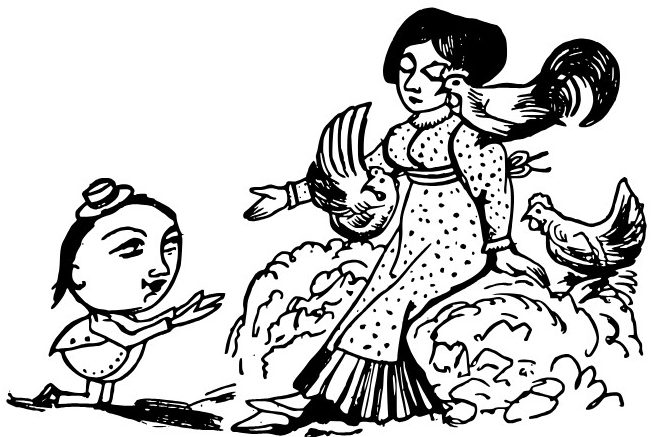
Illustration: by Edward Lear for his poem ‘The Courtship of the Yonghy-Bonghy-Bo’.