Tag Archives: Latin

Using form in translation: Virgil, tr. George Simmers, ‘Rumour’

Through Africa vile Rumour raced,
Of all the plagues the fastest-paced.
She’s supple, smart, light on her toes,
And gains momentum as she goes.
She may start small as creeping mouse
But soon she’ll overtop the house
Till, though in muck her feet may stand,
Her head is in Cloud-Cuckoo-Land.
Watch Rumour go! Her huge black wings
Hide fearful eyes, a tongue that stings,
Lungs that can bellow till they burst
And ears fine-tuned to hear the worst.
By night she’ll hiss round that odd place
Nor earth nor sky, but cyberspace,
And through those small hours she will keep
Alert and growing — she won’t sleep.
Come daylight she’ll observe with malice
Events in cottage and in palace.
Great cities then will shake in fear
At the enormities they hear,
And shudder when they taste the brew
In which she’s mixed the false and true.
Whenever men, fraught with disgust,
All eye each other with mistrust,
Great Rumour grins, her strength unfurled.
She relishes our post-truth world!

from Aeneid, Book Four

*****

George Simmers writes: “Plodding through a book of the Aeneid for O-level Latin when I was fifteen, many many years ago, I took a strong dislike to Virgil. But several decades later, a talk I attended made me think he might not be entirely tedious. The talk’s handout included a prose translation of this ‘Rumour’ passage. I decided to versify it myself, and found that it slipped quite easily into tetrameters. The eight-syllable line is fast and sharp, and avoids the temptation to ponderousness that always lurks within the pentameter.
Since then I’ve read more of Virgil, and have found that he is one of those poets whose writings have the knack of seeming topical. I have attempted some more translations. If I had to choose a top ten of poems that say something profound about the human condition, I would include his description of the souls purged of suffering, re-crossing the Styx to attempt a new life.”

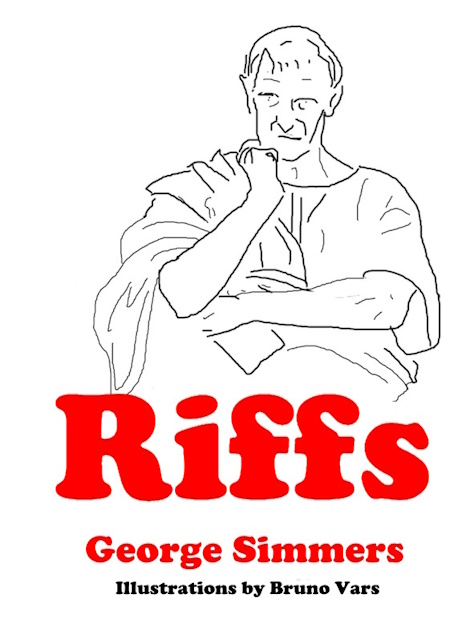
Editor’s note: Both ‘Rumour’ and the Styx-recrossing passage that Simmers mentions are in his recent volume of translations, Riffs, along with his translations from Ovid, Catullus, the Greek Anthology and Francois Villon. Riffs costs £5, and should be available from Amazon, but if you’d like a signed copy, email him: simmersgeorge@yahoo.co.uk and he’ll arrange one for you at no extra cost.

George Simmers used to be a teacher; now he spends much of his time researching literature written during and after the First World War. He has edited Snakeskin since 1995. It is probably the oldest-established poetry zine on the Internet. His work appears in several Potcake Chapbooks, and his recent diverse collection is ‘Old and Bookish’.

Photo: “Dark Angel” by Novafly is licensed under CC BY-SA 2.0.
Verse into Verse: George Simmers translates Catullus ‘VII’

Lesbia, you ask me quantify
How many of your kisses I
Might think enough. My answer? Count,
When you’re in Libya, the amount
Of tiny sand grains on the beach
Along the shining miles that reach
Between Jove’s shrine and Battus’s tomb.
Or count the stars that pierce the gloom
To stare all-seeing from above
Upon the privacies of love.
Let’s kiss and kiss with such excess
We’ll make all voyeurs’ minds a mess;
Add kiss on kiss, till we’ve a sum
So vast all gossips are struck dumb.

*****

This is one of the translations from Catullus to be found in the recently published pamphlet, Riffs, by George Simmers, editor of Snakeskin, the world’s longest-running monthly ezine for poetry. Riffs is a grab-bag of translations of poems that have appealed to him, from Ovid, Virgil, Catullus, the Greek Anthology and Francois Villon. For sample pages (featuring Ovid’s version of the myth of Narcissus) click here.

The plentiful illustrations are by Bruno Vars, whose pictures enlivened George’s previous pamphlet, Old, Old.

Riffs costs £5, and should be available from Amazon, but if you’d like a signed copy, email him: simmersgeorge@yahoo.co.uk and he’ll arrange one for you at no extra cost.

Robert Frost said that poetry is what gets lost in translation. George Simmers has tried to find it again. This is the ideal Christmas gift for the classicist in your life.

Odd poem: Julius Caesar, ‘On the poetry of Terence’ (fragment)

Thou too, even thou, art ranked among the highest, thou half-Menander,
and justly, thou lover of language undefiled.
But would that they graceful verses had force as well,
so that thy comic power might have equal honour
with that of the Greeks, and thou mightest not be scorned in this regard and neglected. It hurts and pains me, my Terence, that thou lackest this one quality.

Tu quoque, tu in summis, o dimidiate Menander,
Poneris, et merito, puri sermonis amator.
Lenibus atque utinam scriptis adiuncta foret vis,
Comica ut aequato virtus polleret honore
Cum Graecis neve​ hac despectus parte iaceres!
Unum hoc maceror ac doleo tibi desse, Terenti.

*****

Julius Caesar is known to have written at least three volumes of verse–‘Praises of Hercules’ and the verse tragedy ‘Oedipus’ as a young man, and a verse travelogue ‘The Journey’ during the civil war–but almost nothing survives. His heir Augustus cancelled the publication of the youthful verse because it was incompatible with the program for his deification.

The fragment above is quoted by Suetonius in his ‘Vita Terenti‘ (‘The Life of Terence‘), and translated by J. C. Rolfe.

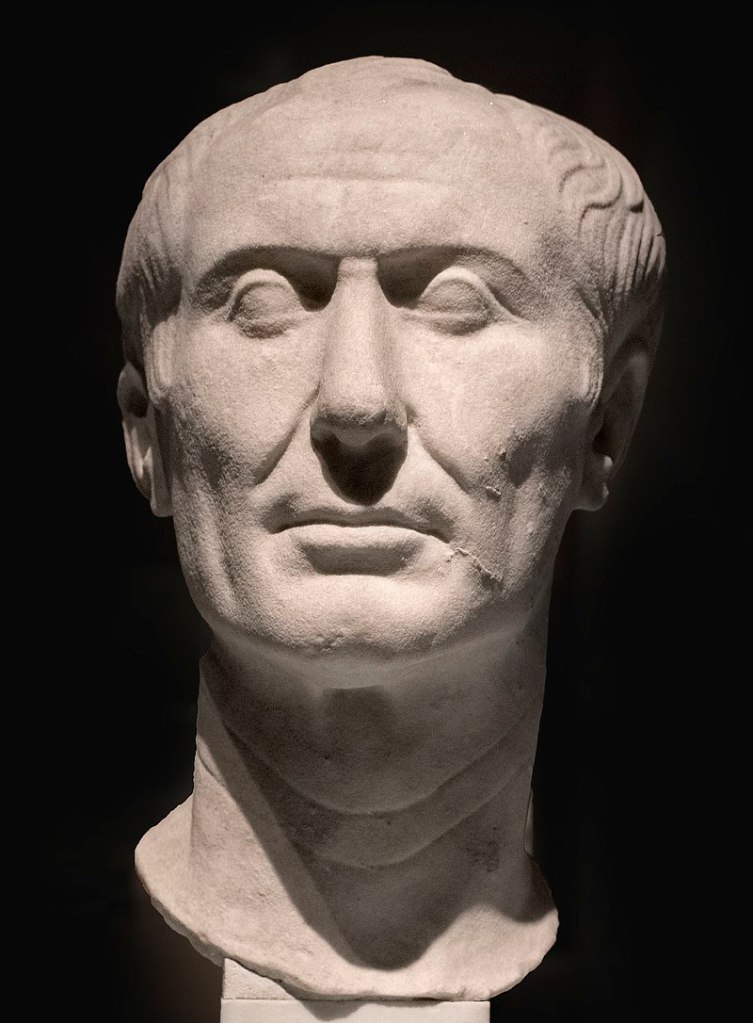
Photo: Retrato de Julio César uploaded by Ángel M. Felicísimo from Mérida, España.

Odd poem: ‘Motor Bus’, macaronic poem by A. D. Godley

What is this that roareth thus?
Can it be a Motor Bus?
Yes, the smell and hideous hum
Indicat Motorem Bum!
Implet in the Corn and High
Terror me Motoris Bi:
Bo Motori clamitabo
Ne Motore caedar a Bo—
Dative be or Ablative
So thou only let us live:
Whither shall thy victims flee?
Spare us, spare us, Motor Be!
Thus I sang; and still anigh
Came in hordes Motores Bi,
Et complebat omne forum
Copia Motorum Borum.
How shall wretches live like us
Cincti Bis Motoribus?
Domine, defende nos
Contra hos Motores Bos!

This elegant piece of nonsense was written in January 1914 to celebrate the introduction of a motorised omnibus service in the city of Oxford–hence the reference to two of its main streets, the Corn(market) and High Street. Noticing that both ‘motor’ and ‘bus’ could be the nominative singular of Latin nouns, Professor Godley wrote this series of couplets, declining and rhyming the nouns through all their presumed cases, singular and plural. (The poem presumes the old-fashioned English pronunciation of Latin with many hard vowels needed for the rhymes.) And why not? ‘Motor’ is Late Latin for ‘mover’, and ‘bus’ is a casual modern abbreviation of ‘omnibus’, Latin for ‘for everyone’. The entire piece is written in a mixture of English and Latin, and translates roughly as:

What is this that roars so,
Can it be a motor bus?
Yes, the smell and hideous hum
Indicates a motor bus!
In the Cornmarket and the High Street
Terror of the motor bus fills me:
To the motor bus I will call out
Lest I be killed by the motor bus–
You can be Dative or Ablative
So long as you let us live:
Where shall your victims flee?
Spare us, spare us, O Motor Bus!
So I sang; while still
Motor buses came in hordes
And the whole market place was filled
With a mass of motor buses.
How shall wretches like us live
Surrounded by motor buses?
O Lord, defend us
From these motor buses!

Macaronic, or mixed languages, literature has ancient roots, showing up wherever two languages overlap in one population for a while, frequently in verse, frequently for humorous effect: alternating Persian and Arabic verses or hemistichs of Saadi and Hafez; Rumi’s occasional mix of Persian, Arabic, Turkish and Greek; Indian poetry written in alternating indigenous Hindi and the Persian of the Mughal rulers; and Latin and vernacular languages throughout Europe at the end of the Middle Ages. Modern examples include the Beatles’ ‘Michelle’ and José Feliciano’s ‘Feliz Navidad’.

Photo: “Brandesburton, with NER motor buses 1915 (archive ref PO-1-18-1)” by East Riding Archives is marked with CC0 1.0

Review: Lord Macaulay, “Lays of Ancient Rome”

horatius

Macaulay’s ‘Lays of Ancient Rome’ are remarkable in several ways. The well-known ‘Horatius’ (aka ‘Horatius at the Bridge’) is glorious, memorable, stirring, heroic, in lovely rolling ballad-type stanzas:

Then up spake brave Horatius,
The Captain of the Gate:
“To every man upon this earth
Death cometh soon or late.
And how can man die better
Than facing fearful odds,
For the ashes of his fathers,
And the temples of his gods?”

Great stuff! It seems in keeping that Winston Churchill (love him or loathe him) would have learnt all 70 stanzas as a schoolboy, inspiring himself to develop courage (and oratory).

But the second remarkable thing is how bad the rest of the material in the volume is. The poetry is uninteresting, and the pure heroism of ‘Horatius’ is replaced either by gods winning the human battle, or by a girl being ‘saved’ from being despoiled by a tyrant by her father killing her when the three are together in the Forum (and not attempting to kill the tyrant), or by the poems deteriorating into blathery fragments.

Macaulay was wordy from an early age. The story is told of him that, uninterested in toys, he was reading avidly by the age of three and he already talked like a book. When hot coffee was accidentally spilled on his legs and a kindly woman asked “Is Diddums all right?” he replied, “Thank you, madam, the agony is abated.”

The third way in which this volume is remarkable is in the main Preface and in the shorter prefaces to each of the poems, especially ‘Horatius’. Here Macaulay lectures in detail on a perceived universal process of ballad creation in preliterate societies (and on the value of verse for memorisation), ballads’ subsequent devaluation when higher standards of literacy come in, and finally their total loss or partial recovery. He recounts the differences between two ballads of the Battle of Otterburn which have quite different outcomes for the protagonists, even though both ballads were probably written by people who were alive at the time of the battle.

And in a throw-away paragraph he inadvertently highlights the changes in education and culture that have taken place in the past 150 years: “The early history of Rome is indeed far more poetical than anything else in Latin literature. The loves of the Vestal and the God of War, the cradle laid among the reeds of Tiber, the fig-tree, the she-wolf, the shepherd’s cabin” (to these five he adds a further 23 examples, ending with) “the combat between Valerius Corvus and the gigantic Gaul, are among the many instances which will at once suggest themselves to every reader.”

As if! Well, that was then, this is now. But ‘Horatius’ itself has a timeless quality to it. Although if you are trying to invoke heroism by reading it to a 10-year-old which I strongly recommend, you should pre-read it and comfortably skip some of the unnecessary early verses.