Tag Archives: Lighten Up Online

Using form: Quatrains: Stephen Gold, ‘So Pseud Me’

My verse is of the humorous variety,
And does its best to brighten up society.
To spread a little joy’s a noble calling,
A life without a laugh would be appalling.

Yet still, of late, I’ve had a thought that niggles;
What worth is work that just produces giggles?
Should it be judged as slight and ineffectual,
Compared to art we label intellectual?

And so I did what “proper” poets do,
And signed up to The Scrivener’s Review,
“The connoisseur of poesy’s magazine”,
Where scribes will scratch your eyes out to be seen.

I found it was a terrifying place,
Where people were obsessed with lower case,
Allusions veered from cryptic to absurd,
And “meaning” seemed to be a dirty word.

Their poetry was like the peace of God,
That passeth understanding – truly odd.
Some claimed to write for womxn and for mxn,
Though none had come across the verb, “to scxn”.

With open mind, I asked, “Is it my fault
That there is nothing here I can exalt?”
But days of dredging through this awful rot
Confirmed beyond all doubt that it was not.

Each new excrescence served to reinforce
That I had veered disastrously off course.
I wheeled around and fled back to the light
Which shines upon the droll and erudite,

Bring on a world where rhyme and meter matters,
And isn’t full of folk as mad as hatters.
Adieu to “Scrivener’s Review”, I quit.
Do I need what you’re full of? Not one bit.

*****

Stephen Gold writes: “The idea for So Pseud Me came from wading through an august poetry periodical which had better remain nameless, and coming to the following conclusion: WTF?
There was some good, thoughtful work, but much of it was pretentious drivel, written by the deservedly obscure with their heads rammed firmly up that place where the Lord causeth not the sun to shine.
If you were to ask them, I guess most would place high verse on a pedestal, way above light. But on this, I am with Kingsley Amis, who wrote in the New Oxford Book of Light Verse:
“Light verse makes more stringent demands on the writer’s technique. A fault of scansion or rhyme, an awkwardness or obscurity that would damage only the immediate context of a piece of high verse endangers the whole structure of a light-verse poem. The expectations of the audience are different in the two cases, corresponding to the difference in the kind of performance offered. A concert pianist is allowed a wrong note here and there; a juggler is not allowed to drop a plate.”
‘So Pseud Me’ is a light-hearted attempt to speak up for jugglers.”

Stephen Gold was born in Glasgow, Scotland, and practiced law there for almost forty years, robustly challenging the notion that practice makes perfect. He and his wife, Ruth, now live in London, close by their disbelieving children and grandchildren. His special loves (at least, the ones he’s prepared to reveal) are the limerick and the parody. He has over 700 limericks published in OEDILF.com, the project to define by limerick every word in the Oxford English Dictionary, and is a regular contributor to Light and Lighten Up Online (where this poem was first published).

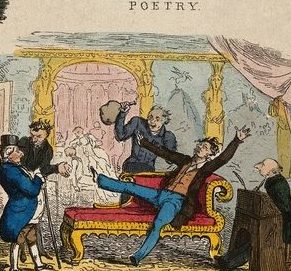
Illustration: “A group of poets carousing and composing verse under the influence of laughing gas. Coloured etching by R. Seymour after himself, 1829.” is licensed under CC BY 4.0.

Short poem: RHL, ‘Friendship, Not Passion’

I had a friendship, more than passionate love, for you;
we could have been so good, easy, together.
But there’s that issue of your strong religious thoughts,
whereas I let my thoughts change with the weather.

I… well, and who’s the I you think that you address?
I ramble, googly-eyed, my arms elastic.
There are so many sweet but sadly firm believers.
I’m – more than atheist – iconoclastic.

*****

If you’re used to iambic pentameter the meter of this poem feels just a little off, with its lines of alternating 12 and 11 syllables, i.e. alternating hexameters and feminine-ending pentameters… not quite comfortable. Which is perfectly in keeping with the relationship described. And I don’t remember precisely which long-ago not-quite-girlfriend I had in mind when I wrote it; I’ve been attracted to more than one charming female, wonderfully calm and sane except for some unfortunate religious orientation or other.

I’m reminded of the 19th century Punch cartoon of the two guests at a dinner party:
She: “And what is your religion, sir?”
He: “Madam, all men of sense are of the same religion.”
She: “And which religion is that, pray tell?”
He: “Madam, men of sense never say.”

Which is all very well for friendship, but hardly a solid basis for a deeper relationship. You’re better off if you hold out for someone philosophically compatible, unless you (and they) really don’t care. In which case, you’re philosophically compatible!

‘Friendship, Not Passion’ was originally published in Lighten Up Online, edited by Jerome Betts.

Illustration: “Friendship” by h.koppdelaney is licensed under CC BY-ND 2.0.

Ed Shacklee, ‘I Think Continually Of Men Dressed As Catherine The Great’

I think continually of men dressed as Catherine the Great,
Betty Boop or Greta Garbo, queens of film and state
who hitched their wagons to a star and switched the sex of Fate.

I think of fervid men in furs, the Humphries and the Dannies,
those lads who walked the walk in highest heels and padded fannies
and promenaded on the stage with debutantes and grannies –

the young, the old, the gayly bold who sashayed with panache
through droll burlesque or discotheques and made a spangled splash
in rainbow-hued ensembles that, while loud, would never clash.

They shaved and plucked, then nipped and tucked, ignoring boring foes
whose morals lagged while knuckles dragged around their unclipped toes.
These Joans – both Crawford and of Arc – and Marilyn Monroes

were kicked for kicks and picked upon, but got back up again;
and whether they were women inside men, or simply men
who liked to paint their nails and put on lipstick now and then,

I think continually of those whose vampy, cutting wit
and campy fame enflamed, then tamed, the bigot and the twit,
who were hammered till they stammered by their glamour and their grit
until a world a size too small became the perfect fit.

*****

This poem by Ed Shacklee, with its reference to Stephen Spender’s ‘I think continually of those who were truly great‘, was published in the current issue of Lighten Up Online.

Ed Shacklee lives on a boat in the Potomac River. His first collection, “The Blind Loon: A Bestiary,” was published by Able Muse Press.

And for those who like odd information and representations of animals, The Blind Loon: A Bestiary Facebook group is worth joining.

Photo: “Men in Drag” by jacki-dee is licensed under CC BY-NC-ND 2.0.

Short poem: ‘Poetic Tours de Force’

We aim to sing
Boldly as the brave acrobat on his thin string
Across the air.
But yet, no matter how we juggle words and dare,
And think ourselves stupendous,
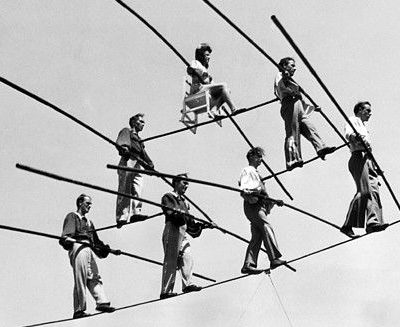
We’re risking nothing… we’re no Flying Wallendas.

*****

The Seven-Person Pyramid, the creation of Karl Wallenda, cost a couple of the acrobats their lives in 1962. https://www.heraldtribune.com/story/news/2012/06/10/wallendas-history-one-of-greatness-and-tragedy/29102856007/ Poetry may also try for spectacular effects, but without the inherent dangers of the highwire. Poets are more likely to risk their lives through their livers than anything else.

This short poem was just published in Lighten Up Online (thanks, Jerome Betts!)

Melissa Balmain, ‘Fallen’

As a kid growing up in New York,
I considered our fall second rate:
how I longed for the grand, mythological land
we exotically labeled Upstate.

In that Eden, I’d heard, leaves turned bright,
endless acres of yellows and reds,
while my single tree browned, dropping one tiny mound
that I kicked to the curb with my Keds.

Now I live several hours to the north,
and the maples and oaks truly blaze—
hues so loud they look fake—till the time comes to rake
without stopping, for numberless days.

And I daydream of trips farther south,
of the places I’ll shop, stroll and dine
in that part of the map where the leaves may be crap
but you don’t need a rod in your spine.

*****

Melissa Balmain writes: “Like so many poems I write, this is a case of making lemonade out of lemons—or, more accurately, salad out of way too many leaves. My husband would like it known that in our family, he does most of the raking. But I do most of the talking about raking.”

‘Fallen’ was first published in Lighten Up Online.

Melissa Balmain edits Light, America’s longest-running journal of light verse. Her poems and prose have appeared widely in the US and UK. She’s the author of the full-length poetry collection Walking in on People (Able Muse Press), chosen by X.J. Kennedy for the Able Muse Book Award, and the shorter, illustrated The Witch Demands a Retraction: Fairy-Tale Reboots for Adults (Humorist Books). Her next full-length collection, Satan Talks to His Therapist, is due out in fall 2023.

Photo: “A walk in the woods” by Let Ideas Compete is licensed under CC BY-NC-ND 2.0.

Jerome Betts, ‘Grim Harvester’

Two walkers once, who left the path
With fleeting union in mind,
Were reaped – oh, tragic aftermath! –
And permanently here combined.

*****

Jerome Betts is the Featured Poet in the current issue of Light. I was glad to provide an introduction to the man and his poetry in that magazine’s Spotlight – the short poem I’ve quoted above is a personal favourite: it is a tight, well-structured play on the ‘grim reaper’ and the ‘combine harvester’.

He lives in Devon, England, where he edits the quarterly Lighten Up Online. Pushcart-nominated twice, his verse has appeared in a wide variety of UK publications and in anthologies such as Love Affairs At The Villa NelleLimerick Nation, The Potcake Chapbooks 1, 2 and 12, and Beth Houston’s three Extreme collections. British, European, and North American web venues include Amsterdam QuarterlyBetter Than StarbucksLightThe Asses of ParnassusThe HypertextsThe New Verse News, and  Snakeskin.

Photo: “Combine Harvester (Deutz-Faher TopLiner 4090 HTS) – at work at Moyvalley, Co. Kildare, Ireland. September 1st 2011” by Peter Mooney is licensed under CC BY-SA 2.0.

Short poem: ‘Disappearance’

I’ve always been around, since before I can remember,
so it just would be so strange, if one day I should dismember,
and my body disappear, like a swallow in September…
Will there be no glowing coal? Of my life survive no ember?

*****

This short poem was published on a page of ‘Senior Moments’ in the current Lighten-Up Online. I like the rhythm (there’s a pause in the patter in the middle of each line) but the simile is bogus: unlike with swallow migration, dead people are unlikely to show up again the next spring…

Photo: “Swallows” by Marie Hale is licensed under CC BY 2.0.

Potcake Poet’s Choice: Jerome Betts, ‘Morning Calls’

Though buds, light-headed, arrow to the sun,
Wood-pigeons cautiously descend to drink
As through the roof the first faint cheepings run
From half-fledged nestlings in some straw-warm chink,
While welling far and near − to float and sink
Like spidery fibre silvered on the lawn −
Mercurial lark song trails out link by link,
Rocking serrated-throated crows have drawn
Their broad indelible raw weals across the dawn.

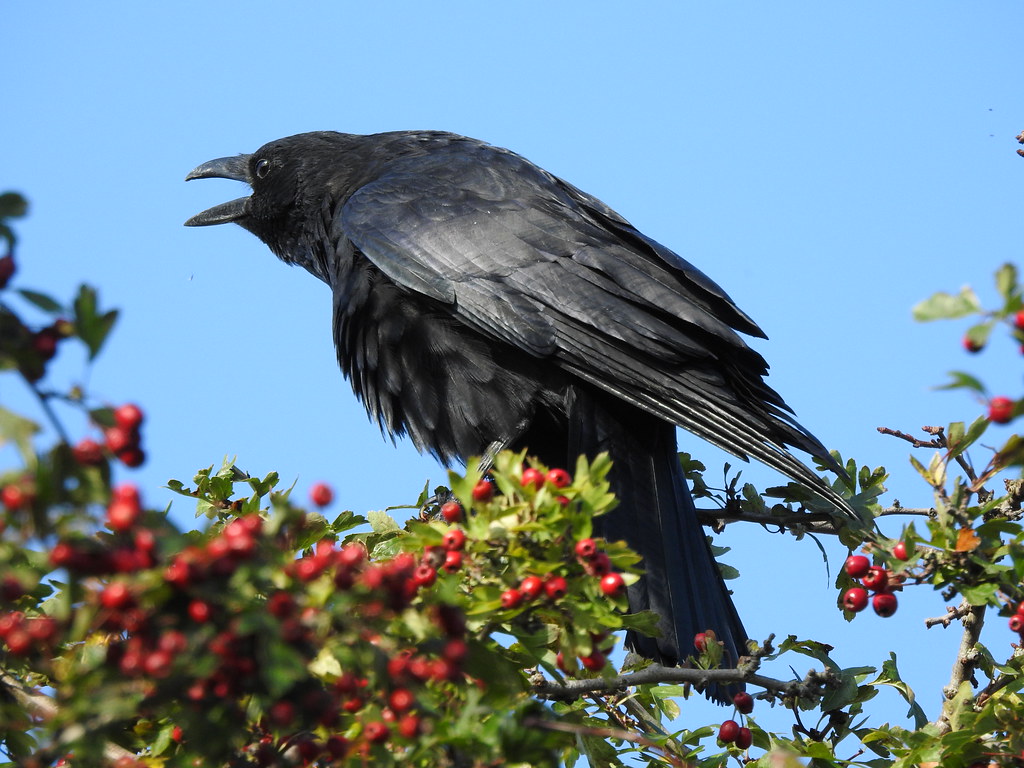
Jerome Betts writes: “Have only tried the intricate patterning of the ‘Spenserian stanza‘ a couple of times. On the first occasion it seemed to suit a comment on the design of a 4th century Roman mosaic floor and on the second, in ‘Morning Calls’, appearing in Snakeskin, a memory of the rich dawn chorus in rural Herefordshire many years ago. The point of particular interest for me is the phrase ‘rocking serrated-throated crows’ in Line 8, unchanged from one jotted at the time. The words fitted a rocking or bobbing movement, but why ‘serrated-throated’?  This is appropriate for ravens with their ‘shaggy throat feathers’  (RSPB Handbook 2014) but not, I thought, crows. The words resisted attempts at tweaking and the stanza stalled. Some weeks later I saw a crow standing on top of a Devon street light rhythmically calling and rocking . . . and as it did so its neck feathers briefly parted on the upstroke of the movement. The line had preserved an exact observation made when young and then forgotten.”

Jerome Betts edits the quarterly verse webzine Lighten Up Online in Devon. His work has appeared in Amsterdam Quarterly, Angle, Autumn Sky Poetry Daily, Pennine Platform, Light, The Rotary Dial, and Snakeskin, other American, British and Canadian publications and two Iron Press anthologies.
www.lightenup-online.co.uk

Photo: “A Crow calling – gardenDSCN9711” by ianpreston is marked with CC BY 2.0.

Short Poem: ‘Chronosynclastic’

In the chronosynclastic infundibulum
That is God’s fantastic waiting room,
You’re always barely on the score,
One show away from being shown the door.

“God’s waiting room” normally applies to places considered to have a large population of retirees, like Eastbourne in the UK, or Victoria, BC, or the state of Florida. But we are all mortal, and all facing an end at an unknown time. So Kurt Vonnegut’s dark existential humour seems universally applicable. He created the term ‘chrono-synclastic infundibulum’ in ‘The Sirens of Titan’ as a label for a place, or a moment, where all the different kinds of truths fit together, and where there are many different ways to be absolutely right about everything.

Take the concept of ‘God’. Though we can all agree on the meaning and validity of “God’s waiting room”, we may disagree vehemently on the meaning and validity of the word “God”. Can there be a place in which all the understandings of that word are simultaneously correct? Perhaps. We are only tiny-brained creatures in an obscure solar system in an unimportant galaxy, and can hardly presume to know all the answers, any more than any of our stone age ancestors did when they thought they knew everything.

Anyway, my poem (first published in Lighten-Up Online) pays homage to the author of ‘The Sirens of Titan’, ‘Cat’s Cradle’, ‘Slaughterhouse Five’… I put Kurt Vonnegut right up there with Tolstoy in the ranking of People Who Should Have Won A Nobel Prize But Didn’t.

So it goes.

Photo: “The Chronosynclastic Infundibulum – Front Elevation” by Fulla T is licensed under CC BY-NC 2.0

Short Poem: ‘The Logophile Picks a Fight’

By the spots of shame with which your life is spattered,
Your position, sir, is grossly overmattered –
Overmattered, sir, or greatly undermined;
And I cannot help but find
That the lot of humankind
Would be bettered, not embittered, were you battered!

After having kicked around for years, this short piece–which has no purpose other than wordplay–finally got an explanatory title (instead of just the first few words) and was published in this month’s Lighten-Up Online in the section ‘Words, Words, Words’. Thanks, Jerome Betts!

Photo: “Picking a fight for net neutrality #ind12” by Kalexanderson is licensed under CC BY 2.0. Photo has been cropped.