Tag Archives: loneliness

Using form: Acrostic Sonnet: Mike Mesterton-Gibbons, ‘Lonely As A Cloud’

Life’s trials left me lonely as a cloud
On high until I found some daffodils,
Not in an adventitious golden crowd
Extending by a lakeside near some hills
Like Wordsworth in his poem, but below
York’s city walls on sloping grassy banks,
Arrayed in row upon enticing row.
So I plucked half a dozen from the ranks
And clasped them and, like Wordsworth, felt a rapt
Companionship that filled me with renewed
Light-heartedness … until a copper tapped
On my left shoulder and rebuked me—”Dude,
Unlicensed flower picking’s stealing”—then
Detained my blooms … to leave me lone, again.

*****

Editor’s comment: Mike Mesterton-Gibbons has produced a Shakespearean sonnet acrostically spelling out the title and theme that references one of the best-known poems in the English language. A full discussion of Wordsworth’s original (text, background, modifications, reception, various photos, etc) is in Wikipedia – including the suggestion that Wordsworth originally came up with “I wandered lonely as a cow” until his sister Dorothy told him “William, you can’t put that.” But rather than Wordsworth’s blissed-out ending, Mesterton-Gibbons goes full circle to a rueful police-induced return to loneliness.

Mike Mesterton-Gibbons is a Professor Emeritus at Florida State University who has returned to England to live in York, where he once attended university after going to school in Cumbria near the Lake District.  His poems have appeared in Autumn Sky Poetry Daily, Better Than Starbucks, the Creativity Webzine, Current Conservation, the Ekphrastic Review, Grand Little Things, Light, Lighten Up Online, MONO, the New Verse News, Oddball Magazine, Rat’s Ass Review (where this poem was first published), the Satirist, the Washington Post and WestWard Quarterly.  Links to all these poems can be found at  https://www.math.fsu.edu/~mesterto/Unscramble/wordplay.html

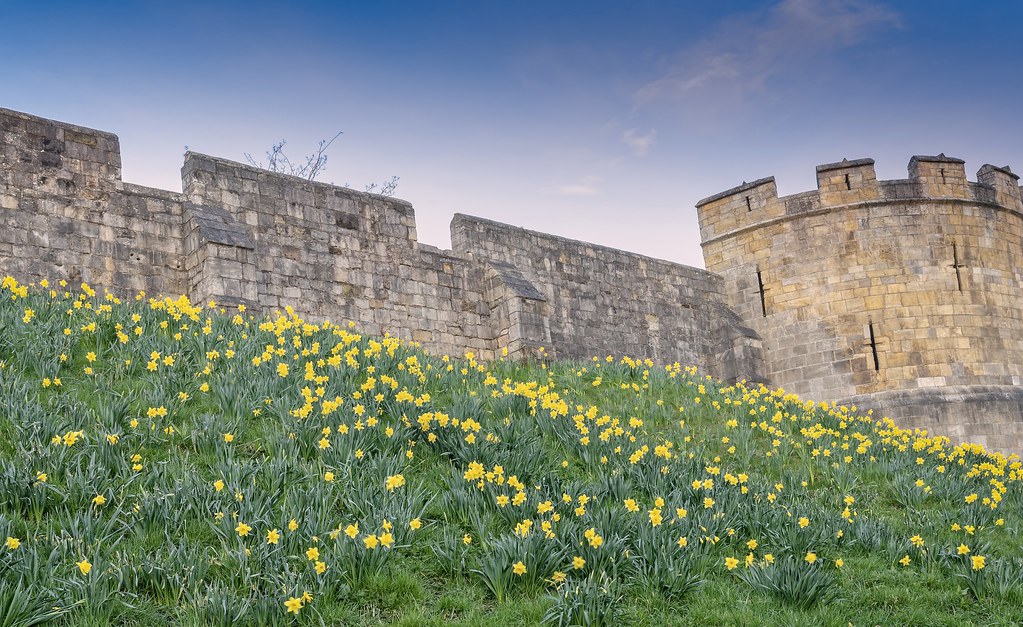
Photo: “York: City Walls and Daffodils” by jack cousin is licensed under CC BY-NC-ND 2.0.

Lisa Marshall, ‘Tango’

The night was cloaked
In disarray
My heart was soaked
In chardonnay
The joint I smoked
In shades of grey
The music broke
A new song played
And then you spoke
Looking my way
A need awoke
Swept me away
Feelings evoked
I dare not say

*****

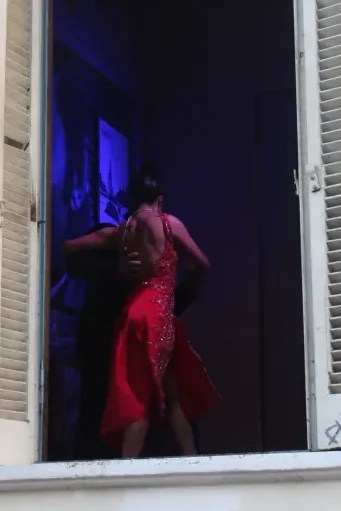
Lisa Marshall writes: “The poem is one long stanza with alternating lines rhyming.  It is about a woman who is feeling forlorn on a night that isn’t going her way.  She uses substances like cannabis and alcohol to forget her feelings and herself.  But suddenly the music changes and she is asked to dance (tango) by a love interest. Suddenly her mood changes and she starts to feel something which she expresses through dance instead of words.”

Lisa Marshall is a poet and author who resides in beautiful Dartmouth, Nova Scotia – also known as the City of Lakes.  She is the author of Black Olive: A Novel and Poetry for the Feminist’s Soul, both of which are available on Amazon Kindle. 
Read more at Not Another Nice Girl Blog.

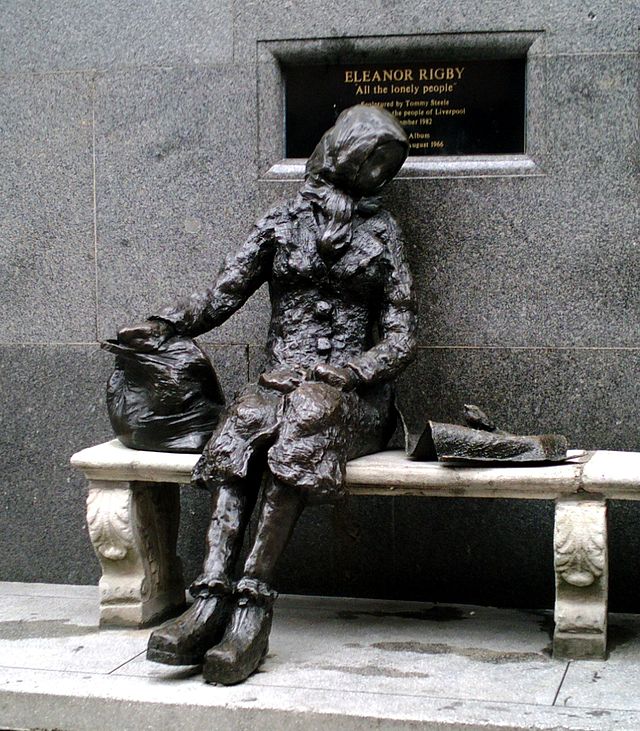
Songs as poems: Lennon-McCartney, ‘Eleanor Rigby’

Eleanor Rigby picks up the rice in the church where a wedding has been,
Lives in a dream.
Waits at the window, wearing the face that she keeps in a jar by the door,
Who is it for?

All the lonely people,
Where do they all come from?
All the lonely people,
Where do they all belong?

Father McKenzie writing the words of a sermon that no one will hear,
No one comes near.
Look at him working, darning his socks in the night when there’s nobody there,
What does he care?

All the lonely people, (etc)

Ah, look at all the lonely people!

Eleanor Rigby, died in the church and was buried along with her name,
Nobody came.
Father McKenzie, wiping the dirt from his hands as he walks from the grave,
No one was saved.

All the lonely people, (etc)

Written and released in 1966 on the Revolver lp and also as a double-A-side single with Yellow Submarine, ‘Eleanor Rigby’ was part of the Beatles’ dramatic move away from simple pop love songs into a vastly larger realm of portraits and social concerns and musical experimentation. Here, in a few lines, we have the protagonist’s lonely day-to-day life and unattended funeral, weaving back and forth with the empty church and its equally lonely priest. If Paul Simon’s ‘I Know What I Know’ is like a condensed Alice Munro short story, ‘Eleanor Rigby’ could be a full-length novel by Knut Hamsun or Kazuo Ishiguro… reduced to three 4-line verses and a refrain or two. The ideas are expressed as simple visual events, without speech. The words are straightforward, the rhymes uncomplicated–and some are slant rhymes, almost unnoticeable in song: been/dream, from/belong, grave/saved. But the impact is very powerful.

So who is the poet behind the song? Its article in Wikiwand states:

McCartney wrote the first verse by himself, and the Beatles finished the song in the music room of John Lennon’s home at Kenwood. John Lennon, George Harrison, Ringo Starr and Lennon’s childhood friend Pete Shotton all listened to McCartney play his song through and contributed ideas. Harrison came up with the “Ah, look at all the lonely people” hook. Starr contributed the line “writing the words of a sermon that no one will hear” and suggested making “Father McCartney” darn his socks, which McCartney liked. It was then that Shotton suggested that McCartney change the name of the priest, in case listeners mistook the fictional character in the song for McCartney’s own father.

McCartney could not decide how to end the song, and Shotton finally suggested that the two lonely people come together too late as Father McKenzie conducts Eleanor Rigby’s funeral. At the time, Lennon rejected the idea out of hand, but McCartney said nothing and used the idea to finish off the song, later acknowledging Shotton’s help.

Lennon was quoted in 1971 as having said that he “wrote a good half of the lyrics or more” and in 1980 claimed that he wrote all but the first verse, but Shotton remembered Lennon’s contribution as being “absolutely nil”. McCartney said that “John helped me on a few words but I’d put it down 80–20 to me, something like that.” Historiographer Erin Torkelson Weber has studied all available historical treatments of the issue and has concluded that McCartney was the principal author of the song, while speculating that Lennon’s assertions to the contrary were the result of lingering unresolved anger and the influence of manager Allen Klein.

John Lennon may have the stronger reputation as a poet, but this gem appears to be Macca’s. (Sorry; Sir Paul’s.)

Wikiwand credit: CC BY-SA 4.0 license
Poem: “The Silence”

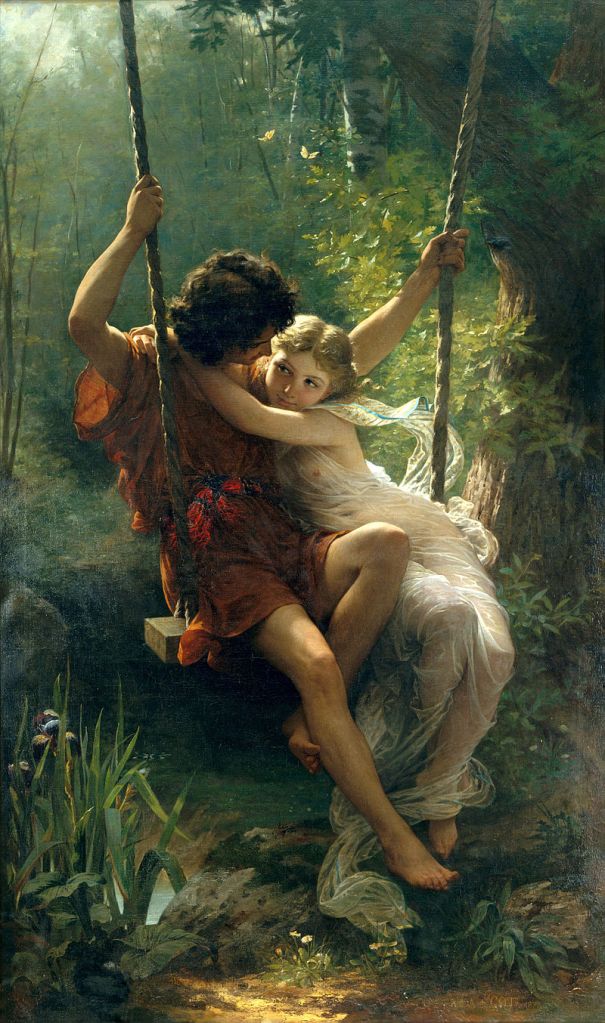
“Pareja (Couple)” by Daquella manera 

On those days when, because you felt attacked,
you just won’t speak, it’s like a dress rehearsal
for one of us being dead. (So, a prehearsal?)
Can’t speak for you, how you’d react,
but for myself, if you die, I know only:
I’d be lonely.

After the slow dispersal
of the acquisitions of the years
from yard sales, impulses, unfinished plans–
after the children’s and grandchildren’s tears,
(their own mortality foretold in Gran’s)
there’d be an emptiness.

Routine unravels:
I’d need an act of will to even shave–
the dogs don’t care how I behave.
All I need’s here in cupboards, shelves, on line.
I’d be just fine…
apart from growing restlessness.

I guess I’d restart travels.
Meanwhile I’ve learned how it will be
to live without you, just your memory,
a silent apparition in this room and that,
the ghost of one who used to laugh and chat.

Think of this as a melancholy love poem, written in a temporary (thank goodness) state of being that can occur in any relationship.

This poem was published this month in Snakeskin No. (or #) 276. I feel proud to be in the issue, as I rate it as one of the best ever in the 20+ years that George Simmers has been putting the magazine out. Though much of the poetry is formless (but still worth reading!), there is some truly impressive work by Tom Vaughan and Scott Woodland, with well-structured work by Robert West, Nick Browne and Jerome Betts, and with interesting innovations in form by Marjorie Sadin, Claudia Gary and George himself–in this last, the character of the verse becomes more lively as the character in the verse becomes more alive.

Technically the form of the poem–uneven lengths of iambics, all lines rhyming but not in a structured way–is one that allows the line breaks to echo your intact chunks of thought as well as the rhythms of speech. It is the form of Eliot’s Prufrock and, earlier, of Arnold’s A Summer Night:

And the rest, a few,
Escape their prison and depart
On the wide ocean of life anew.
There the freed prisoner, where’er his heart
Listeth will sail;

It is a casual form, but it retains enough of the hooks of more formal verse to make it easy to memorise and recite.