Tag Archives: love

Terza Rima: Louise Walker, ‘The Swing’

I hold you on my lap; I think you’re dead.
Next to us hangs a rusty, creaking swing.
I look down as my white dress blooms with red.

Such fun to pull the seat right back, then fling
it free. You’re two, I’m four, so I’m to blame;
now I’m screaming bloody murder to bring

someone to the garden to witness my shame
where swaying grimly like a tolling bell
the swing is the proof of the deadly game.

It’s a story my mother liked to tell
while tracing the faint white mark on your brow:
how she found me soothing you after you fell.

The truth is, I can’t remember why or how
I hurled that dead weight directly at you.
Did she wonder at all, as I do now

if I pushed it so hard because I knew
the swing’s unpredictable to and fro
showed love and jealousy can both be true?

You never reproached me, but even so
I still bear the scar of that reckless throw.

*****

Louise Walker writes: “The Swing was my second effort at writing a poem in terza rima; my first was a complete disaster, written in response to an assignment set by Cahal Dallat during a course I did with Coffee-House Poetry earlier this year. That novice attempt followed the rules of the form perfectly, with 3-line stanzas rhyming aba  bcb  cdc   ded  efe fgf gg. However, my poem was pompous, stilted and vacuous. It also took me an entire day. The next morning, a memory from early childhood came to me and I thought I would try terza rima one more time. To my surprise (and joy!) the poem called ‘The Swing’ came very quickly, was a pleasure to write and didn’t require my usual endless revisions and tweakings. What’s more, I found that the terza rima form became a little engine for generating my poem – for example, searching for a rhyme for ‘you’ threw up the word ‘fro’ which made think of the swing as a metaphor for the oscillating feelings of a child when a younger sibling arrives. I also found that the chain-like effect of the form, swinging back for rhymes, and then forward, suited the subject matter perfectly. Deep in my subconscious, the terza rima form had been working its magic overnight!

I was not at all delighted to get the terza rima assignment at first, but I learnt such a valuable lesson: sometimes one has to write a really bad poem to be able to write a decent one. ‘The Swing’ became an important poem in my recent debut collection ‘From Here to There’ published by Dithering Chaps, which has at its core my journey from childhood, through the death of my brother in our twenties, then onwards.”

Louise Walker was born in Southport and now lives in London. After reading English at Magdalen College, Oxford, where she was a member of the Florio Society, she taught English for 35 years at girls’ schools. Her work has been published in journals such as Acumen, Oxford Poetry, South, Prole and Pennine Platform. Highly Commended in the Frosted Fire Firsts Award and longlisted in in The Alchemy Spoon Pamphlet Competition, in 2023 she was shortlisted in the Bedford Competition and won 3rd prize in the Ironbridge Poetry Competition. Commissions include Bampton Classical Opera and Gill Wing Jewellery for their showcase ‘Poetry in Ocean’. She has recently published her debut collection with Dithering Chaps:
https://www.ditheringchaps.com/from-there-to-here
Instagram @louise_walker_poetry

Photo: “The Garden Swing” by theirhistory is licensed under CC BY-NC-SA 2.0.

Sonnet: RHL, ‘Communication Breakdown’

I love you with that love floppy and large,
As one of us a man – the other, dog;
Involved, detached, our life’s a travelogue
Of countrysides seen from a rented barge,
“Travels With You” along some river’s marge,
Failing at interspecies dialogue
Till tries at talk are lost in night and fog,
Drifting with batteries we can’t recharge.

Yet there’s no option but to travel on,
Each varied day no different than before,
Wondering if we’ll find some magic door
Which, risking entry, gives communion;
And if, by talking, love would be enhanced,
Or if we’d then destroy all we have chanced.

*****

Sonnet originally published in Candelabrum in 2007.

Photo: “Accordion player” by eltpics is licensed under CC BY-NC 2.0.
Using form: unconventional couplets: Helena Nelson, ‘The Hill’

His heart is okay (it has been checked)
but not far from the top his pace is checked

and he stops. ‘Enough. Let’s go back.’
Mrs Philpott doesn’t want to go back.

If they get to the summit, they’ll see the view.
He doesn’t give tuppence about the view.

‘It’s not far,’ she says. ‘Too far,’ he says.
She doesn’t care a bit what he says,

she wants to get to the top of the hill. ‘Come on,’
she says. ‘Best foot forward.’ ‘You go on,’

he says. ‘I’ll wait here.’ So she walks on her own
and quickly sets up a pace of her own

not pausing and not once looking back
until for some reason she stops and looks back

and he’s quite out of sight, could be anywhere
and a sort of fear catches her where

head and heart meet. This stupid emotion is love
and because of that, because of her love,

if he won’t get to the top of the hill,
then she won’t get to the top of the hill

either. Anyway, a few drops of rain
fall on her hair and she knows he hates rain.

He might even have turned
and gone home without her. She turns

and half-runs down the path. He’s waiting for her,
sitting on his coat and waiting for her.

‘About time,’ he says. ‘Where have you been?’
She says, ‘Where do you think I’ve been?’

He doesn’t ask about the view from the top.
She doesn’t tell him she didn’t get to the top.

She might think, ‘This is the story of my life,’
but although this is the story of her life

that is not what she thinks.
She thinks something else.

*****

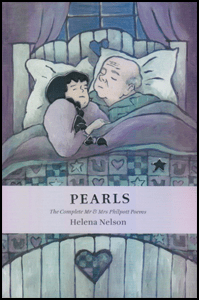
This poem comes from midway through Helena Nelson’s 2022 book ‘Pearls – The Complete Mr & Mrs Philpott Poems‘, some 100 poems (I haven’t counted) detailing their years of marriage, starting with a couple of references to their first marriages, through to their own noticeable ageing.

The book’s blurb asks: ‘Where did Mr and Mrs Philpott come from? The author has no idea. They popped into her head over twenty years ago and have refused to go away. Their story is one of ordinary, difficult, everyday love. And yet they themselves aren’t ordinary. Their dreams, anxieties and needs, their separate and difficult pasts, have somehow coalesced into mutual understanding–even sudden spurts of happiness–despite the rainy holidays, arguments and illness. The ordinariness of their love is magical and miraculous. Because ordinary love is a kind of miracle.’

Helena Nelson writes: “I didn’t choose this absorption with the Philpotts. It just happened, and it seems I really have stopped writing them now. But I’m terribly fond of them and often think about them. Probably one of my top favourite Philpott poems is ’The Hill’. Nearly all the poems have some kind of formal pattern underpinning them. Even when they appear to be free, the rhythms are deliberate. I don’t know if I could say any more about them. I feel as though they’ve gone off on their own now, for better or worse, and I’m happy about that.”

Helena Nelson runs HappenStance Press (now winding down) and also writes poems. Her most recent collection is Pearls (The Complete Mr and Mrs Philpott Poems). She reviews widely and is Consulting Editor for The Friday Poem.

Photo: “Day 40: Grey Skies” by amanky is licensed under CC BY-NC-ND 2.0.

Using form: Ruba’i: RHL, ‘Ancient Tales of Love and War’

The pipes and women wail and skirl,
deaths following the flowering girl.
Ancient tales of love and war
show costs of dimple or a curl.

Tamil spear tips illustrate
intent before the towering gate;
bangles slide on her young wrists;
kings make war when made to wait.

Gods and goddesses choose sides:
a Trojan steals a youthful bride.
Who Trojans were we’ll never know –
Greeks burn the city, once inside.

A lovely face, a swelling bust –
and treasure, fame – inspired by lust
kings storm the ramparts, steal the girl,
before, like all, they turn to dust.

*****

This poem was inspired by a blog post in ‘Horace & friends’ on ‘Doing without consolation – Tamil poetry, Yeats and Simone Weil‘. The author, Victoria, touches on a lot more topics than my small piece does; visit her blog to see how Yeats’ “Like a long-legged fly upon the stream / Her mind moves upon silence” connects to ancient Tamil as well as ancient Greek poetry…

My poem here is in iambic tetrameter (with some liberties taken), rhyming AABA in English ruba’i form. It was published in the current (August 2024) Snakeskin, issue 320.

Illustration: The Fall of Troy by Johann Georg Trautmann (1713–1769)

Using form: Short poem: Helena Nelson, ‘Duel’

Your false self says to my true self, Hate.
My true self says to your false self, No.

Your false self says to my false self, Shit.
My false self says to your false self, Go.

Your true self says to my false self, Love.
My false self says to your true self, Late.

Late, too late, too late, too late.
My true self sings to your true self, Wait.

*****

Helena Nelson writes: “I can’t explain this easily. It’s both simple and obscure, like a sealed box holding the idea of opposition: a duel between two people, a duet; dual positions. Then there’s the idea of a two-sided self: the true or authentic self versus the manipulative side, the side that does deliberate damage. I don’t even believe in ‘the true self’; but I do in this poem. And I recognise a dispute where one person (especially if for some reason acting from twisted emotion) can push another to come back from that same position, even when they don’t want to. From experience, I’ve known this. The rhyming words trace the development. The slant rhyme between Hate and Shit, for me, has a dark twist. Hate is powerful but Shit is horrible. Late is potentially the last word. The poem could end there, but it doesn’t. Each of these two people summons a ‘true self’. Each dismisses the ‘false’. ‘Late, too late, too late, too late’ is the line that breaks the pattern. No direct speech in that line, perhaps because it’s not a spoken statement but a feeling experienced by both. For me, there’s intense sadness at this point, and the shadow of death too, and because of this—just in time—true speaks to true. Only seventy words in the whole thing but most repeated several times. If you go by unique usage, fifteen words in total. It reminds me of one of R. D. Laings’ Knots. The switch from ‘says’ to ‘sings’ at the end? Yes—significant.”

Helena Nelson runs HappenStance Press (now winding down) and also writes poems, one of which is ‘Duel’. It was originally published in PN Review, collected in Plot and Counter-Plot, Shoestring Press, 2010, and was reprinted in the Potcake Chapbook ‘Lost Love’. Her most recent collection is Pearls (The Complete Mr and Mrs Philpott Poems). She reviews widely and is Consulting Editor for The Friday Poem.

Photo: “Argument” by helena_perez_garcia is licensed under CC BY-NC-ND 2.0.

Shamik Banerjee, ‘A Meeting’

We chose our old patisserie, Faheem’s,
One Monday noontime. Half the chairs were stacked.
The waiter Abdul’s smile displayed the fact
He knew our likes: fudge brownies with whipped cream.

Her clothes were simple, just a plain Salwar
Kameez—not what she mostly wore to meet me.
No dimples sat upon her cheeks to greet me;
Her body there, her mind was somewhere far

Away. “Must be a slight familial thing,”
I thought and asked, “A crossfire with your mother?
The usual hijinks by your puckish brother?”
It seemed no act or word of mine could bring

The truth out of her throat. After a pause,
She spoke (as if an old, corroded door,
Reluctant to be slid): “Just six months more.
My baba says it’s for my own good cause.

The boy’s an engineer from our own caste
With good emoluments.” She turned away
From me to hide her face, now moist and gray.
This news, like summer’s heat, wizened the last

Bright bloom of optimism in my heart.
“When is the day?” I wished to ask but could
Not voice a word — perhaps, for my own good;
Perhaps, to keep my soul a bit apart,

Veiled from the knowledge of her wedding date.
We sat, hands clasped, and watched the hour grow,
The people leave, the lightbulbs’ dimmish glow.
The food remained untouched on both our plates.

*****

Shamik Banerjee writes: “If, in the battle between love and societal norms, the latter wins, then no doubt humanity’s end days can be counted on fingers. My poem speaks about this battle and faintly (if not fully) gives a peek into my own experience of it. I hope it speaks to all those who lost the love of their lives to the hands of caste, salary, name, pride, honour, and religion.”

Shamik Banerjee is a poet from India. He resides in Assam with his parents. Some of his recent works will appear in York Literary Review, Willow Review, Thimble Lit, and Modern Reformation, to name a few.

Photo: “in the distance” by Viva La Marx is licensed under CC BY 2.0.

Using form: ghazal: Barbara Lydecker Crane, ‘Love Refrains’

Mom banged her hairbrush down in a reprimand of love.
“What an awful question! You don’t understand love.

“Of course Dad loves you. How can you question that?
He doesn’t have to blare it out, like a brass band of love.

“You aren’t a princess to be coddled on a lap or praised
without good reason. That’s a never-never land of love.

“Your father works hard, with a great deal on his mind.
Now don’t go causing trouble, making a demand of love.

“Yes, I know he yells and sends you to your room a lot.
But be glad he never hits you with the backhand of love.

“Once, banished to your room, you drew a picture poem
for him. I watched him beam at you with unplanned love.

“He said he’s proud of you. I’ve heard him tell you twice.”
She brushed my hair, hard. “Barbara, that’s a brand of love.”


Barbara Lydecker Crane writes: “Based on a real interaction with my mother when I was about five, I think this poem reflects a different style of parenting back then (this was in the 50’s), perhaps a British approach: “don’t spoil your children with a lot of praise or affection.” I like modern ways better! As for the form, I love ghazals because you always know where you are headed–the fun is choosing your route to get there.”

Barbara Lydecker Crane was a finalist for two recent Rattle Poetry Prizes, including with this poem.  She has received two Pushcart nominations and various awards from the Maria W. Faust and the Helen Schaible Sonnet Contests. Her poems have appeared in Atlanta Review, Ekphrastic Review, First Things, Light, THINKValparaiso Literary ReviewWriter’s Almanac, many others, and in several anthologies. Her fourth collection, You Will Remember Me (ekphrastic, persona sonnets) was recently published by Able Muse Press, and is available from Amazon: https://www.amazon.com/You-Will-Remember-Me-Ekphrastic/dp/1773491261. Barb lives with her husband near Boston.

Photo: “She’s On The Naughty List” by Cayusa is licensed under CC BY-NC 2.0.
Sonnet: Shamik Banerjee, ‘A Lesson From Zaheer, Our Fishmonger’

All things are measurable, son: the food
You have, the sprawling mains, for man has power
Over the world; He deems what’s bad or good;
Determines if a plant should wilt or flower.
But ordeals measure us—we take the test
Of mercy when affliction’s cavalry
Threatens to loot the kindness off one’s chest
As in the massacre of ’83,
When every lane had reeked of Muslim blood,
My Abba Jaan had fallen to the sword
Held by your neighbours; trembling on the mud,
He mumbled, “What’s my sin? My faith? O’ Lord,
Don’t charge them for their deeds.” Love was his wish
That lives through me, for I still feed them fish.

*****

Shamik Banerjee writes: “This poem was first published in Fevers of the Mind. The incident described by our fishmonger is the Nellie Massacre, which took place in central Assam (an Indian state) during a six-hour period on February 18, 1983. The massacre claimed the lives of 1,600–2,000 people. The victims were all Muslims. Abba Jaan is an affectionate term for one’s father (used by Muslims).”

Shamik Banerjee is a poet from India. He resides in Assam with his parents. When he is not writing, he can be found strolling the hills surrounding his homestead. His poems have appeared in Fevers of the Mind, Lothlorien Poetry Journal and Westward Quarterly, among others and some of his poems are forthcoming in The Hoogly Review, Dreich and Sparks of Calliope.

Photo: “Old man inside Jamu Masjid, Fatapur Sikri” by nilachseall is licensed under CC BY-NC-ND 2.0.

Short poem: RHL, ‘Friendship, Not Passion’

I had a friendship, more than passionate love, for you;
we could have been so good, easy, together.
But there’s that issue of your strong religious thoughts,
whereas I let my thoughts change with the weather.

I… well, and who’s the I you think that you address?
I ramble, googly-eyed, my arms elastic.
There are so many sweet but sadly firm believers.
I’m – more than atheist – iconoclastic.

*****

If you’re used to iambic pentameter the meter of this poem feels just a little off, with its lines of alternating 12 and 11 syllables, i.e. alternating hexameters and feminine-ending pentameters… not quite comfortable. Which is perfectly in keeping with the relationship described. And I don’t remember precisely which long-ago not-quite-girlfriend I had in mind when I wrote it; I’ve been attracted to more than one charming female, wonderfully calm and sane except for some unfortunate religious orientation or other.

I’m reminded of the 19th century Punch cartoon of the two guests at a dinner party:
She: “And what is your religion, sir?”
He: “Madam, all men of sense are of the same religion.”
She: “And which religion is that, pray tell?”
He: “Madam, men of sense never say.”

Which is all very well for friendship, but hardly a solid basis for a deeper relationship. You’re better off if you hold out for someone philosophically compatible, unless you (and they) really don’t care. In which case, you’re philosophically compatible!

‘Friendship, Not Passion’ was originally published in Lighten Up Online, edited by Jerome Betts.

Illustration: “Friendship” by h.koppdelaney is licensed under CC BY-ND 2.0.

Short poem, ‘Vetch in the Spring’

Love comes back like vetch in the Spring:
You knew it was there, but it’s still a surprise –
The flower is lovely, but wildly unwise.
Love comes back like vetch in the Spring,
You keep pulling it out but you’re never free;
You think it’s gone, but it won’t ever be.
It just comes back like vetch in the Spring.
Love’s just a thing.

*****

With a bit more attention, this poem might have made a satisfactory rondelet (like the previous post by Susan McLean)… but it’s in the form that it occurred to me and, like vetch, it’s just there in its undisciplined fashion. Published this month in Allegro Poetry Magazine, edited by Sally Long.

Photo: “vetch flower and tendril, with ant” by Martin LaBar is licensed under CC BY-NC 2.0.