Tag Archives: LUPO

Villanelle variation: James B. Nicola, ‘My MFA’

I thought I’d go and get my MFA
since college never taught me how to write.
It’s not that I had anything to say;
 
I needed somehow, though, to spend the day
and, existentially I guess, the night
as well. So I went for an MFA
 
in Creative Writing. I did OK,
creatively. My grammar was a fright,
and there was nothing that I had to say,
 
but you got extra points for this. The way
you said squat was what mattered. Outasite, 
I thought, which, when I got my MFA,
 
I didn’t know was not a word. But stay,
they’d said, you can’t create if you’re uptight.
There is no wrong or right. And who’s to say
 
that parts of speech, or lie in lieu of lay,
or topic sentences, are not a blight
on Creativity? What could I say?
I’d paid a lot to get my MFA.

*****

James B. Nicola writes: “Purists take note. ‘My MFA‘ is not quite a villanelle, since the repeated lines vary so much. I suppose Elizabeth Bishop started the ball rolling with ‘(Write it!)’ in the last line of her now-famous villanelle (or is it?) ‘One Art.’ Like her, I am originally from Worcester, Massachusetts; perhaps that explains our consaguinity.”

James B. Nicola’s poetry has appeared internationally in Acumen, erbacce, Cannon’s  Mouth, RecusantSnakeskinThe South, Orbis, and Poetry Wales (UK);  Innisfree and  Interpreter’s House (Ireland); Poetry Salzburg (Austria), mgversion2>datura (France);  Gradiva (Italy); EgoPHobia (Romania); the Istanbul Review (Turkey); Sand and The Transnational (Germany), in the latter of which his work appears in German translation;  Harvests of the New Millennium (India); Kathmandu Tribune (Nepal); and Samjoko (Korea). His eight full-length collections (2014-2023) include most recently Fires of Heaven: Poems of Faith and Sense, Turns & Twists, and Natural Tendencies. His nonfiction book Playing the Audience won a Choice magazine award.

‘My MFA’ was originally published in the current Lighten Up Online

Photo: “creative-writing-ideas Atlanta GA” by agilemktg1 is licensed under CC BY 2.0.

Max Gutmann: Planet of Love

Venus, our neighbor that lies toward the sun,
    Is a sultry and amorous spot;
The astrologers tell us our passion and fun
   Are engendered right there, where it’s hot.

She’s the brightest of stars yet she’s hidden in cloud,
  So her pull on our psyches is double,
An enticing enigma concealed in her shroud
  And, like all such allurements, big trouble.

To the faithfully married, the word from above
  About passionate partnership stings.
There’s a planet we’re told governs all earthly love,
   And it isn’t the one with the rings.

*****

Max Gutmann writes: “I’m afraid I can’t think of anything interesting to say about ‘Planet of Love,’ which exists to support its punchline. The joke popped into my mind, so I wrote the poem.”

‘Planet of Love’ was published in the March 2025 issue of Lighten Up Online.

Max Gutmann has contributed to New StatesmanAble MuseCricket, and other publications. His plays have appeared throughout the U.S. (see maxgutmann.com). His book There Was a Young Girl from Verona sold several copies.

Photo: “Venus” by katmary is licensed under CC BY 2.0.

Tom Vaughan: ‘Is This It?’

Well if it is, and this is it
then what will be will be
and time will toil and time will tell
if there’s a guarantee

that at the least and at the last
the daily here and now
which now and here are thick as thieves
will be transformed, somehow

and either way, here’s my advice –
lie back and think of all
the ups which came between the downs
before your curtain call.

*****

Tom Vaughan writes: “There was no particular trigger for this poem, apart from my fitful attempts to be Stoical about the state – and weirdness – of the world. But just at the moment the anger occasioned by the former keeps breaking through.”

‘Is This It?’ was published in the current Lighten Up Online.

Tom Vaughan is not the real name of a poet whose previous publications include a novel and three poetry pamphlets (A Sampler, 2010, and Envoy, 2013, both published by HappenStance; and Just a Minute, 2024, from Cyberwit). His poems have been published in a range of poetry magazines, including several of the Potcake Chapbooks and frequently in Snakeskin and Lighten Up Online. He currently lives in Brittany.
https://tomvaughan.website

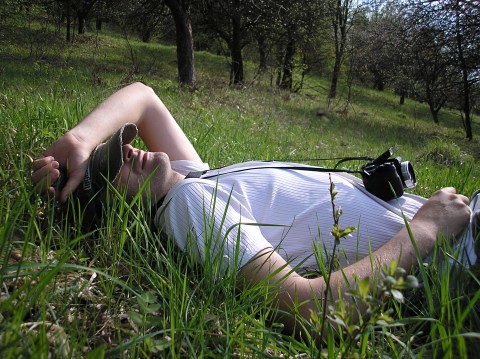
Photo: “man-relaxing-in-the-grass_8954-480×359” by Public Domain Photos is licensed under CC BY 2.0.

Melissa Balmain: ‘A Super-Subtle Metaphor’

(For my son)

Dear Unruly Backyard Maple:
I’ve been clipping you for years,
convinced that efforts to reshape’ll
pay for one who perseveres.

But now I get it, stubborn maple –
though I’ve trained your docile peers,
my double-bladed snip and scrape’ll
never give you classic tiers.

And I am seeing, steadfast maple,
how your tousled crown endears:
you shelter birds; come spring, your drape’ll
glow just like a chandelier’s.

So please forgive me, patient maple,
if it’s not too late, for here’s
my blessing, solemn as the papal.
Grow your way.
                        Love, Pruning Shears

*****

Melissa Balmain writes: “Looking back at poems I’ve written for and about my family, I realize many are metaphorical. I suspect that metaphor–like rhyme and meter–helps steer me toward interesting thoughts and away from over-sentimentality. (Whether my son agrees has yet to be seen!)”

‘A Super-Subtle Metaphor’ is the lead poem in the current issue of Lighten Up Online.

Melissa Balmain’s third poetry collection, Satan Talks to His Therapist, is available from Paul Dry Books (and from all the usual retail empires). Balmain is the editor-in-chief of Light, America’s longest-running journal of light verse, and has been a member of the University of Rochester’s English Department since 2010. She is a recovering mime.  

Photo: “Red Maple Tree” by Stanley Zimny (Thank You for 52 Million views) is licensed under CC BY-NC 2.0.

Susan McLean, ‘Anagram: A Pallor, An Edge’

Late at night, I saw a glowing,
as if realms beyond our knowing
kindly solace were bestowing.
Could this phantom be my wife?
 
But the gleam, as I drew nearer,
taking form and growing clearer,
was my visage in the mirror,
and the figure held a knife.
 
“Fool,” said I, “your idle dreaming
on some insubstantial seeming
is some demon’s way of scheming
to mislead your soul to hell.

“Melancholy, doom-and-glooming,
pining, horror, guilt, exhuming,
Nevermore and Ulalume-ing –
write your angst out: that could sell.”

*****

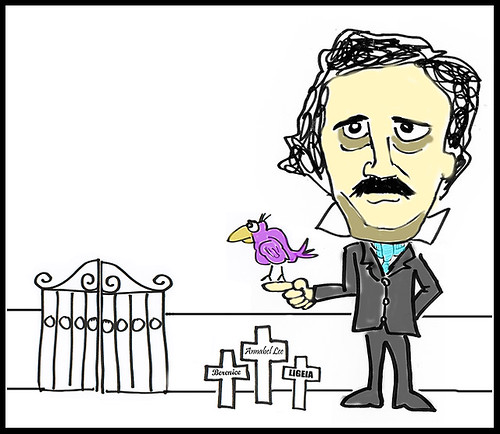
Susan McLean writes: “This poem was inspired by a 2019 competition at The Spectator to write a poem in the style of a famous author and to have its title be an anagram of the poet’s name. I was a big fan of the poetry and short stories of Edgar Allan Poe when I was a teen, so I investigated words that I could draw from his name that would have strong associations with his work. Poe married his thirteen-year-old cousin, Virginia Clemm, who died of tuberculosis eleven years later. Many of his poems and stories concern mourning for the death of a beautiful woman, including his most famous poem, “The Raven.” This poem borrows the trochaic meter and some elements of the rhyme scheme of that poem. It also alludes to a number of Poe’s favorite themes, and echoes some of his lines. It was not among the winners at The Spectator, but I later reworked it, and it recently appeared in Lighten Up Online.”

Susan McLean has two books of poetry, The Best Disguise and The Whetstone Misses the Knife, and one book of translations of Martial, Selected Epigrams. Her poems have appeared in Light, Lighten Up Online, Measure, Able Muse, and elsewhere. She lives in Iowa City, Iowa.
https://www.pw.org/content/susan_mclean

Edgar Allan Poe (ilustración off topic)” by El Humilde Fotero del Pánico is licensed under CC BY-NC 2.0.

RHL, ‘Boy With Scab’

The boy he’s always been still takes delight
In testing scabs on elbows, knees,
To see if fingernails can assert their right
To lift with satisfying ease
The lid from off the mystery healing box
And see the flesh beneath the skin
Where the wise body-mind slowly unlocks
Corpuscles and white pus within.
The hint of pain, like some itch that you scratch,
Is fun alongside look-and-see.
What does the boy do with that useless patch,
The scab? Easy: autophagy.

*****

Curiosity is a useful aspect of intelligence. This poem first published in Lighten Up Online (aka LUPO). Thanks, Jerome Betts!

Photo: “War Stories” by Noël Zia Lee is licensed under CC BY 2.0.

Melissa Balmain, ‘No Ifs, Ands, Or Bots’

Tradwife? No, thanks. I’m not the type you’ll find
exclaiming “Yippee!” “Yesiree!” or “YOLO!”
at thoughts of chores I might be doing solo –
especially the old-school kitchen kind.
Churn butter? Grow a sill of herbs? You’re kidding.
Give me boxed broth and Hellman’s mayonnaise
and sourdough I didn’t have to raise.
Give me technology that does my bidding.

Yet how I love to cook up verse from scratch:
to handpick thoughts I planted as a kernel
within the fertile pages of a journal,
add rhymes (a meaty or a salty batch),
then whip them into something that – although it
may stink at times – tastes vastly fresher than
the glop inside an algorithmic can
because you know it comes from me, Tradpoet.

*****

This poem was the lead poem in the latest Lighten Up Online (“LUPO”). Melissa Balmain writes: “Ironically, in the weeks since I wrote this poem, a health condition has forced me to do a lot more tradwifely stuff in the kitchen–making low-acid salad dressing, say. But I still refuse to churn butter.”

Melissa Balmain’s third poetry collection, Satan Talks to His Therapist, is available from Paul Dry Books (and from all the usual retail empires). Balmain is the editor-in-chief of Light, America’s longest-running journal of light verse, and has been a member of the University of Rochester’s English Department since 2010. She is a recovering mime.

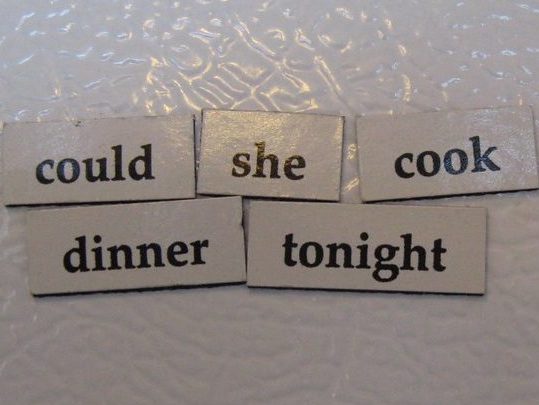
Photo: “could she cook” by aprilskiver is licensed under CC BY 2.0.

RHL, ‘Everyone’

Everyone’s naked under their clothes,
everyone’s bald under their hair;
hide if you like, everyone knows!
Everyone sees what you’re like under there.

Everyone’s meat under their skin,
everyone’s bones under their meat;
we know what your outside is hiding within:
hiding will always end in defeat.

So banish the words and censor the book,
draw little clothes on the cartoons for kids;
everyone knows where your dirty eyes look,
everyone sees that your life’s on the skids.

This poem was a response to the news out of Florida that elementary schools are being forced to draw clothing on cartoon characters in children’s books if the printed images show nakedness of either front or back. The right-wing nutcase group ‘Moms For Liberty’ is causing the trouble.
This link https://popular.info/p/pressed-by-moms-for-liberty-florida gives details and shows some of the results.
Incidentally, one co-founder of the Moms for Liberty group is Bridget Ziegler. Apparently she and her husband Christian Ziegler had sexual threesomes with another woman; and when Bridget backed out of a planned threesome event in October 2023, Christian went along anyway; the third party declined sex, saying she was in it more for Bridget; so Christian raped her. The woman then filed a complaint with the police.
Why is it that the hysterically over-moral types seem to be the ones causing most of the problems?

This poem was published in the March 2024 issue of Lighten Up Online (aka LUPO); thanks, Jerome Betts!

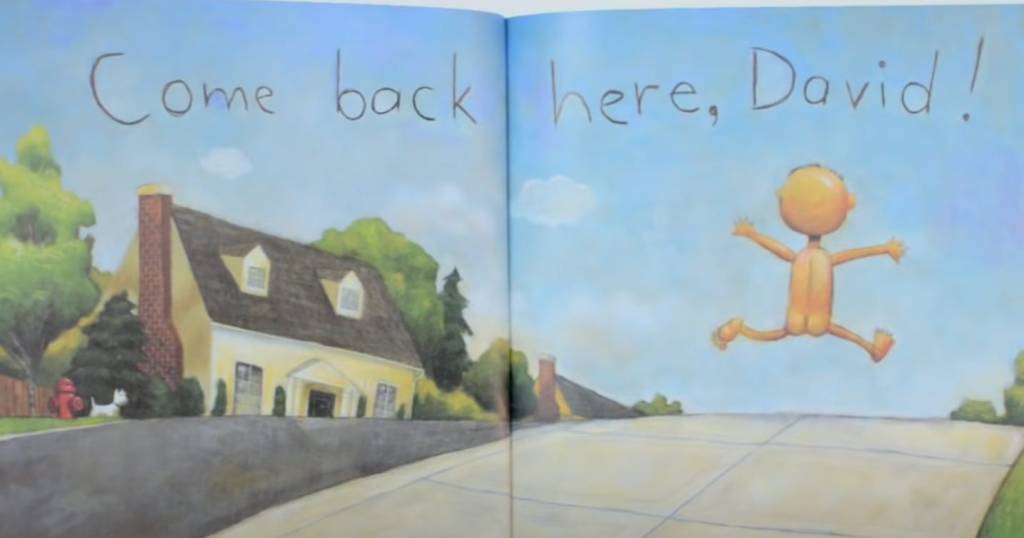
Photo: illustration from ‘No, David!‘, written and illustrated by David Shannon.

Duncan Lawrence, ‘The Poet is the Luckiest of Artists’

There is no struggling with a wayward cello on the train 
Or carting a large canvas through dank cornfields in the rain.

No need to worry chapter sixteen has somehow been deleted 
Or that the woodwind section remains a long way from completed.

No welding burns to speak of, hammered thumbs or calloused palms,
No temperamental band mates whose bad habits raise alarms.

No fearing, that the next plié will surely split these tights 
Or some acerbic, carping critic has got you in their sights.

Just, fingers crossed the last few lines like miracles unfold 
Before the walk is over or the bath become too cold.

Yes, I concede the poet’s lucky, yet still I do despair 
For all the artful artistry the money isn’t there.

*****

Duncan Lawrence writes: “I do not remember any specific incident as a catalysis for this poem. I did see an interview with John Cooper Clarke on the BBC, he said something to the effect that one might splash out on Tap Dance lessons only to discover that you were not that good but a pencil and a bit of paper are always available. That was either the source of the piece or resonated because I had just written it.
As to the form, I understand that it might be “Iambic heptameter with some anapestic
substitutions” but I don’t really know what that means.
I cannot sit down with a blank piece of paper and decide to write about something. The
poem just forms in my head over a few days. I then write it down and clean it up a bit. After I put it aside and continue to mull it over on a walk or in the bath before looking it
over again and, with luck, if it sounds all right, finishing it off.”

Duncan Lawrence is a retired English Teacher. Originally from the United Kingdom, he is a long-term resident in rural Japan. Here he spends an inordinate amount of time walking dogs for the local Guide Dog Association.
He has had three poems (including this one) published by Jerome Betts on his magazine Lighten Up Online.

Photo: “Who says I can’t relax?” by Ed Yourdon is licensed under CC BY-NC-SA 2.0.

Using form: Quatrains: Stephen Gold, ‘So Pseud Me’

My verse is of the humorous variety,
And does its best to brighten up society.
To spread a little joy’s a noble calling,
A life without a laugh would be appalling.

Yet still, of late, I’ve had a thought that niggles;
What worth is work that just produces giggles?
Should it be judged as slight and ineffectual,
Compared to art we label intellectual?

And so I did what “proper” poets do,
And signed up to The Scrivener’s Review,
“The connoisseur of poesy’s magazine”,
Where scribes will scratch your eyes out to be seen.

I found it was a terrifying place,
Where people were obsessed with lower case,
Allusions veered from cryptic to absurd,
And “meaning” seemed to be a dirty word.

Their poetry was like the peace of God,
That passeth understanding – truly odd.
Some claimed to write for womxn and for mxn,
Though none had come across the verb, “to scxn”.

With open mind, I asked, “Is it my fault
That there is nothing here I can exalt?”
But days of dredging through this awful rot
Confirmed beyond all doubt that it was not.

Each new excrescence served to reinforce
That I had veered disastrously off course.
I wheeled around and fled back to the light
Which shines upon the droll and erudite,

Bring on a world where rhyme and meter matters,
And isn’t full of folk as mad as hatters.
Adieu to “Scrivener’s Review”, I quit.
Do I need what you’re full of? Not one bit.

*****

Stephen Gold writes: “The idea for So Pseud Me came from wading through an august poetry periodical which had better remain nameless, and coming to the following conclusion: WTF?
There was some good, thoughtful work, but much of it was pretentious drivel, written by the deservedly obscure with their heads rammed firmly up that place where the Lord causeth not the sun to shine.
If you were to ask them, I guess most would place high verse on a pedestal, way above light. But on this, I am with Kingsley Amis, who wrote in the New Oxford Book of Light Verse:
“Light verse makes more stringent demands on the writer’s technique. A fault of scansion or rhyme, an awkwardness or obscurity that would damage only the immediate context of a piece of high verse endangers the whole structure of a light-verse poem. The expectations of the audience are different in the two cases, corresponding to the difference in the kind of performance offered. A concert pianist is allowed a wrong note here and there; a juggler is not allowed to drop a plate.”
‘So Pseud Me’ is a light-hearted attempt to speak up for jugglers.”

Stephen Gold was born in Glasgow, Scotland, and practiced law there for almost forty years, robustly challenging the notion that practice makes perfect. He and his wife, Ruth, now live in London, close by their disbelieving children and grandchildren. His special loves (at least, the ones he’s prepared to reveal) are the limerick and the parody. He has over 700 limericks published in OEDILF.com, the project to define by limerick every word in the Oxford English Dictionary, and is a regular contributor to Light and Lighten Up Online (where this poem was first published).

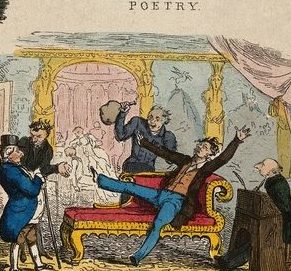
Illustration: “A group of poets carousing and composing verse under the influence of laughing gas. Coloured etching by R. Seymour after himself, 1829.” is licensed under CC BY 4.0.