Tag Archives: Marcus Bales

The Two-State Dissolution: Yankevich, Kenny, Helweg-Larsen, Foster, Vaughan, Jackson, Bales, Burch

Leo Yankevich: ‘The Terrorist’

Only six, she stands before a tank,
looking at its armour, while inside
soldiers heed orders from a higher rank.
There isn’t any place for her to hide,
no door to head for, no abandoned car
to slide beneath. Pure terror rules her land.
When finally crushed, she rises past the star
of David, with a stone clutched in her hand.

Janet Kenny: ‘Didn’t They Know?’
(In memory of a lost poem by Robert Mezey)

Didn’t they know that when they swarmed
and slashed and slaughtered what they saw
as an oppressor’s nest, the rage
that they aroused would turn and pour
with molten heat back on their house?

Their captive children now must pay,
small targets in a concrete cage.
No treaty, pact, no peace no truce.
Didn’t they know? Didn’t they know?

No map to show another way.
Olive farmers pay for crimes
of other nations, other times.
No mercy here, no one is just.
Two agonies, two brains concussed.

Nothing to see here. False alarm.
Police not needed to disarm
two weeping peoples each aware
that no solution slumbers there.
Hearth and cradle now makes clear
an ancient poem brought them here.

Where is the psalm that both can share?

Robin Helweg-Larsen: ‘Both Sides Justify Their Terrorism’

When pleas for justice are of no avail,
when governments praise death and theft,
and courts say you’re in error;
when the UN is blocked to fail,
the only recourse left
is terror.

When no one cares that Yahweh willed
that Jews alone should have this land
(and God’s never in error)
and prior residents must be killed,
yet they won’t leave, they force your hand:
to terror.

Gail Foster: ‘On The Occasion of Benjamin Netanyahu Quoting Dylan Thomas’

Don’t tell me that you fight a righteous fight
How many children have you killed today
I’ll give you rage. I’ll give you rage alright

Your anger and your ego burning bright
Are razing all that’s standing in your way
Don’t tell me that you fight a righteous fight

How many have you sent into the light
Before they even had the time to pray
I’ll give you rage. I’ll give you rage alright

How many have you saved or sent in spite
Up to the sky in ashen clouds of grey
Don’t tell me that you fight a righteous fight

In clouds as those who in the fog and night
Were put in trains and disappeared away
I’ll give you rage. I’ll give you rage alright

You speak as if your soul was white as white
Yet deep inside you darkness holds its sway
Don’t tell me that you fight a righteous fight
I’ll give you rage. I’ll give you rage alright

Tom Vaughan: ‘The Land’

Let’s pretend that the war
could be over, and peace
reigned even if only
this evening. O please

pick up your anger
and soak it with mine
in six large barrels
of miracle wine

and then let us dance
like lovers, as though
this land’s many meanings
didn’t all signal no

and we could make ploughshares
out of our swords
and translate the past
into one shared world

and even if dawn
will scatter the night
and send us both stumbling
into the light

where smooth olives glisten
in the warm sun
like belts of bright bullets
ripe for a gun.

Jean MacKay Jackson: ‘War’

Some say that war is bright flares and drama,
A glory of fireworks illumining skies.
This is all lies.
War is a child calling out for his mama
And getting no answer.
War is a merchant of hatred and grief:
War is a thief,
War is a cancer.
Some say that war is hell. Perhaps that is so.
Yet hell has a lack
Of innocent bystanders, hell has no
Collateral damage, no accidental black
Body-bags for old women and babies.
Hell has no maybes;
Everything makes sense.
In hell there is no defense:
You belong there. You chose your path.
Hell has a cold, hard justice drained of wrath.
War is the horrified look in the eye
Of a young person dying without knowing why.

Tom Vaughan: ‘Aleppo’

Never again we say, each time
never, never again,
and every time we mean it so
when it happens again

we watch it on our screens, and say
never, never again

we meet and vote and all agree
never, never again.

Marcus Bales: ‘Genocide is Genocide’

Genocide is genocide. There’s no
Legitimacy on the table. None.
Your killing and your maiming only show
What horrors piled on horrors you have done.

The US taught the method to the Germans
The Trail of Tears leads to the Holocaust.
And now Israeli policy determines
They’ll do the same in Gaza. That boundary’s crossed.

Why not, instead, a reconciliation,
Where all the old and evil wounds can be
Accepted by each side without probation?
With zealotry forgiven, all are free.

Until that happens, hate corrupts you all,
With “Ams Yisrael Chai” the new decree —
Unless it turns out that the final call
That wins is “From the river to the sea.”

And that’s the choice: that each side does the worst
That it can do to keep the hatreds growing,
Shouting slogans of revenge, and cursed
To trade atrocities that keep the business going.

The other choice is reconciliation.
Yes, all the old and evil wounds will be
Accepted by each side without probation,
And zealotry forgiven, to be free.

If “Look at what they did to us!” is your
Refrain, then all you’ve done is to condemn
Your children to a world where they’ll endure
Their children’s gloat: “Look what we did to them!”

There’s always someone left to live resenting
The evils your revenges made you do —
And they will spend their hearts and souls inventing
A suitable revenge to take on you.

Be strong enough for reconciliation
Where all the old and evil wounds must be
Accepted by each side without probation.
With zealotry forgiven, all are free.

Michael R. Burch: ‘Epitaph for a Palestinian Child’

I lived as best I could, and then I died.
Be careful where you step: the grave is wide.

*****

Acknowledgements:

Leo Yankevich: ‘The Terrorist’, collected in ‘Tikkun Olam & other poems’, Counter Currents, 2012
Tom Vaughan: ‘The Land’, published on Hull University Middle East Study Centre website, 2022, and in Professor Raphael Cohen-Almagor’s December 2022 Politics Newsletter
Tom Vaughan: ‘Aleppo’, published in Snakeskin 233, October 2016
Michael R. Burch: ‘Epitaph for a Palestinian Child’, first published in Romantics Quarterly, and many places since. Michael R. Burch is the founder and editor-in-chief of The HyperTexts, and its extensive collections of poetry include ones on both the Holocaust and the Nakba.

Photo: “Gaza war Nov2012” by EU Civil Protection and Humanitarian Aid is licensed under CC BY-NC-ND 2.0.

Weekend read: Marcus Bales, ‘Ambush’

You’re smiling, nodding, entering some room
Where what weight you once swung you swung for years,
Acknowledging this or that one, most of whom
Are people you politely call your peers.

And like the step you miss that wasn’t there
Kaboom: the rush returns. Awareness bursts
Enormously inside and out, the where
And when, the who and why, the lasts, the firsts.

Then no one listens as you start to speak,
And there’s another, higher, step you miss.
You squint, and almost hear the leather creak,
But readiness is all there is of this.

Your saddlebags and holsters do not rate.
There’s nothing to fight out of if you can.
The ambush turns, indifferently, to wait
For something more than you. Move on, old man.

*****

Editor: I like this poem as it is. However there appears to be more backstory, and Marcus Bales assembles the following: an excerpt from ‘Lonesome Dove’, and Daniel Keys Moran’s comments, and Marcus Bales’ own comments:

After a few minutes the empty feeling passed, but Call didn’t get to his feet. The sense that he needed to hurry, which had been with him most of his life, had disappeared for a space.
“We might as well go on to Montana,” he said. “The fun’s over around here.”

Augustus snorted, amused by the way his friend’s mind worked.

“Call, there never was no fun around here,” he said. “And besides, you never had no fun in your life. You wasn’t made for fun. That’s my department.”

“I used the wrong word, I guess,” Call said.

“Yes, but why did you?” Augustus said. “That’s the interesting part.”

Call didn’t feel like getting drawn into an argument, so he kept quiet.

“First you run out of Indians, now you’ve run out of bandits, that’s the pint,” Augustus said. “You’ve got to have somebody to outwit, don’t you?”

“I don’t know why I’d need anybody when I’ve got you,” Call said.

Even though he still came to the river every night, it was obvious to Call that Lonesome Dove had long since ceased to need guarding. The talk about Bolivar calling up bandits was just another of Augustus’s overworked jokes. He came to the river because he liked to be alone for an hour, and not always be crowded. It seemed to him he was pressed from dawn till dark, but for no good reason. As a Ranger captain he was naturally pressed to make decisions—and decisions that might mean life or death to the men under him. That had been a natural pressure—one that went with the job. Men looked to him, and kept looking, wanting to know he was still there, able to bring them through whatever scrape they might be in. Augustus was just as capable, beneath all his rant, and would have got them through the same scrapes if it had been necessary, but Augustus wouldn’t bother rising to an occasion until it became absolutely necessary. He left the worrying to Call—so the men looked to Call for orders, and got drunk with Augustus. It never ceased to gripe him that Augustus could not be made to act like a Ranger except in emergencies. His refusal was so consistent that at times both Call and the men would almost hope for an emergency so that Gus would let up talking and arguing and treat the situation with a little respect.

But somehow, despite the dangers, Call had never felt pressed in quite the way he had lately, bound in by the small but constant needs of others. The physical work didn’t matter: Call was not one to sit on a porch all day, playing cards or gossiping. He intended to work; he had just grown tired of always providing the example. He was still the captain, but no one had seemed to notice that there was no troop and no war. He had been in charge so long that everyone assumed all thoughts, questions, needs and wants had to be referred to him, however simple these might be. The men couldn’t stop expecting him to captain, and he couldn’t stop thinking he had to. It was ingrained in him, he had done it so long, but he was aware that it wasn’t appropriate anymore. They weren’t even peace officers: they just ran a livery stable, trading horses and cattle when they could find a buyer. The work they did was mostly work he could do in his sleep, and yet, though his day-to-day responsibilities had constantly shrunk over the last ten years, life did not seem easier. It just seemed smaller and a good deal more dull.
Call was not a man to daydream—that was Gus’s department—but then it wasn’t really daydreaming he did, alone on the little bluff at night. It was just thinking back to the years when a man who presumed to stake out a Comanche trail would do well to keep his rifle cocked. Yet the fact that he had taken to thinking back annoyed him, too: he didn’t want to start working over his memories, like an old man. Sometimes he would force himself to get up and walk two or three more miles up the river and back, just to get the memories out of his head. Not until he felt alert again—felt that he could still captain if the need arose—would he return to Lonesome Dove.

“Ambush” developed out of following Daniel Keys Moran on F*c*book. For some time now he has been posting about coming changes in his life, one of which is retirement from the work-force. My poem actually has no connection to his situation at all, apart from my also having retired. He was a much bigger deal, in charge of a lot more than I ever was, in any of my endeavors, but within my limits I was usually in charge of whatever small enterprises I participated in. I imagine the experience of going from being in charge to being supernumary   is about the same, internally, for everyone.

Moran posted the excerpt from McMurtry’s “Lonesome Dove” just recently, as, I inferred, a comment and possibly a reflection on his situation. It certainly resonated with me. Of course Call, the Captain in “Lonesome Dove”, and Moran, and the narrator of “Ambush” all have different situations and different reactions. But there is, I think a family resemblance.

*****

Not much is known about Marcus Bales except that he lives and works in Cleveland, Ohio, and that his work has not been published in Poetry or The New Yorker. However his ‘51 Poems‘ is available from Amazon. He has been published in several of the Potcake Chapbooks (‘Form in Formless Times’).

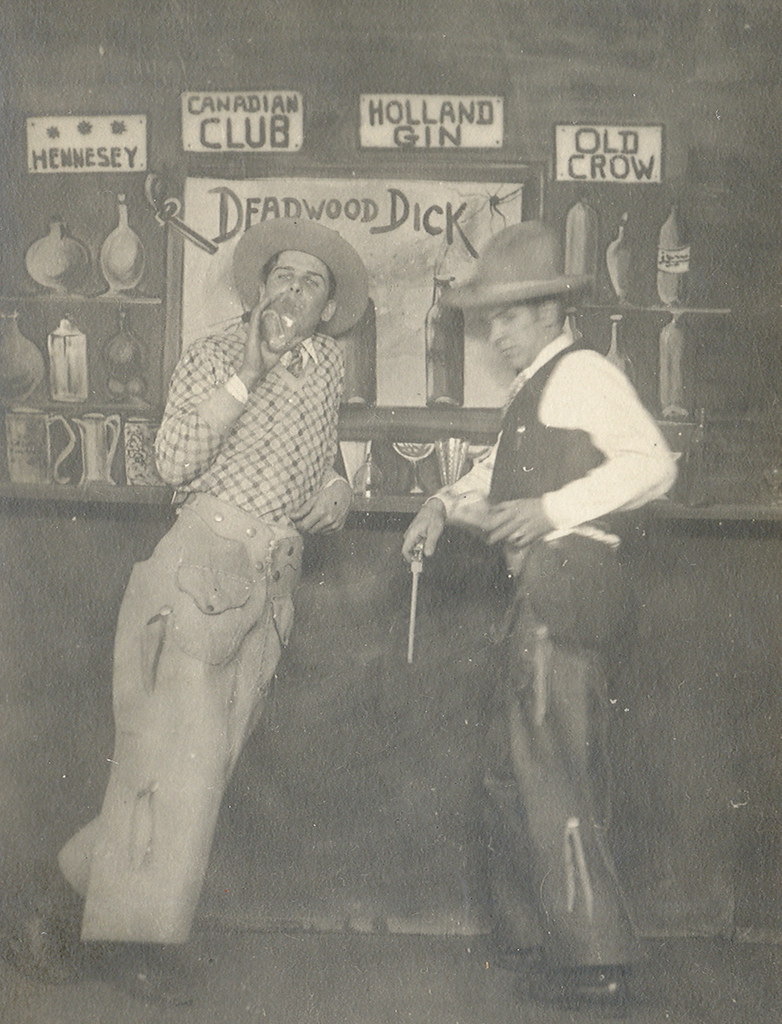
Photo: “Real Photo Hard Drinking Handsome Cowboys at the Deadwood Dick Saloon Studio Photograph RPPC AZO Stamp Box Hennesy Canadian Club Holland Gin Old Crow 2” by UpNorth Memories – Don Harrison is licensed under CC BY-NC-ND 2.0.

Marcus Bales, ‘This Be The Verse’

Post this, post that, post-modernists –
   Denying narrative’s cabal.
The story that they tell insists
   It’s not a story after all.

New Criticism made them see
   That reading closely what was said
Meant cutting off biography,  
   And authors might as well be dead.

Like raisin oatmeal cookies, picked
   In hopes of chocolate chip, they bust
Your faith in how things seem. You’re tricked
   To only trust in doubting trust.

Without the person or the text,
   No human mind, no human heart,
I guess we know what’s coming next:
   Let the AIs do the art.

*****

Marcus Bales writes: “This is one of what I call my habitual poems. I have a perfectly good stand-alone idea, and start to work on it, but the parody turntable in my head takes over and the needle slides down into the groove and instead of stealing only the world-weary and faintly snarky Larkin tone it turns out I steal the whole poem. 

I have a file of these to be revised away from parody and into something that is less parodic, or at least less immediately noticeable as theft. 

The problem is I’m lazy about this stuff. There is a straightforward tradition of doing these kinds of parodicish things in song, called ‘filks’, and I’ve done some of them. It’s carried over into the same sort of thing in poems. The groove is there, the tonality is familiar, the original is familiar, and like the soap coming out of your hand in the shower, clunk, it hits the floor. 

So, since Robin asked me to write this, I’ve got a revised version for you. It loses some of the immediacy of Larkin’s opening, of course, but I’ll bet if you hadn’t got that in your head associated with this one first, this second version would only have marked a faint echo — and you might not of noticed how Larkinesque it is at all.”

Editor’s note: Bales revised the first and fifth lines; the originals read:
They fuck you up, post-modernists,
(…)
But others fucked them up to see

Hence his Larkin references.

Not much is known about Marcus Bales except that he lives and works in Cleveland, Ohio, and that his work has not been published in Poetry or The New Yorker. However his ‘51 Poems‘ is available from Amazon. He has been published in several of the Potcake Chapbooks (‘Form in Formless Times’).

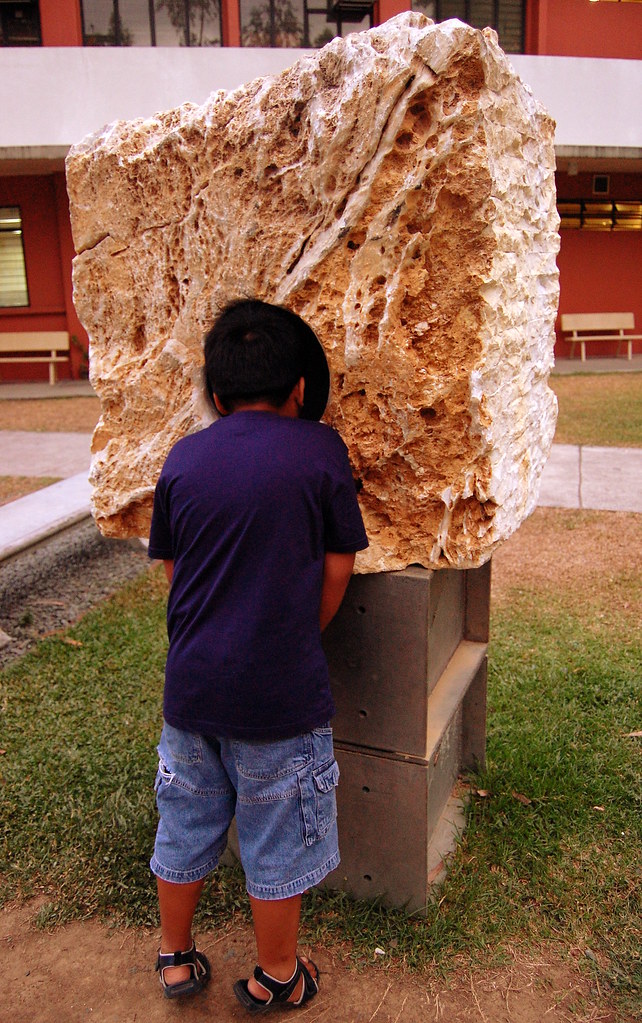
Photo: “Post-Modern Urinal” by ~MVI~ (warped) is licensed under CC BY 2.0.

Sonnet: Marcus Bales, ‘Walking in the Rain’

Today when we went walking it was raining,
Not so hard to keep us from it — still
Distinctly wet. We thought about abstaining,
But March this year has lost its normal chill,
So on we went. She did her bombs away,
I bagged, and she looked up, with fur-soaked skin,
And shook some water off, as if to say,
Open up the door let’s go back in.
Well you’re the one who brought us out this far
I said as if I thought she had a plan.
She body-languaged Well, since here we are,
We’ll sniff back slow and get wet as we can.
And now we’re on the rug here, somewhat dryer,
Breakfasted, and dozing by the fire.

*****

Marcus Bales writes: “If ever a poem cried out for explication, this poem is that poem. Its hidden meanings and elusive innuendos chase each others’ tails with such sly allusions that even the b in subtle seems to thrust itself forward in comparison.

“The depths this poem sounds, the heights beyond which it reaches, evinces nothing of the feline grace other poets aim for and achieve. Nothing here looks at the reader and refuses to respond to the call for extra petties. This is a poem that trots wetly over and rubs eagerly against knees, and receives the towelling-off and the “Who’s a wet one, eh, who’s a wet one, today?” with effervescent attempts to put its muddy feet on the reader’s shirt. This poem has but one thing to say, and it says it by leaning in for another pat on the head, and then swiftly shaking that fine final spray of mist into the reader’s face before they can back quickly enough away.

“It is the doggily doggish dogness of the thing that dogs the dogging dog of this poem, and makes it so, well, dogilicious.

“Cry havoc, and let slip the hounds of love.”

*****

Not much is known about Marcus Bales except that he lives and works in Cleveland, Ohio, and that his work has not been published in Poetry or The New Yorker. However his ‘51 Poems‘ is available from Amazon. He has been published in several of the Potcake Chapbooks (‘Form in Formless Times’).

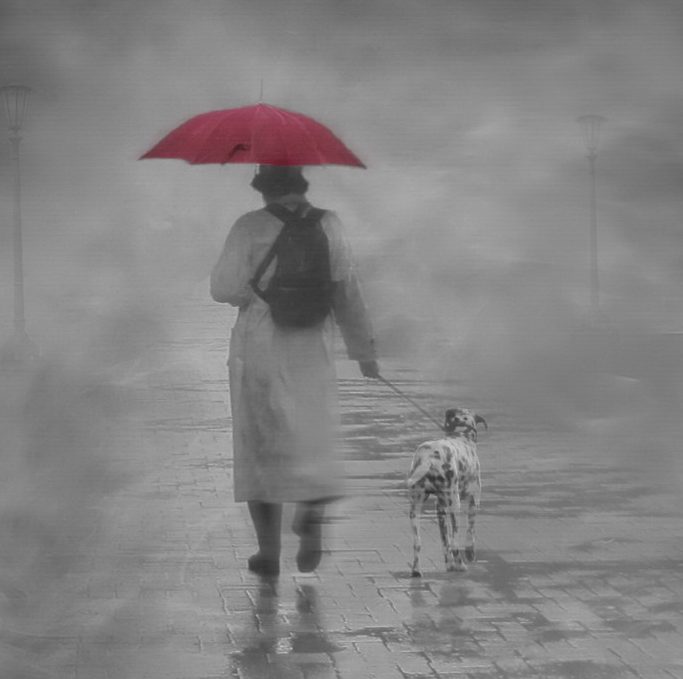
Walking in the Rain” by h.koppdelaney is licensed under CC BY-ND 2.0.

Marcus Bales, ‘Down-sizing’

I will retire and go to buy a ranch-house home,
And a fenced yard build there, for the dogs to roam around,
And raised beds, full of easier-weeding loam,
And cultivate my garden’s ground.

And I shall have my wife there, who knows the signs of stroke.
Morning and night, we’ll take the pills our doctors gave us,
And cook our meals of beans and rice because we’re broke —
And hope the kids vote blue, and save us.

I will retire, and maybe write and, when I’ve napped,
Cruise the internet, perhaps, and lament the loss
Of civility, and watch the fascists arrive, wrapped
In the flag, and holding a Bible and cross.

*****

Marcus Bales writes: “Yeats‘s ‘The Lake Isle of Innisfree‘ irritates me. Its narrator, left to live on an isle, would be dead in a week. Yeats’s mode of life was a series of retreats from country-home to country-home, sponging off the wealthy. Retreat is his vade mecum, and ‘The Lake Isle’ is only his most famous one. So I thought, well what the hell am I doing differently? And the answer is, not much. I made a career out of selling expensive things to rich people, too. And my retirement will be a retreat as well. Where’s my Lake Isle? In the suburbs, funded by Social Security instead of Lady Gregory, perhaps, but no less a throwing up of the hands and leaving it to the next generation to try to straighten out what mine has done.

“So Yeats’s narrator retreats to the high-fantasy farming of an isle in a lake, as if farming weren’t hard enough but it needed the difficulties of getting supplies across water. My narrator retreats to the suburbs without enough money to sustain his prior lifestyle. Two silly poets writing silly stuff.”

Not much is known about Marcus Bales except that he lives and works in Cleveland, Ohio, and that his work has not been published in Poetry or The New Yorker. However his ‘51 Poems‘ is available from Amazon. He has been published in several of the Potcake Chapbooks (‘Form in Formless Times’).

Photo: “Rosie poising with the garden Buddha, plants, raised bed, bamboo fence, Garden for the Buddha in progress, front yard, Seattle, Washington, USA” by Wonderlane is marked with CC0 1.0.

Non-traditional sonnet: Marcus Bales, ‘The Durable Rain’

The durable rain was conducting its drumming descent
Without any decent regard for the dawning of day
As if a dim evening was all of the morning it meant
To allow from a sun that was doing a landscape in grey.
Never begin with the weather the boffins have said.
If nature’s as stormy and dark as a novelist’s mind
The reader will sneer at the metaphor. Offer instead
A prose that’s so difficult readers are left far behind.
But back to my tale. Is it cozy inside, or does rain
Express what discursive description would talk past in vain?
Does a cry break a heart when the kettle releases its steam
Or, piping, awaken a lover up out of their dream?
What it will mean will depend on your context and age.
A poem exists in the reader and not on the page.

*****

Marcus Bales writes: “The first four lines rolled out without much trouble. I had let the dogs out after they’d woken me at what they thought was the right time but which to me was five in the a.m. It was cold and grey but not rainy at all. Who can figure how the brain works. I did worry briefly about the alliteration but finally put it off, hoping it would sound like rain on the roof. Sort of. And it seemed portentous and poetry-like, but where to go from that?

“I don’t know where I first heard that you’re not supposed to open with the weather. It sounds like one of those pieces of advice the internet kicks up from time to time purportedly by Elmore Leonard, along the lines of “You know those parts that readers skip over? Don’t write those.” Or “You got to know when to hold ‘em and know when to fold ‘em.” Advice that is absolutely both spot-on and worthless at one and the same time. If you know you don’t need any advice; if you need advice, it’s because you don’t know. It makes sense in that maddening way of all advice, but it is untakeable. However much you may agree that the reader doesn’t care what the weather is, they care what happens and who it happens to, there I still was without anyone there to have something happen to, except the damn rain.

“Sitting at breakfast reading my usual dollop of Wodehouse, I noticed that when things are going well for his characters the weather gets some generous play, and when not, not. Then I reflected that really I don’t have a large supply of written descriptions of the weather from anywhere. There’s ‘Neutral Tones’, of course, where the weather is a metaphor for the breaking relationship, and “Nothing that is not there and the nothing that is.” And ‘Stopping By Woods’ where the weather is the reason for the stopping, or the first lines of ‘Journey of the Magi’. There’s Auden’s ‘In Memory of Yeats’, Housman’s cherries hung like snow, if that even works, though who Snow was and how Housman knew is a mystery. And after that it’s vague references to this or that month or season generally in Keats, Poe, Byron, or Shelley, and the inference that all of Yeats happens in the summer what with swans and people fighting the horses of the sea, and all. And finally, again, all those descriptions of the morning in the Blandings and the golf stories. After that my memory starts to flail about. This isn’t the sort of thing where research is indicated at five in the ack emma. Perhaps you remember more examples of how the weather is used in prose and poetry, but it’s too late now, isn’t it.

“I wasn’t sure how to go on. It seemed as if nearly the whole practice of poetry in English was against me, aside from the sub-genre of song with all those deep and crisp and evens, and sleigh rides that began to echo in the back of my head, along with all those singers who seem to be perpetually crying or dancing or walking in the rain. Then I thought well, why not use that? I might get three or four lines out of it, and then maybe something else would occur to me. Well, I got my four lines and arrived at the volta of the sonnet, if sonnet it turned out to be. What now?

“Turning at the question that had stopped me I trod upon that patch for a few lines, and then I had got to the couplet. Well, I really had nothing, did I, among all this meta- bit, and what I had seemed to call for some digging into the whats and whys of how literature worked. Well, of course no one knows. I worried some about having failed to provide any context for the reader to see me through, and put it aside to eat breakfast.

“After that, and a shower, and a bit of humor watching the dogs return to the scene of the five o’clock crime outside to chase a squirrel in the yard, somehow the notion of context reasserted itself, and I remembered a sort of juicy quote from a professor 50 years ago who was gassing on about how a poem isn’t the sounds or the words or the meanings as the poet meant them, but rather the unpredicatable ways that the people misread poems. I recall he had half a dozen examples right to hand, as scholars so annoyingly seem to do, but I couldn’t bring a single one to mind. Fortunately, I’m a poet, not a scholar, so I don’t have to be able to give good – or any – examples, so I decided to steal his assertion and let it go at that.

“And there it is. A complete mishmash of false starts, interrupted middles, and squishy endings. Enjoy!”

Not much is known about Marcus Bales except that he lives and works in Cleveland, Ohio, and that his work has not been published in Poetry or The New Yorker. However his ‘51 Poems‘ is available from Amazon. He has been published in several of the Potcake Chapbooks (‘Form in Formless Times’).

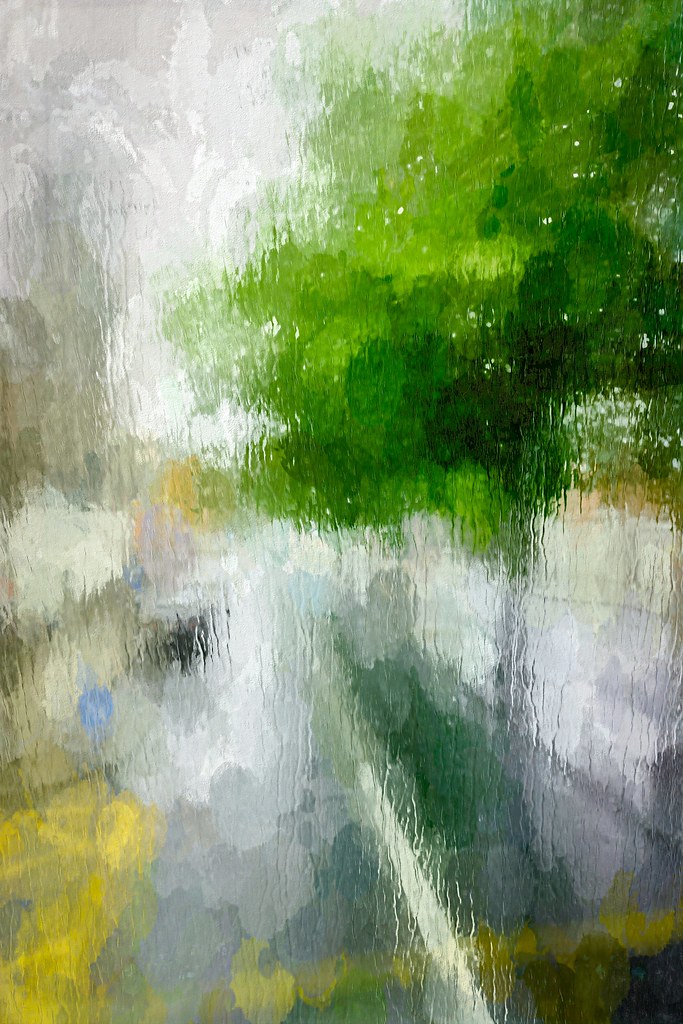
Photo: “Rainy Day” by SammCox is licensed under CC BY-NC-ND 2.0.

Marcus Bales, ‘Sailing to Margaritaville’

That is the country we go to, all of us
Made young again by music, smooth with oil
And lust, all generations generous
With youth and laughter. Couples coil
And uncoil, casually amorous,
With booze in the blender and shrimp beginning to boil.
Everybody dreams they have the chance
To chase the charms and challenge of romance.

A laughing bard is the essential thing.
A patterned shirt, an old six-string guitar,
Who urges us to sing and louder sing
And clap and dance and order from the bar,
And thank hard-working servers as they bring
The stuff that lubricates this whole bazaar.
And though the bard is covering the bill,
Tip well when you’re in Margaritaville.

Oh, parrotheads — imagination’s fire
Illuminates the marvel of it all,
And conjures every sorcery we require,
The call to the response, response to call,
A consummation fevered with desire,
Beatified by the local alcohol.
The song creates the dream. The dream creates
Another song the dreamer celebrates.

And once reality is far away,
Our youth returned, our stamina restored,
We eat and drink and sing and dance and play
And manifest ourselves within each chord
As if we might entrance ourselves to stay
Within this reverie we’ve found aboard
The magic vessel Margaritaville,
Distilling what distillers can’t distill.

*****

Marcus Bales writes: “Someone immediately floated a raft of shit my way over this poem, claiming, in a local Cleveland group generally given to local music, that I’m normalizing alcoholism. I know — it’s an astonishing misinterpretation, but there it is. And in spite of my protestations, he insisted on shouting that I was a lush, a drunk, and an idiot for promoting and approving a disease. Well, it’s not as if poets aren’t used to being misunderstood.

The odd thing to me about this is that I work hard to trigger people through poetry. That’s what art does, in my view, confront us with our frauds and foibles, and makes us look at them in detail. If, of course, we read poetry at all. There must be some corollary to Murphy’s Law that states that when a poem can be misinterpreted it will be misinterpreted. Normally I’m delighted by responses to my poems that are outraged and offended, because normally those responses are from the people I’m trying to outrage and offend. But this blindsided me. The entire Jimmy Buffett phenomenon was built on the fantasy of sun and sand and sea, which is only tangentially alcohol-fueled. No doubt alcohol plays a role in lubricating the enchantment, but it’s the enchantment people go for, not alcoholism.

And that enchantment is powerful. It makes people wear loud clothes and play loud music. But the central lure is that we can think of ourselves as all multi-talented and tanned, slim and young and horny. It’s not the lure of tales of drunkenness and cruelty on a summer afternoon, but rather the opposite: tales of slightly disreputable fun, but tales of the lure of the freedoms from regimentation for the freedoms of a more relaxed like-minded culture where everyone is youthfully attractive and eagerly lascivious.

And what a lure! Even those of us whose only encounter with youthfully attractive and eagerly lascivious were our own dreams had those dreams. And with Jimmy Buffett the price of admission was a seducing tune and a clever lyric. You didn’t need a white sportcoat, much less a pink crustacean. All you needed was a sense of lockstepness of the modern bourgeoisie and a desire to escape it. The whole thing is all in your mind. You create your own sensitive young poet self in a lubricious setting among the young and eager to love you. It’s thrilling, it’s fulfilling, it’s art.”

*****

(Editor’s note: From the title, to the ottava rima form, to the themes, ‘Sailing to Margaritaville’ pays homage to Jimmy Buffett by riffing on W.B. Yeats’ ‘Sailing to Byzantium‘. Beginning with Yeats’ opening words, “That is no country for old men” and all the way through, Bales echoes and plays with Yeats’ words, bringing everything to Buffett’s Margaritaville.)

Not much is known about Marcus Bales except that he lives and works in Cleveland, Ohio, and that his work has not been published in Poetry or The New Yorker. However his ‘51 Poems‘ is available from Amazon. He has been published in several of the Potcake Chapbooks (‘Form in Formless Times’).

Photo: “Wasting away again in Margaritaville……..” by efleming is licensed under CC BY 2.0.

Marcus Bales, ‘Labor Day 2023 – RIP Jimmy Buffett’

He died on Labor Day, the end of summer,
And left us going back to work or school.
The days are shorter, now, the parties glummer,
Less heat and light, less beat and life, less cool.
We fall back on our favorite expressions
Of what it means to be young, tan, and free,
And weigh the anchors of adult discretions
Imagining we sail a sapphire sea.
The songs he sang, those figurative vacations,
Have turned our water into stronger stuff.
We toast each other, changing our frustrations
With dailiness to fantasizing fluff,
And drink the happy liquor we distil
From metaphoric Margaritaville.

*****

Marcus Bales writes: “My favorite Jimmy Buffett songs are ‘A Pirate Looks At Forty‘ and ‘Tin Cup Chalice‘, but I think his best song is ‘Margaritaville.’ I’m not as fond of ‘He Went To Paris‘ or ‘Death of an Unpopular Poet‘ as other celebrants of his work, and ‘Why Don’t We Get Drunk and Screw‘ is certainly the best of the more raucous end of his oeuvre.

Like many other singer-songwriters Buffett seemed to me to work without an editor, possibly because the music business is such that even when you find a peer-group that you trust to say this or that just ain’t right, it’s hard to get the group together often enough, and for long enough, for the trust to re-blossom so that real reflection and re-working of lyrics can happen.

Those circumstances lead a lot of singer-songwriters, I think, to something that is not exactly laziness, and not quite smugness, but rather perhaps more like a sense that they’re the only ones whose taste they trust to judge their own work. Then they slide into a state where they are not themselves as critical of their own work as they once were. They get a good idea and a good line or two in the chorus, and the rest of it gets sort of clamped and glued together without a final planing, sanding, and paint job. The music is well-arranged and well-performed because you can’t fool musicians about music, but the lyrics tend to seem a little hasty, a little down-at-heels, a little scratch-and-dent. It’s too bad because their early work is almost always lyrically inventive and musically simple, while their later work is musically slick and lyrically spotty.

When I first heard A1A in 1978 I was entranced. No one else that I knew of was trying to sketch people and places from the point of view of a sort of scruffily aimless charmer. Oh, there was Tom Waits, but that was more noir and Bukowski than charming. Buffett’s work was entrancing, a refreshing way to write songs and perform them. A lot gets forgiven in the enchantment of the charm, but eventually the clanker lines and the narratives that don’t quite hold together accumulated, and I started to notice the tarnish more than the shine.

So the later work did not grip me as the early work had, and for most of the last 40 years, as the work drifted into crowd-pleasing medium-tempo rockers with a cheery tale told by a richer, more self-congratulatory narrator offering a smoother sail in a bigger boat crewed by professionals, I became less and less interested in what I had come to view as a pervasive sloppiness in the contemporary singer-songwriter tradition. It seemed to affect them all as they worked longer in the business, except perhaps for Paul Simon. But Buffett, Diamond, Prine, Browne, just to name a few, seemed all to become more facile than artful And Buffett in particular seemed to have decided to pursue sing-along music for the car instead of headphone music for the chair, and it started him on the path to wealth. And good for him.

But what I celebrate overall, and I hope in this poem, is the work that tried to be more than a pop song, that was striving, even if slyly and beneath the listener’s first perceptions, to be art. That’s what entranced me at the beginning, and that’s what I want to remember most fondly.”

Editor’s note: Jimmy Buffett died on the night of September 1st, and the news came out over the Labor Day weekend.

Not much is known about Marcus Bales except that he lives and works in Cleveland, Ohio, and that his work has not been published in Poetry or The New Yorker. However his ‘51 Poems‘ is available from Amazon. He has been published in several of the Potcake Chapbooks (‘Form in Formless Times’).

Marcus Bales, ‘Lighthouse’

She needed constant, searching light
And some firm continent
From which to dive into the night
To find what darkness meant.

She fought the horses of the tides
And they her urgency.
She caught their lunar reins and rides
Triumphant out to sea.

And now she knows the powers of
The dark sea’s character,
And scorns the note her former love
Moans out, moans out to her.

*****

Marcus Bales writes: “Probably poets ought not tell this sort of story about their work. I found a stash of very old poems, carefully typed out on now-yellowed paper in a metal file box amid 5” Tandy floppy discs, and printed on a dot-matrix printer, a little faded, some months ago, and have started the often painful task of retyping them into my little electronic library of my work. Many of them are obviously student stuff, but this one seemed a little less studious than the rest. It brought back its context in my mind pretty clearly.
This is a very early poem, maybe sophomore year. I’d read someone’s comment that Yeats wrote about his friends as if they were characters in a Greek myth, and it had struck me as a sudden truth — to me, anyway. Nothing would do, of course, except to try the thing on my friends. Then a woman I knew gave me a copy of Adrienne Rich’s ‘Transformations’, which tells the stories of ancient myths about women, mostly, as if they had much more contemporary attitudes, and that seemed like a much better model than the Yeats tone and manner — and besides, Yeats had already done that tone and manner. So though the idea originated in Yeats, it is really Rich’s idea that I tried to follow, trying for the tone of metaphor in a contemporary voice. And Larkin was in there somewhere too, as I recall, having discovered him when asked to write a paper contrasting and comparing one of his poems to one of Wilbur’s. The Larkin was the one starting:
Sometimes you hear, fifth-hand,
As epitaph:
He chucked up everything
And just cleared off,

And that led me to many others, notably ‘The Trees’, with its amazingly unlarkinish  repetition at the end.
Steal from the best has long been my motto.”

Not much is known about Marcus Bales except that he lives and works in Cleveland, Ohio, and that his work has not been published in Poetry or The New Yorker. However his ’51 Poems’ is available from Amazon. He has been published in several of the Potcake Chapbooks (‘Form in Formless Times’).

Photo: “my father was the keeper of the eddystone light” by sammydavisdog is licensed under CC BY 2.0.

Marcus Bales, ‘Helpless’

Life is one long horrible disease.
As victim or as witness it’s the same:
There are no opportunities to seize,
And helplessness leaves no one left to blame.
The path ahead seems only downward, slick
As running water on a plastic slide,
And pausing seems to be a magic trick
That never works however hard you’ve tried.
Eventually of course that blame gets laid,
No matter what you want. A gap, a fault,
A wall, some outside force that can’t be stayed,
And you become at one with the gestalt.
Some love, some fear, some cry, some laugh to death.
You cannot talk to addicts. Save your breath.

*****

Marcus Bales writes: “This sonnet began as a set-up for a re-write of one of the terrible-pun-spoonerism poems from February 2023, and it sort of got away from me. It happens sometimes — you start out with one idea of what a poem is about and then the poem just won’t cooperate. At every line i was trying to tell the story of the alcoholic swami with cirrhosis who had been unfortunate enough to have married a woman who was impatient of inheriting, and who finally killed him when she weighed down upon the swami’s liver. As you can see, the poem was determined to have none of that, and went its own way, cleverly taking all the addiction and death for itself and leaving me with nothing I could use for my purposes. So to punish it I let it sit for a few months, hoping it would come to its senses and realize that the only way to see the light of day was to accept the purposes I had had in mind for it, but even there it was too smart for me, and kept quietly to itself until a day came when I hadn’t finished anything else. With a sigh and a shake of my head I posted it. So here it is.”

Not much is known about Marcus Bales except that he lives and works in Cleveland, Ohio, and that his work has not been published in Poetry or The New Yorker. However his ’51 Poems’ is available from Amazon. He has been published in several of the Potcake Chapbooks (‘Form in Formless Times’).

Helpless” by Scarlizz is licensed under CC BY-NC 2.0.