Tag Archives: meaning of life

Excerpt, semi-formal: Matthew Arnold, ‘A Summer Night’ (2)

And the rest, a few,
Escape their prison and depart
On the wide ocean of life anew.
There the freed prisoner, where’er his heart
Listeth, will sail;
Nor doth he know how there prevail,
Despotic on that sea,
Trade-winds which cross it from eternity.
Awhile he holds some false way, undebarred
By thwarting signs, and braves
The freshening wind and blackening waves.
And then the tempest strikes him; and between
The lightning-bursts is seen
Only a driving wreck,
And the pale master on his spar-strewn deck
With anguished face and flying hair
Grasping the rudder hard,
Still bent to make some port he knows not where,
Still standing for some false, impossible shore.
And sterner comes the roar
Of sea and wind, and through the deepening gloom
Fainter and fainter wreck and helmsman loom,
And he too disappears, and comes no more.

*****

This fragment is the response to the previous excerpt from Matthew Arnold’s ‘A Summer Night’ that I blogged two days ago. As a teen in a well-regimented boarding school I found that previous fragment terrifying with its prospect of living as a bored wage-slave forever, and this second fragment exhilarating in its freedom despite the expectation of catastrophe. Altogether a very subversive poem, and I thank my schooling for including such works. For the next couple of decades I followed the wild path, failing to earn a degree at universities in three countries, never holding a job for more than 18 months, frequently moving. Eventually I found an occupation that was constantly changing, where Eliza and I were our own bosses, and that took us to dozens of countries to teach business seminars. So that successfully combined the wage-slave and the freed prisoner, and it all worked out.

Arnold originally ended his poem:

Is there no life, but these alone?
Madman or slave must man be one?

But ten years later he added a much more wishy-washy piece about learning from the pure heavens and seeing what a nice life you could make for yourself. I always thought he should have stopped with the original “madman or slave” view of life: much more dramatic! But his later addition was probably justified…

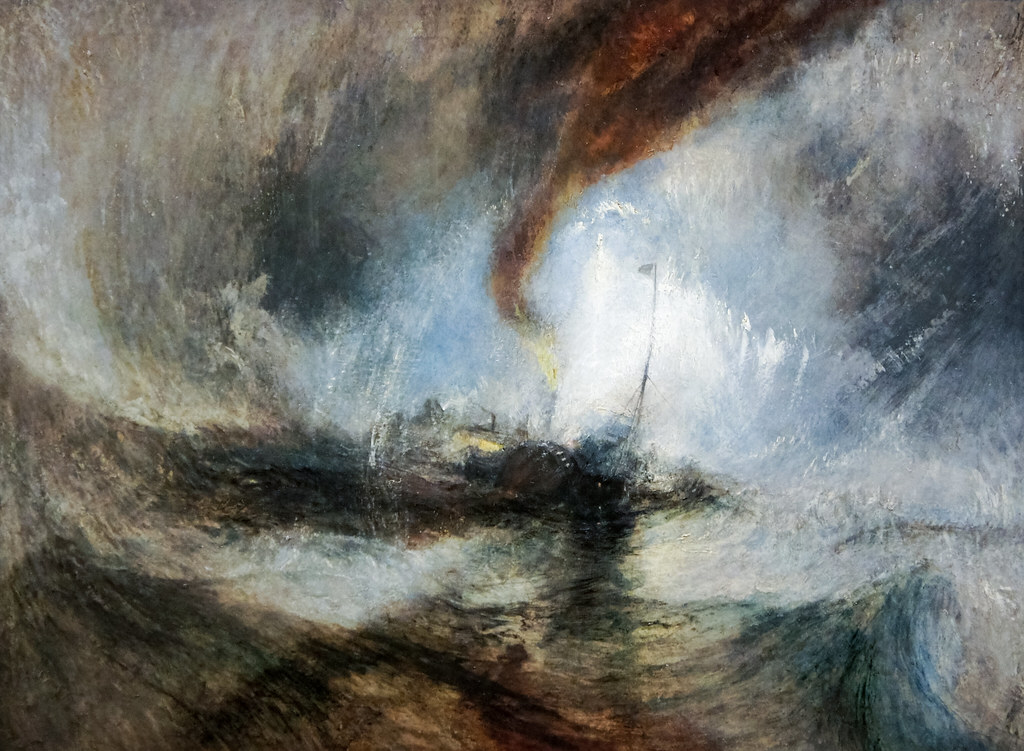
Snow Storm—Steam-Boat off a Harbour’s Mouth” by hyperion327 is licensed under CC BY-NC-SA 2.0. (Note: the painting is by J.M.W. Turner, of course.)

Len Krisak, ‘A Life’

The streets, albeit not with gold, were paved,
The path both broad and even; wide the way
And easy, with no uniform to don.
By almost nothing was he put upon.
Old age had been foreseen, and so he saved,
The modicum matched with its rainy day.
The sheets were clean, as were the neat clothes worn
From bawling babe, to teen, to man, and on.
Few were the oaths required to be sworn,
And almost nothing had been sacrificed,
Or found worthwhile, or worth the dying for.
As to the depredations brought by war,
None had been undergone. All things sufficed,
Since almost nothing crucial had been needed.
Yes, easy, broad, and even, he conceded,
Though through it all, what all of it had meant
He couldn’t say. No, not in any event.

*****

Len Krisak writes: “the speaker, slightly morose (?), confesses both to a life of no particular hardship and to an inability to decide on the meaning or quality of such an existence.”

‘A Life’ was first published in Pulsebeat Poetry Journal.

Len Krisak’s translation of the Aeneid appeared in 2016. His translation of the Inferno will be out from Routledge in September, as will his own poems, Magpie. The past winner of the Richard Wilbur and Robert Frost prizes, he is a four-time champion on Jeopardy!

empty suits” by paul goyette is licensed under CC BY-NC-SA 2.0.

Richard Meyer, ‘Sapiens’

By evolution born and bred
with something extra in the head
(and maybe also in the heart)
that sets us markedly apart

from all the teeming life on Earth,
we sapiens, for what it’s worth,
create and feel and comprehend,
but to what purpose, to what end?

Wisely foolish, cruelly kind,
with jumbled passions, muddled mind,
we’re oxymorons through and through.
In what we do or fail to do

a pestilential gifted ape
with a history we can’t escape.
Our future tenuous and stark,
we stumble onward in the dark.

*****

Richard Meyer writes: “I’ve always been amused that our species defines itself as Homo sapiens, meaning “wise man” or “wise human.” The history of humanity contains much that is wonderful, beautiful, and commendable, but it also records much that is horrible, dreadful, and appalling. The verdict as to which tendency will prevail remains uncertain. It’s difficult to be optimistic when the Doomsday Clock was recently set at 85 seconds to midnight. In addition, the political situation in the United States is grim. So, we stumble onward.”

‘Sapiens’ was originally published in the Alabama Literary Review (2023, Vol. 32)

Richard Meyer, a former English and humanities teacher, lives in Mankato, MN. His book of poems Orbital Paths was a silver medalist winner in the 2016 IBPA Benjamin Franklin Awards. He was awarded the 2012 Robert Frost Farm Prize for his poem “Fieldstone.” His poetry has appeared in a variety of print and online journals and has also received top honors several times in the Great River Shakespeare Festival sonnet contest. He is also the author of Wise Heart, a memoir of his mother Gert who was born in poverty, came of age during the Great Depression, enlisted in the army during World War II, served overseas, achieved the rank of first sergeant, and was awarded the Bronze Star for meritorious service performed during the Battle of the Bulge. Richard’s most recent book is Stumbling Onward, a collection of new and selected poems. His books are available on Amazon. 

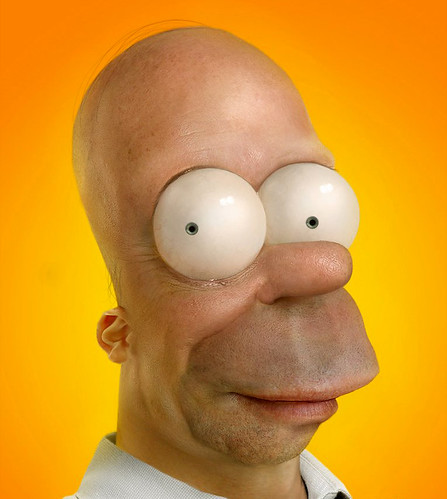
Photo: “Homer Sapiens” by Brett Jordan is licensed under CC BY 2.0.

Poem: ‘Some Fling Away’

Some fling away
Some stay and cling—
Each their own Way
To do their own thing.

Sacrifice meaning
For love of the rhyme;
Know that in dreaming
You make up the time.

Sacrifice meaning—
When thought becomes sight
Your soul from its mole-hole
Blinks into life-light.

*****

An early poem, from when I was searching for meaning and questioning the various Meanings that were presented. Decades later, I feel the answer to the meaning of everything is best expressed by Leonard Cohen at the end of Tower of Song. That, and by John Cleese in the photo’s poster, and Douglas Adams’ “42”. Do your own thing, indeed; and keep dreaming and rhyming.

‘Some Fling Away’ was first published in ‘Metverse Muse‘ in India.

Do Your Own Thing” by mikecogh is licensed under CC BY-SA 2.0.