Tag Archives: muse

Using form: Sonnet: Max Gutmann, ‘How to Inspire a Sonnet – advice from the pros’

Inspire amore first, but molto forte
If in sonetti dolci you’d be sung.
Then see that you stay bella. You’ll support a
Passione deep and long by dying young.
— Laura

If thou upon his stage the Muse’s part
Wouldst play, each act thou study’st must prolong
Thy Poet’s pain. ‘Tis pain shall prompt great Art.
Then con thy lines with style, and do him wrong.
— The Dark Lady

Stay always by her. Never for a day
Be from her cherished side. ‘Tis paramount
To share the highest love. (And, by the way,
It helps to choose a lover who can count.)
— Robert Browning

‘Tis mystery that fires the crucial spark,
So make him wait–and keep him in the dark.
— Milton’s blindness

*****

Max Gutmann writes: “A reader of Light Quarterly (the marvellous Light back in its days as a print journal) was so offended by a poem of mine ridiculing a lousy president that he cancelled his subscription. Beloved editor John Mella forwarded a copy of the note to me. It was a sonnet! I’d never thought I could inspire a sonnet. I had a ways to go before rivaling Laura or the Dark Lady, but I’d taken the first step. That inspired this poem.

“John declined the poem, so it first appeared in a journal that didn’t specialize in light verse, one highly thought of. (Digging it out now, I see that contributors to the issue the poem appeared in included, among others I admire, Updike, Espaillat, Turner, Gioia, and Hadas.) But the journal goofed. They changed sonnetti dolci to sonnetti dolce (plural noun, singular adjective). This must have been a typo, I imagined, but when I asked, the chief editor not only admitted the change had been intentional, but defended the decision. Dolce being the more familiar form, he argued, it was reasonable to make the change without consulting the writer. I never sent them anything again

“This story calls for a shout-out to Jerome Betts, who reprinted ‘How to Inspire a Sonnet’ in Lighten Up Online (LUPO). (To avoid the impression that Jerome is less than meticulous about acknowledgements–or about anything–I should make clear that I asked him not to acknowledge the earlier journal, and I didn’t name it for him.) Jerome, like most editors I’ve worked with, always asks before making changes–and his proposed changes are usually improvements, often big ones!”

Editor’s note: This poem suggests what might be appropriate ways to inspire sonnets, according to the subjects of sonnets: Petrarch’s Laura, Shakespeare’s Dark Lady, Elizabeth Barrett Browning’s Robert and Milton’s blindness. Self-referentially, the poem is itself a Shakespearean sonnet, written in response to being the subject of a sonnet. Gutmann is therefore both sonneteer and sonnetee, and has the credentials to write a “How to –“

Max Gutmann has worked as, among other things, a stage manager, a journalist, a teacher, an editor, a clerk, a factory worker, a community service officer, the business manager of an improv troupe, and a performer in a Daffy Duck costume. Occasionally, he has even earned money writing plays and poems.

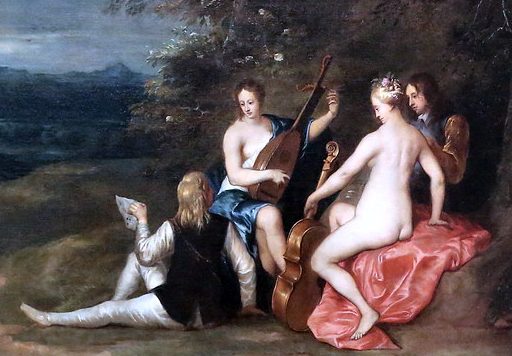
Photo: “IMG_0323C Frans Wouters. 1612-1659. Antwerp. The rural concert. 1654. Dole” by jean louis mazieres is licensed under CC BY-NC-SA 2.0.

Poem: ‘Milking the Stars’

My Milky Way muse
Is spread through the skies.
I’ll tickle and tweak
Those nipples the stars,
Till, teased and engorged,
They fill out and stretch;
I milk them to books
To leather-bound books,
To leather-bound buckets of books.
A two-handed milking,
Steady and rhythmic,
As generations
Before me have milked them.
Then when the pail’s full,
Star needs being met,
Stars twinkle and glow.
The Milky Way muse
Thrives on such use.
I drink and give thanks,
Bound to give thanks,
Leather-bound star-shining thanks.

*****

Published in this month’s Snakeskin (No. 307, June 2023). Thanks, George Simmers!

Photo: “Milky Way” by be creator is licensed under CC BY 2.0.

Calling the Poem: 14. ‘What About Failure?’

But what if the poem’s not there?
Is just an idea?
A vague vapor?
What if there were only a few words, heard freshly?
Then write them down even (or rather, especially)
if you must get out of bed, find pen and paper.

By getting up and writing out
the poem letter by blind letter
you are showing by your doing
your devotion to your gods.
Writing verse invokes the Muses,
turns up fresh thoughts, more and better…
not for certain, but just writing
will of course increase the odds.

The hidden gods now bidden,
gods willing, by gods you’ll be ridden.

*****

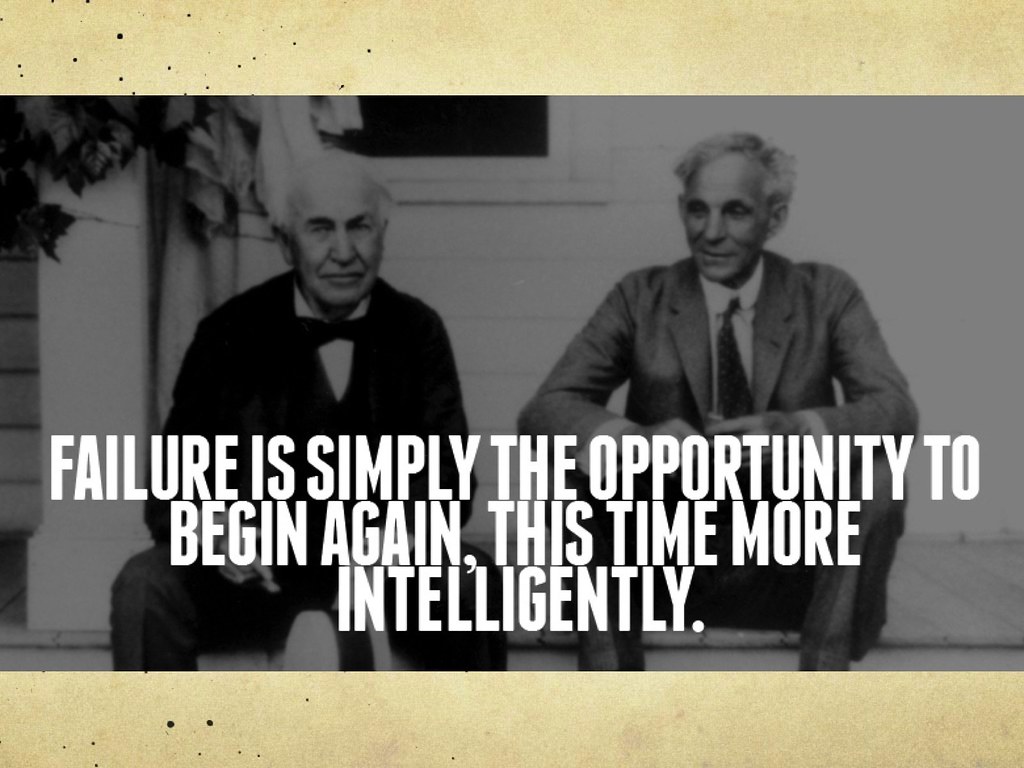
It’s not possible for everything to succeed every time. So what? As they say, Wisdom comes from learning; learning comes from experience; experience comes from mistakes. Failure is an inherent part of life and learning and achievement – but of course it is essential to learn from failures, not to simply repeat them. So even failures are a gift – be grateful!

Photo: “Failure – Try again” by Tatiana12, CC from OpenPress

Calling the Poem: 9. ‘The Poem Comes’

Do you see the tigerish poem, or is it seeing you?
Sensing you, sizing up your form…
(You know that lovely feeling, warm,
When you’re stared at by somebody you like…
How creepy though, if someone you dislike…)
Perhaps it will ring true,
Perhaps the lines
Will just ring hollow…
But having offered yourself up like some bonbon,
Prayed at the shrines
Of lares and penates, Mercury, Apollo,
Ganesh and Odin, Legbas Atibon,
Liminal gods of paths and gates,
And stories, lies, poetry and fates,
You have no right, nor no ability,
To choose between rough trade or some civility;
Stared at by god or demon, grand or scum,
You’ve whored yourself to gods. Take what may come.

*****

This is the ninth in the 15-poem series of the ‘Calling the Poem’ e-chapbook that Snakeskin published a couple of years ago. (Unfortunately the Snakeskin Archives are currently down.) It reflects my sense that you can evoke artistry by invoking those unconscious inner forces that can only communicate with your conscious self through dreams and images, hints and melodies, words that well up but are not quite random…

The invocation requires two things to be successful: alertness to your changing moods, and showing respect for whatever “inspiration” you receive by writing it down, sketching it out, formalising it as appropriate – and thereby encouraging further communication.

I’m aware that all this sounds pretentious. But I think that the unconscious mind knows different things, in some ways truer things, than the conscious mind, especially about physical health, mental balance and the process of changes in life. Finding a way to tap into this – through prayer, meditation or the arts – is life-affirming for most people… but perhaps dangerous for a few.

The next poems in this series deal with things going right, going wrong, needing work…

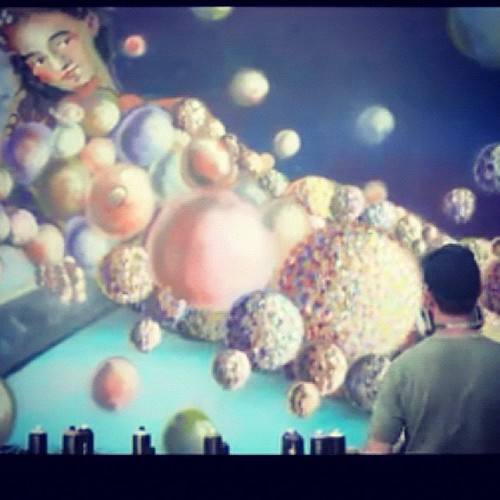
Photo: “Streetart at the state of art #art #streetart #dublin #graffiti #montana #street #woman #beautiful #poetic #inspiring #graffiti #artistic #gorgeous #wall #graff” by Romana Correale is licensed under CC BY-ND 2.0.

NSFW poem: ‘The Zeus Credit Card Company’

Homeless and eyes cast down, young Danae found
the credit card just lying on the ground.
‘Zeus Credit’… with her name on it… and it said
it had no limit. So she thought
‘Why not just try it?’ and she bought
sandals, silk underwear, a dress;
it worked… so then, why not,
a light lunch in the choicest, chicest spot.
It worked again. Its back was odd:
no legalese, just logos, ads…
‘Insert in slot for all dreams to come true.’
Tearful, she checked into Hotel Princess,
went up and had the best bath in some years,
Reading again with happy tears
‘Insert in slot for all dreams to come true’
and thought again ‘Why not?’
and put it in her slot…
in sudden stir
Zeus filled the room and her.

*****

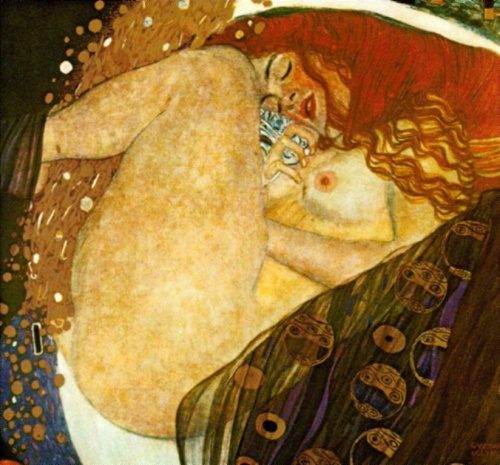
This poem, semi-formal at best, was published in this month’s Snakeskin (thanks, George Simmers!) with the accompanying Gustav Klimt ‘Danae’. I wrote the poem earlier this year but I have very little memory of doing so, and no sense of what triggered it. I put it down to the mysterious workings of the subconscious or whatever else the Muse may be.

This is an appropriate poem to post before I head into the next set of poems from the e-chapbook ‘Calling the Muse’. Is it always correct to offer up art (of any kind) that is edgy? What if the expression is sexist, even obscene? What if the work is irreligious, even blasphemous in the eyes of a believer? Is it enough to say “If you don’t like it, don’t look at it”? Is it enough to post a warning, “NSFW”?

And the Greek gods often tend toward the sexist and the licentious. Zeus is not a clean-living figure. But no one seems to object to his being depicted and popularised, even if he is a rapist. Because “that was then, this is now”? And if the Muse offers you a fresh take on an ancient rape legend, just use it because after all, the Muse must be listened to?

More on this shortly.

Calling the Poem: 7. ‘The Tiger’

That wild white wind that whips the world away –
The darkness deep and dread in dazzling day –
The light and dark that fuse with furious force –
The leaping tiger that gives no recourse –
Acknowledge, fear, that lurking tiger’s rage,
The terrifying sense of spring-taut powers,
Menacing, tail-tip twitching while it glowers,
Lethal both to ignore or to engage.
Acknowledge it, succumb: you’ve been rewarded.
And now produce – because the debt’s recorded.

*****

This is the 7th of the 15 poems of the Snakeskin e-chapbook ‘Calling the Poem’. ‘The Tiger’ and the next few poems deal with the difficulties of first begging your Muse for inspiration and then finding that the inspiration is uncomfortable – personally, socially, politically, whatever. Perhaps the inspiration isn’t what you were hoping for… but what are your obligations once you have in effect contracted to receive something unknown?

The Muse, the gods, the unconscious or however you like to think of your source of inspiration is not to be trifled with. It is to be respected if you want to stay on good terms with it and benefit from it.

The word ‘music’, by the way, means Muse-ish, ‘of the Muses’. The following is blended from passages in Wikipedia: According to Pausanias in the later 2nd century AD, there were three original Muses, three original Boeotian muses before the Nine Olympian Muses were founded: Aoidē (“song” or “voice”), Meletē (“thought” or “contemplation”), and Mnēmē (“memory”). Together, these three form the complete picture of the preconditions of poetic art in cult practice.

So song, contemplation and memory are the Muses that together drive poetry. Poetry is totally Muse-ish. Therefore poetry is inherently musical. Its music is essential.

(And it was only after writing this blog that I found that the current Oglaf comic features a tiger…)

Photo: ‘Tiger’ by Captain Chickenpants is licensed under WordPress Openverse.

Calling the Poem: 6. ‘Of Sacrifice’

You learn to call, to pray, and to invoke
the gods with incense, roasting meat and smoke,
the smell drawing the gods like flies.
They like being honoured, they like gifts and sacrifice.
How do you gift a god of writing? Write!
Write when you have a thought, write day, write night.
How do you sacrifice? Accept this hardship:
you give up all activities
(regardless of your duties, your proclivities,
relationships) – for bardship,
because you don’t have time for them and writing.
Downgrade all love, work, striving, fighting –
for you must write.
You read, read, write, recite,
write and rewrite,
reread and rerecite.
(The modes you read impact the words you write,
impact the thoughts you have, and how they’re phrased.
Read novels, you’ll have thoughts in prose: straight, trite;
read verse, your thoughts will ramble, rhyme, be crazed.)
How bargain with the gods? Well, you can offer.
Can you demand? Well, no; you can’t.
Do they play fair? Take care with what they proffer;
you’re never sure if it’s a loan or grant.
How long will favours last? While you’re in favour;
a god or goddess owns you like a slaver.
And while for them you still produce,
still honour them… you still have use.
So keep on writing until you collapse,
and they’ll continue liking you. Perhaps.

*****

This is the sixth in the 15-poem sequence on Calling the Poem. The basic idea is that if you pay attention to the little scraps of poetry that come your way, in a random rhyme, a stray image; if you write them down and expand on them as you can; if you respect what comes to you, even if it isn’t what you want to hear; if you spend more time immersed in the medium that you want to develop… then you are encouraging the further communication from the mysterious force that provides the insights and images and words, the force that appears to be both inside and outside of you, the force that can be thought of as a muse or god. But the process is unreliable, because gods are unreliable, being inherently uncontrollable by us.

Matthew Arnold has a typically lugubrious and pessimistic overview of ‘The Progress of Poesy’:

Youth rambles on life’s arid mount,
And strikes the rock, and finds the vein,
And brings the water from the fount,
The fount which shall not flow again.

The man mature with labour chops
For the bright stream a channel grand,
And sees not that the sacred drops
Ran off and vanish’d out of hand.

And then the old man totters nigh
And feebly rakes among the stones.
The mount is mute, the channel-dry;
And down he lays his weary bones.

But that’s Matthew Arnold for you. He had a remarkably mournful muse. Perhaps he spent too much time as a responsible Victorian, a dedicated Inspector of Schools, and not enough time in the state T.S. Eliot called the “necessary receptivity and necessary laziness” of the poet. Eliot again: “The progress of an artist is a continual self-sacrifice, a continual extinction of personality.” You are striving to be at the mercy of forces outside your conscious control – there can be no guarantee that it will work out exactly the way you want.

Illustration: “Sacrifice” by Tamara Artis is licensed under CC BY-SA 2.0.

Calling the Poem: 5. ‘Of Muses’

When thoughts, fantastic dreams, bright images,
invade you from inside without relief –
thoughts that aren’t yours, nor come from the outside –
then, heedless of the real world’s scrimmages,
you can’t ignore, forget, refute, refuse.
Forces not you, that ride you and bestride,
when viewed with self-delusion, self-belief,
must therefore be some spirit, god, or muse.

*****

This is the fifth of the 15 poems in the ‘Calling the Poem’ series, published as a Snakeskin e-chapbook. From the awareness of the creative mood to the valuing of an idea, to the attempt at expression, to the crafting and polishing of the item, there are several stages in the creation of a piece of art. I am trying to lay out my sense of this process, and of how any individual can choose to develop it, and produce more and better art.

It’s my belief that many, many people could be the most amazing poets or other creators, but they don’t go down that path because they choose not to pay attention to the stray thoughts and images that come their way. For those of us who try to follow and develop the images, there is always the question of where they come from: from within us, or from the outside? I think humanity’s self-understanding is very primitive so far, and that there are layers under layers still to be peeled back. All our answers are best guesses, working hypotheses, delusions… but they are all we have, and valid and valuable when seen in that light.

Most of the poems in this series are semi-formal – they have enough rhythm and rhyme to facilitate their recitation, but lack the formal structures, the appropriate patterns, that can be aspired to. To me the recitation is key, because poetry is auditory in nature, in its origin, at its heart. It is almost as old as singing, which is in turn almost as old as rhythmic babbling and drumming. The poem printed on the page is not the poem itself, it needs to be read (aloud, or in your mind’s voice) in order to become the poem.

So I don’t have strong opinions on whether to capitalise the first letter of each line of a poem: it doesn’t impact the sound. But if it can help with the reading and comprehension – by not capitalising and thereby showing the flow of the sentence, or by capitalising in order to differentiate from spillover part-lines and thereby retaining the metre or rhythm – then an appropriate choice should be made. The version of this work that I am using is all first-letter capitalised. I’ve modified that today because I felt the poem was more comprehensible when the individual sentences were more clearly marked; the issue isn’t otherwise important.

And, no, I’m not impressed with concrete poems or shape poems as verse, although they can be excellent as jokes and witticisms.

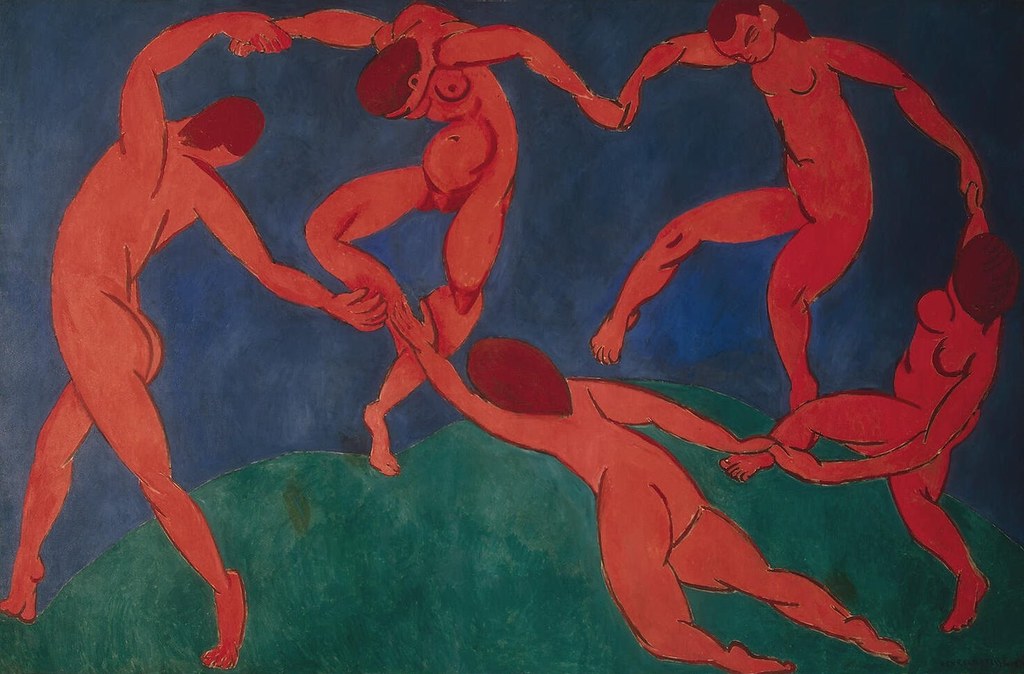
Photo of “Henri Matisse – Dance [1910]” by Gandalf’s Gallery is licensed under CC BY-SA 2.0.

Calling the Poem: 3. ‘Self-Belief’

Can you handle the wild poem? Can you tame the thing, or kill?
The certainty, uncertainty, of writing as a skill,
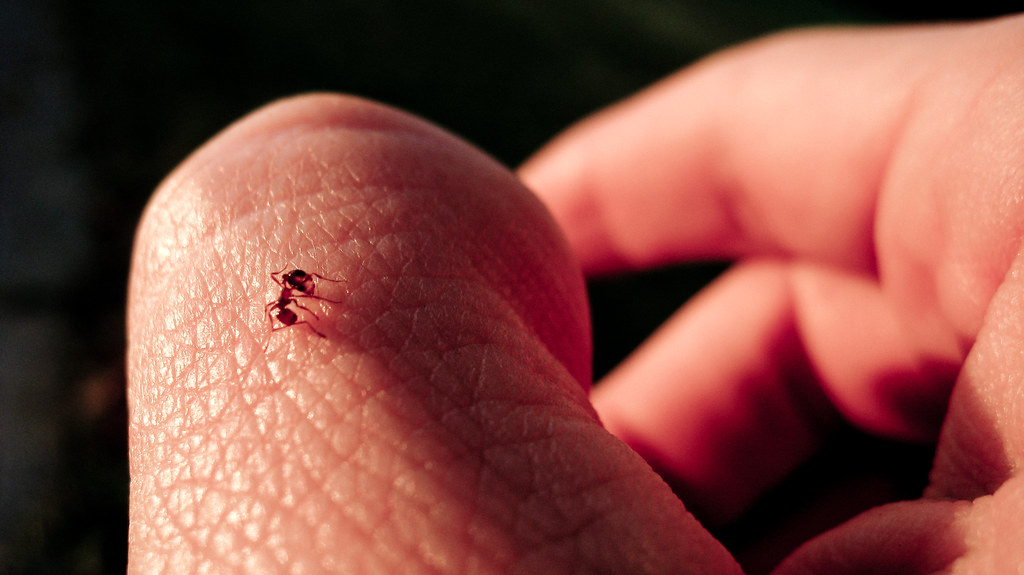
The being told to “find your voice”, the crawling like an ant
Across the skin of Literature, that giant, to implant
Some token of your individuality, some pin
To jab into the giant’s vast and ant-infested skin,
To make your mark by scrawling words, tattoos, to claim a win…
You can’t succeed alone against such odds!
But there are gods…

*****

This is the third poem in the ‘Calling the Poem’ chapbook sequence in Snakeskin. The question of self-belief can be difficult for any artist – given the thousands of years of recorded paintings, sculptures, poems, music, etc, how can you know that your tiny ant-like efforts will be enough to make a mark in the world? Can you hope to succeed? The choice might seem to be between the hubris of Yes and the defeatism of No – but you have a secret ally, if you pay attention: the Muse. If you are self-aware and mindful, if you stay alert for scraps from the unconscious, the dream-world including daydreams, if you are respectful enough to try to capture the little hints you are given, then the Muse (She, or He, or Them, Yourself, your unconscious, God or Gods or Angels, however you visualise this force and process) will provide you with insights and material you never knew you could access.

Your Muse is available to you… if you stop and listen, remain open and respectful of the unexpected. Again, the learning and the workloads imposed by others tend to act against this attitude. Take heart from T.S. Eliot: “a poet ought to know as much as will not encroach upon his necessary receptivity and necessary laziness.” That was not a flippant comment of his: it goes to the heart of learning to work with your Muse.

Photo: 8/17/09 Houston – Fire Ant Bite by stefan.klocek used under OpenVerse license

Calling the Poem: 1. ‘Invocation’

O Odin,
Living outside me or within,
Share your mead of poetry you earned in night’s delight,
Spare me from the mead you shitted out in flight and fright.
By Thought and Memory, I swear
A poem needs your care,
For poems… magic poems… are nothing,
and come from your nowhere…

A poem comes in flurries:
A phrase that catches, sticks,
A rhyme that matches
With some thought that dog-worries,
And a verse that clicks.

*****

Just to be clear, I’m no more a believer in the Norse gods than I am in Yoruba, Hindu or Christian deities. Also, I’m not a white nationalist. But mythology has a couple of uses for me: pure enjoyment of the tangled tales; a way of looking at historical mindsets; and a tool for trying to communicate with the unconscious, i.e. to let the creative unconscious funnel ideas and images to the conscious mind.

What I do believe is that invoking the Muse, or a god, is a way of telling your unconscious that you are receptive to its comments… it is a fishing expedition, and you never know what you’re going to get. But I believe it is a system that works (sometimes), and I don’t practise another. (Various drugs are alleged to get results, too.)

So a few years ago I set out to describe the process that I follow to try to bring poetry to me. The result was a series of 15 poems, published by Snakeskin as an e-chapbook in January 2017. It was available as a free download from Snakeskin No. 236, and it should be again, when the Snakeskin archives are again operational. I named it ‘Calling the Poem’.

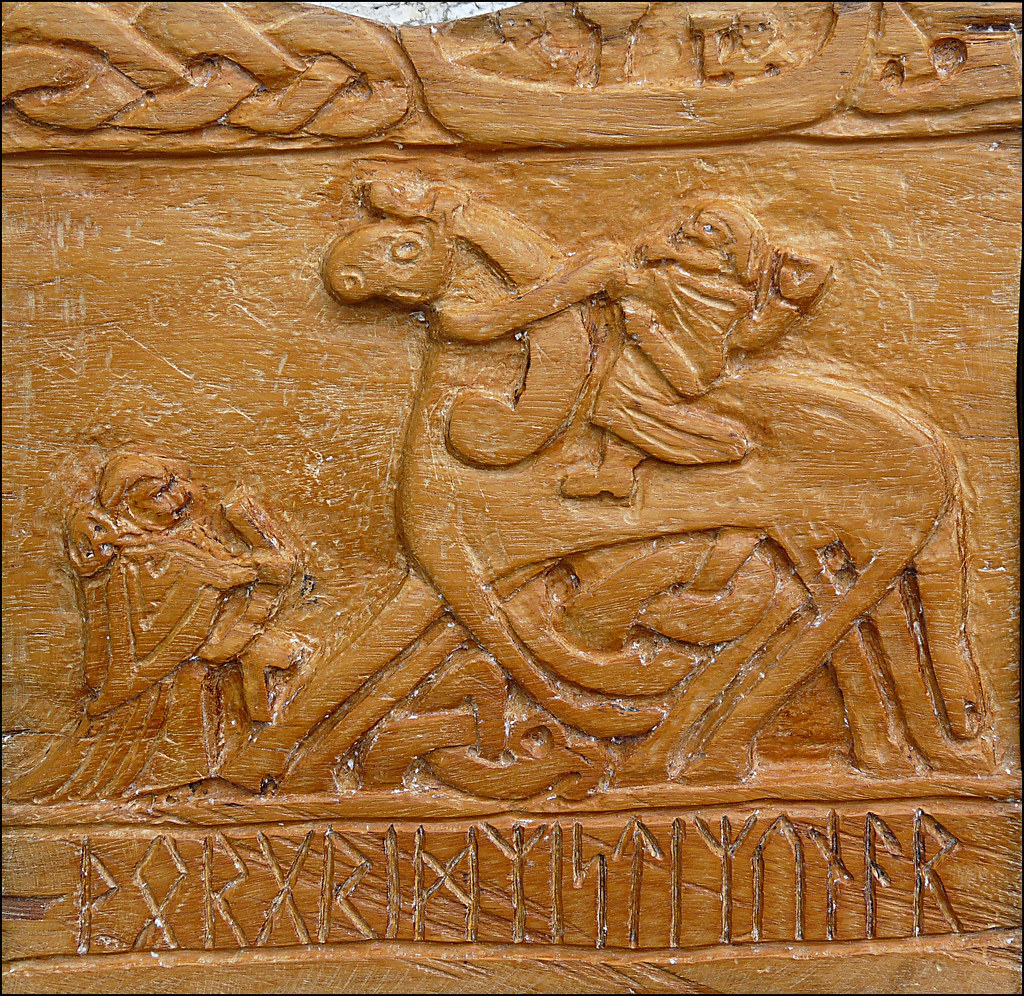
‘Calling the Poem’ starts by invoking the Muse – male, female, human, animal, I think the Muse can be however you choose to imagine it. But the Muse should be a dream-image, for the Muse, the unconscious, is as likely to communicate through dream as anywhere. Odin is a good figure, with his ravens of Thought and Memory who give him the news of the world, his eight-legged horse Sleipnir who can carry him through all the worlds, his ability to shapeshift and prophesy, the sacrifices he made to obtain wisdom such as gouging out an eye to put in Mimir’s well, and of course the mead of poetry that he stole and disburses as he feels.

And so the first poem – somewhat rough-hewn, semi-formal – is the invocation addressed to Odin.

Photo: “Odin on Sleipnir” by Hornbeam Arts is licensed under CC BY-NC 2.0.