Tag Archives: odd poem

Weekend read: Odd poem: Benjamin Disraeli, ‘To A Beautiful Mute (The Eldest Child of Mr. Fairlie)’

Tell me the star from which she fell,
Oh! name the flower
From out whose wild and perfumed bell
At witching hour,
Sprang forth this fair and fairy maiden
Like a bee with honey laden.

They say that those sweet lips of thine
Breathe not to speak:
Thy very ears that seem so fine
No sound can seek,
And yet thy face beams with emotion,
Restless as the waves of the ocean.

‘Tis well. Thy face and form agree,
And both are fair.
I would not that this child should be
As others are:
I love to mark her indecision,
Smiling with seraphic vision

At our poor gifts of vulgar sense
That cannot stain
Nor mar her mystic innocence,
Nor cloud her brain
With all the dreams of worldly folly,
And its creature melancholy.

To thee I dedicate these lines,
Yet read them not.
Cursed be the art e’er refines
Thy natural lot:
Read the bright stars and read the flowers,
And hold converse with the bowers.

*****

This poem for a mute girl and another (‘To a Maiden Sleeping After her First Ball’) can be found in All Poetry; they each have an accurate but uninspiring AI-driven analysis after them; the subsequent comments are more engaging:
WolfSpirit – “keep writing, Benjamin. you may just be a known poet someday. “
Linda Marshall – “I know Disraeli as a novelist and (of course) as a politician.
This is the first poem of his I’ve ever read!
It has its moments and of course tastes were different in those days but there are rhythmical infelicities and some rhymes that verge on the comic.
I can see why he’s known for his prose rather than his poetry!”

Benjamin Disraeli was born into a Jewish family in 1804; his father quarrelled with the synagogue and renounced Judaism, and had all the children baptised into the Church of England when Disraeli was 12. After school, Disraeli was articled to a law firm at age 16, and his career went from there to stock market speculation, financial ruin, novel writing, and then politics. He was twice Prime Minister of the United Kindom, and was appointed Earl of Beaconsfield by Queen Victoria in 1876. He died in 1881, unmourned as a poet.

Photo: Earl of Beaconsfield, K.G. Photographed at Osborne by Command of H.M. The Queen, July 22, 1878. This file was derived from: Benjamin Disraeli CDV by Cornelius Jabez Hughes, 1878.jpg
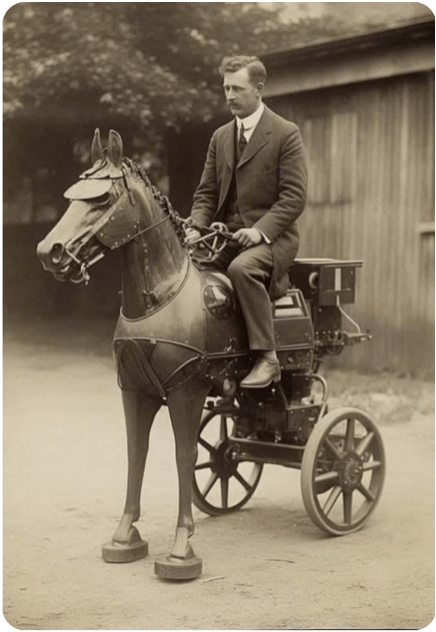
Odd poem: Light verse: Richard Fleming, ‘The Equestropede’

George, wishing to proceed at speed,
built the world’s first Equestropede.
This fusion of a horse and cart,
a tribute to the welder’s art,
had a strong engine, 12 hp,
which meant George travelled speedily.
It ran on oats and gasoline,
a strange concoction, unforeseen
by Elon Musk and the X folk
who would have seen it as a joke.
George, Michelangelo reborn,
treated the neigh-sayers with scorn.

*****

Richard Fleming writes: “The Equestropede, when it was first unveiled at the Exposition Universelle in 1901, proved to be the centaur of attraction. I post a rhyming poem every day on my Facebook page https://www.facebook.com/richard.fleming.92102564/ and accompany it with a quirky image that I’ve found online. Does the poem precede the image or vice versa? That depends. In the case of ‘The Equestropede’ the strange image definitely preceded the rhyme and fairly begged to be ‘poeticised’. The Equestropede name, however, is purely my invention as is its unveiling at the Exposition Universelle.”

Richard Fleming is an Irish-born poet (and humorist) currently living in Guernsey, a small island midway between Britain and France. His work has appeared in various magazines, most recently Snakeskin, Bewildering Stories, Lighten Up Online, the Taj Mahal Review and the Potcake Chapbook ‘Lost Love’, and has been broadcast on BBC radio. He has performed at several literary festivals and his latest collection of verse, Stone Witness, features the titular poem commissioned by the BBC for National Poetry Day. He writes in various genres and can be found at www.redhandwriter.blogspot.com or Facebook https://www.facebook.com/richard.fleming.92102564/

Odd poem: Couplet wordplay: Daniel Galef, ‘Letters to an Editor’

When I was in the printing biz,
in magazines (I worked at MS),
under my office door was slipped
a neatly-typed-out MS,
its cover letter curt and snippy,
return address in MS.
And what a scoop! New drug (its doses
prescribed for MS)
a fraud! The source, in bold defiance,
a chemist with a MS.
I showed my boss. “Yeah, right!” she reckoned,
and canned me in a MS.

*****

Daniel Galef provides this key to the various standard meanings of the abbreviation:
“Ms. Magazine; manuscript; Mississippi; multiple sclerosis; Master of Science degree; millisecond.”

Daniel Galef’s first book, Imaginary Sonnets, was published last year. ‘Letters to an Editor’ was published as part of his being the Featured Poet in Light Poetry Magazine. He is currently working on a book of comic poetry and wordplay, as well as on a PhD from the University of Cincinnati.

Photo: “Ms. magazine Cover – Winter 2015” by Liberty Media for Women, LLC is licensed under CC BY-SA 4.0.

Odd poem: Muhammad Ali, ‘Me, We’

Me?
We.

*****

Muhammad Ali was invited to talk to a group of Harvard students on June 4, 1975. Someone shouted, ‘Give us a poem, Muhammad’ and he paused, looked up and said: ‘Me? We’. But as it was spontaneous and spoken, the punctuation is what you will, and evokes a variety of ideas and responses. Questions of identity… of Ali himself being part of the roomful of attendees… of the needs of the group outweighing the needs of the individual… the human journey from selfishness to altruism… Certainly all that is in keeping with the speech he gave that night, excerpted here.

It claims title to the World Championship for the shortest poem, at least in the English language.

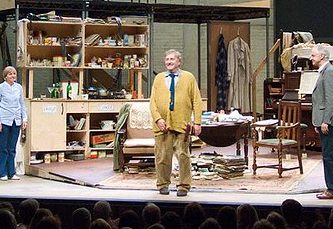
Odd poem: George Simmers on audiences on Alan Bennett’s play on W.H. Auden, ‘On “The Habit of Art”.’

The poet drinks, he stinks, he pees in sinks.
The audience, superior as shrinks,
Appraise a life amusingly in tatters.

How they appreciate a play that flatters
Their minds with chat about artistic matters!
And how much more they savour nods and winks
And saucy homosexual high-jinks!

They go home thinking:
‘Poets? Mad as hatters!
They drink, you know! They stink! They pee in sinks!’

*****

George Simmers writes: “Alan Bennett’s 2009 play The Habit of Art deals with the later life of W.H. Auden, and deals frankly with Auden’s sexual and hygenic peculiarities, as well as giving a sense of the poet’s talent. Looking back on his poem, written soon after seeing a performance at the National Theatre, I was more annoyed by the sniggering audience of London sophisticates than by Bennett’s play, which has interesting things to say about the relationship between poetry and the fallible humans who create it.”

George Simmers used to be a teacher; now he spends much of his time researching literature written during and after the First World War. He has edited Snakeskin since 1995. It is probably the oldest-established poetry zine on the Internet. His work appears in several Potcake Chapbooks, and his recent diverse collection is ‘Old and Bookish’.

https://greatwarfiction.wordpress.com/
http://www.snakeskinpoetry.co.uk/

“The Habit of Art by Alan Bennett, National Theatre, London” by chrisjohnbeckett is licensed under CC BY-NC-ND 2.0.

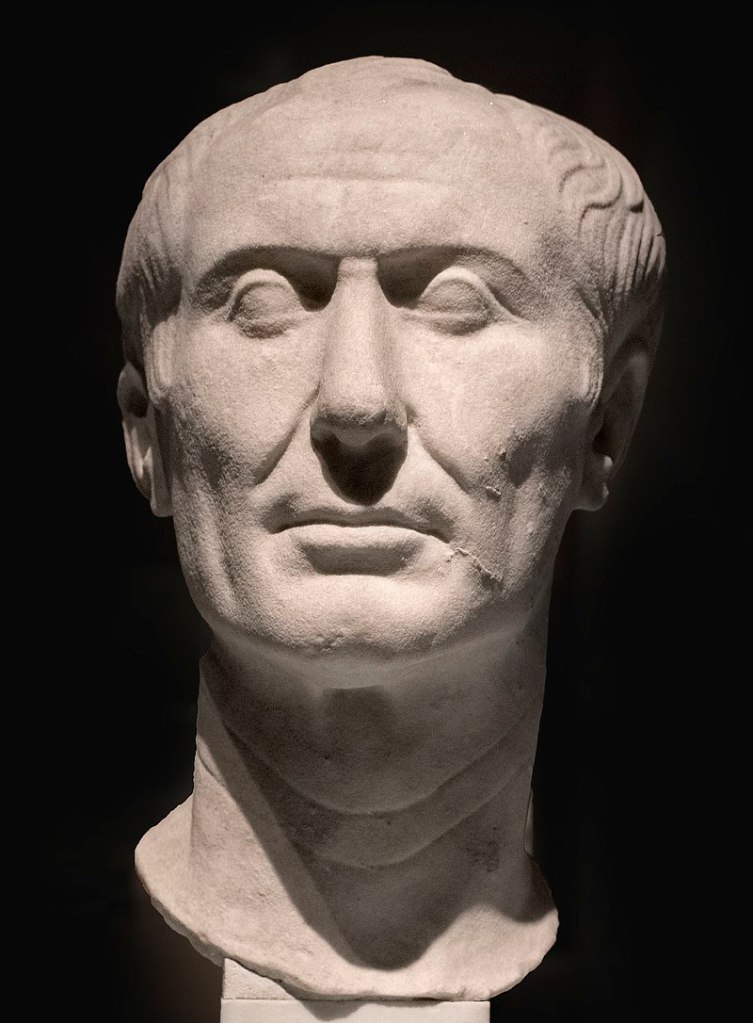
Odd poem: Julius Caesar, ‘On the poetry of Terence’ (fragment)

Thou too, even thou, art ranked among the highest, thou half-Menander,
and justly, thou lover of language undefiled.
But would that they graceful verses had force as well,
so that thy comic power might have equal honour
with that of the Greeks, and thou mightest not be scorned in this regard and neglected. It hurts and pains me, my Terence, that thou lackest this one quality.

Tu quoque, tu in summis, o dimidiate Menander,
Poneris, et merito, puri sermonis amator.
Lenibus atque utinam scriptis adiuncta foret vis,
Comica ut aequato virtus polleret honore
Cum Graecis neve​ hac despectus parte iaceres!
Unum hoc maceror ac doleo tibi desse, Terenti.

*****

Julius Caesar is known to have written at least three volumes of verse–‘Praises of Hercules’ and the verse tragedy ‘Oedipus’ as a young man, and a verse travelogue ‘The Journey’ during the civil war–but almost nothing survives. His heir Augustus cancelled the publication of the youthful verse because it was incompatible with the program for his deification.

The fragment above is quoted by Suetonius in his ‘Vita Terenti‘ (‘The Life of Terence‘), and translated by J. C. Rolfe.

Photo: Retrato de Julio César uploaded by Ángel M. Felicísimo from Mérida, España.

Odd poem: ‘The Mother’ or ‘Thanks’ (‘Dank’es!’) NOT by Adolf Hitler (my apologies about the post!)

When your mother has grown old,
And you have grown older
When what used to be easy and effortless
Has now become a burden to her,

When her dear, faithful eyes
no longer see life as they once did,
When her tired feet
don’t want to carry her any more while walking. –

Then give her your arm to support,
Accompany her with pleasure –
The hour is coming. When you, weeping,
Must accompany her on her last walk!

And if she asks you a question, then give her an answer.
And if she asks again, then answer!
And if she asks yet again, answer again,
Not impatiently, but with gentle calm.

And if she cannot understand you properly
Explain her everything happily.
The hour will come, the bitter hour,
When her mouth asks no more.

Wenn deine Mutter alt geworden / Und älter du geworden bist
Wenn ihr, was früher leicht und mühelos / Nunmehr zur Last geworden ist,
Wenn ihre lieben, treuen Augen / Nicht mehr, wie einst, ins Leben seh’n
Wenn ihre müd’ gewordnen Füße / Sie nicht mehr tragen woll’n beim Gehen. –
Dann reiche ihr den Arm zur Stütze, / Geleite sie mit froher Lust –
Die Stunde kommt. Da du sie weinend / Zum letzten Gang begleiten musst!
Und fragt sie dich, so gib ihr Antwort. / Und fragt sie wieder, sprich auch du!
Und fragt sie noch mehr, steh ihr Rede, / Nicht ungestüm, in sanfter Ruh!
Und kann sie dich nicht recht verstehen, / Erklär’ ihr alles froh bewegt.
Die Stunde kommt, die bitt’re Stunde, / Da dich ihr Mund nach nichts mehr fragt!

*****

This poem is actually from Georg Runsky (pen name of Karl Wilhelm August Georg Runschke). It appeared in 1906 under the title “Habe Geduld!” in his book “Blüthen des Herzens”.

Rightwing groups have claimed that it is a 1923 poem by Hitler about his mother Klara Hitler who had died in 1907. He seems to have loved her very deeply… but he was a painter, not a poet. His mother had been cared for by the Jewish Doctor Eduard Bloch, and Hitler painted the picture above of the doctor’s house in 1913. So what? So Hitler was a Malignant Narcissist like an unfortunate number of powerful modern politicians and businesspeople. That doesn’t mean that he wasn’t capable of love or artistic impulses; you can have them and still be a narcissist. People who insist that there is pure evil in the world (whether Nazism or Judaism) are themselves a lot of the problem. Personally, I have a lot of difficulty with both Nazism and Judaism (and Communism and Christianity, and anyone who insists they are Right and they Know because their Leader or their Book says so), but I also have family and friends of all those persuasions. I don’t respect them for their authoritarian tendencies, but I also don’t think they are pure evil. The demonising of people who you disagree with or fear or are jealous of, that’s the start of the problem. We’re all people, and people are apes after all. Some people are stupid, some are intelligent but uneducated, some are sick, some have genetic defects, some were badly raised, some are sociopaths… then study them, try to make them better human beings, and in the meantime make sure they don’t have access to guns. Thank you. Rant over.

Photo: Watercolour by Adolph Hitler, 1913, House of Dr. Bloch. https://www.wikiart.org/en/adolf-hitler/maison-du-dr-bloch-1913

Odd poem: ‘The Naughty Preposition’ by Morris Bishop

I lately lost a preposition:
It hid, I thought, beneath my chair.
And angrily I cried: “Perdition!
Up from out of in under there!”

Correctness is my vade mecum,
And straggling phrases I abhor;
And yet I wondered: “What should he come
Up from out of in under for?”

*****

Morris Bishop had a high regard for light verse: “The aim of poetry, or Heavy Verse, is to seek understanding in forms of beauty. The aim of light verse is to promote misunderstanding in beauty’s cast-off clothes. But even misunderstanding is a kind of understanding; it is an analysis, an observation of truth, which sneaks around truth from the rear, which uncovers the lath and plaster of beauty’s hinder parts.”

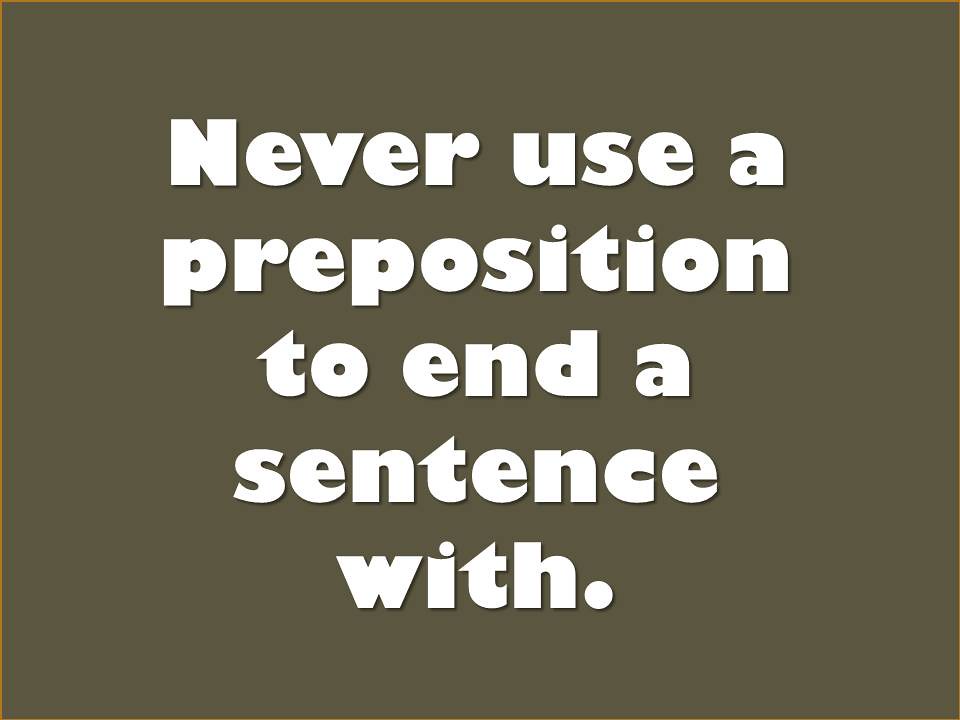
Bishop was an acknowledged master of rhyme and meter, but that doesn’t imply that he would be limited by the grammatical restrictions of the apparently well-educated. He employed and enjoyed common speech.

Now this may sound strange coming from me, someone who writes a blog dedicated to the expansion of formal verse, but many “rules of grammar” are garbage. To me, correct speech is whatever unambiguously communicates what the speaker intended. This is naturally aided by the use of predictable patterns of word usage, because we are a pattern-recognition species, and this in turn leads to “rules”; but these rules are really only “commonly used patterns”.

Similarly the forms of traditional verse are there because they are useful: rhythm guides and builds emotion; rhyme, rhythm and wordplay all create engagement and help memorisation. The forms are neither arbitrary nor sacrosanct. The formality is purely useful (and part of its use is creating fun). Grammatical rules and formal verse have that in common.

Winston Churchill is often cited as the author of a scribbled comment on someone “correcting” his grammar: “This is the sort of nonsense up with which I will not put.” But that joke appears to predate his involvement with the issue: there is a lengthy discussion of it here in the Quote Investigator.

English has particularly confusing and contradictory rules because of the blending of several waves of Germanic speakers (Anglo-Saxons, followed by Danish invaders and later Dutch merchants) overrunning the British (i.e. Celtic speakers with their complicated auxiliary verbs: “How did you do that?”), in turn being overrun by French-speaking conquerors supported by Latin-speaking priests. (I recommend John McWhorter’s ‘Our Magnificent Bastard Tongue‘.) It was this latest ruling class that was averse to (among other things) ending a sentence with a preposition. But that’s a natural and correct part of speech for a Dane to end with.

And I’m an Anglo-Dane.

“T-shirt Slogan: ‘Never use a preposition to end a sentence with.’” by Ken Whytock is licensed under CC BY-NC 2.0.

Odd poem: Abraham Lincoln, ‘The Suicide’s Soliloquy’

Here where the lonely hooting owl
Sends forth his midnight moans,
Fierce wolves shall o’er my carcase growl
Or buzzards pick my bones.

No fellow-man shall learn my fate,
Or where my ashes lie;
Unless by beasts drawn round their bait,
Or by the ravens’ cry.

Yes! I’ve resolved the deed to do,
And this the place to do it:
This heart I’ll rush a dagger through,
Though I in hell should rue it!

Hell! What is hell to one like me
Who pleasures never knew;
By friends consigned to misery
By hope deserted too?

To ease me of this power to think,
That through my bosom raves,
I’ll headlong leap from hell’s high brink,
And wallow in its waves.

Though devils yell, and burning chains
May waken long regret;
Their frightful screams, and piercing pains,
Will help me to forget.

Yes! I’m prepared, through endless night,
To take that fiery berth!
Think not with tales of hell to fright
Me, who am damn’d on earth!

Sweet steel! come forth from out your sheath,
And glist’ning, speak your powers;
Rip up the organs of my breath,
And draw my blood in showers!

I strike! It quivers in that heart
Which drives me to this end;
I draw and kiss the bloody dart,
My last—my only friend!

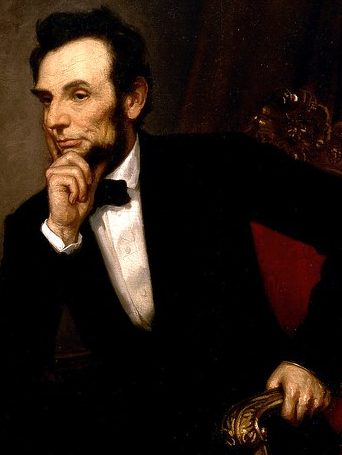
This poem was published anonymously in the April 25, 1838 edition of The Sangamo Journal of Springfield, Illinois, under this introduction: “The following lines were said to have been found near the bones of a man supposed to have committed suicide, in a deep forest, on the Flat Branch of the Sangamon, sometime ago.” For various reasons it is now commonly assumed that this is the poem that Lincoln’s friend Joshua Speed told Lincoln’s biographer William Herndon about, a poem that the President had written on suicide as he struggled through a period of deep depression.

A full discussion of the identification of the poem with Lincoln can be found in the magazine Shenandoah, and I happily quote their assessment of Lincoln’s merits as a poet:

The poem is similar to other mortality poems of the period, though even more melodramatic than most (the last stanza, in which the speaker continues to narrate his feelings after he has stabbed himself through the heart, is particularly painful). Aside from the historical curiosity of its authorship, the piece—with its glamourizing of suicide and its overwrought morbidity—does little to distinguish itself from other amateur poetry in the school of Poe.

Photo: “16 Abraham Lincoln” by US Department of State is marked with CC PDM 1.0

Odd poem: ‘Motor Bus’, macaronic poem by A. D. Godley

What is this that roareth thus?
Can it be a Motor Bus?
Yes, the smell and hideous hum
Indicat Motorem Bum!
Implet in the Corn and High
Terror me Motoris Bi:
Bo Motori clamitabo
Ne Motore caedar a Bo—
Dative be or Ablative
So thou only let us live:
Whither shall thy victims flee?
Spare us, spare us, Motor Be!
Thus I sang; and still anigh
Came in hordes Motores Bi,
Et complebat omne forum
Copia Motorum Borum.
How shall wretches live like us
Cincti Bis Motoribus?
Domine, defende nos
Contra hos Motores Bos!

This elegant piece of nonsense was written in January 1914 to celebrate the introduction of a motorised omnibus service in the city of Oxford–hence the reference to two of its main streets, the Corn(market) and High Street. Noticing that both ‘motor’ and ‘bus’ could be the nominative singular of Latin nouns, Professor Godley wrote this series of couplets, declining and rhyming the nouns through all their presumed cases, singular and plural. (The poem presumes the old-fashioned English pronunciation of Latin with many hard vowels needed for the rhymes.) And why not? ‘Motor’ is Late Latin for ‘mover’, and ‘bus’ is a casual modern abbreviation of ‘omnibus’, Latin for ‘for everyone’. The entire piece is written in a mixture of English and Latin, and translates roughly as:

What is this that roars so,
Can it be a motor bus?
Yes, the smell and hideous hum
Indicates a motor bus!
In the Cornmarket and the High Street
Terror of the motor bus fills me:
To the motor bus I will call out
Lest I be killed by the motor bus–
You can be Dative or Ablative
So long as you let us live:
Where shall your victims flee?
Spare us, spare us, O Motor Bus!
So I sang; while still
Motor buses came in hordes
And the whole market place was filled
With a mass of motor buses.
How shall wretches like us live
Surrounded by motor buses?
O Lord, defend us
From these motor buses!

Macaronic, or mixed languages, literature has ancient roots, showing up wherever two languages overlap in one population for a while, frequently in verse, frequently for humorous effect: alternating Persian and Arabic verses or hemistichs of Saadi and Hafez; Rumi’s occasional mix of Persian, Arabic, Turkish and Greek; Indian poetry written in alternating indigenous Hindi and the Persian of the Mughal rulers; and Latin and vernacular languages throughout Europe at the end of the Middle Ages. Modern examples include the Beatles’ ‘Michelle’ and José Feliciano’s ‘Feliz Navidad’.

Photo: “Brandesburton, with NER motor buses 1915 (archive ref PO-1-18-1)” by East Riding Archives is marked with CC0 1.0