Tag Archives: Painting

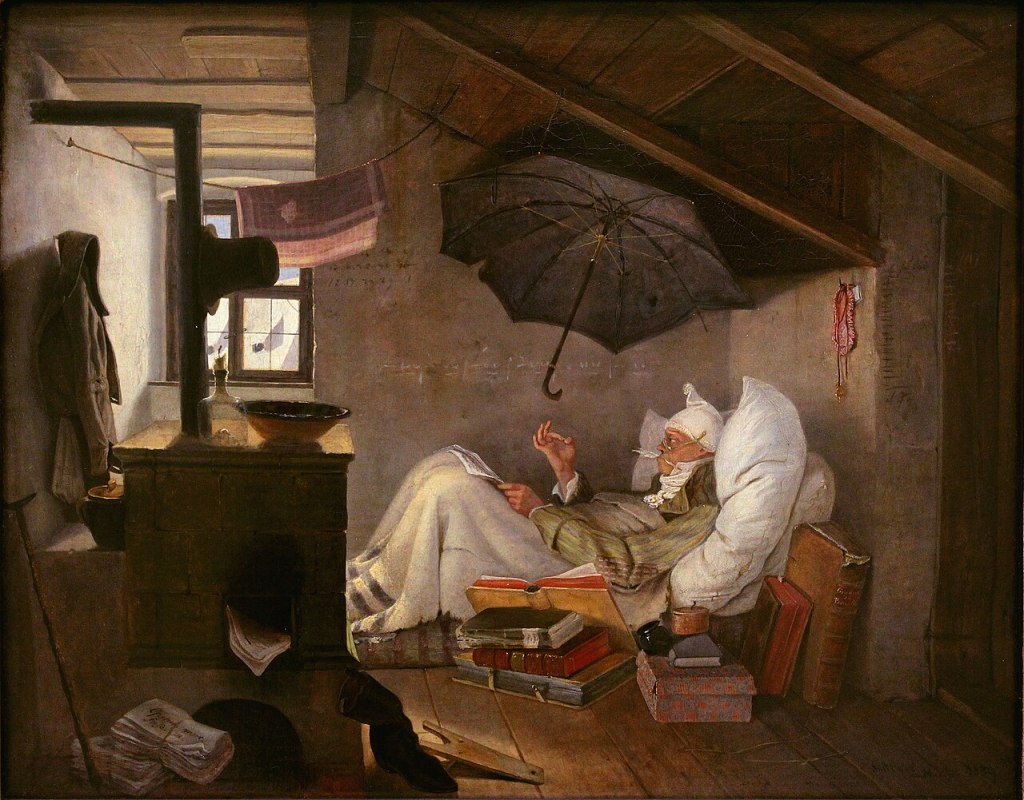
Villanelle: Janice D. Soderling, ‘The Poor Poet, Carl Spitzweg’

Der Arme Poet (best-known painting by Carl Spitzweg, 1839)

​​If only I can hatch a heartfelt rhyme,
(with thought and frowns, it can’t be very hard),
I’ll take my rightful place with the sublime.

O, gradus ad parnassum. One quick climb.
I’ll be crème de la crème and avant-garde,
if only I can hatch a heartfelt rhyme.

Top hat, cravat and walking stick meantime
are ready—attributes to reap regard.
I’ll take my rightful place with the sublime.

No more damp attic life; no fleas or grime.
My poem will be perfection—a petard!
If only I can hatch a heartfelt rhyme.

My peers will shout, “Alors, a paradigm!
Such lofty wit, a wise camelopard.“
I’ll take my rightful place with the sublime.

I bite my quill: crime, slime, Mülheim, enzyme.
The world will bow, salute and call me bard.
If only I can hatch a heartfelt rhyme,
I’ll take my rightful place with the sublime.

*****

Janice D.Soderling writes: ​​“This poem is ekphrastic, generated from a preceding work of art.
“About the mysterious motor that generates, I can say little. But no composer, artist, poet, sculptor works ex nihilo. Earliest man, woman, looked at their handprint, their footprint, and a thought rose, an urge to express what they felt – a primitive fear of death perhaps – and off they went to the caves to imprint their hand, or to carve a footprint on the rockface by the sea. A shout-out that Kilroy was here.
“We hear music in the babbling brook, in the sighing wind, in the raindrop falling from leaf to leaf and plopping into the puddle below. There is poetry in the emotive sounds we make and hear: tinkling laughter, cooing seduction, growling rage, keening sorrow, barking grief. Of such, language is made; of language Shakespeare made Sonnet 73.
“All art is imitation, from birdsong to a symphony orchestra, from the walking stride to the metrical verse. All art is a denial of death. Even the comic art.“

​​Janice D. Soderling is an American–Swedish writer who lives in a small Swedish village. Over the years, she has published hundreds of poems, flash and fiction, most recently at Mezzo CamminEclecticaLothlorien Poetry Journal and Tipton Poetry Journal. Collections issued in 2025 are The Women Come and Go, Talking (poems) and Our Lives Were Supposed to Be Different (short stories).

‘The Poor Poet’ was originally published in American Arts Quarterly, and republished in the current Well Met, where links at the bottom will take you to other poets in the issue.

Pic credit: Carl Spitzweg, The Poor Poet (via Wikipedia)​

​​​

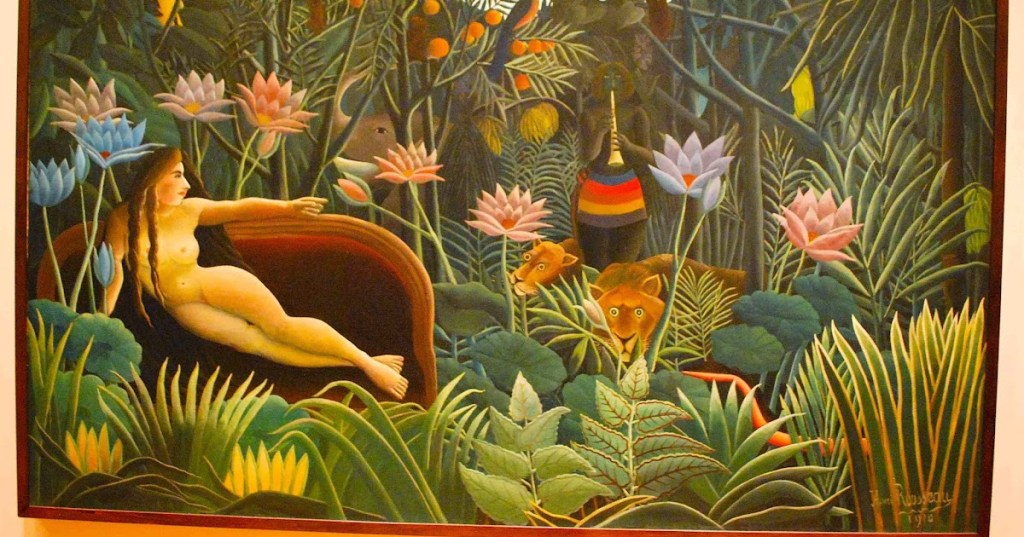
Odd poem: Henri Rousseau, ‘Inscription pour La Rêve’

Yadwigha dans un beau rêve
S’étant endormie doucement
Entendait les sons d’une musette
Dont jouait un charmeur bien pensant.
Pendant que la lune reflète
Sur les fleuves [or fleurs], les arbres verdoyants,
Les fauves serpents prêtent l’oreille
Aux airs gais de l’instrument.

Yadwigha in a beautiful dream
Having fallen gently to sleep
Heard the sounds of a reed instrument
Played by a well-intentioned [snake] charmer.
As the moon reflected
On the rivers [or flowers], the verdant trees,
The wild snakes lend an ear
To the joyous tunes of the instrument.

*****

Henri Rousseau‘s last completed work, ‘The Dream‘ is huge – almost 7′ x 10’ – and is remarkable for a couple of reasons: it features his Polish mistress of decades before, and it was the first of his pieces to bring him wide-spread acceptance. Completed and sold in early 1910, it was exhibited for six weeks in the early spring, was praised by poet and critic Guillaume Apollinaire, and gave him long-sought recognition. He died in September of that year.

Picasso and Matisse understood and admired Rousseau’s work, but many people did not. Rousseau wrote the poem to help viewers understand the painting; he also wrote in a letter to art critic André Dupont, “The woman asleep on the couch is dreaming she has been transported into the forest, listening to the sounds from the instrument of the enchanter.”

‘The Dream’ is one of the most striking pieces of art on display in MoMA, the Museum of Modern Art, in New York.

Odd poem: French Verse on painting, by Winston Churchill

La peinture á l’huile
Est bien difficile,
Mais c’est beaucoup plus beau
Que la peinture á l’eau.

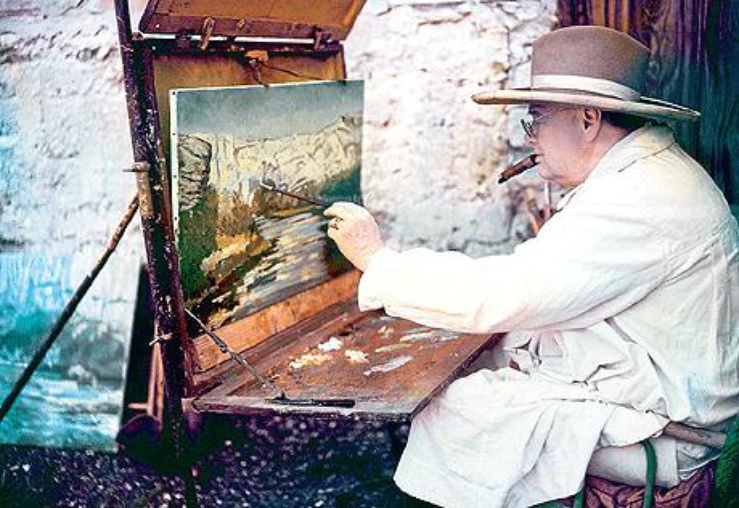
The translation: “Oil painting / Is certainly hard, / But it’s much lovelier / Than watercolour.” For reasons unknown, Winston Churchill came up with what is almost a Clerihew in style, but in French, as a comment in his little 1948 book ‘Painting as a Pastime‘.

Churchill first took up painting in 1915 at age 40 when he was removed as First Lord of the Admiralty. His fall was a result of the disastrous Dardanelles and Gallipoli attacks on Turkey that he had organised.

He took up painting for distraction, but it became increasingly a part of his life. He didn’t have hopes of making money from his “daubs”, and didn’t consider he had mastered the art. As he wrote in that slim book, “When I get to heaven I mean to spend a considerable portion of my first million years in painting, and so to get to the bottom of the subject.” Early on he submitted and exhibited under pseudonyms as a way of assessing his abilities without the influence of his name. In 1921 he exhibited at Galerie Druet in Paris under the pseudonym Charles Morin and sold six paintings for £30 each. In 1947 he submitted paintings to the Royal Academy Summer Exhibition under the name David Winter, and was successful with two of them.

He continued to paint for over 40 years, landscapes when the weather was obliging, still lifes when stuck indoors. Wherever he travelled–Morocco and Egypt, France and Italy, Jamaica, Canada and the US–his easel, brushes and paints went with him and were put to use. He produced at least 500 paintings, giving many away and not keeping records of them. You can see several of his paintings here if you scroll to the bottom.

‘Photo: Churchill painting a view of the Sorgue river in 1948, photographer unknown

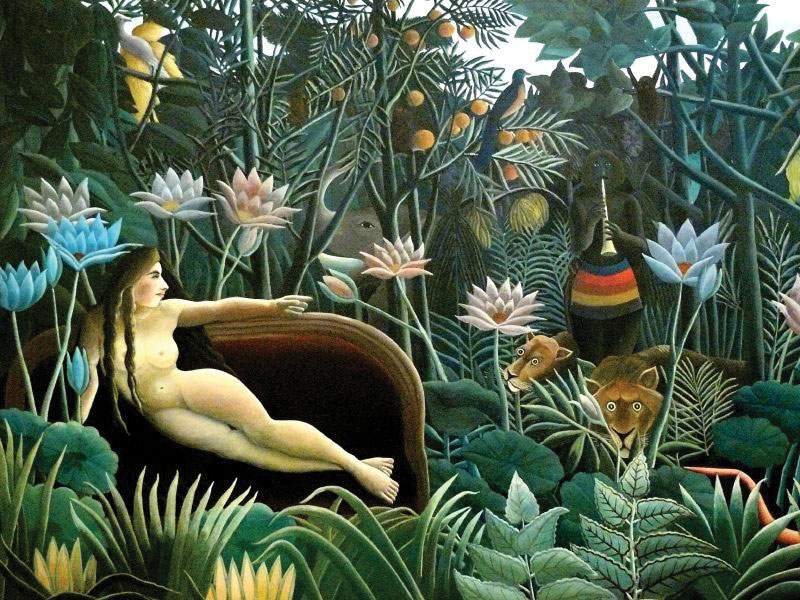
Poem: “On Rousseau’s Dream”

Rousseau, The Dream

Henri Rousseau, “The Dream”

I will be a flutist
standing in the trees
with the lions and tigers
stalking past my knees;

you, my naked lady
languid on a couch –
is the tiger standing,
or is it in a crouch?

Enormous tropic blossoms
open in the heat;
your hand is out toward me,
the pipe I play is sweet.

You have no need to answer
if things are as they seem.
The scene will last forever,
A moment, and a dream.

Henri Rousseau’s 1910 painting, The Dream, is one of his jungle-themed paintings, and hangs in one of the world’s greatest museums, MoMA, New York’s Museum of Modern Art. It is very powerful seeing the original – for one thing, it’s big – 2 x 3 metres. But my immediate inspiration for the poem was the Chaleur coffee mug of the painting – the colours are brighter (or they were, until I put the mug through the dishwasher too many times), and the flute player is more prominent.  

Technically the poem is… well, ekphrastic, because it’s about a painting, or at least a coffee mug. First published in The Lyric, it is a simple poem; perhaps colloquially you could say it is in hymn format. Regular quatrains. Three iambic beats to the line, with an extra syllable on the first and third line of each quartet. Just like

“From Greenland’s icy mountains
To India’s coral strand…”

But unlike a lot of hymns, only rhyming the 2nd and 4th lines. That’s just me being lazy. The painting itself is far better (of course!). My poem doesn’t even mention the elephant, trumpeting away in the foliage…