Tag Archives: parenting

Sonnet: Amit Majmudar, ‘Homing’

My parents stacked the best years of their youth as
Bricks to build me. Taught me words I taught
Myself to shout them down with when we fought.
My parents loved me, though I could be ruthless
Hurting myself with things I poured or burned
And those who loved me with the things I said.
My parents never gloated once I learned,
Just held me through my sobs, and kissed my head.

Now, in the living room I stormed out of,
They tell me I can stay the month, or year,
Because my room will never not be here
No matter where I go, or who I love.
I am their blood, they tell me. I depart
From them as blood does from a beating heart.

*****

Amit Majmudar writes: “A homing pigeon knows where its home is by training, as the falcon knows the falconer’s arm. But there are deeper instincts at work in nature that science still struggles to explain fully, like the way birds know how to migrate by looking at the stars, and the way monarch butterflies find their way to the same vast swath of oyamel trees in Mexico every year. Human beings have something of that in them. Not just for the neighborhoods where we grew up, but for the people, the family, who were there with us. This poem is about that. I distinctly recall its writing; I woke up at the “witching hour,” as I often do, while visiting my sister-in-law’s house in Texas over Christmas break. Ten family members were asleep in the same house, and, unable to fall back asleep, I picked up my phone and found an invitation to submit to a new sonnet journal in my inbox. Immediately, still in the awoken, excited, “witching hour” state (which the Indian tradition calls the Hour of Brahma, the time of peak creativity), I wrote this poem about the bond between the far-afield child and the fixed star of family, first line to last.”

‘Homing’ was just published in The Sonneteer which can be accessed at thesonneteer@substack.com. It offers a free, partial service as well as an upgraded paid subscription.

Amit Majmudar’s recent books include Twin A: A Memoir (Slant Books, 2023), The Great Game: Essays on Poetics (Acre Books, 2024), and the hybrid work Three Metamorphoses (Orison Books, 2025). More information about his novels and poetry collections can be found at www.amitmajmudar.com.

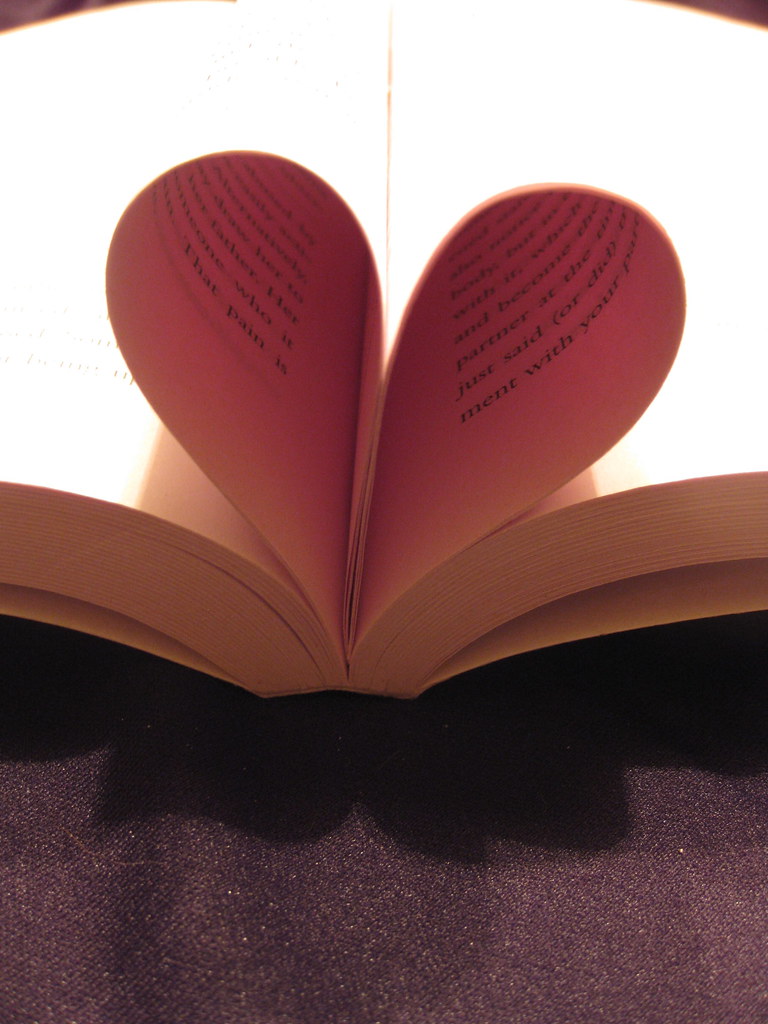
“There are many things in life that will catch your eye, but only a few will catch your heart…pursue those.”~Michael Nolan” by katerha is licensed under CC BY 2.0.

Rondeau: Political Poem: J.D. Smith, ‘Citizen Vain’

Who burned his sled? That would explain
The wisps of hair coiffed like a mane,
The name writ large on thrusting towers,
His rating of his works and powers.
Who wouldn’t take up his refrain?

A loser, say, without a brain
And envious he can’t obtain
Fresh wives imported like cut flowers.
(Who burned his sled?)

A nation may endure a reign
Of fire once tended with some pain
Outlasting its appointed hours
Yet starved, for all that it devours.
The question holds fast like a stain–
Who burned his sled?

*****

J.D. Smith writes: “I try not to say or write the name of the moral homunculus who is currently the 47th President of my country, lest my words get entangled in his omnipresent branding. That said, in verse I have occasionally renounced him and all his works. This poem was first published during the 2016 primary season, when speculating on how that troubled and troubling man became that way was still an interesting parlor game with low stakes. While others with credentials in psychology have discussed his origin story, perhaps most notably in this book, as a poet I gravitated toward metaphor. As some will ask a badly behaved person “Who broke you?” or “Who hurt you?”, I began to wonder ” Who burned his sled?” in the sense of some analog to the loss of Charles Foster Kane’s sled Rosebud in Citizen Kane. What early personal trauma made the current collective trauma possible?”

J.D. Smith’s seventh collection of poetry, The Place That Is Coming to Us, was published in September by Broadstone Books. His first fiction collection, Transit, is available from Unsolicited Press. Further information and occasional updates are available at www.jdsmithwriter.com.

Photo: screenshot from that unbelievably offensive AI-generated video that Trump posted of himself as King Trump in a King Trump fighter-jet, bombing American protesters with his diarrhoea.

Using form: ghazal: Barbara Lydecker Crane, ‘Love Refrains’

Mom banged her hairbrush down in a reprimand of love.
“What an awful question! You don’t understand love.

“Of course Dad loves you. How can you question that?
He doesn’t have to blare it out, like a brass band of love.

“You aren’t a princess to be coddled on a lap or praised
without good reason. That’s a never-never land of love.

“Your father works hard, with a great deal on his mind.
Now don’t go causing trouble, making a demand of love.

“Yes, I know he yells and sends you to your room a lot.
But be glad he never hits you with the backhand of love.

“Once, banished to your room, you drew a picture poem
for him. I watched him beam at you with unplanned love.

“He said he’s proud of you. I’ve heard him tell you twice.”
She brushed my hair, hard. “Barbara, that’s a brand of love.”


Barbara Lydecker Crane writes: “Based on a real interaction with my mother when I was about five, I think this poem reflects a different style of parenting back then (this was in the 50’s), perhaps a British approach: “don’t spoil your children with a lot of praise or affection.” I like modern ways better! As for the form, I love ghazals because you always know where you are headed–the fun is choosing your route to get there.”

Barbara Lydecker Crane was a finalist for two recent Rattle Poetry Prizes, including with this poem.  She has received two Pushcart nominations and various awards from the Maria W. Faust and the Helen Schaible Sonnet Contests. Her poems have appeared in Atlanta Review, Ekphrastic Review, First Things, Light, THINKValparaiso Literary ReviewWriter’s Almanac, many others, and in several anthologies. Her fourth collection, You Will Remember Me (ekphrastic, persona sonnets) was recently published by Able Muse Press, and is available from Amazon: https://www.amazon.com/You-Will-Remember-Me-Ekphrastic/dp/1773491261. Barb lives with her husband near Boston.

Photo: “She’s On The Naughty List” by Cayusa is licensed under CC BY-NC 2.0.

Potcake Poet’s Choice: Mindy Watson, ‘The Three’

Young Clotho spins new Thread of Life,
She holds Fate’s spindle taut. Precise
Lachesis measures life’s strand’s length,
Thus governs lifetime’s span and lot.
And Atropos, death’s agent, cuts
The mortal thread that Clotho wrought.

When I first burst from mother’s womb,
Three Fates were watching o’er my room.
Lachesis doled me ample thread,
And so, in time, I grew to be
The mother of my own young Three.

Upon my bosom all three drank;
They slept and flourished there. Across
Ten years, four jobs, three homes – I nursed
Away their sorrows, hurts, and scares.

And now I know our nursing age
(Which one year past, met poignant end)
Was in itself a life, a thread,
Spun, drawn, and sheared by three small Fates.

My eldest son precisely spun
That nursing thread with infant’s cord.
His warm-breathed suckling sutured closed
The wound my late son’s loss exposed.

My younger boy, for four years straight,
Was nursing life’s allotting Fate.
He lengthened thread, bridged start and end –
Became his sister’s nursing mate.

My Three’s sole girl, at three years old,
Adroitly sheared our tender twine
When, blonde crown bowed, she deftly swore,
“I don’t need boo-boo anymore.”

And from these Fates I deem my Three,
I’ve learned the joys of genesis –
I’ve learned there’s silent eloquence
In birth, in growth – in severance.
From newborn’s threaded cry all Three
Ascend—beginning, middle, end.

Mindy Watson writes: “The Three is an internally/intermittently rhymed poem in (mostly) iambic tetrameter, equating my three children to three Greek Fates who taught me, via our respective breastfeeding “threads,” to cherish all beginnings, middles, and ends.  I’m enduringly sentimental about this one, which represents not only my first published poem (originally appearing in the Quarterday Review’s October 2016 Samhaim issue) and my first creative post-grad school venture (although I’d majored in nonfiction/science writing rather than poetry)—but also my first attempt at articulating (and externalizing) my children’s and my seemingly endless nursing journey… a year after its bittersweet conclusion.”

Mindy Watson is a formal verse poet and federal writer who holds an MA in Nonfiction Writing from Johns Hopkins University. Her poetry has appeared in venues including Snakeskin, Think Journal, the Poetry Porch, Orchards Poetry Journal, Better Than Starbucks, Eastern Structures, the Quarterday Review, and Star*Line. She’s also appeared in Sampson Low’s Potcake Poets: Form in Formless Times chapbook series and the Science Fiction and Fantasy Association’s 2019 Dwarf Stars Anthology. You may read her work at: 
https://mindywatson.wixsite.com/poetryprosesite.

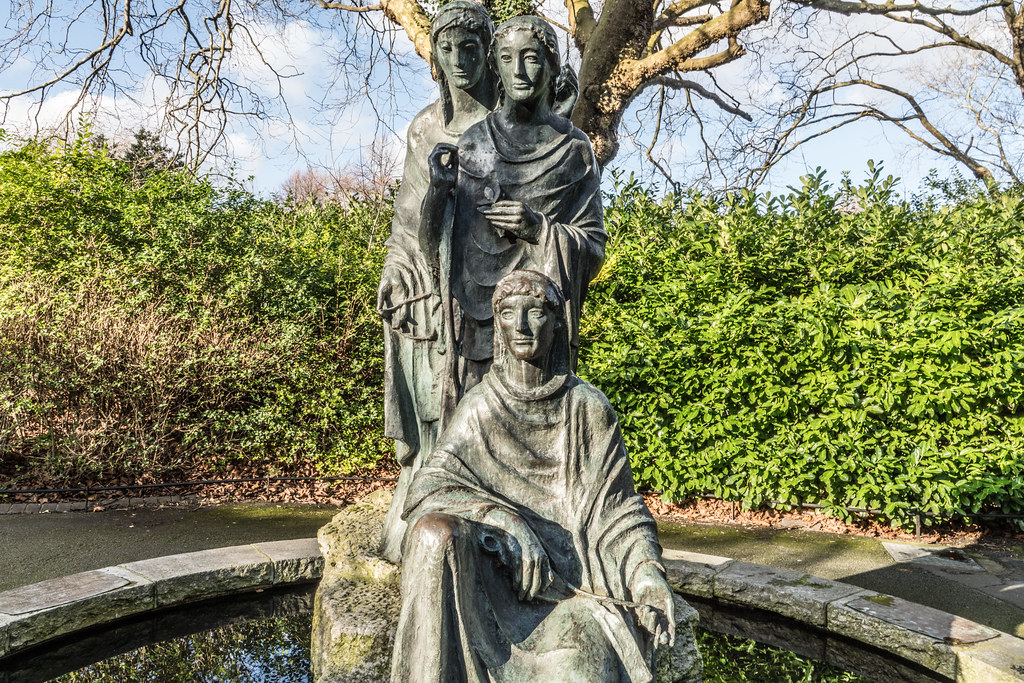
“THE THREE FATES MEMORIAL FOUNTAIN [A GIFT FROM THE GERMAN FEDRAL REPUBLIC]-136831” by infomatique is licensed under Openverse from WordPress.org