Tag Archives: prize-winning verse

Weekend read: George Simmers, ‘Hymn’

All things dull and ugly, all creatures gross and squat,
All things vile and tedious, the Lord God made the lot.

He made the sly hyena, the hookworm and the slug,
Your moaning Auntie Margaret and pervy Uncle Doug.

He made that dreary Welshman who so often reads the news,
And he made us, the ragtag lot who worship at St. Hugh’s.

We’re far from high achievers, we don’t have gorgeous bods;
At best you’d call us humdrum, a group of odds and sods.

We’re verging on the useless and we have got a hunch
No deity could think we were a preposessing bunch.

That’s why we’re rarely cheerful, but feel a bit less blue
When thinking how the mighty Lord can be ham-fisted too.

‘Cause frankly we’d be daunted by a more efficient chap.
We feel a lot more comfy with a God who’s slightly crap.

*****

George Simmers writes: “This is a poem that would never have existed had it not been for the Spectator magazine, which each week sets a challenge to its readers, demanding produce a short piece of writing (it might be 16 lines of verse or 150 words of prose) on a particular theme. The task is often a silly one. A couple of years ago the demand was for a hymn beginning ‘All things dull and ugly…’

“Competitive light verse is a tradition that stretches back a long way in Britain. In the early years of the twentieth century Naomi Royde-Smith of the Saturday Westminster Gazette set challenges that were responded to by up-and-coming writers like Rupert Brooke and Rose Macaulay, among others. In the thirties the Weekend Review was notable for its literary competitions, and when that magzine was incorporated into the New Statesman, the comp came with it.

“Those New Statesman competitions became a notable feature of English literary life, producing star writers such as Allan M. Laing, Stanley J. Sharpless, Roger Woddis, E.O. Parrott, Martin Fagg, Bill Greenwell and Basil Ransome-Davies.. look in any good anthology of light verse, and you’ll find glittering examples of some of their work. The Spectator and Punch were later in running competitions that attracted many of the same writers.

“I first entered a New Statesman competition in 1981, earning a pound for a one-line joke. Easy money! I entered a few more, mostly prose, and it was a while before I had a verse winner. Before that my verse writing had been a bit modernist and self-indulgent; no more. To succeed in the comps you need to master rhyme and metre. It’s a great training ground. Wendy Cope, one of the best writers of neat epigrammatic verse today began in New Statesman competitions (Much of her first, and arguably best, book, Making Cocoa for Kingsley Amis, is made up of her competition winners.) At about the same time, D.A. Prince began her competition career, which continues in the Spectator today (and I’m proud to have her as regular poet in Snakeskin.)

“From the thirties to the seventies, the New Statesman was a crucial publication in British culture, with a left-wing front-end but back half that was welcoming to all sorts of attitudes and points of view. A couple of dull editors diminished its appeal and importance in the eighties, but the comps continued to flourish, though in the twenty-first century they mostly seemed to welcome only rather predictable political humour. A few years ago the editor, Jason Cowley arbitrarily cancelled them. I’ve not looked at the magazine since then, but I’m told that it has gone from bad to worse.

“The Spectator, meanwhile, has flourished. My first Spectator winner (which imagined Wordsworth doing a snooker commentary) was in 1983. It was the top winner that week, and in addition to a small cash prize I was sent a very good bottle of wine. Those were the days. At that time the competition was run by James Michie, himself a good poet notable for his translations of Horace and Catullus. His was a generous welcoming personality, and many talents flowered under his watch.

“After him, Lucy Vickery ran the comp for many years, showing good judgement Though when she went away on maternity leave for a while, a substitute was brought in who gave prizes to some very inept stuff. It’s not an easy job. At present Victoria Lane is the adjudicator. I like her, because she has awarded me a good few prizes. Others may have grumbled.

“The Spectator competition is today just about the only forum for light verse in Britain. While the respectable poetry outlets have mostly given up on traditional rhyme and metre (Have you ever tried to read the stuff printed in the heavily subsidised Poetry Review?) the Spectator comp still demands well-formed and witty verse. Bill Greenwell and Basil Ransome-Davies are still star turns, and they have been joined by Adrian Fry, Janine Beacham, Sylvia Fairley, Chris O’Carroll and others.

” ‘All things dull and ugly…’ was a task that appealed to me, because I’ve always been struck by the way church congregations can make even sprightly tunes like ‘All Things Bright and Beautiful’ sound really drab and tedious. The ‘dreary Welshman’ is Huw Edwards, a BBC news-reader whom I had always found obnoxious, especially when toadying to the Royals. I’m rather proud of having had a dig at him in this poem, which pre-dates his fall from grace when he was dismissed after his appalling taste in pornography was discovered.”

George Simmers used to be a teacher; when he retired he then amused himself by researching a Ph.D. on the prose literature of the Great War. He now spends his time pottering about, walking his dog and writing a fair bit of verse. He is currently obsessed by the poetry of Catullus, and may be issuing a volume of translations within the next year or so. He has edited Snakeskin since 1995. It is probably the oldest-established poetry zine on the Internet. His work appears in several Potcake Chapbooks, and his recent diverse collection is ‘Old and Bookish‘. ‘

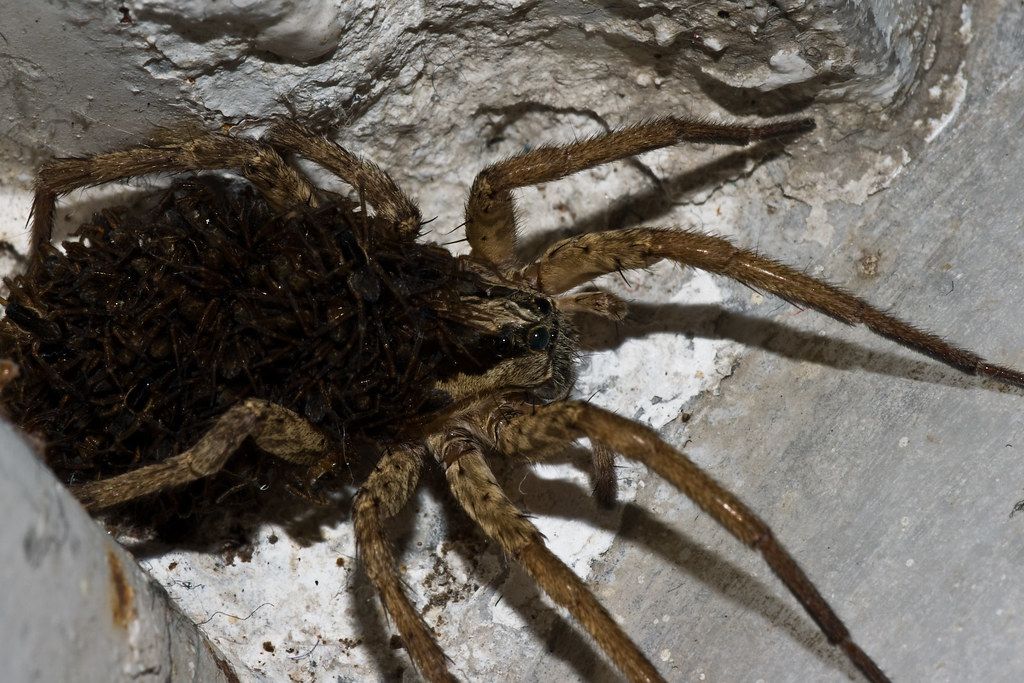
Photo: “Mother Spider” by agelakis is licensed under CC BY-NC-SA 2.0.
Susan McLean, ‘The Whetstone Misses the Knife’

I answered your desire to meet
resistance and be honed by friction.
Sharp as you were, you couldn’t beat
the zero-sum of contradiction.

Abrasion was your privilege,
the only stroking I have known.
Now you have lost your cutting edge
and I am just another stone.

*****

Susan McLean writes: “This poem was inspired indirectly by the suicide of a talented poet whom I had seen at conferences, but had never had a conversation with. I heard that she had killed herself on Christmas Eve because of an unhappy love affair. Since I knew nothing about her personal life, this poem is not about her, but her fate made me think about unhappy relationships, particularly those in which both partners have strong but conflicting personalities. I had in mind such stormy creative relationships as those of Sylvia Plath and Ted Hughes, Diego Rivera and Frida Kahlo, Camille Claudel and Auguste Rodin, in which the clashes are initially part of the attraction, yet turn destructive eventually. However, the imaginary relationship depicted in this poem is not based on the specifics of any of those relationships.
Balance and antithesis are the key characteristics of the theme of this poem, so I thought two quatrains with a rhyme scheme of ABAB would give equal weight to the “I” and the “you” of the poem.
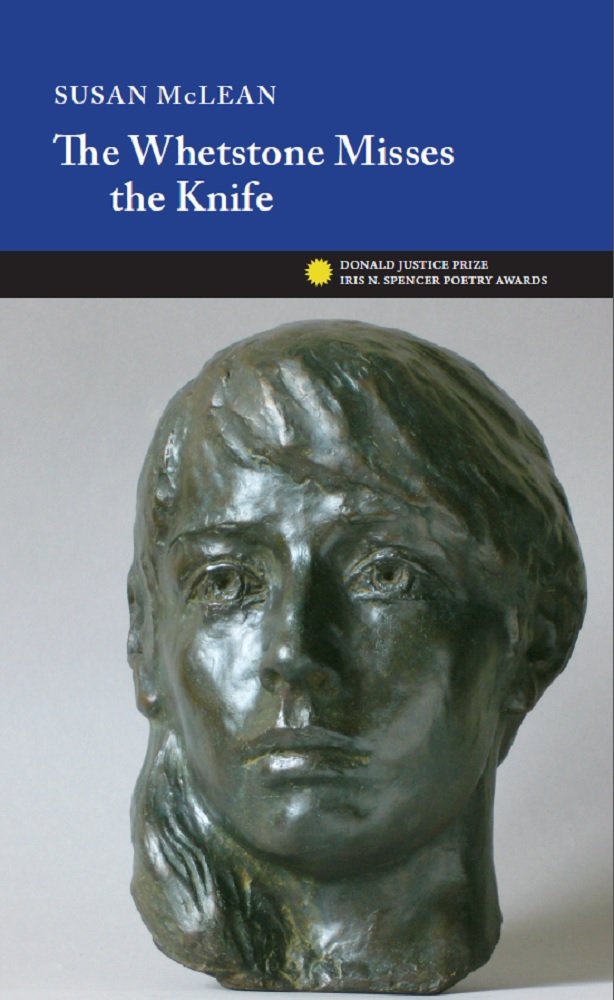
This poem first appeared in Mezzo Cammin, an online journal of female formalist poets, and later was published in my second book, The Whetstone Misses the Knife, which featured a bronze bust of Camille Claudel by Jacques Chauvenet on the cover.”

Susan McLean has two books of poetry, The Best Disguise and The Whetstone Misses the Knife, and one book of translations of Martial, Selected Epigrams. Her poems have appeared in Light, Lighten Up Online, Measure, Able Muse, and elsewhere. She lives in Iowa City, Iowa.
https://www.pw.org/content/susan_mclean

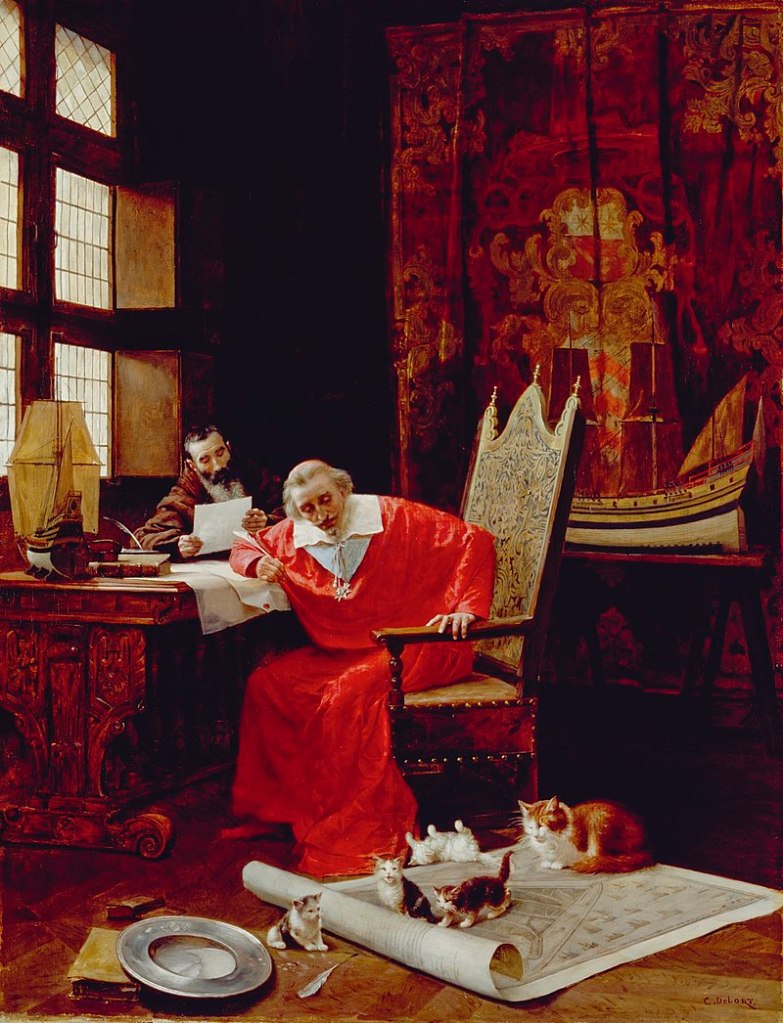
Nonce form: Gail White, ‘Cardinal Richelieu’s Cats’

The Cardinal works into the night
To realize his dream:
To keep the nobles in their place,
Make royalty supreme.
He knows it’s time for government
To grow and centralize,
And when the nobles sober up
They won’t believe their eyes.

And at his feet
The indiscreet
Delightful pet he calls Gazette
Provides his inspiration.

He spreads the map of Europe out
And studies its repair,
Especially in ways that might
Reduce the Hapsburg share,
With here a war and there a plot
And now and then a coup..
His opposition? Well, he might
Assassinate a few.

While on his knees
Soft Soumise,
The Cardinal’s best Eminence Grise,
Provides his inspiration.

*****

This poem by Gail White won The Lyric Magazine’s Roberts Memorial Prize for 2022. White, the resident poet and cat lady of Breaux Bridge, Louisiana, writes: “I’d love to know the names of all 14 of his cats. I’m a believer!”

In a post entitled ‘The Cardinal liked cats – in 1642 he had fourteen!‘, the Eminence Rouge blog states: ‘Here are some of the names of the fourteen favourite felines: Racan (poet and Academician), Gazette (indiscrete), Rubis sur l’Ongle (scratchy), Pyrame & Thysbe (lovers who slept with paws entwined), Serpolet (loved sunning himself), Felimare (tiger-striped), Soumise (submissive, R’s favourite), Lucifer (jet black), Ludovic le Cruel (rat-killer), Ludoviska (rat-catcher’s Polish mistress), Mimi-Paillon (‘straw’ angora), Mounard le Fougueux (‘ardent’, quarellsome,capricious,worldy), Perruque (fell from Racan’s wig), and Gavroche (gastro-angora).’ (Note: this totals 14 if ‘Pyrame & Thysbe’ is the name of one cat that sleeps holding its own paws.)

However in the comments posted by readers of that blog there is scepticism about the story. One writes: ‘Elizabeth Wirth Marwick, The Young Richelieu (Chicago, 1983), says she has been unable to find contemporary documentation on cats, but that he had canaries and warblers, and also 12 small dogs were boarded at Rueil. She wonders if lap-dogs have been turned into cats in the telling. (p. 242, n. 124) But that would be a bizarre change to make.’

A further comment is: ‘I always did think this was true, but now it’s looking more and more likely to me that Richelieu never had cats. I can’t find a source anywhere for all this oft-repeated “information” on the web; people just seem to be copying one another. The earlier comment about the 1938 biographer who was unable to find contemporary documentation is significant. Katharine Macdonogh, in her 1999 book Reigning Cats and Dogs, A History of Pets at Court Since the Renaissance, states on page 124 that the story is a myth, and that it was invented by Paradis de Moncrief, a “toady” at the court of Louis XV.’

Gail White’s books ASPERITY STREET and CATECHISM are available on Amazon. She is a contributing editor to Light Poetry Magazine. “Tourist in India” won the Howard Nemerov Sonnet Award for 2013. Her poems have appeared in the Potcake Chapbooks ‘Tourists and Cannibals’, ‘Rogues and Roses’, ‘Families and Other Fiascoes’, ‘Strip Down’ and ‘Lost Love’.
https://www.amazon.com/Catechism-Gail-White/dp/0692696660

Painting: Charles Édouard Delort (1841-1895): La distraction de Richelieu (The cardinal’s leisure), in the public domain.

Odd poem: ‘The Influenza’ by Winston Churchill, age 15

Oh how shall I its deeds recount
        Or measure the untold amount
        Of ills that it has done?
        From China’s bright celestial land
        E’en to Arabia’s thirsty sand
        It journeyed with the sun.

I omit the next nine stanzas, as the influenza makes its way to Britain. The poem ends:

        For though it ravaged far and wide
        Both village, town and countryside,
        Its power to kill was o’er;
        And with the favouring winds of Spring
        (Blest is the time of which I sing)
        It left our native shore.

        God shield our Empire from the might
        Of war or famine, plague or blight
        And all the power of Hell,
        And keep it ever in the hands
        Of those who fought ‘gainst other lands,
        Who fought and conquered well.

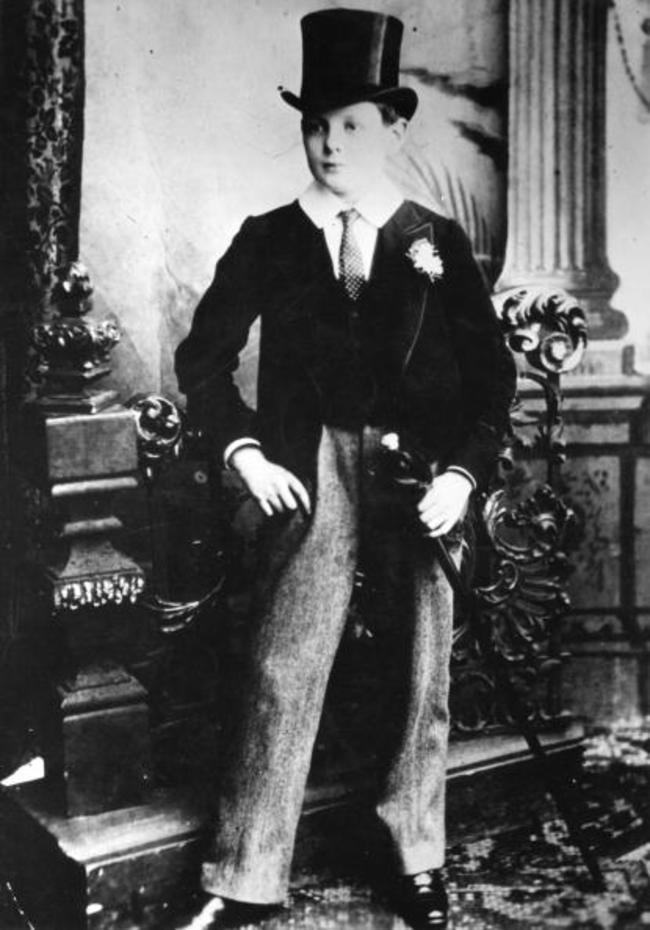
Written in 1890 when he was a lazy 15-year-old Harrow schoolboy who did badly at everything except English, Winston Churchill partially redeemed himself with this prizewinning poem on the global influenza epidemic (which may have been a Coronavirus) of his day. This “Asiatic Flu” or “Russian Flu” killed about a million people worldwide.

The photograph shows Churchill in his school clothes at age 14.

So there you have him: a teenage Churchill, with excellent control of English and an early exposition of his oratory, bombast, nationalism, imperialism, and enjoyment of warfare. And fifty years later he did brilliantly for Britain in the Second World War (but thank goodness for Clement Attlee picking up the pieces afterwards).