Tag Archives: Rachel Hadas

Rachel Hadas, ‘Summer Nights and Days’

So far the nights feel lonelier than the days.
In light, the living keep me company,
and memories of voices through the years.

Each summer threads a green familiar maze.
Emerging sun-struck, you can barely spy
the slow kaleidoscope of clouds and hours.

Those flannel nightshirts chilly sleepers wear
as summer wanes: I’m giving them away.
Pass it on: you keep at the same time.

A bough has broken from the Duchess tree.
Rain swelled the apples. Too much lightness weighs
heavy: the heft of the idea of home
tempered with the detachment of a dream,
or tidal pulls, like ocean, like moonrise.

*****

Rachel Hadas writes: “Summer Nights and Days, from perhaps 2009-2011, is one of a number of pieces written in and about Vermont which I recently tightened into short prose texts and collected in my latest book, Pastorals (2025); as it appears here, it’s still in its poem format. This piece may or may not have been written after my late husband’s death in 2011, but is certainly refers to a time when I was essentially living alone. My son and his visiting friends were the recipients of old nightshirts (more recycling).”

Rachel Hadas’s recent books include Love and Dread, Pandemic Almanac, and Ghost Guest. Her translations include Euripides’s Iphigenia plays and a portion of Nonnus’s Tales of Dionysus. Professor Emerita at Rutgers-Newark, where she taught for many years, she now teaches at 92Y in New York City and serves as poetry editor of Classical Outlook. Her honors include a Guggenheim fellowship and an award from the American Academy-Institute of Arts and Letters.

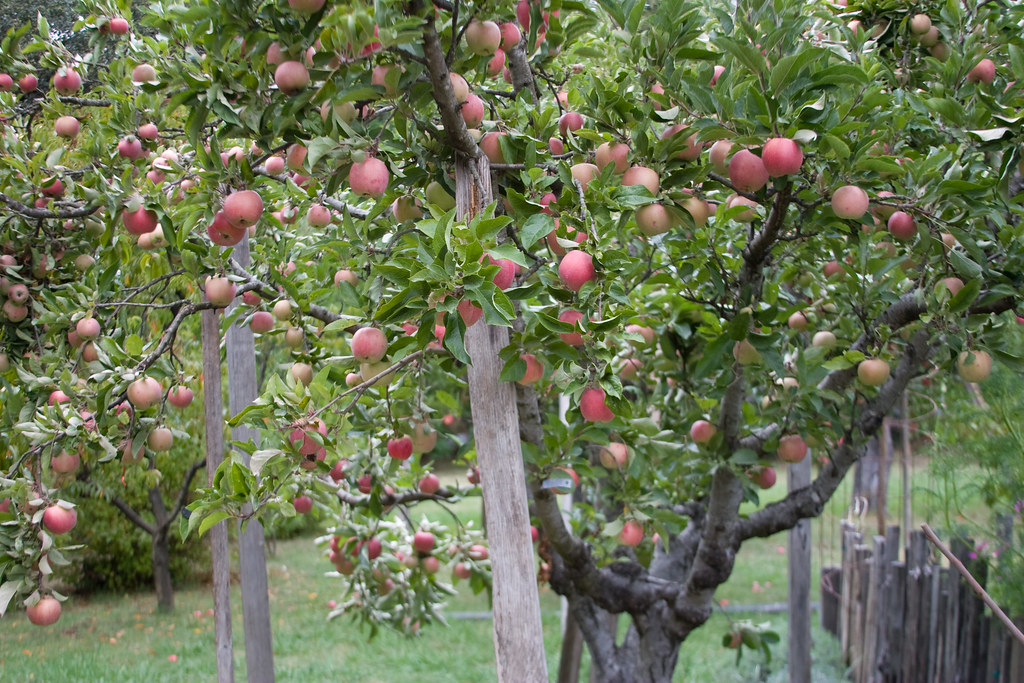
Photo: “Apple Tree” by bgreenlee is licensed under CC BY 2.0.

Rachel Hadas, ‘Rag Rug’

It has arrived—the long rag rug
multiply folded. On top, one alien hair.
I put my face to the folds and smell despair
palpable as salt air
in all those rooms and houses, small and smug—
enclosures I passed through on my way where?

Whoever did the weaving appears old
in my mind’s eye. I can’t make out her face,
can only conjure up the faintest trace
of an abstracted grace,
clack of the loom. Does she know they’ll be sold
these precious things, in some unheard-of place?

I perch her on a hill, precariously
beyond the reach of waves’ daily boom.
Sun blazes overhead, but her dim room
(no bigger than the loom)
is proof against the violence of the sky
From it I further spin what I once called my home:

Endless horizons fading into haze,
the mornings dawn came up so rosy clear;
snails in the garden, sheep bells everywhere,
the brightness of the air,
terraces, valleys organizing space
and time’s cessation. So this package here

I’m now unwrapping, in New York, today
(rugs like rainbows, woven with a grace
my strands of language barely can express;
dishrags of dailiness
dispersed and recombined and freshly gay)
comes to me imbued with images,

slowly and faithfully across the water,
across the world. It represents a time
I myself snipped and recombined as rhyme
as soon as I went home,
if that is where I am. These rugs recover
the sense of stepping twice into a single river.

*****

Rachel Hadas writes: “Rag Rug, written probably around 1980 or sometime in the early Eighties, describes my experience opening packages of rag rugs handwoven by a woman or women in Samos, the Greek island where I’d lived between 1971 and 1974. The rags in question were blue jeans, pajamas, tablecloths, you name it – I’d cut these into narrow strips which I sewed together and rolled into a ball, and when I had enough such balls I mailed them to my former mother-in-law in Samos; she eventually sent me the finished project, long rag rugs perhaps eighteen inches wide, colorful, washable, which eventually faded and blended as madras does. The evocative smell of the cloth; the memories of the island and my life there; the fact that poetry, like the making  of these rugs, like quilting, is a piecing together, recombining and recycling of fragments – reading the poem now brings all this back.”

Rachel Hadas’s recent books include Love and Dread, Pandemic Almanac, and Ghost Guest. Her translations include Euripides’s Iphigenia plays and a portion of Nonnus’s Tales of Dionysus. Professor Emerita at Rutgers-Newark, where she taught for many years, she now teaches at 92Y in New York City and serves as poetry editor of Classical Outlook. Her honors include a Guggenheim fellowship and an award from the American Academy-Institute of Arts and Letters.

Photo: “Colourful rag rug” by theihno is licensed under CC BY-ND 2.0.

Semi-formal quatrains: Rachel Hadas, ‘Roadblock’

Call me the bee buzzing in the museum.
The younger sister fussing through a house
still stiff with loss.
The meddling goblin in the mausoleum.

My dream: with three in the front seat, we drive
under a bridge and halt. A huge gray bus
blocks the whole road, including us,
the only travelers who are left alive.

It’s drizzling; the windshield wiper blades
busily gesture, yet we’re nearly blind.
You two seem not to mind
blank windows, pulled-down shades.

I mind. I want to get out and explore,
to move around
the deathly obstacle. “Don’t make a sound,”
you say. (Who are you?) “Don’t go near that door.”

Our mountain drive last month—that wasn’t dreamed.
We three again. We ran a dog down. I
alone looked back, alone let out a cry.
I saw it lying in its blood and screamed.

So tell me what these images portend.
Am I a noisy bird of evil omen
or just a person, apprehensive, human,
moving ahead, kid sister into woman,

stonewalled by death each time she rounds a bend?

*****

Rachel Hadas writes: ” ‘Roadblock’ is an older poem, inspired by a visit to my sister and her then husband  years ago.  Our drive, and running over the dog really happened, as did the dream…but which came first?  And another question: would I have remembered either the car accident or the dream had I not written them into a poem?  Dreams still figure often in my poems.  And the fact that I’ll always be a younger sister, while it doesn’t get mentioned all that frequently, is a permanent feature of my consciousness that probably works its way into many of my poems however subliminally. The bee buzzing: my sister once complained that going to a museum with me was like going to a museum with a bee, a comment I’d forgotten until rereading this poem brought it back.  And those “blank windows, pulled-down shades”: doesn’t poetry often strive to pull the shades up?”

‘Roadblock’ is collected in ‘Halfway Down the Hall: New and Selected Poems’ (Wesleyan University Press, 1998)

Rachel Hadas’s recent books include Love and Dread, Pandemic Almanac, and Ghost Guest. Her translations include Euripides’s Iphigenia plays and a portion of Nonnus’s Tales of Dionysus. Professor Emerita at Rutgers-Newark, where she taught for many years, she now teaches at 92Y in New York City and serves as poetry editor of Classical Outlook. Her honors include a Guggenheim fellowship and an award from the American Academy-Institute of Arts and Letters.

Photo: “Bus Crash at Ladprao-Chokchai4” by isriya is licensed under CC BY-NC 2.0.

Using form: Villanelle: Rachel Hadas, ‘However Cool’

However cool X may have thought he was
made very little difference in the end.
We are transformed as we approach the close.

Everyone is subject to these laws.
Ozymandias collapsed in sand,
however cool he may have thought he was.

We live in structures—marriage, job, or house—
steered steadily toward an unknown land,
slyly transfigured as we near the close,

additions and subtractions dealt by whose
enormous unseen hand?
However cool Y may have thought Z was,

her freshness faded like a poet’s rose,
malady no medicine can mend
disguising her before she reached the close.

Think of it as time; a veiled command;
a principle: I do not give. I lend.
However cool we might have thought A was,
we all are changed as we approach the close.

Rachel Hadas writes: “The villanelle ‘However Cool’ was occasioned by a conversation with a friend; she and I were talking about a mutual acquaintance who was ill, and my friend uttered a perfect iambic pentameter line which became the first line of the poem, as well as, with variation, one of the repeated lines.  It was fun to keep switching initials – the “however cool…” downward arc applies in different ways to so many people.

“A.E. Stallings has commented that villanelles are more fun to write than to read, and she may have a point.  At this point in life, I certainly find them easier to write than sonnets. But I hope there’s a bit of rueful fun to be had in ‘However Cool’.”

Rachel Hadas’s recent books include Love and Dread, Pandemic Almanac, and Ghost Guest. Her translations include Euripides’s Iphigenia plays and a portion of Nonnus’s Tales of Dionysus. Professor Emerita at Rutgers-Newark, where she taught for many years, she now teaches at 92Y in New York City and serves as poetry editor of Classical Outlook. Her honors include a Guggenheim fellowship and an award from the American Academy-Institute of Arts and Letters.

Photo: “cool for kids – summer holidays” by oddsock is licensed under CC BY 2.0.