Tag Archives: reality

Weekend read: Maryann Corbett, ‘An Orientation’

If, in the midst of this elated day,
someone took him aside with the stern warning,
Most of your life will not be like this morning,
he’d never hear it. How–while fountains play
beside clipped lawns and walkways arched with green
maples that move to stipple white and gold
on paths he and his harried parents have strolled
laden for move-in–how could he hear? He’s seen
Arcadia now, where classical facades
put a straight face on tanglements of thought,
and edgy spears of light and color, wrought
in steel and glass, look daggers at the gods.

The whole week’s strewn with glittering temptations
and parti-colored parties for the eyes:
gown-sleeves aflap like tropical butterflies,
professors float along in convocations.
Some one of them, someday, and over a drink,
will show him grittier visions: Rumor. Snark.
Administrative bloat. Nowhere to park.
How only summers bless you with time to think.
How even the mind’s beauties fester, vexed
by deadlines, balky software, budget hassle.
How research builds its turreted air-castle,
gorgeous for one day, rubble on the next.

But here, today, does anybody give
a bleep for realness? Let us cleave to form,
leaving him to his roommate and his dorm
and whispering, Here’s the poison. Drink and live.

*****

Maryann Corbett writes: “A few years ago, I happened to be on the campus of a nearby university on move-in day during freshman orientation week. It was an experience that gave me poem-provoking nostalgia.
“Orientation week is an institution I know well; I’ve lived my own college orientation and each of my children’s, and I’ve worked as a university staffer conducting such events. Freshman orientations usually take place in the week before classes begin in the fall and before other students return to campus. They’re meant to give new students everything they need to settle in and become part of the university community.
“But in addition to practicalities like moving young people into their dormitories — and dealing with parents’ emotional goodbyes — orientations will always involve hype and hoopla. Beautiful campuses are part of that hoopla, part of the seduction of academe. There will also be welcoming events that overpraise what students have achieved just by being admitted, tours that overpraise the campus’s buildings and amenities, and academic convocations with professors in full regalia delivering speeches that overpraise everything about the academic world.
“How true is all this as a picture of the scholarly life? I’ve been close enough to the facts of that life to know that the picture needs some correcting pessimism. The poem offers that but says it can wait. Let’s let the students fall in love with the vision before we tell them the truth.”

Maryann Corbett earned a doctorate in English from the University of Minnesota in 1981 and expected to be teaching Beowulf and Chaucer and the history of the English language. Instead, she spent almost thirty-five years working for the Office of the Revisor of Statutes of the Minnesota Legislature, helping attorneys to write in plain English and coordinating the creation of finding aids for the law. She returned to writing poetry after thirty years away from the craft in 2005 and is now the author of two chapbooks and six full-length collections, most recently The O in the Air (Franciscan U. Press, 2023). Her work has won the Willis Barnstone Translation Prize and the Richard Wilbur Award, has appeared in many journals on both sides of the Atlantic, and is included in anthologies like Measure for Measure: An Anthology of Poetic Meters and The Best American Poetry. ‘An Orientation’ is from her collection In Code.

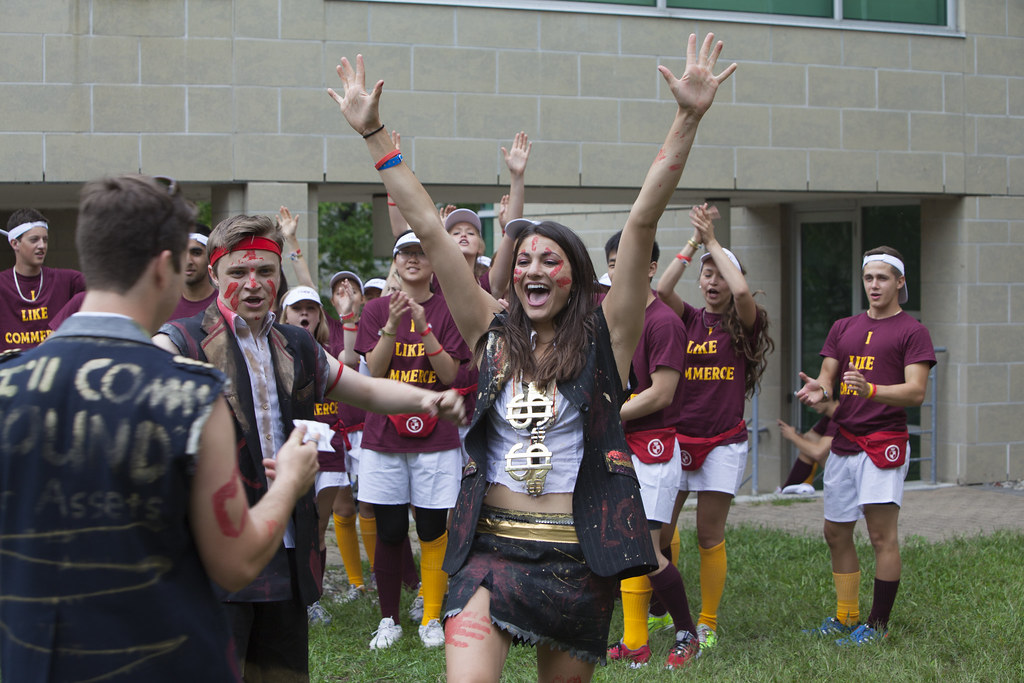
Photo: “Orientation week” by queensu is licensed under CC BY-NC-ND 2.0.

Sonnet: RHL, ‘The Days Have Come Unhooked’

The days have come unhooked from passing time,
its little Brio trucks are off their tracks;
the past and future mix to make their rhyme,
with pieces placed at random in fresh stacks.
Clear memories blend their present, future, past.
The days stretch out, and yet the months fly by –
you turn in circles, facing first, not last.
As childhood deepens, old age pools go dry.
Behind its smoke and mirrors, whores and pimps,
its harshly lovely playful attitude,
reality is thinning – you now glimpse
an indescribable infinitude.
The game is won – your enemies are no more,
yet you don’t end it while you max your score.

*****

Published in the Spring 2024 issue of The Road Not Taken.

Photo: “Brio freight train set” by Ben Sutherland is licensed under CC BY 2.0.

Using form: Ottava Rima: Max Gutmann, ‘Conscious Agents’ (from Don Juan Finish’d)

You sages aren’t surpris’d to learn that cowardice
Is courage. Truths illumine and conceal.
The dulcet affirmation and the sour diss
Can equally be true. That’s no big deal.
The world is full of paradox — and now word is
That even space and time may not be real.
We only think we see and smell and touch things.
The “world” is like, say, Donkey Kong and such things.

It’s all just icons on an interface:
The sound of rain, that contract you just sign’d,
The microbe on a slide, the feel of lace,
The smell of skunks, the corner you were fined
For parking at, your arm, the very space
You (think you) move through — products of your mind.
And even little quarks, atomic particles,
Are not, as thought, the fundamental articles.

No, “conscious agents” are what’s fundamental.
The theory says it’s they and they alone
We’re sure of. Space? Time? Objects? Incidental.
They hint at some reality unknown.
The dawn, the dung, the breeze, the brain, the lentil:
In all of these, our faith is overblown.
Those conscious agents compass us and we
Create those things — though not, um, consciously.

*****

Max Gutmann writes: “Don Juan Finish’d fancifully completes Lord Byron’s unfinished comic epic. Excerpts have been contributed to LightLighten Up Online, Orbis, Slant, Think, the website of the Byron Society, and Pulsebeat, where ‘Conscious Agents’ is among the excerpts to have appeared. Formalverse has also reprinted another excerpt. ‘Conscious Agents’ is part of a digression from the plot, digression being an aspect of Byron’s epic mimicked in Don Juan Finish’d.”

Max Gutmann has contributed to dozens of publications including New StatesmanAble Muse, and Cricket. His plays have appeared throughout the U.S. and have been well-reviewed (see maxgutmann.com). His book There Was a Young Girl from Verona sold several copies.

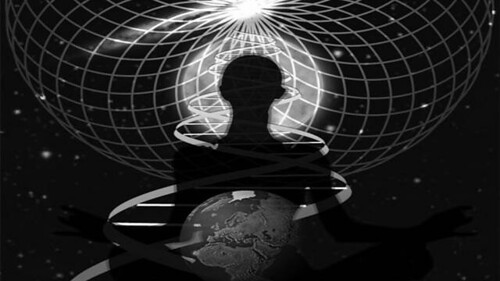
Photo: “Consciousness Awakening on Vimeo by Ralph Buckley” by Ralph Buckley is licensed under CC BY-SA 2.0.

Light verse: RHL, ‘Question the Universe’

Odin wrote runey verse
Rumi wrote Sunni verse
Edward Lear? Loony verse.
Question the universe
with your buffoony verse.

*****

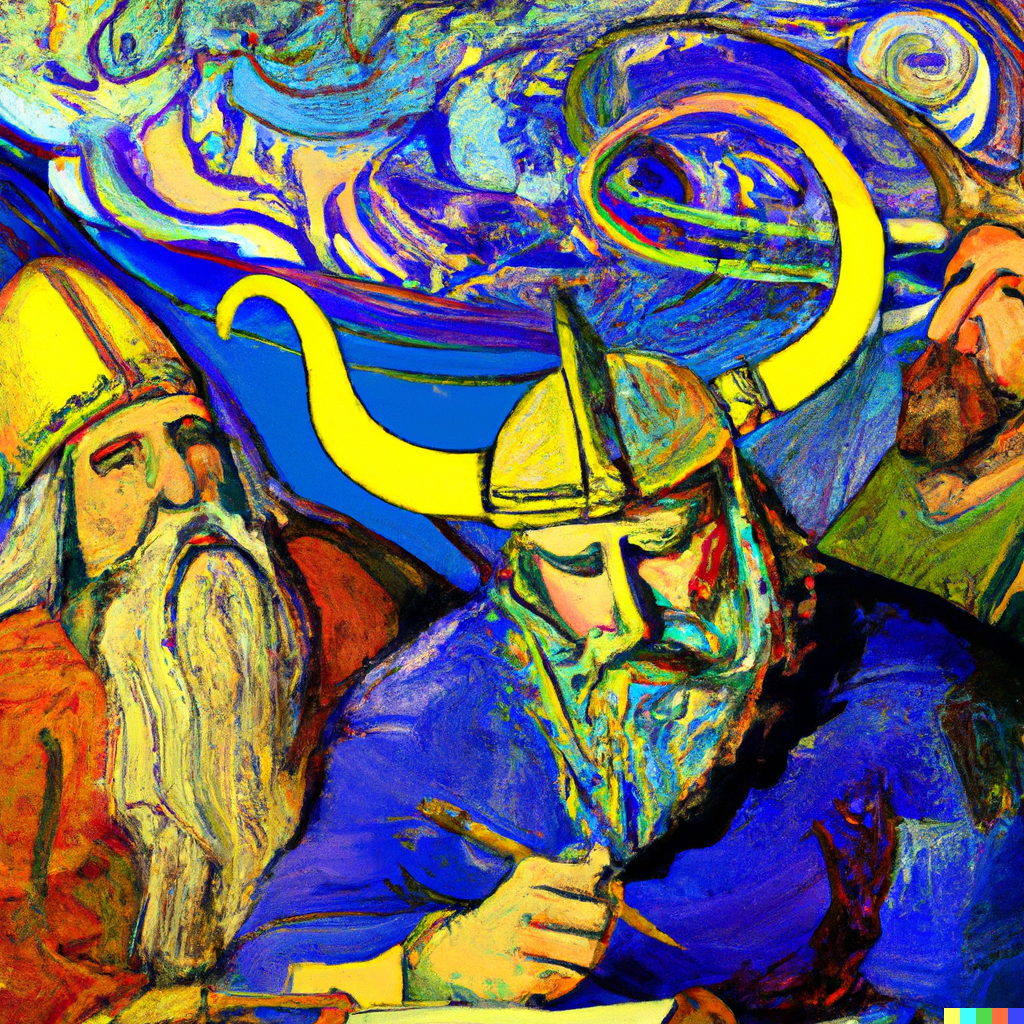
Sometimes you jot down a little light piece inspired more by wordplay than anything else, and the more you look at it the more it resonates. This is one such. The characters are diverse, coming from pre-literate Scandinavia, Renaissance-inspiring Islam, and Victorian England – they touch the roots of my cultural identity. They are from the past, but their searches are timeless, fully modern, quintessentially human. And I fully subscribe to the idea that we should question everything, and that the Fool‘s tools of succinct and enigmatic wordplay may be as good an approach as any in trying to formulate – let alone answer – all questions, physical and existential.

It further resonates for me in being published (which I find important); in being published just now in Light (which is a wonderfully reassuring place to be); in having been improved in response to Light’s editorial comments (meaning, yes, I am proud that sometimes I am open to criticism and it’s useful); and in being my 400th poem published (by one of my conflicting counts).

Nothing is definite, not the historical reality of historical and semi-historical figures, not the permanence of printed words, not the definition of a poem, not the count of things hard to define, not the nature of physical reality. So though we have to make prosaic choices based on appearances and best guesses, that should be balanced by questioning everything. Preferably in verse.

TL;DR: Even short poems can be unpacked.

Illustration: DALL-E by RHL, ‘Rumi, Odin and Edward Lear are writing poetry to question the universe’

Sonnet: ‘Simulating the Past’

In the far future, humans gone from Earth,
now disembodied as self-structured flows
of energy and information, woes
of the unknown replacing old Death, Birth
and even Copulation; when a dearth
of physical experience bestows
rich glamor on ideas of Nature’s shows–
sunset, moon rise, trees, seas–the planet’s worth…
they’ll lust after these days we suffer through,
marveling at the rich chaotic times,
enthralled by nearing immortality
while planetary destruction loomed in view.
Wrapping themselves in simulated climes,
they think them us… Are they?… We’re them?… Maybe!

*****

One of my more obscure Petrarchan sonnets, perhaps… but Nick Bostrom of Oxford University hypothesises that, as simulations get increasingly complex, engaging and realistic, there will ultimately be many more simulations than the original reality… and therefore that there is a higher probability that you are living in a simulation than in the “real” world. Whatever the “real” world is. Or whoever you actually are. And seeing as Quantum Mechanics is drawing us all into a sense of the illusory nature of reality (particles being waves when they feel like it, or until closely questioned), then maybe somewhere between Ancient Hinduism and future physics we are all something that we haven’t come close to figuring out yet.

Published in Rat’s Ass Review – thanks, Rick Bates!

Woman having fun with a VR set” by Rawpixel Ltd is licensed under CC BY 2.0.

Sonnet (?): ‘Sleep is Like’

Sleep is like heading to the locker room at halftime
Sleep is like stepping into the wings between acts
Sleep is like going outside for a cigarette.

And then you go back to work
Back to the performance
Back to the game.

The game that may go thirty thousand rounds;
But who you really are is when you’re on break;
The rest is just your job, performance, game, not you.

And when at last it ends, and you go home,
Back to where you came from,
Who are you? and where do you go?

Perhaps you know this while you’re deep
Asleep…

This poem–if it is a poem–on (one of) the mysteries of the universe was just published in Snakeskin. I suppose you could call it a sonnet if you want… it has 14 lines. With four thoughts in four sets of three lines and a concluding sort of rhymed couplet, it has an organised form. Sonnetish. But it’s not elegant, it’s coarse–like life and death, consciousness and sleep.

It has no regular beat, let alone formal metre. And it’s not reasonable to claim that ABC DEF GHI JKL MM is a rhyme scheme. The piece simply doesn’t have the carefully balanced exposition of a sonnet, the flow of rhythm, the inevitability of rhyme.

If I put together a collection of my sonnets, I wouldn’t include it.

Probably.

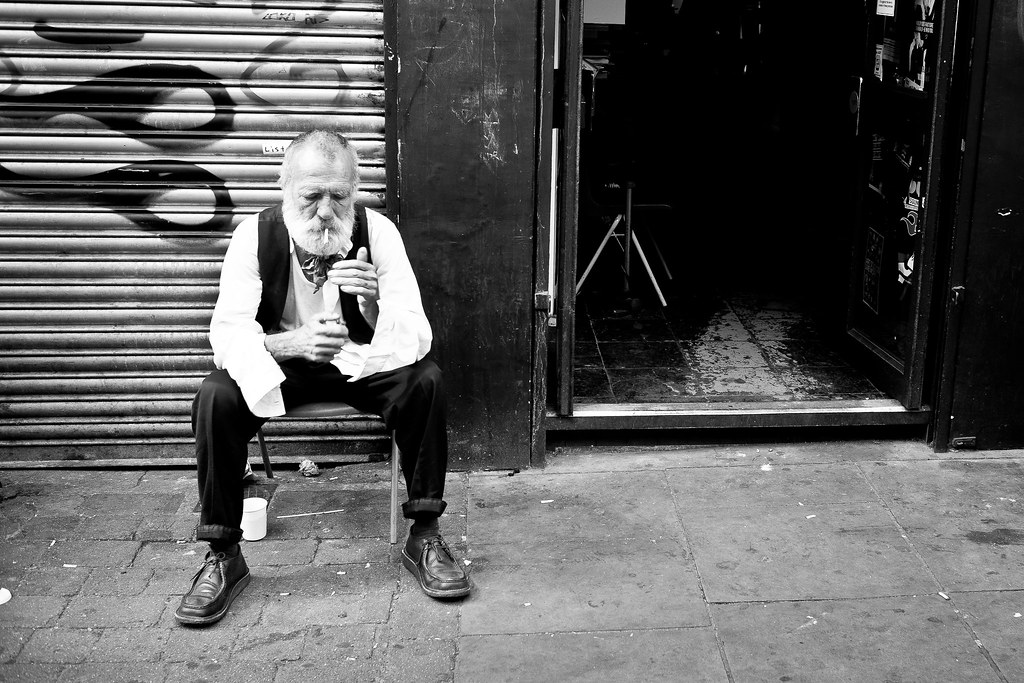
“Smoking outside London Bar” by macabrephotographer is licensed under CC BY-SA 2.0