Tag Archives: rhythm

Weekend read: Essay: Victoria Moul, ‘On rugby and metre’ (excerpt)

Victoria Moul writes: When I hear or read people — often though not only American “formalists” — discussing “correct” metre in English, and the supposed dominance of accentual-syllabic forms in general and the iambic pentameter in particular, I often think rather impatiently of poets like Arnold and Yeats. Arnold’s verse is musical, highly memorable and — to my ears at least — mostly very straightforward to speak correctly. But it’s often not very iambic at all and he typically uses lines of very varying syllable length. ‘Rugby Chapel’ is a good example of this — its pattern is, technically speaking, more trochaic (rugby) than iambic (endured), the trochaic pattern is established very clearly at the outset (‘Coldly, sadly descends’) and the lines have between six and nine syllables each. If you (inexplicably) wanted to spend an hour “scanning” it you’d find a complex variety of combinations of stressed and unstressed syllables. But its music is easy to hear and read, and very easy to remember, because regardless of the number of the syllables all the lines have three stresses.

Repeated three-stress lines are relatively unusual in English, especially in longer poems, but the four-stress line is very common, perhaps in fact the most natural English line of all, and indeed a lot of so-called iambic pentameter has a tendency to drift towards four rather than five stresses. ‘The Wild Swans at Coole’ establishes an iambic pattern at the outset (‘The trees are in their autumn beauty / The woodland paths are dry’) but is in stanzas of 4/3/4/3/5/3 stresses, with quite varied syllable length and relatively few perfectly iambic lines. Day-Lewis’ poem, by contrast, looks to the eye like it might be iambic pentameter, since the line-length hovers around 10 syllables (ranging from 9 to 12). But most of the lines are spoken naturally with four stresses, not five (‘A sunny day, with leaves just turning’; ‘Wrenched from its orbit, go drifting away’), and only a handful of lines certainly have five.

As far as I know — do comment if you can think of any counter-examples — there are no really good poems about rugby itself, so the poems I discussed today were just those which came into my mind as I watched the practices. None of these English poems are obscure — all are by poets who were considered major in their own lifetime, and all three have been very well-known at some point even if they are not now — and not one of them is in iambic pentameter. In fact, not one of them is obviously in a ‘syllabic’ metre, strictly speaking, at all (as in the familiar statement that traditional English verse is ‘accentual-syllabic’, i.e. where both the number of stresses and the number of syllables are set by the metrical pattern). These poems, like a great deal of English poetry, establish and follow an accentual pattern — of a certain number of stresses in a line, though this too is open to variation — but not, or only very loosely, a syllabic one. Verse of this kind is very common in the English tradition, and the hundred years of poetry between the mid-19th and mid-20th century, even if you set aside the full-blown “modernists” completely, is particularly rich in metrical variety. It is puzzling that this is not better reflected in most discussions of English metre and form. But the best way to get a feel for the actual — rather than imagined — conventions of a literary tradition is, of course, by reading it.

*****

Editor: The passage above is excerpted with permission from a recent Substack post by Victoria Moul in her ‘Horace & friends’ – the full thing is at https://vamoul.substack.com/p/on-rugby-and-metre. In it, with thoughts inspired by watching her nine-year-old son playing rugby, she discusses Cecil Day-Lewis’ ‘Walking Away’, Yeats’ ‘The Wild Swans at Coole’ and Arnold’s ‘Rugby Chapel’. The piece is engaging in several ways, but the point that stands out the most for me is this:
“These poems, like a great deal of English poetry, establish and follow an accentual pattern — of a certain number of stresses in a line, though this too is open to variation — but not, or only very loosely, a syllabic one.”

This is much on my mind when I consider the forms that create formal verse. From my school days on, I have felt that analysing English grammar with Latin rules was wrong, just as straightjacketing English verse into syllabic requirements was not always useful, beautiful or appropriate. English is a Germanic language, and plays effectively by looser accentual rules: perhaps harder to define and analyse, but truer to the work of poetry which is to be word-for-word memorisable. Rhythm is one of the essential tricks of memorisation, along with rhyme, alliteration, assonance and a host of rhetorical tricks; and rhythm plays a variety of casual games. Also, accentual pattern corresponds to the continuum that I see at the root of poetry: from womb heartbeat, to dance, to music, to song, to formal verse. Formal verse is at its best when it is rhythmic and rich in musicality as well as in ideas and images and wordplay. Without the music, without the rhythm, it is prose… no matter how well expressed.

So rap and spoken word are inherently more poetic because more memorisable than 99% of what has been published as ‘poetry’ in the past 50 or 60 years. All songwriters are of course genuine poets – not all are good ones, but Bob Dylan certainly deserves his Nobel Prize (and I wish it could have been shared with Leonard Cohen).

Another point is that French too, and other Romance languages, are more accentual than professors often claim. When Françoise Hardy sang
Tous les garçons et les filles de mon âge
Se promènent dans la rue deux par deux
she was following the accentual beat, not giving every syllable equal weight, and completely skipping a couple of unstressed syllables. (Are French professors still teaching that all syllables have equal weight in French verse? Surely not! I hope that died out some time last century…)

Not all poetry is singable – but at its best it has a musicality that both creates enjoyment and enhances its ease of memorisation.

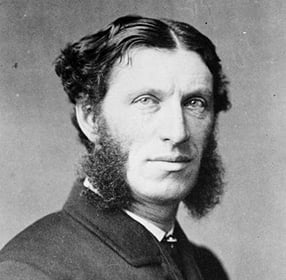
Photo: Matthew Arnold
Casual form: Lisa Marshall, ‘Lust’

Under the moonlight’s magical hold
Lust prowls like a wolf, hungry and bold

Slinking by with a wink of the eye
Slowly drawing me in on the sly

Into temptation’s cunning allure
Tainting even the purest of pure

Whispered confessions into the wind
Forgive me, Father, for I have sinned

*****

Editor’s comments: I’m classifying these lines as ‘casual form’: the meter is undisciplined by classical standards, but the beat is clear and the rhymes are straightforward. The verse is as natural to English as nursery rhymes, noted for their ease of memorisation without being classically regular. Look at the varying numbers of syllable per foot in the four lines of ‘Baa Baa Black Sheep’, for example. English speech is very forgiving regarding unstressed syllables, while still maintaining a rhythmic flow – as we know from rap. By that standard, adherence to beat and structured rhyme is adherence to form.

Lisa Marshall is a poet and author who resides in beautiful Dartmouth, Nova Scotia – also known as the City of Lakes.  She is the author of Black Olive: A Novel and Poetry for the Feminist’s Soul, both of which are available on Amazon Kindle. 
Read more at Not Another Nice Girl Blog.

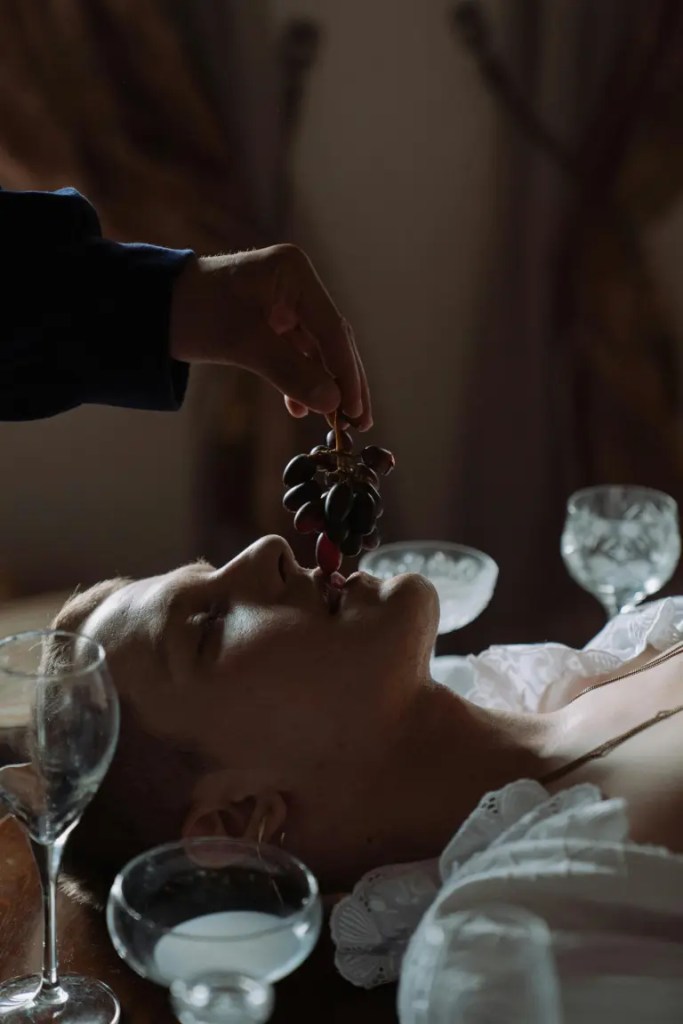
Photo: from Lisa Marshall’s blog.

RHL, ‘Everyone’

Everyone’s naked under their clothes,
everyone’s bald under their hair;
hide if you like, everyone knows!
Everyone sees what you’re like under there.

Everyone’s meat under their skin,
everyone’s bones under their meat;
we know what your outside is hiding within:
hiding will always end in defeat.

So banish the words and censor the book,
draw little clothes on the cartoons for kids;
everyone knows where your dirty eyes look,
everyone sees that your life’s on the skids.

This poem was a response to the news out of Florida that elementary schools are being forced to draw clothing on cartoon characters in children’s books if the printed images show nakedness of either front or back. The right-wing nutcase group ‘Moms For Liberty’ is causing the trouble.
This link https://popular.info/p/pressed-by-moms-for-liberty-florida gives details and shows some of the results.
Incidentally, one co-founder of the Moms for Liberty group is Bridget Ziegler. Apparently she and her husband Christian Ziegler had sexual threesomes with another woman; and when Bridget backed out of a planned threesome event in October 2023, Christian went along anyway; the third party declined sex, saying she was in it more for Bridget; so Christian raped her. The woman then filed a complaint with the police.
Why is it that the hysterically over-moral types seem to be the ones causing most of the problems?

This poem was published in the March 2024 issue of Lighten Up Online (aka LUPO); thanks, Jerome Betts!

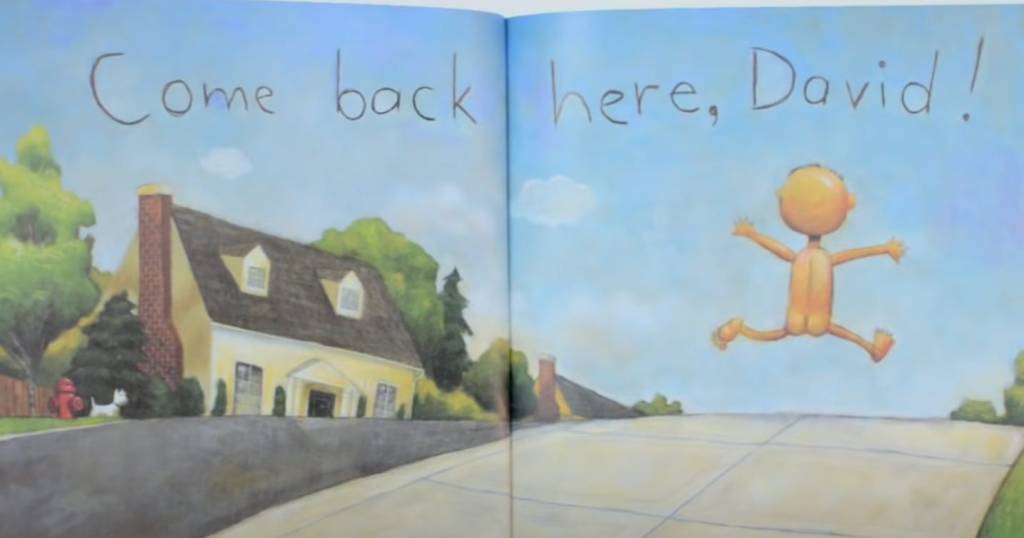
Photo: illustration from ‘No, David!‘, written and illustrated by David Shannon.

Using form: Quatrains: Stephen Gold, ‘So Pseud Me’

My verse is of the humorous variety,
And does its best to brighten up society.
To spread a little joy’s a noble calling,
A life without a laugh would be appalling.

Yet still, of late, I’ve had a thought that niggles;
What worth is work that just produces giggles?
Should it be judged as slight and ineffectual,
Compared to art we label intellectual?

And so I did what “proper” poets do,
And signed up to The Scrivener’s Review,
“The connoisseur of poesy’s magazine”,
Where scribes will scratch your eyes out to be seen.

I found it was a terrifying place,
Where people were obsessed with lower case,
Allusions veered from cryptic to absurd,
And “meaning” seemed to be a dirty word.

Their poetry was like the peace of God,
That passeth understanding – truly odd.
Some claimed to write for womxn and for mxn,
Though none had come across the verb, “to scxn”.

With open mind, I asked, “Is it my fault
That there is nothing here I can exalt?”
But days of dredging through this awful rot
Confirmed beyond all doubt that it was not.

Each new excrescence served to reinforce
That I had veered disastrously off course.
I wheeled around and fled back to the light
Which shines upon the droll and erudite,

Bring on a world where rhyme and meter matters,
And isn’t full of folk as mad as hatters.
Adieu to “Scrivener’s Review”, I quit.
Do I need what you’re full of? Not one bit.

*****

Stephen Gold writes: “The idea for So Pseud Me came from wading through an august poetry periodical which had better remain nameless, and coming to the following conclusion: WTF?
There was some good, thoughtful work, but much of it was pretentious drivel, written by the deservedly obscure with their heads rammed firmly up that place where the Lord causeth not the sun to shine.
If you were to ask them, I guess most would place high verse on a pedestal, way above light. But on this, I am with Kingsley Amis, who wrote in the New Oxford Book of Light Verse:
“Light verse makes more stringent demands on the writer’s technique. A fault of scansion or rhyme, an awkwardness or obscurity that would damage only the immediate context of a piece of high verse endangers the whole structure of a light-verse poem. The expectations of the audience are different in the two cases, corresponding to the difference in the kind of performance offered. A concert pianist is allowed a wrong note here and there; a juggler is not allowed to drop a plate.”
‘So Pseud Me’ is a light-hearted attempt to speak up for jugglers.”

Stephen Gold was born in Glasgow, Scotland, and practiced law there for almost forty years, robustly challenging the notion that practice makes perfect. He and his wife, Ruth, now live in London, close by their disbelieving children and grandchildren. His special loves (at least, the ones he’s prepared to reveal) are the limerick and the parody. He has over 700 limericks published in OEDILF.com, the project to define by limerick every word in the Oxford English Dictionary, and is a regular contributor to Light and Lighten Up Online (where this poem was first published).

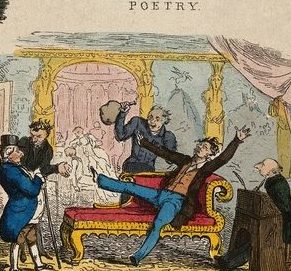
Illustration: “A group of poets carousing and composing verse under the influence of laughing gas. Coloured etching by R. Seymour after himself, 1829.” is licensed under CC BY 4.0.

Calling the Poem: 12. ‘Memorableness’

That* for an idea, for an idea’s transmission.
But that isn’t poetry. Poetry’s mission
is memory – every quick trick of the tongue
to give ear-to-mouth memory,
words sung and strung
from an ear to an ear,
bearing clear repetition,
not just the idea,
but the idea’s expression,
silk wrapping the emery –
rhythm and rhyme,
form, pattern, compression,
feet, movements, beat, time,
iter-, reiter- and alliteration,
sense, nonsense and assonance, insinuation,
barbs and allusions,
hooks, jokes and confusions,
directions, inflections, creating connections…
So memory favours your chanting, reciting,
enchanting beyond all mere reading and writing –
and magicking into the mind of forever.
You’ve taken control of poetic endeavour.

*****

*The first word, “That”, is referring back to the previous poem in the e-chapbook’s sequence, dealing with the process of obtaining the thoughts and ideas for a poem. This poem shifts the focus to the wordsmithing that makes a poem word-for-word memorable, memorisable, repeatable, recitable.

Consider the pieces of verse that are easiest for you, personally, to recite… nursery rhymes, passages of Shakespeare, bits of Tennyson’s ‘Charge of the Light Brigade’, quatrains from FitzGerald’s ‘Rubaiyat of Omar Khayyam’, an Emily Dickinson or Edward Lear poem?

Then consider how many prose passages of similar length you can recite – perhaps a Bible passage or part of Lincoln’s ‘Gettysburg Address‘? There will be some, prose passages you have heard many, many times. But poetry is going to win out over prose by number of pieces, length of pieces, and accuracy, because poetry is deliberately uses a variety of tricks that make memorisation as easy as possible.

Poetry is not just the idea but also, essentially, the idea’s expression.

Photo: “Maori Chant” by pietroizzo is licensed under CC BY-NC-SA 2.0.

Odd poem: Edward Lear, ‘Imitation of the Olden Poets’

Time is a taper waning fast!
Use it, man, well whilst it doth last:
Lest burning downwards it consume away,
Before thou hast commenced the labour of the day.

Time is a pardon of a goodly soil!
Plenty shall crown thine honest toil:
But if uncultivated, rankest weeds
Shall choke the efforts of the rising seeds.

Time is a leasehold of uncertain date!
Granted to thee by everlasting fate.
Neglect not thou, ere thy short term expire,
To save thy soul from ever-burning fire.

This poem is a gorgeous piece of deliberately bad verse. Edward Lear had a wonderful ear for rhythm, and this appalling piece is a great jab at poets who, even to a Victorian like Lear, were long out of date: meaning, syntax and prosody are all garbled, wrapping around bland but unclear moralising exhortations.

The first line of each stanza ends with an exclamation mark even if, as in verse three, it is in the middle of a sentence.

The very first line has four simple feet in iambic tetrameter, eight syllables.
The second line also has eight syllables but manages to make the rhythm stumble through poor phrasing.
The third line has ten syllables; it can be read as iambic pentameter, but the previous lines encourage an attempt to keep to four slightly crowded feet.
The fourth line goes to twelve syllables, at which point the prosody is collapsing towards Lear’s younger contemporary, William McGonagall–you either cram everything into four feet, or let the stanza dribble out in too many iambics.

The second stanza begins “Time is a pardon of a goodly soil!” Very affirmative, but what does it mean? And are we back to pentameters now? It’s not clear–the second line is definitely tetrameter… so how to read the third and fourth lines?

The last stanza is pure iambic pentameter. The chaos is in the confused understanding of time, “a leasehold of uncertain date”, but is somehow part of “everlasting fate”. Similarly “thy short term” is shadowed by “ever-burning fire”. On balance, time appears to be represented as infinite–events are portrayed as everlasting–but time is also called “a leasehold of uncertain date”; that phrase is merely a poor expression that confuses Time with the time of a human’s life.

The poem has been set to music by Bertram Wooster with a Betty Boop video. They credit Lear, and the poem shows up in PoemHunter and a couple of other places… and I want to believe it is Lear… but I’d be happier if I could find more about the origin of the piece.

Candle” by kkalyan is marked with CC BY-SA 2.0.

Potcake Poet’s Choice: Maryann Corbett, ‘The Vanished’

 In the autumn of 2015, the production of paper cards for library catalogs ceased.

No matter how long ago they completed their disappearance,
I still expect them,
perhaps in a sort of narthex just past a pillared entry,
or off to the side
as if in a private chapel, or straight ahead like an altar.
Shrined in the silence,
modest and single, or ranged in ranks and banks and rows,
the gods of Order
lived in their tabernacles of honey and amber maple
or oak like chocolate,
darkened at times from the touch of a hundred thousand fingers.
On every drawer-front
the face of a tiny gargoyle waggled its brazen tongue out.
And so we pulled them.
And the drawers slid waxen-smooth, and the fingers flicked like a weaver’s
through card upon card,
and above the drawers were our faces, our heads all bobbing and davening.
A kind of worship
it was, with an order of service. A physical act of obeisance.
Its cloudy replacement
(perfect in plastic efficiency, answering almost to thought,
near-disembodied)
hurries us past the notion of order itself as a Being
worthy of honor.
So here I am, misplaced as a balky fourth-century pagan
mulling conversion,
but nursing doubts that the powers should be called from the general air,
seeking the numinous
still in its tent of presence, and longing to keep on clutching
the household gods.

Maryann Corbett writes: “This was one of those poems that spent several years stewing at the back of my brain as soon as I read the factoid that actually library catalog cards were no longer being produced. It’s a disappearance not likely to be noticed much by younger people, and I wanted to give it attention. What eventually let my brain’s stew boil over in images of all the card catalogs I’ve known, I can’t say. But it did so in a rush, a rush and roll that took the form of very long lines. I’ve written several other poems in hexameters–lines with six stresses–and I wanted to do something a bit different–and to leave space to breathe!–so I decided to alternate the hexameter lines with much shorter ones: dimeters, or two-stress lines.

 ‘The Vanished‘ appeared first in Alabama Literary Review, was anthologized in The Orison Anthology, Vol. II, and was included in my most recent book, In Code.

Maryann Corbett lives in Saint Paul, Minnesota, where she worked 35 years for the Legislature. Poetry: Breath Control (2012), Credo for the Checkout Line in Winter (2013), Mid Evil (2014 Richard Wilbur Award), Street View (2017), and In Code (2020). Past winner, Willis Barnstone Translation Prize. Work included in The Best American Poetry 2018, as well as in the Potcake Chapbooks Families and Other Fiascoes and Robots and Rockets.

Photo: “Catalog Cards” by Travelin’ Librarian is licensed under CC BY-NC-SA 2.0

Poem on poetry: ‘Diatribe Against Unversed Poets’

Ignoring clockwork towns and fertile farms
Tied to the sun-swing as the seas to moon,
They searched for verse in deserts without rhyme,
Lifted erratic rocks nonrhythmically
In search of poetry, then through the slough
Of their emotions hunted for a trail:

“The scent is cold. Its Spirit must have fled;
The body of its work, though dead,
Has been translated to some higher plane.
Look how the world’s translated verse
Comes to us plain—why can’t we emulate?
Then if the words themselves are unimportant,
If poetry in essence is idea,
And song is wrong,
Rhyme a superfluous flamboyance
(Like colour in Van Gogh),
Rhythm a distraction to the memoring mind,
Then we determine poetry’s true form is mime!”

While in the air the deafening blare
Confounds their silence everywhere:
Before our hearts began to beat
We were conceived in rhythmic heat;
So, billions strong, we sing along
For all the time, in time, our time, the song
Goes rocking on in rhythmic rhyme. Rock on!

“Unversed” means “not experienced, skilled, or knowledgeable”. Poetry takes different forms in different languages, but the forms all have the same desirable outcome: to make it easier to memorise and recite word-for-word. Alliteration, assonance, rhyme, metre – these are all useful tools for achieving this, along with less tangible tools such as fresh or startling imagery. Metre/beat/rhythm is viscerally important to us, because the mother’s heartbeat is the background to sensory development in the womb, and our own heartbeat and breathing rhythms continue throughout life. As humans we drum, we dance, we sing, just as we walk and run rhythmically, tap our fingers rhythmically when we are bored, teach small children to clap and sing, teach older children clapping and skipping games. Rhythm is built into us from before birth.

Rhythmic poetry didn’t die when it almost stopped being publishable. It just went into folk songs, blues, rock, country-and-western, musicals, rap, hip hop… Popular music let teenagers and adults continue to thrive with what they were not given by schools: rhythm and rhyme. This drive to make words memorable and recitable is part of who we humans are. So schools do best when they leaven “creative self-expression” with getting kids to learn things by heart, and getting them to pay attention to the qualities that make it easy to memorise and recite.

Photo: “Lost in desert” by Rojs Rozentāls is licensed under CC BY-SA 2.0

Evocative Fragments: from Macaulay’s ‘Horatius at the Bridge’

But the Consul’s brow was sad,
And the Consul’s speech was low,
And darkly looked he at the wall,
And darkly at the foe;
“Their van will be upon us
Before the bridge goes down;
And if they once may win the bridge,
What hope to save the town?”

Then out spake brave Horatius,
The Captain of the Gate:
“To every man upon this earth
Death cometh soon or late.
And how can man die better
Than facing fearful odds,
For the ashes of his fathers,
And the temples of his gods!”

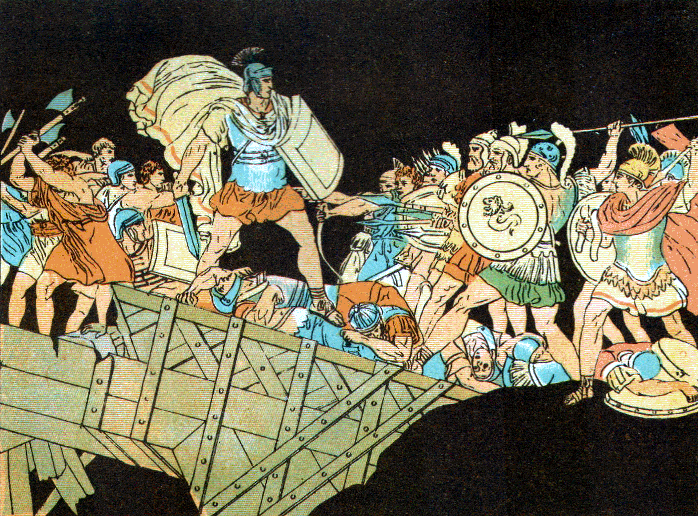
An alliance of neighbouring city-states is attacking the young Roman republic with 10,000 cavalry and 80,000 foot soldiers. The River Tiber provides a natural defence, but the broad wooden bridge is a weak spot. Horatius with two friends will try to hold off the enemy while the bridge is being destroyed underneath them. Enemy champions attack them in single combat and are defeated, until the huge Astur strides up with his “four-fold shield”, shaking the sword “which none but he can wield”. He attacks Horatius and gashes his thigh. Horatius

… reeled, and on Herminius
He leaned one breathing-space,
Then, like a wild-cat mad with wounds,
Sprang right at Astur’s face.
Through teeth and skull and helmet
So fierce a thrust he sped,
The good sword stood a handbreadth out
Behind the Tuscan’s head.

(…)

On Astur’s throat Horatius
Right firmly pressed his heel,
And thrice and four times tugged amain,
Ere he wrenched out the steel.
And “See,” he cried, “the welcome,
Fair guests, that waits you here!
What noble Lucumo comes next
To taste our Roman cheer?”

I was probably 11 when our English classes in my Jamaican boarding school were enlivened by Macaulay’s nearly 600-line poem (though, truthfully, our textbook cut out a lot of the slow introductory verses). As someone who otherwise lived on works like Tarzan of the Apes and Bomba the Jungle Boy (and of course banned comics of Superman and Batman when I was home for the holidays), it was wonderful to discover that verse could deliver just as dramatic, violent and heroic a story as novels and comics. Further, verse can do so in passages of enormous emotional power, heightened by the drama of their rhythm and rhyme, with short passages sticking in the mind forever even if you aren’t trying to learn them by heart.

The other qualities that appealed to me were undoubtedly the feelings of patriotism and religious approval that I suspect are natural in children – the sense of community, of tribe, of duty, of being morally in the right, of overcoming difficulties, of excelling, of supporting and saving people, of being praised for it. And what I value in that today is that it was done without any reference to an actual modern-day country or an actual modern-day religion. In other words the emotions could be stirred up and the child could be (at least temporarily) ennobled, without the poisons of nationalism or religious fundamentalism finding a place. Indeed, by placing the heroic emotions outside the here and now, I think the poem helped inoculate me against such diseases.

I was already very comfortable with poetry when I was introduced to ‘Horatius’ – A.A. Mine, Edward Lear, Robert Service and the Anglican hymn book come to mind – but this poem took poetry into another dimension entirely!

Updated Call for Submissions: Potcake Chapbooks

I am always keen to read and consider rhymed and metered verse that has already been published. There are several chapbooks that are jostling in the queue for completion and publication:

Travels and Travails (travel)
City! O city! (urban life)
Just a Little Naughty
Portraits Unpleasant
Various Heresies (religion)
Lost Loves
The Horror of Spring! (seasons)

and there are more; but the last one, Rockets and Robots, wasn’t part of my original plans: I just ran across a bunch of Science Fiction poems that I liked, and they filled a chapbook nicely. So I’m an unashamed opportunist. I’ll modify my plans if I think something better is available. All the chapbooks listed above are nearly full already but, as with all of them, if I run across another poem I really like, I’ll include it. And if I receive enough good poems on an unplanned theme, that theme will get slotted in.

When there is enough good material on a single theme to fill 13 pages of a chapbook (still leaving room for Alban’s artwork, of course), then it may become the next project. But until a chapbook actually goes to print everything is subject to change. An even better poem may show up and displace one tentatively placed. A slew (or slough) of poems on a new theme may cause a reprioritisation of planned chapbooks.

This is one of the reasons that I prefer to consider only poems that have already been published–so that I don’t feel guilty about having a bunch of poems that will sit with me for months, years, and may or may not be included in the Potcake series. I have flagged a thousand poems that interest me; but I can only publish a dozen in a chapbook, and only a few chapbooks will get produced in a year.

Poems in the chapbooks run from two or three lines to some 40 lines in length–obviously, with space at a premium, poems over 20 lines and running over one page are less likely to be included… but it does happen. Other criteria: I’m looking for wit, elegance, a variety of traditional and nonce forms, a variety of voices and moods: happy, sad, angry, sardonic, meditative… anything interesting I can scrounge. If you have something you think I might like, on any topic, please send it along to robinhelweglarsen@gmail.com

I can’t promise to use it, but I will read it and reply!