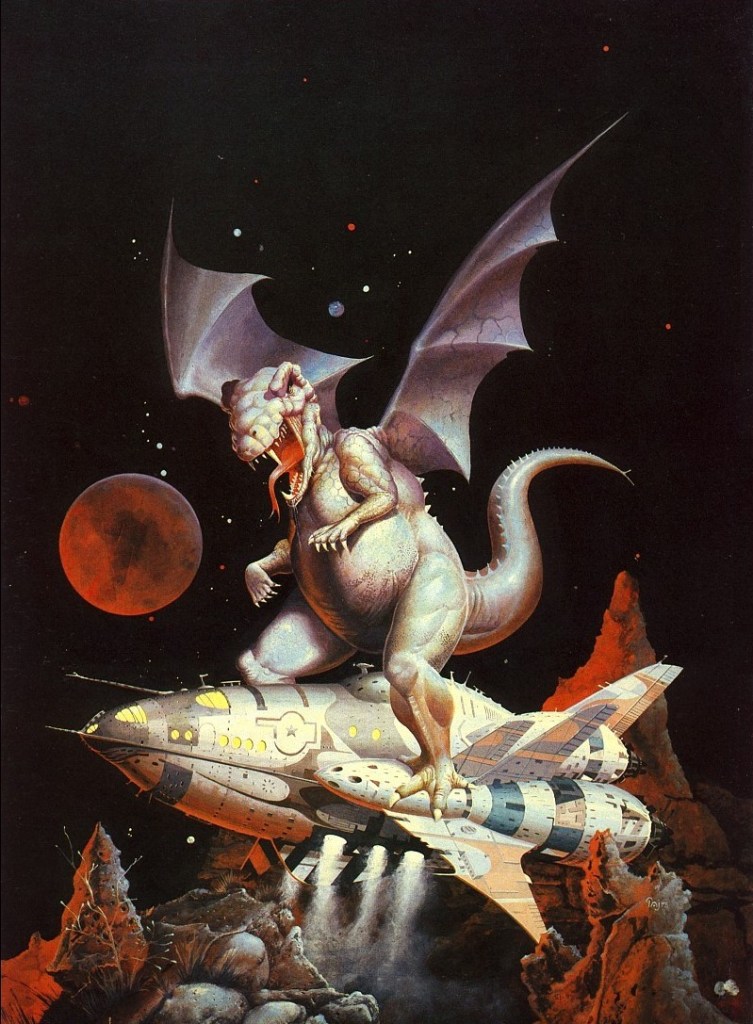
A dinosaur straddles a rocket And whether the pilot within Was trying to launch it or dock it To finish a trip or begin, It looks like a fight that the dinosaur might By weight and ferocity win.
But how did it mount there? Its wings Though bat-like are really too small To soar to the perch where it clings Indeed, to get airborne at all It better hold tight as the rocket takes flight For if it slips off it will fall.
The monster can only have boarded The spaceship when close to the ground (Its huge-muscled hind legs afforded The strength for a crouch and a bound) And as it gains height in the star-speckled night It will squat, legs and tail firmly wound.
A rodeo cowboy! Each buck Of boosters a challenge to greet! A contest of power, skill, luck To see if a lizard can beat This beast that takes fright at the terrible sight Of a dragon that thinks it’s in heat.
For that is the heart of the matter: This brute who bears down from above Will scrabble and buffet and batter Then, spent, wrap as close as a glove With licks to invite its cold mate to requite Its misallied dinosaur love.
*****
Simon MacCulloch writes: “Rocket Ride was inspired by Peter Andrew Jones’s book cover painting for The Second Experiment (Granada Books, 1975); the poem was first published in Aphelion.”
Simon MacCulloch lives in London and contributes poetry to a variety of print and online publications, including Reach Poetry, View from Atlantis, Pulsebeat Poetry Journal, Spectral Realms, Black Petals and others.
If particles only exist as waves, precipitating out only when measured, seen, till then just ghostly, nebulous, roughed-in… If that’s the way the universe behaves, then who’s to say the moons of Jupiter existed before Galileo scoped them out? Our simple world had coped, pre-Hubbell, without needing to infer a billion galaxies. Again, if things newly observed are different than before, then things that once were real are real no more, especially nebulous, wave-form, with wings, hence dragons, fairies, elves all now seem odd… and angels, demons, giants, ghosts… and God.
*****
This sonnet was recently published in Bewildering Stories (thanks, Don Webb), and seems to have touched a chord with that issue’s theme of esse est percipi; so it leads off that week’s questions in the magazine:
George Berkeley’s philosophy of Idealism is based upon the principle: “To be is to be perceived.” How does the theory of Quantum Physics support the principle of perception? Or does it?
The poem concludes by listing a number of supernatural beings whose reality is implicitly denied as long as they have not been perceived. How does “God” differ — by definition — from the others in the list?
Christian culture’s crucifixation nails us to our seats as, station by station, we travel the trammelled line until we find that terminal more primal.
The humanstrain’s end-of-line stop is Ragnarok. Everyone please disembark into the dark– no light, no map. Mind the Ginnungagap.
*****
This is as close as I get to religion: existential uncertainty. I’m a Militant Agnostic: “I don’t know… and neither do you!” Yet this attitude is apparently compatible with religion, being not that different from Eliot’s ‘East Coker‘: O dark dark dark. They all go into the dark, The vacant interstellar spaces, the vacant into the vacant, The captains, merchant bankers, eminent men of letters (…) I said to my soul, be still, and let the dark come upon you Which shall be the darkness of God. But Christianity? I think not. Altogether too unlikely, with so many impossibilities packed into such a small understanding of the cosmos. We don’t know where we are headed, not just as individuals with finite lives, but as a species that is simultaneously developing space travel and genetic modifications… the possibilities are endless and the future, dark as well as light, is unknowable.
The poem is semi-formal with its loose iambics and paired rhymes or slant rhymes, but no structure beyond its natural flow. It was originally published in the Experimental section of a 2019 issue of Better Than Starbucks, and republished as part of work being spotlighted in The HyperTexts in August 2024.
Gods! Admire us; we’re your virus formed of land and sea. Air and fire take us higher, a plague now breaking free; a wild agent of contagion through the galaxy; death-defying, modifying… infecting all we see.
*****
This brief poem was recently published in Bewildering Stories. Humans have already spread round the planet into all ecosystems like an uncontrollable virus; and now we’re seeing the beginnings of a far vaster expansion, presumably entailing endless mutations as we go. It’s going to be a wild ride and, once we’re established and self-sustaining off-planet, I don’t see anything stopping it.
(To those who don’t share this world view, I apologise for what must come across as a religious rant. Maybe it is. We’re all trying to make sense of a life that refuses to be pinned down, and quantum physics shows no more common sense than do tales of angels and demons.)
Having predicted the future in vague outline, I admit I think the future is unpredictable in detail. It is chaotic and formless… which is all the more reason for imposing what form we can in writing about it. Form is a good antidote to formless times. And understanding why we developed our cultural techniques over millennia, why we love song, dance, rhythm and rhyme, is useful in preparing ourselves for an unpredictably evolving future. We developed our cultural strengths for good reasons, and they speak to our evolving ape core. Yes, things will keep changing; but for good or ill we are social beings, and our rhythms and harmonies are part of what keep us grounded in society and prevent our mental collapse.
On an asteroid there was an alien artefact. If such it was… a droid… I’ve no idea, in fact. Its metal (leg?) seemed (deployed?) and so I touched it, but responses lacked.
Once there were women; once I was a man (touching a leg then always brought response) before the search for life and light began to change me into this dark renaissance. The teacup storms on which I’ve tossed, when she or I have bitched and bossed till all the loves I’d ever marked were all the women that I’ve lost. They chose the certainty of Dark over the uncertainty of Light.
The joys of life are what’s uncertain: hopes of what’s behind the curtain, knowing the results will grate of things that you anticipate, knowing your life could be wrecked by what you never could expect. And though you think you’re circumspect, you can’t deflect, inspect, collect. Knowing the harvest is unknown with crops that grew from deeds you’d sown, while all your greatest hopes and dreams will be exceeded by the future’s smallest gleams.
Because change never stops, you find what matters is never really known. You may get verbal assurance of your future status, but was it “throne” or “thrown”? The only certainty would be if, offered immortality, you feared what such an altered world would lose, would save, and chose instead to go into the Dark with furnace no less dark than the grave wherein there lies no risk of further blight. Most people choose the Certainty of Dark over the Uncertainty of Light.
But we who strive to stay alive long enough for rejuvenation hope, hope only, we will thrive, post-humans in a re-Creation, unknowing what our ape-based genes will do with power dominance, with war, with sex, Earth mined and undermined, but glad to take the chance. How else can we see scenes of how it all turns out — destroyed? refined? — unless we scrape through, level up with wounds and scars and watch a world we love and leave behind? So at last I am here, between the stars, transiting the darkness of the Void, the empty galaxy’s apparent night, chanting the mantra that keeps spirits buoyed: Let there be Post-Humanity’s own light!
Between the spiral arms in the near-void there’s still thin light of distant galaxy and star, still specks of dust, rarely an asteroid. Earth left (millennia in old Earth years ago), I cross the dark immortally, beyond, afar, through what is darkness only to Earth-eyes which myriad wavelengths up and down can’t know, but which I now apprize. Light here abounds, and boundlessly surrounds, astounds.
Take the smallness from slight, take the bad from the blight, take the fear out of flight and you’re left with the light, the light, the light. We stumble from dark caves of night into day, trying not to tumble; our parents the dark; post-humans the light; ourselves just the stumble.
*****
This poem (published in this week’s Bewildering Stories) is a response to conversations in which people have expressed pessimism about the value of life extension, rejuvenation, cryonic preservation and resuscitation… anything beyond the certainties of a clear end to life after a normal lifespan. “How will you… why would you… what if they… you won’t understand… you won’t have…” Ah, but everyone who has immigrated into a foreign culture has done this: had to learn a new language in order to find a job and start making friends and find out how everything works. Some of us are comfortable doing this; some people aren’t. I’ll take the uncertainty, and enjoy its discomforts… because it’s just so interesting!
Two hundred million sperm in one ejaculation; and we are standing firm and spouting with elation, though but a single germ survives to incarnation.
And much in nature throws vast clouds into the ocean, where myriad embryos become a magic potion consumed by all that goes with food its only notion;
yet one or two survive to adulthood and, later, will make the species thrive and serve up like a waiter new young crowds that arrive like cargo crammed on freighter.
This is how nature lives; we should not think it foolish eight billion of us gives but forty fierce and mulish posthuman narratives, godlike as much as ghoulish,
in retrospect appearing nature’s plan for how we cross to Nietzsche’s Superman.
*****
This poem was originally published in the Amsterdam Quarterly, although without the final couplet. I usually allow editors to make changes if they suggest them, and often the changes are an improvement that I retain. But in this case I’m afraid the science fiction speculation may be lost without those last lines: the idea that the present billions of us are on the point of being superseded by the first handful among us who achieve a godlike state of posthumanity… and that this ratio of 200,000,000 seeds being sacrificed to achieve one mature adult in the next generation is not unusual in nature.
On a dead spaceship drifting round a star, the trapped inhabitants are born and die. The engineers’ broad privileges lie in engine room and solar panel power. The fruit and vegetables and protein co-ops are run by farmers with genetics skills: the products of their dirt and careful kills help service trade between the several groups. Others — musicians, architects — can skip along the paths of interlinking webs. Beyond these gated pods that the rich carve for their own selves (but still within the ship), in useless parts, are born the lackluck plebs. Heard but ignored, they just hunt rats or starve.
*****
This sonnet was republished in Bewildering Stories in April 2024 – original publication had been in Star*Line five years previously. I find something very satisfying about using a formal sonnet structure to express science fiction and speculative fiction ideas – the ideas are by nature open-ended, unconstrained, and it feels good to tie them down as in a neat package with a bow on top. Topiary.
As for what political comments can be read into the poem, read away!
The humans crowd the riverbanks in cities while you, would-be transhuman in your boat, trust to your dreams and luck as on you float, ignoring all the land’s static committees, the buildings taller with their strident voices, the citied banks ever more crammed and loud, leaders and statues oversize and proud, fixed in their views. But you see other choices.
And then there’s no more land. Only the sea. You deso-, iso-, yet e-lated find after the Desolation of the Years, sailing and searching past humanity in the vast oceans of the future mind, a life within the music of the spheres.
*****
This sonnet has just been published in Space and Time #146, a magazine where fantasy, science fiction, horror and whatever else are presented in a variety of print, online and audio forms. The sonnet owes something to one of my favourite Matthew Arnold poems, ‘The Future‘, which begins
A wanderer is man from his birth. He was born in a ship On the breast of the river of time; Brimming with wonder and joy He spreads out his arms to the light, Rivets his gaze on the banks of the stream.
and ends flowing out into the ocean:
As the pale waste widens around him, As the banks fade dimmer away, As the stars come out, and the night-wind Brings up the stream Murmurs and scents of the infinite sea.
I assume Matthew Arnold limited this vision to the individual life, but I see it also as an image relevant to the progress of the human species into something vaster and unknowably different – not far removed from Nietzsche’s sense of Man as being a bridge between animal and… superman, or transhuman. Not the nasty small-minded punks of Nazi and neo-Nazi superman stupidity, but something far grander in a far larger development towards what life could become.
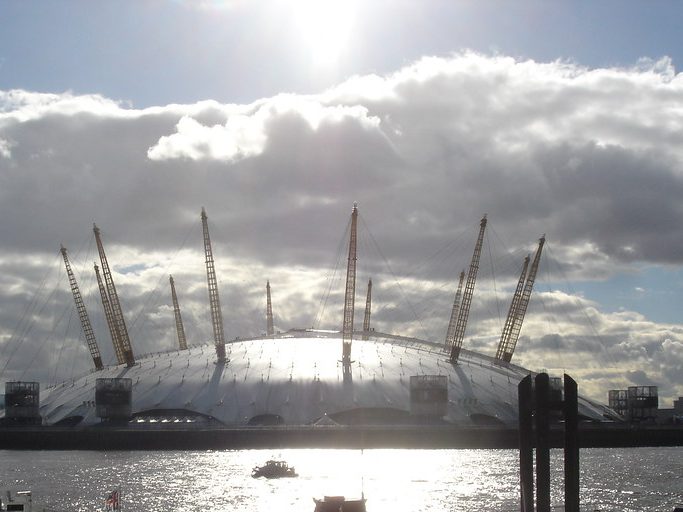
This very short (poem?) was just published in The Asses of Parnassus – thanks, Brooke Clark! I chose this post’s accompanying photo for its enigmatic mixture of futuristic construction and threatening natural conditions – the building is the Globe, or Avicii Arena, in Sweden but that is irrelevant.
An alternative photo I considered had a doomsday prophet holding a sign saying “The beginning is nigh”, which would be equally true: the end of homo sapiens being the beginning of some unguessable post-humanity. I read Ray Kurzweil and Yuval Noah Harari, and ponder. And then I look back at (others’) 2015 predictions of what the next ten years would bring, and, well, not so fast…
Like ants searching randomly across a table like water dribbling across uneven ground and pooling here, running to the side, filling and flowing to the next dip, so we have walked out of Africa for a hundred, two hundred thousand years, over the hills, around the coasts, seeking the greener grass, the next best land, glad of a tree, glad of a cave, catching the lightning for our own hearth, settling, pooling, then spilling out over the next hill, round the next headland, following bird flight, following game herds, exploring then leading then fetching our families, finding and fighting with those who were there before, killing or trading, absorbing or raping, loving, despising the different, the ogres and trolls, like a stain spreading out round the world, and walking then running up as though to take a free kick, walking then running up as though to bowl, walking then running as along a diving board to bounce once, twice in the air and launch into space… Here comes, there goes the human race.
I wrote this piece as a long rambling exploratory sentence which picks up speed and purpose towards the end and a concluding rhyme. This (not exactly formal) poem was first published in Bewildering Stories a few years ago.


 Form in Formless Times