Tag Archives: Snakeskin

Iambic hexameter: Martin Parker, ‘Man of the Match’

You swore at me and hurled your ring into the pond
then drove off back to London “for some bloody fun”
with friends whose Chelsea coven held you in its bond.
I was next in, scored twelve and hit the winning run.

The beers were long and cool, the Captain shook my hand.
Dusk shaded in, a final liquid blackbird sang.
A coughing tractor crawled a strip of fading land.
An owl flew low across the pitch, a church bell rang.

Two muddy urchins with a shrimp-net dredged the pond
their hopeful piping rippling in the cooling air
while you choked on exhaust at Guildford or beyond
along your golden road to Knightsbridge and Sloane Square.

Another world and just two perfect hours away
your eyes had been bright green. Or brown. Or were they blue?
I still recall the details of that Summer day
so much more clearly than I now remember you.

*****

Martin Parker writes: “The only point I might add is my hope that if the muddy urchins’ dredging efforts were rewarded they were not too disappointed to learn that the ring’s diamond might not have been a real one! The intervening sixty-five-plus years have, mercifully, erased the fact that I may have been nothing but a cheapskate!”

‘Man of the Match’ was first published in Snakeskin.

Martin Parker is a writer of mainly light and humorous verse much of which has appeared in national publications including The Spectator, The Oldie and The Literary Review. In 2008 Martin founded the quarterly light verse webzine, Lighten Up Online at www.lightenup-online.co.uk, now edited by Jerome Betts. His website at www.martinparker-verse.co.uk gives details and excerpts from his two “hopefully humorous and only occasionally wrily depressing books”.

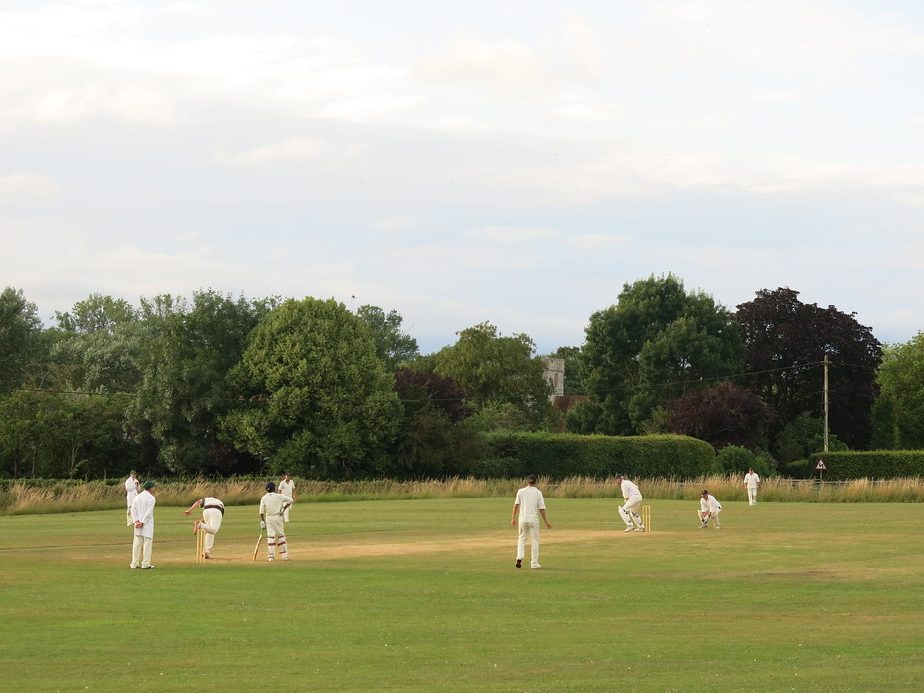
Photo: “Village cricket” by Peter Curbishley is licensed under CC BY 2.0.

Lee Evans, ‘Late in the Evening’

The more she strained her mother wit
To put the jigsaw into place,
The more the pieces wouldn’t fit.
 
Too bad the cat had felt the need
To leap into the midst of things—
The puzzle would have been complete.
 
Somehow she had misplaced the lid,
Which had a picture stamped on it
Of what she searched for in her head.
 
The work lay spread in front of her;
The shapes appeared and disappeared,
Each morphing into metaphor.
 
Sometimes they’d stay where they belonged—
But then, to her weak eyes, it seemed
She’d put them all together wrong.
 
She kept on shuffling scattered bits;
Meanwhile a lifetime passed beneath
Her aged, trembling fingertips.

*****

Lee Evans writes: “This particular poem arose from the year-long habit my wife and I have of doing jigsaw puzzles. (Big surprise!) In such circumstances one gets to thinking a lot about putting the pieces of one’s life together, especially those of us who are in our mid seventies. I may have stolen the title from a Paul Simon song, but that has nothing to do with it. Several people I have known have suffered from dementia late in life, but the poem is more about trying to grasp fluid realities than dementia, and attempting this in the frailty of one’s declining years. But that’s not all there is to the poem…”

‘Late in the Evening’ was first published in Snakeskin.

Lee Evans was born in Annapolis, Maryland and worked for the Maryland State Archives. Having retired to Bath, Maine, he worked for the local YMCA and retired from there. He has self-published 13 books of poetry, which can be found on Amazon and Lulu.com. He occasionally puts poems on a blog, The Road and Where It Goes  (Formal purists should be forewarned that he has written a fair amount of free verse!)

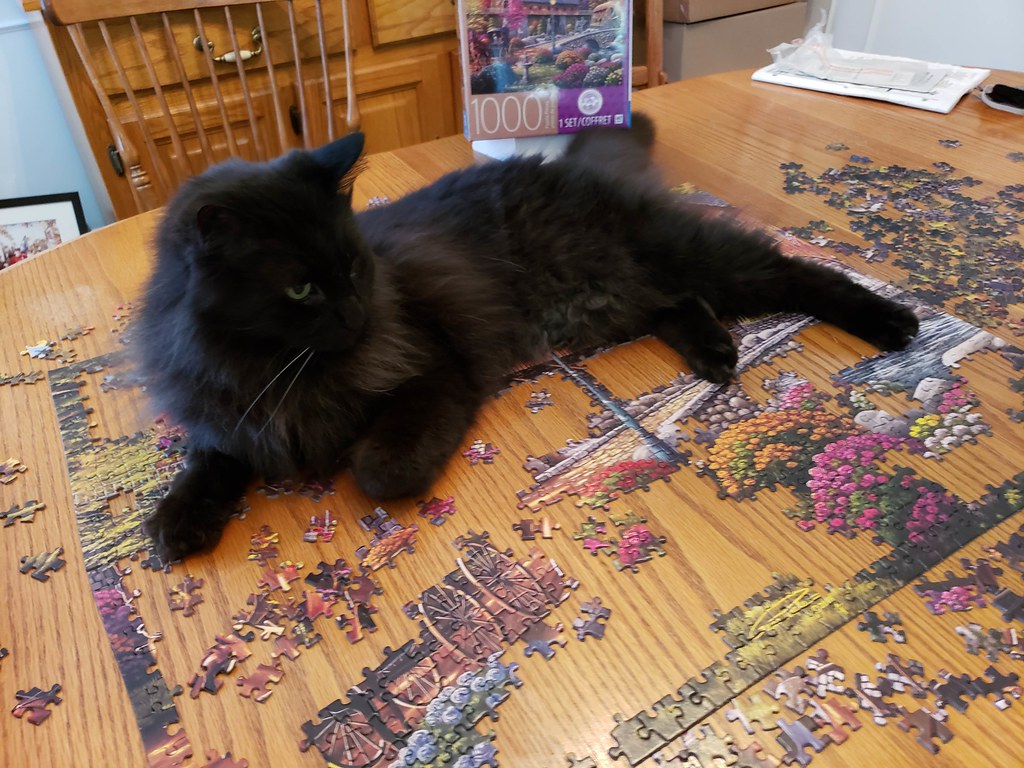
Photo: “Cosmo Helping with Jigsaw Puzzles – 2020” by cseeman is licensed under CC BY-NC-SA 2.0.

RHL, ‘How Sweet It Is’

To be loved by you is like floating on my back,
falling asleep in the sea’s slack.
Sometimes. Sometimes it is more unnerving,
leaping with a wave for bodysurfing,
being swept facedown up the beach,
hair and ears full of sand.
That too is love, and grand.
Sometimes, again, I hope for more that’s out of reach –
(and you do too – don’t glower!)
and sometimes we get gifts hard to believe,
dolphins swimming with us half an hour
till mutually we and they
just turn away,
they to sea and we to shore,
and then they come back suddenly once more
and leap, so close, and leap, and leap again… and leave.

All those are in “loved by” –
the calm; the turbulent rift,
the sparkling fizz,
the sudden unexpected gift.
What can I say? I couldn’t, wouldn’t, choose to deny
how sweet it is.

*****

Thirty-five years with Eliza and still going strong. Who knew.

‘How Sweet It Is’ was published in the current Snakeskin.

Free sea summer scenery background image” by Ajda Gregorčič is licensed under CC BY-SA 2.0.

Martin Parker, ‘Fifty Ways to Leave a Lover. No. 51’

No bitterness and no recriminations,
no flesh hacked off in gladiatorial sport,
no claims for unpaid debts, no scornful laughter
to mock experience so dearly bought.

But differences all gently papered over,
cracks filled and memory’s cobwebbed cupboards cleared.
Receipts for all the good times carbon copied
our life divides more simply than we’d feared,

with dogs and books and vinyl all apportioned,
all ledgers balanced with forgiveness sought
and paid for with a parting smile.
For this had once been love – or so we’d thought.

*****

Martin Parker writes: “Sadly I can offer no significant thoughts about its background.  I simply wrote it then left it in a drawer for about ten years as it did not seem to fit with anything I was writing at the time.  But I do remember hoping that I had written something gentler and more civilised and sympathetic than much of what was appearing on the net at the time. And my ancient hope seems to have been justified in the light of recent reactions to the poem.

“My website at www.martinparker-verse.co.uk gives details and excerpts from my two hopefully humorous and only occasionally wrily depressing books in which parody, pastiche, satire, farce and poetic irreverence should appeal to all but the most po-faced of poetry fans.”

‘Fifty Ways to Leave a Lover. No. 51’ was originally published in Snakeskin.

Martin Parker is a writer of mainly light and humorous verse much of which has appeared in national publications including The Spectator, The Oldie and The Literary Review. In 2008 Martin founded the quarterly light verse webzine, Lighten Up Online at www.lightenup-online.co.uk, now edited by Jerome Betts.

Illustration: “|||||||| DIVIDER |||||||| — *** CAUGHT UP! ***” by Claire CJS is licensed under CC BY-NC-SA 2.0.

Sonnet: Paul Burgess, ‘Reynadine’s Farm’

“The chickens should have been a tighter group,
and Farmer should have purchased stronger locks
instead of whining now about the coop
and getting mad at Reynardine, the fox.

The chickens didn’t mend defensive flaws
or try to get a gun or sharper beak.
Why blame the beast with wits and stronger jaws
for weeding out the losers and the weak?

The victim here, whose name they’ve tried to harm,
has suffered public shame and sad disgrace.
To make it right, he must receive the farm.
I thank Your Honors now and rest my case.”

The judges ruled in Reynardine’s support
because the fox had also bought the court.

*****

Paul Burgess writes: “The Elizabethan sonnet, which I love to adapt to many purposes, is a natural fit for the structure I like best: a setup, a volta, and a jolt at the end.  Many of my best poems succeed, and my worst fail, because of my persistent embrace of tonal ambiguity. This poem is no exception. I like the tension between a seemingly folksy and witty parable and a traditionally serious, elegant form. For me, there’s humor in darkness and darkness in humor. The balance shifts, but I don’t think I could ever completely separate the two and still be myself, as a person or as a writer.”

‘Reynadine’s Farm’ was first published in Snakeskin.

Paul Burgess, an emerging poet, is the sole proprietor of a business in Lexington, Kentucky that offers ESL classes in addition to English, Japanese, and Spanish-language translation and interpretation services. He has recently contributed work to Blue Unicorn, Light, The Orchards, The Ekphrastic Review, Pulsebeat, The New Verse News, Lighten Up On Line, The Asses of Parnassus, and several other publications.

About

Photo: “Ely Cathedral: Stained Glass Museum” by Phil McIver is licensed under CC BY-NC 2.0.

Lindsay McLeod, ‘The Swing’

The black dog comes less to me lately
I fight the bait of the Siren’s barbed songs
I’ve tightened my belt to the hunger I’ve felt
scanned the sky for a place to belong.

But I’ve been to this point of the compass before
since we twitched off our vows and our rings
alone in the dark at one end of the arc
where that half-broken pendulum swings.

Still I’ve nothing left here to hold onto
afraid I’ll fall back to the place that I came
where I’ll take up my axe to the rainbow again
and bite deep into bright shining pain.

*****

Lindsay McLeod writes: “Fear not for my current mental health, as I wrote this 20 years ago.”

‘The Swing’ was originally published in Snakeskin.

Lindsay McLeod is an Australian writer who lives quietly on the coast of the great southern penal colony with (yet another ferocious Aussie animal) his cattle dog,  Mary. Lindsay still drives a forklift to support his poetry habit.

Image: “Feeding The Black Dog” by @mich.robinson is licensed under CC BY-NC-ND 2.0.

David Stephenson, ‘Payday’

My dad’s plant was across the railroad tracks
from half a dozen shot and chaser bars,
and on paydays the bars were visited
and stocked with stacks of bills by armored cars,
 
and women waited at the gates and tracks
at shift changes, to try to intercept
their thirsty husbands in the passing throng
before they cashed and drank up half their check.
 
At the time, I didn’t think about
how desperate those women must have been
to go out on a crowded public street
and chase after their irresponsible men;
 
I guess I found it droll.  But if I’d been
more aware, what could I have done or said?
When people’s lives are going off the rails
strangers only frown and shake their heads.

*****

David Stephenson writes: “When I was in high school, my dad worked at John Deere Plow-Planter—now called Seeding and Cylinder—in Moline, Illinois.   This was before direct deposit, so the workers got paper paychecks.  As with many factories, there were several taverns nearby, any of which would happily cash a paycheck.  If I borrowed Dad’s car, I would have to pick him up and drop him off, so I was sometimes there during shift changes.  On paydays you would see armored cars outside the bars, and at the end of the afternoon shift you would see women waiting on the railroad tracks, as described in the poem.  It didn’t really register with me at the time, but later on I realized it was quite sad.  I wrote the first two stanzas of the poem four or five years ago, but was stuck as to how to proceed, since I didn’t know what to say about the scene.  What can you say?  I finally came up with the current ending, which says there isn’t anything to say, but says it well.”

‘Payday’ was first published in Snakeskin.

David Stephenson is a retired manufacturing engineer from Detroit, and the editor of Pulsebeat Poetry Journal.  His most recent collection is Wall of Sound (Kelsay Books, 2022).

Illustration: RHL and ChatGPT

Sonnet: Felicity Teague, ‘Robot Dawn’

I sensed your rising in the paper years,
when I was sitting on the garden wall
to copy edit, through my teens. My fears
were few, back then, because the threat seemed small
and I still held the tools. My pencil case
contained my biros, red and royal blue,
my trusty ruler. And at quite a pace,
the work to trim and tidy would ensue,
just as required. But slowly, over time,
the paper-scape was lost to you, your screens,
your checks, your macros. Now, you’re in your prime,
you’re winning worlds of words with your machines,
while I am, we are, shrinking, dwindling, done,
deleted. Humans, zero; robots, one.

*****

Felicity Teague writes: “Due to the advance of the robots in my profession, I’m currently exploring other employment options. These are limited as I have severe and worsening autoimmune arthritis, but I really want to keep working for as long as I can.”

‘Robot Dawn’ was first published in Snakeskin.

Felicity Teague (Fliss) has featured in a number of poetry journals and has published two collections, From Pittville to Paradise (2022) and Interruptus: A Poetry Year (2025). Since April, she has put together the monthly metrical poetry showcase Well Met, and the November issue is here.

Photo: “Greenhouses – Castle Bromwich Hall Gardens – Silver robot potted man” by ell brown is licensed under CC BY-NC-SA 2.0.

Tom Vaughan, ‘One of Us’

A starter British passport,
now with a French one too,
I can vote in both and put down roots
in either, and stroll through

eGates and customs checks
head high, as one of us,
legitimately pukkah, blessed
by birth/life/luck, and thus 

with paperwork in order
should copper or gendarme
ask me who on earth I am:
I smile and keep my calm

and my right to an annual break
upon a sunlit beach
where seas digesting some who yearned
my paradise to reach

lap peacefully as though
the summer days could last
as far into the future as
they failed to in the past . . .

*****

Tom Vaughan writes: “The older I get, the more I ask myself the question: ‘Where would we be without our (double) standards?’.”

‘One of Us’ was first published in Snakeskin.

Tom Vaughan is not the real name of a poet whose previous publications include a novel and three poetry pamphlets (A Sampler, 2010, and Envoy, 2013, both published by HappenStance; and Just a Minute, 2024, from Cyberwit). His poems have been published in a range of poetry magazines, including several of the Potcake Chapbooks and frequently in Snakeskin and Lighten Up Online. He currently lives in Brittany.
https://tomvaughan.website

Illustration: RHL and ChatGPT

Using form: Quatern: Susan McLean, ‘Cropped’

He doesn’t care for flowers or for fruit,
so don’t implore him not to clip or prune
the fig trees and camellias. His pursuit
of geometric form makes him immune

to luscious tastes and beauties others crave.
He doesn’t care for flowers or for fruit,
so once the buds appear, don’t try to save
them from his trimmer. All your pleas are moot.

He holds a tidy yard in high repute,
a verdant symbol of his mastery.
He doesn’t care for flowers or for fruit,
but takes some pleasure in your misery

as he destroys what you had hoped to see.
His need to have control is absolute,
and you can’t argue with machinery.
He doesn’t care for flowers or for fruit.

*****

Susan McLean writes: “This poem started with my desire to write a quatern, a form that I had encountered in Chad Abushanab’s workshop on rare poetic forms at the Poetry by the Sea conference in 2024. A quatern is four quatrains long, and the first line of stanza one becomes the second line of stanza two, and so on. As for the poem’s content, it grew out of a dispute about gardening practices with someone I know well. I was unable to convince him to change his ways. I should add that his ascribed motives are all conjectural on my part, not based on anything he said. But poets don’t really lose an argument; they just take the opportunity to restate it as a poem. This poem first appeared in the August 2025 issue of Snakeskin.”

Susan McLean has two books of poetry, The Best Disguise and The Whetstone Misses the Knife, and one book of translations of Martial, Selected Epigrams. Her poems have appeared in Light, Lighten Up Online, Measure, Able Muse, and elsewhere. She lives in Iowa City, Iowa.
https://www.pw.org/content/susan_mclean

Photo: Snakeskin