Tag Archives: Snakeskin

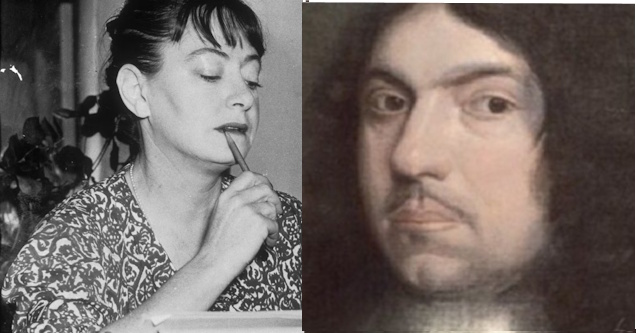
Chris O’Carroll, ‘Dorothy Parker on Andrew Marvell’

He doesn’t have the time, he pleads,
For long and patient wooing.
A mortal man with urgent needs,
He would be up and doing.

He’d worship for two hundred years
Your left breast, then your right,
He swears, but can’t because he fears
Death’s swift-encroaching night.

He notes how brief are human lives.
He says you mustn’t tease,
For once that chariot arrives,
You’ll have no days to seize.

Though you know joining him in bed
Is what you’ll likely do,
You’re certain romance will be dead
Before the two of you.

*****

Chris O’Carroll writes: “Dorothy Parker’s verse paints her enthusiastic about sex but skeptical about romance. I wanted to incorporate both of those outlooks into her imagined response to Marvell’s famous come-hither argument.”

‘Dorothy Parker on Andrew Marvell’ was first published in Snakeskin.

Chris O’Carroll is the author of four books of poems — The Joke’s on MeAbracadabratudeQuantum Creed, and the newly published Ridiculous Positions. He is a Light magazine featured poet and a contributor to Love Affairs at the Villa NelleExtreme SonnetsNew York City Haiku, and The Great American Wise Ass Poetry Anthology, among other collections.

RHL, ‘Fifty Year Argument: Old Fool, Young Twit’

1. To Myself in Fifty Years Time

Old fool!  You really think yourself the same
As I who write to you, aged 22?
Ha!  All we’ve got in common is my name:
I’ll wear it out, throw it away,
You’ll pick it up some other day….
        But who are you?

My life’s before me; can you say the same?
I choose its how and why and when and who.
I’ll choose the rules by which we play the game;
I may choose wrong, it’s not denied,
But by my choice you must abide….
        What choice have you?

If, bored, I think one day to see the world
I pack that day and fly out on the next.
My choice to wander, or to sit home-curled;
Each place has friends, good fun, good food,
But you sit toothless, silent, rude….
        And undersexed!

Cares and regrets of loss can go to hell:
You sort them out with Reason’s time-worn tool.
Today’s superb; tomorrow looks as well:
The word “tomorrow” is a thrill,
I’ll make of mine just what I will….
        What’s yours, old fool?

2. Reply to Myself – Fifty Years Later

Young twit! You really think we’re not the same?
That means you’re too young to extrapolate.
You’re the mere seed of what I since became:
    a husband, father, game creator,
    global skills facilitator…
        well paid; thought great!

You claimed to thrive, renting some garbage heap;
you travelled: hitchhiked, froze, thought life’s a bitch,
and ate whatever you could find that’s cheap;
    I travel too, and I eat well,
    and choose to sleep in a hotel…
        not in a ditch!

Your search for happiness was excellent;
you lived with several countries, faiths and girls,
though little lasted from those years you spent;
    for when you can’t tell love from lust
    and never work out who to trust…
        of course life whirls!

Your limited perspective proved a sham.
Your rude invective, though a load of shit,
helped fertilise my growth to what I am.
        My resumé –kids raised, loves gained,
        a business built –shows much attained…
            what’s yours, young twit?

*****

I was proud of the form I created when I wrote the first bratty poem, with both the rhyme scheme (abaccb) and the lines getting shorter (3 pentameter, 2 tetrameter, and a dimeter) contributing to the effect of each stanza ending with a punchline. But after I wrote that first poem to my future self at age 22, I was nagged by the need to respond as I got older; and I was never able to produce anything I liked. Finally, a full 50 years later, I produced the 72-year-old’s point by point rebuttal in the same form as the original. The original took a couple of hours over two days to write; the response was done in a couple of hours in one day.

The argument was first published in Snakeskin.

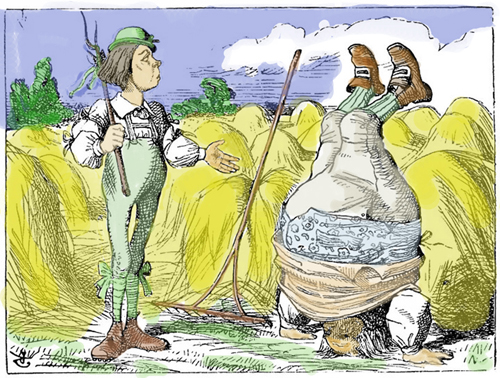
The illustration is one of Tenniel’s for Lewis Carroll’s “You are old, Father William“. And, yes, I still do headstands.

Sonnet: Saad Kayani, ‘Sonnet’

I see no pretty things to write about.
Industrial smoke obscures the summer skies.
No novel image schemas to lay out—
no logical entailments to devise.
I’ll write instead of how efficient, say,
a cluster bomb can be, the skill it takes
to mow the grass on which the children play
and monetize the rubble that it makes.
But better artists beat me to that muse:
the medalists whose medals killers win,
the columnists who weave the daily news,
and spin, and spin, and spin, and spin, and spin!
I’m dizzy now—no pretty things to say.
Poetry is for fascists anyway!

*****

‘Sonnet” was first published in Snakeskin.

Saad Kayani lives in Toronto. Recent poems appear in Shot Glass Journal and Neologism Poetry Journal.

Photo: “GAZA Crisis July 2014” by Syeda Amina Trust® is licensed under CC BY 2.0.

Villanelle: Susan Jarvis Bryant, ‘Gassy Asses – a windy villanelle’

He had a wealth of worthless words to say –
A jawing maw of poppycock to spout.
His bellyful of bluster blew all day.

From dawn till dusk the cosmos heard him bray.
He hee-hawed on until the sun went out.
He had a wealth of witless words to say.

Like rasping bagpipes cranking up to play  
With unremitting eardrum-splitting clout
His bellyful of bluster blew all day.

One Stone-of-Blarney afternoon in May
He heard a louder bloviator shout.
She had a wealth of wicked words to say –  

A brassy blast – a gossipy array
Of noxious guff – the lingo of a lout.  
Her bellyful of bull blew him away.

Their hot air flared. It seared the Milky Way.
It charred a slew of stars and left no doubt   
They had a wealth of wedded words to say –  
A honeymoon of hooey night and day.  

*****

Susan Jarvis Bryant writes: “Through fear of reprisal, I have nothing to say about the bloviating brayers who prompted this windy villanelle. Asses have been known to bite and kick (savagely) when mocked. I know this from personal experience… and livid scars.”

‘Gassy Asses’ was first published in Snakeskin.

Susan Jarvis Bryant is originally from the UK and now lives on the coastal plains of Texas. Susan has poetry published on The Society of Classical Poets, Lighten Up Online, Snakeskin, Light, Sparks of Calliope, and Expansive Poetry Online, The Road Not Taken, and New English Review. She also has poetry published in The Lyric, Trinacria, and Beth Houston’s Extreme Formal Poems and Extreme Sonnets II anthologies. Susan is the winner of the 2020 International SCP Poetry Competition and was nominated for the 2022 and 2024 Pushcart Prize. She has published two books – Elephants Unleashed and Fern Feathered Edges.

Photo: “Braying donkey” by arcticpenguin is licensed under CC BY-NC 2.0.

Elizabeth Hurst, ‘April’

I have to admire their heartless lust
Performing with no emotional fuss,
And when it’s done, no flower cares
That its lover still sprawls bare
To bees and wind, to hummingbirds.
Petals don’t worry if they’re the third
Or fourth—it just doesn’t matter
After they’ve spread pollen’s splatter.
They live to turn their airy tricks.
No rumpled sheets, no mess to fix,
No wet spots stuck to sated thighs
And stamens aren’t concerned with size
Or any of our skillful lies
Or hearts destroyed as sorrows rise.
No flower mourns when another dies.

*****

‘April’ was first published in Snakeskin… in March.

Elizabeth Hurst is originally from Los Angeles and moved up to San Francisco many years ago. She lives out by the beach with her husband, Gerald Stack.

April Flowers” by Jocey K is licensed under CC BY-SA 2.0.

Using form: dactyls: Max Gutmann, ‘Junípero Serra’

Critics of Father Junípero Serra
Maintain that the priest was a murderous churl,
Killing American natives religiously.
(“Serra,” too, sounds like the name of a girl.)

Minor official in Spain’s Inquisition, he
Saw many heretics tortured and burned.
Some people frowned on such zealous conversion modes.
Serra took copious notes. And he learned.

Later, his ministry in the Americas
Opened a chain of magnificent missions.
There, after doing the building, the natives were
Shepherded out of their base superstitions.

Serra’s supporters admit that the shepherding
Sometimes went overboard. “Perfect he ain’t.”
Many who died, though, were first brought to Jesus and
That is enough to make Serra a saint.

*****

Max Gutmann writes: “The poem may be a bit behind the times. In my youth, Serra’s sainthood didn’t seem to me widely controversial, but after writing the poem, I started seeing that that had changed. Shortly before the poem appeared in Snakeskin in November, even the statue of him overlooking a highway I grew up near was removed. Of course, given all the reactionary revision of history going on, this remains a good time for light verse to tell the truth.”

Max Gutmann has contributed to New StatesmanAble MuseCricket, and other publications. His plays have appeared throughout the U.S. (see maxgutmann.com). His latest book, Finish’d!: A Pleasant Trip to Hell with Byron’s Don Juan, is forthcoming from Word Galaxy..

Titelprent voor Nederlantsche Oorloghen van Pieter Bor, 1621, RP-P-OB-79.017” by Rijksmuseum is marked with CC0 1.0.

Valentine’s Week: Lisa Barnett, ‘Evolution: A Love Song’

What’s evolution but a whole lot of sex,
the slippery, mutating mix of Y and X?
Man laddered up out of the ooze and the muck,
ascending rung by rung and fuck by fuck—
DNA colliding and combining;
brains and bodies gladly realigning.

Now let us in our turn embrace the dance
and give our separate genes a moment’s chance
to alter, rearrange, exchange, reshuffle
and triumph in the rude ancestral scuffle.
What’s evolution? Just a whole lot of sex,
the slippery, mutating mix of Y and X.

*****

Lisa Barnett writes: “This poem is a testament to the powers of revision. It had a long gestation (or should I say evolution); it was begun in early 2021 and completed in January 2026. For a long time it was just a two-line fragment…then a failed triolet…and ultimately evolved into pentameter couplets.  At some point I was reading Andrew Marvell’s “To His Coy Mistress,” which partly inspired the 2nd stanza. My husband is always partial to my poems about sex, and this was no exception.”

 Lisa Barnett’s poems have appeared in The Hudson ReviewMeasureNew Verse ReviewSnakeskin (including this poem), and elsewhere. She is the author of two chapbooks: The Peacock Room (Somers Rocks Press) and Love Recidivus (Finishing Line Press). She lives in Haverford, Pennsylvania with her husband.  

Photo: from Snakeskin, February 2026

Valentine’s Week: Elizabeth Hurst, ‘Hearts and Flowers’

Genitals? They look like mouths
Splayed wide open to the south;
The backyard’s cool and scented tongues
Sing the lyrics of mud and dung.
They slobber pollen on the wind,
Obscenely, but without meat’s sin.
No lubricated pump and writhe
But floating leakage to contrive
Survival of their rooted kind,
Just letting loose to maybe find
Receptive innards gaping wide,
Exposing their perfumed insides
To dust from reproduction’s floor.
So why so sexy? Not called for
When all they need is neutral breeze
To engage in flowery sleaze
As one sweet self blows to another.
Most chaste of all the planet’s lovers
And we give them for Valentines
Along with silly little rhymes
To sanitize our sweaty humps,
And thickened fluids in a clump.
But all this grossness turns to joy:
The heart’s true love or blissful toy,
As sticky human lust conspires
To imitate the spring’s desires.

*****

Elizabeth Hurst writes: “This poem was inspired by the short California spring.”

‘Hearts and Flowers’ was originally published in Snakeskin.

Elizabeth Hurst is originally from Los Angeles and moved up to San Francisco many years ago. She lives out by the beach with her husband, Gerald Stack.

Lady Orchid” by anataman is licensed under CC BY-NC-ND 2.0.

Using form: Triolet: Susan McLean, ‘Negative Capability’

Succeeding as a poet means you know
you’re nobody. Writing your name in water,
you dissipate, dissolving in the flow.
Succeeding as a poet means you know
you’re planting rows of seedlings in the snow.
Not truth but mere oblivion is Time’s daughter.
Succeeding as a poet means you know.
You’re nobody, writing your name in water.

*****

Susan McLean writes: “This triolet, originally published in Snakeskin, is a tribute to two poets who died almost completely unknown, but who are now considered to be among the greatest poets of the English language: John Keats and Emily Dickinson. When Keats died at the age of 25, he asked that nothing be written on his gravestone except “Here lies One whose Name was writ in Water.” His friends disobeyed his instructions, adding the information “This Grave / contains all that was Mortal, / of a / YOUNG ENGLISH POET, / Who, / on his Death Bed, / in the Bitterness of his Heart, / at the Malicious Power of his Enemies, / Desired / these Words to be engraven on his Tomb Stone / Here lies One / Whose Name was writ in Water / Feb 24th 1821.” They did not include his name. Keats’s letters later made famous his phrase “negative capability,” which he defined as “capable of being in uncertainties, Mysteries, doubts without any irritable reaching after fact & reason.”

Emily Dickinson wrote at least 1775 poems, though only ten were published in her lifetime. Her poem now known as 288 (because she did not title her poems) reads:

I’m Nobody! Who are you?
Are you – Nobody – too?
Then there’s a pair of us!
Don’t tell! they’d advertise – you know!

How dreary – to be – Somebody!
How public – like a Frog –
To tell one’s name – the livelong June –
To an admiring Bog!

Both Dickinson and Keats are now very famous. But it could easily have been otherwise. Sir Francis Bacon once wrote “Truth is the daughter of time, not of authority.” I wish I could believe that a poet’s true value will always be revealed in time. What I know instead is that all poets’ works will be forgotten in time. Succeeding as a poet means that you go on writing anyway, whether or not your writing will ever be appreciated, even if you feel quite certain that it won’t. To lose yourself in the moment of creation is reward enough.

Susan McLean has two books of poetry, The Best Disguise and The Whetstone Misses the Knife, and one book of translations of Martial, Selected Epigrams. Her poems have appeared in Light, Lighten Up Online, Measure, Able Muse, and elsewhere. She lives in Iowa City, Iowa.
https://www.pw.org/content/susan_mclean

Photo: “Seven bathtubs and a man who writes on water.” by jpmm is licensed under CC BY-NC-ND 2.0.

Sonnet: Jerome Betts, ‘Fly-By’

(For S. H. W.)

Bench slats, warm-sleeved in lichen’s rough grey-green,
Sandwiches, ivy’s shade, the garden scene,
Dozens of white-tailed bumblebees, a hum
Among the clustered heads of marjoram.

Background to thoughts that intertwine and drift . . .
sudden sombre sickle shape – a swift
So low, so near, not distant in the sky,
Skims past, a flash of wings and beak and eye.

Why come that strangely close? Drawn down in chase
Of food, despite the human form and face?
Why did it circle once, then speed away
Towards the woods and cliffs that fringe Lyme Bay?

Soon, news – an old friend gone whose joy was birds.
It almost seemed a farewell without words.

*****

Jerome Betts writes: “The passage of the swift so close I could glimpse its shining eye was a memorable moment in these times when I see only a very occasional two or three usually high in the sky. It resulted in a sunny and summery ten lines concluding, A brief encounter, but it made the day. Some hours later the news came of an old school friend’s death in France. This completely altered any feeling about the event. I suppose the subtext of the aftermath was something like Hardy’s Hoping it might be so, which nearly became the title.”  

‘Fly-By’ was first published in Snakeskin.

Jerome Betts edits Lighten Up Online in Devon, England. His verse appears in Amsterdam Quarterly, Light, The Asses of Parnassus, The New Verse News, The Hypertexts, Snakeskin, and various anthologies.

Photo: “Swift (Apus apus)” by Billy Lindblom is licensed under CC BY 2.0.