Tag Archives: Snakeskin

Formless poem: RHL, ‘Marty Ravellette’

The man with no arms sat on the stool in the diner;
he was shoeless: How else could he drink his coffee,
eat his scrambled eggs?

The man with no arms parked his truck and got out barefoot.
He fired up his chainsaw; he had a landscaping business.
With the log out of the way, he could cut the grass,
push the lawnmower around with his chest.

The man with no arms saw the woman in the burning van,
barefoot, he kicked in the window, so his wife
could reach in and unlock the door, help the woman escape.

Somewhere Kipling’s Creator of All Things must have told him “Play –
play at being who you are,” and he played.

Somewhere Lear’s Aunt Jobiska must have told him “This is the best.”
And he lived, happy with who he was, glad for no arms
because no arms made him who he was, and he liked who he was.

Nor was the man with no arms alone.
The boy with no hands sat in the laundromat, knitting.
He had metal pincers. His mother was washing the clothes.
The girl with two heads, or rather the twins with only one body,
they live, argue, love, share.
And the men with no legs have a chance to run faster than all,
will require a new type of Olympics.
And the child born to die – does that disturb you, “the child born to die”?
The child born to die is me and is you, is all humans, all life,
all planets, stars, galaxies, all.
Listen to Lear’s Aunt Jobiska: This is the best.
Listen to Kipling’s Creator of All Things, and play.

*****

Marty Ravellette was a highly respected inhabitant of Chapel Hill, North Carolina, where he lived the last 16 years of his life – running his landscaping business, taking a break in a local diner, frequently a guest lecturer in journalism at UNC. He was a Baha’i convert, and a hero.

Occasionally I break my own rules about poetry, and write a poem in a style which I consider to be really flash fiction (or flash non-fiction in this case). The things I had to say didn’t present themselves in anything hinting at traditional verse, and therefore I just said them as best I could. But both Snakeskin and The HyperTexts consider it poetry, so I won’t argue. I’m not sure it should be in the formalverse.com blog, however…

Photo: Figure 8 Films

Joe Crocker, ‘What Sunflowers See’

They lift and fix their heavy insect eyes
upon the East, from where the sun will send
the bees to stroke and lick and fertilize.
 
They wait, where once they craned their necks to see
his passing arc. They wait, amazed. Surprise
has painted yellow lashes, perfectly
 
coronal round a crowded, dark eclipse.
Its buzzing beauty pixelates and stares.
An alien array of cells unzips.
 
A thousand thousand sisters nurse the same
regret. His warmth is gone. And left behind
to hang their heads, disconsolate, they blame
themselves. Their tears drop hard and black and blind

*****

Joe Crocker writes: “The French call them Tournesols because, when they are growing, the follow the sun. But when the flowerhead is fully formed, they all face East so they warm up quickly and are more attractive to the bees. The poem came about because I’ve been seeing them more frequently in our local supermarkets and my wife grew some this year. Seeing them close up, I was reminded of the reaction a friend from many years ago used to have. She liked them but kept her distance because she was spooked by their dense busy centres. So the insect eye was the starting metaphor and then the poem led me on. Big, beautiful, disturbing, and in the end, sad.”

Joe Crocker is no relation of the Sheffield-born rock singer. But he does live in Yorkshire and gets by (with a little help from his friends). He is a bit old now to be starting out in poetry but was infected by the muse during Covid lockdown a couple of years ago and has had a few things published, mainly in Snakeskin magazine (where this poem first appeared) and other online venues. He doesn’t have a website but if you Google him, you’ll learn a lot more about a certain Sheffield-born rock singer.

Photo: accompanied the poem in Snakeskin.

Using form: biform poem: Daniel Galef, ‘A Poke of Gold to the Lady That’s Known as Lou’

I saw the sigh in your pretty eye
    When you dreamed that I’d be yours,
But those who steal me fast reveal
    My shine is the start of wars.

First I passed through the purse of a miner who nursed
    A chill. He seemed to be
Just a helping of hurt in a flannelette shirt
    From Plumtree, Tennessee.

It’s the goal of gold to be bought and sold
    And melted and poured in a mould.
From the day they scratched me out of that patch
    Of dirt, I’ve been near as cold.

Now again I change hands, and again the sands
    Run out, and men lie dead.
Good chances, I’d rate, that the heftier weight
    Is a couple of rounds of lead.

I’ve been sought by those men—half a dozen or ten—
    Who flash gold in pokes and pounds,
Who begged you for dances and killed for your glances—
    It’s not as nice as it sounds.


I saw the sigh in your pretty eye when you dreamed
That I’d be yours, but those who steal me fast
Reveal in my shine is the start of wars. First I passed
Through the purse of a miner who nursed a chill. He seemed
To be just a helping of hurt in a flannelette shirt
From Plumtree, Tennessee. It’s the goal of gold
To be bought and sold and melted and poured in a mould.
From the day they scratched me out of that patch of dirt,
I’ve been near as cold. Now again I change hands, and again
The sands run out, and men lie dead. Good chances,
I’d rate, that the heftier weight is a couple of rounds
Of lead. I’ve been sought by those men—half a dozen or ten—
Who flash gold in pokes and pounds, who begged you for dances
And killed for your glances—It’s not as nice as it sounds.

*****

Daniel Galef writes: “Last month Robin posted ‘Casey to His Bat,’ a poem which scans as both a sonnet and as fourteeners in ballad meter. The intro mentioned that I’d written a few more of this type of poem after ‘Casey,’ one of which was titled ‘A Poke of Gold to the Lady That’s Known as Lou.’
As much as I loved the challenge of writing the Casey sonnet, I felt the form had to be justified somehow by the subject, and so, just as ‘Casey’ followed Ernest Thayer* in its alternate scheme of iambic heptameter couplets, each of the subsequent convertible sonnets, part of my Imaginary Sonnets series of persona poems, is also a response to or parody of a specific existing poem in a different meter which the sonnet doubles.
The second convertible sonnet, ‘A Poke of Gold to the Lady That’s Known as Lou’, is a riff on the famous narrative poems of Robert Service ‘The Shooting of Dan McGrew’ and ‘The Cremation of Sam McGee’ in his 1907 collection Songs of a Sourdough. (Like Thayer, Service is sometimes scorned as a jingle-writer partly because of his popularity and his populism, writing in the vernacular voice of Yukon prospectors.) Both of these narrative poems are written in a much looser anapestic ballad meter with more inversions and extra syllables than sonnets normally allow. While ‘McGrew’ has the basic ballad rhyme scheme, scanning as heptameter couplets like ‘Casey,’ ‘McGee’ has a much denser scheme, adding on top of these end-rhymes a pattern of dimeter internal rhyme. I loved the much greater challenge of compounding this rhyme scheme with that of a Petrarchan sonnet, but, due to the anapests, the finished product feels less like a sonnet than ‘Casey ‘did.
This poem appeared in Snakeskin Poetry in 2017, and, although it is not included in my book Imaginary Sonnets published this year, you will find, in the poems there, these same immortal threads: gold (p. 41), murder (p. 71), poetic parody (p. 72), and Canada (p. 19). danielgalef.com/book/
*Thayer’s poem, possibly the last American poem to have massive popular appeal to the extent that it was commonly memorized for fun and performed on the vaudeville stage, was published in 1888, the same year as the florid Victorian sonneteer Eugene Lee-Hamilton published Imaginary Sonnets, which inspired my book.”

*****

Daniel Galef’s first book, Imaginary Sonnets, is a collection of persona poems all from the point of view of different historical figures and objects, including Nossis the Epizephyrian, Christopher Smart’s cat, and a breakfast taco. Besides poetry, he has written plays that won the McGill University Drama Festival, flash fiction selected for the Best Small Fictions anthology, and last year he placed second in the New Yorker cartoon caption contest, which doesn’t really mean anything but he’s been telling everyone anyway.

Tom Vaughan, ‘Swot’

It’s time to hunker down and swot
with coffee as my only friend

and each dawn closer to the end
which in the distance I can spot:

the happiness which lies ahead
when I’ll have passed with flying colours

and on a day unlike all others
will saunter through the streets instead.

I won’t be bored, I tell myself:
the world will sparkle, and the hours

will sprinkle down in golden showers.
I won’t need anything – my wealth

will be the knowledge I’ll forget
and which I haven’t learnt as yet.

*****

Tom Vaughan writes: “Swot was inspired by coming across this sonnet form in a collection of poems – This Afterlife – by AE Stallings. It was – at first – simple imitation of her layout. But then I came to like – and to feel – the tension between the couplet form and the cross-couplet rhyming, as if the poem wasn’t sure it was a sonnet. I like things which pull against one another, and most of all I like doubt.
It was subsequently heartening to learn, in June, that she had been elected as the new Oxford Professor of Poetry, given her combination of massive formal skills and deep classical culture, plus her sharp contemporary voice and relevance. So there’s still hope . . . “

Editor’s note: Some non-Brits may only connect the word “swot” with SWOT Analysis (Strengths, Weaknesses, Opportunities, Threats), but Vaughan is using it as the perjorative verb to study hard for an exam or, disapprovingly as a noun, a person who studies hard and avoids other activities. Swot was published in this month’s Snakeskin.

Tom Vaughan is not the real name of a poet whose previous publications include a novel and two poetry pamphlets (A Sampler, 2010, and Envoy, 2013, both published by HappenStance). His poems have been published in a range of poetry magazines, including several of the Potcake Chapbooks:
Careers and Other Catastrophes
Familes and Other Fiascoes
Strip Down
Houses and Homes Forever
Travels and Travails.
He currently lives in Brittany.
https://tomvaughan.website

Photo: “The Studious One” by Szoki Adams is licensed under CC BY-NC-ND 2.0.

George Simmers, ‘Earth’

Old Becky’s in her garden, delving among roots,
Cutting away dead wood, caressing shoots.
All this June morning, she has given her garden love
Tough as the fabric of her gardening glove.
She’s a no-nonsense woman; her words are earthy words.
She calls a spade a spade; she calls turds turds.

How old is she? As well ask how old’s that
Ridiculous and ragged old sun hat.
As well ask why the sun is blazing gold;
As well ask why she loves the limping old
Fat spaniel whose idea of summer fun
Is stretching indolent in the summer sun
And watching as she plods around the plot.

Dogs, children, husbands: these are what
Her life has been. Husbands both buried now.
Children all visit when their lives allow,
And relish her gruff love and plenteous food.
The dog’s grown old with her, and now his mood
Is slow contentment. She was at his birth
And soon she’ll bury him beneath this earth.

For in this garden it is understood
That death is natural, and the earth is good.

*****

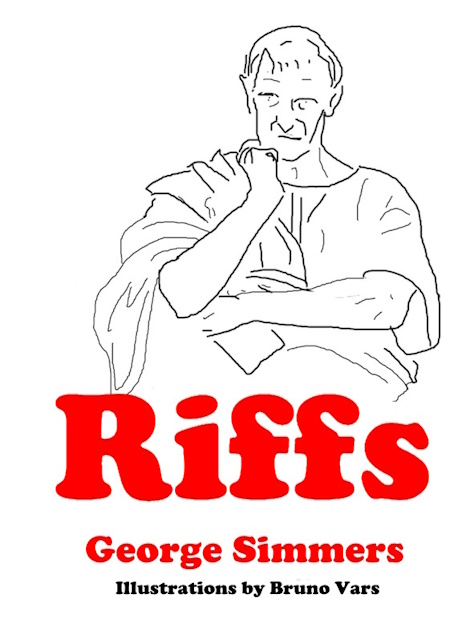
George Simmers writes: “This is the first of four character sketches, each based on one of the ancient elements – Earth, Air, Fire and Water. The complete sequence can be found in Snakeskin 309 (August 2023).”

George Simmers used to be a teacher; now he spends much of his time researching literature written during and after the First World War. He has edited Snakeskin since 1995. It is probably the oldest-established poetry zine on the Internet. His work appears in several Potcake Chapbooks, and his recent diverse collection is ‘Old and Bookish’.

Dog moving as the shade goes” by Ed.ward is licensed under CC BY-SA 2.0.

Michael Tyldesley, ‘Ballad of the Siren Song’

“Come closer and I will tell you a secret
To you, to you, only to you.
Come Closer.”

You’re perched sultry on a craggy cliff,
curvy on a windswept rock
with red dress clinging to your breasts:
you play that tune, that tune you play
it’s calling out to me.

And I’m sailing, roving, lost at sea,
bedraggled by the ocean spray
and changing course for you.

Because, that tune, that tune you play
it jolts me, hooks me, reels its prey:
from silent waves to violin,
from moonless numb to sun-kissed-skin
from topsail calm to snatching whip,
from steady course to daring trip.

I hear that tune, that tune you play
it takes me further, far away:
your spiral smile, your whirlpool lips,
they whisper songs to rolling ships.

That tune you play, with gravity
hypnotic moonstruck melody,
there’s no escape, the heavens swarm
electrostatic pulses form –

I’d love to be your thunderstorm,
whipping up the specks of you,
teasing you; perplexing you
not pleasing you; just vexing you
yet needing the effects of you,
a feeling that projects on you,
it’s squeezing me and sexing you.

And yet, that tune, that tune you play
it leads me on in some strange way –
I see beached skulls and broken hulls
shadows changing, screeching gulls,
till I’m marooned, a castaway,
a shipwreck in your taloned splay.

*****

Michael Tyldesley writes: “The poem was inspired by the trap of damaging relationships earlier in my life and the metaphor that sits behind the poem and continues to burn in me is the irresistible lure of hypomania. The poem structure was inspired by the freeform rhyming style of Jenni Doherty and the language of Dylan Thomas’s Under Milk Wood. It’s been gathering dust in my drawer over the years and it’s quite an old poem. I wrote most of it at 26 and I’m now 42. It’s slightly raunchy and I suppose I didn’t want to be judged negatively due to that but it’s always been a very popular poem when I shared it.”

Michael Tyldesley works in British submarine design. At the time of writing this post he is in Australia, doing performance poetry at Melbourne’s Vibe Union. ‘Ballad of the Siren Song’ was published in this month’s Snakeskin.

Photo: Image Creator powered by DALL·E

Poem, ‘Honesty’

Honesty’s doing nothing you’re ashamed
to talk of; otherwise you’re being gamed
by a smooth angel with a cloven shoe.
Man, know thyself; to thine own self be true;
accept you’re not some other one’s ideal
from their religion or philosophy;
accept your thoughts are yours, impure and real
with lust, greed, envy, anger, vanity–
normal in that we’re powered by an ape’s drive
that needed those traits to survive and thrive.
Whether you act on them’s different again.
Do nothing that, if done, would make you lie–
but don’t be shamed you’ve had the thoughts within.
Don’t stifle, don’t suppress, and don’t deny.
Acknowledge, but don’t act. In that’s no sin.

*****

Published in Snakeskin, January 2018

Photo: “Here is contained ‘Self-Liberation through Seeing with Naked Awareness,’ this being a Direct Introduction to the State of Intrinsic Awareness, From ‘The Profound Teaching of Self-Liberation in the Primordial State of the Peaceful and Wrathful Deities.’” by Wonderlane is marked with CC0 1.0.

The Kipling Boom, 1890

“Rudyard Kipling, gifted stripling”… a lot of his work is superb: the voices caught in his poems and short stories, the endlessly rereadable Just So Stories with his own lush illustrations and catchy peripheral poems, his novels. It’s more than just the verse that has lasting strength.

George Simmers's avatarGreat War Fiction

Researching (i.e. idly Googling) Kipling, I came across this rather good bit of verse printed in the San Francisco Examiner of 1890. It’s a reaction to the sudden and seemingly unstoppable vogue for the works of Kipling. The Examiner credits it to the Saturday Review, but since the references are mostly American, I don’t think this would be the London Saturday.

View original post 90 more words

Poem: ‘Milking the Stars’

My Milky Way muse
Is spread through the skies.
I’ll tickle and tweak
Those nipples the stars,
Till, teased and engorged,
They fill out and stretch;
I milk them to books
To leather-bound books,
To leather-bound buckets of books.
A two-handed milking,
Steady and rhythmic,
As generations
Before me have milked them.
Then when the pail’s full,
Star needs being met,
Stars twinkle and glow.
The Milky Way muse
Thrives on such use.
I drink and give thanks,
Bound to give thanks,
Leather-bound star-shining thanks.

*****

Published in this month’s Snakeskin (No. 307, June 2023). Thanks, George Simmers!

Photo: “Milky Way” by be creator is licensed under CC BY 2.0.

Poem: ‘True Believers’

A visionary dies an ignoble death;
prophets arise
who transmute his tale to a fairytale,
uplifting, wise,
and establish themselves to receive as
on his behalf, cash from pilgrims, believers–
all of it lies.

One of the new believers rashly tries
to challenge the powers the fairytale calls Evil,
strikes at the Powers That Be, is caught and dies,
dies an ignoble death… Prophets arise
and transmute the events into a new fable,
glory surpassing the skies.
At a cost, of course, they spread out a table
for all to gather and feast. They, the deceivers,
live yet again from the wealth of the true believers;
one of whom…

*****

I love seekers after Truth, Knowledge, the Meaning of Life, no matter where they are led in belief or unbelief. I loathe those who come after them to distort the message and extort innocent followers. But it’s all an old, old story.

This semi-formal poem was first published in Snakeskin – thanks, George Simmers!

Photo: “Megachurch” by Silly Deity is marked with Public Domain Mark 1.0.