Tag Archives: sonnet

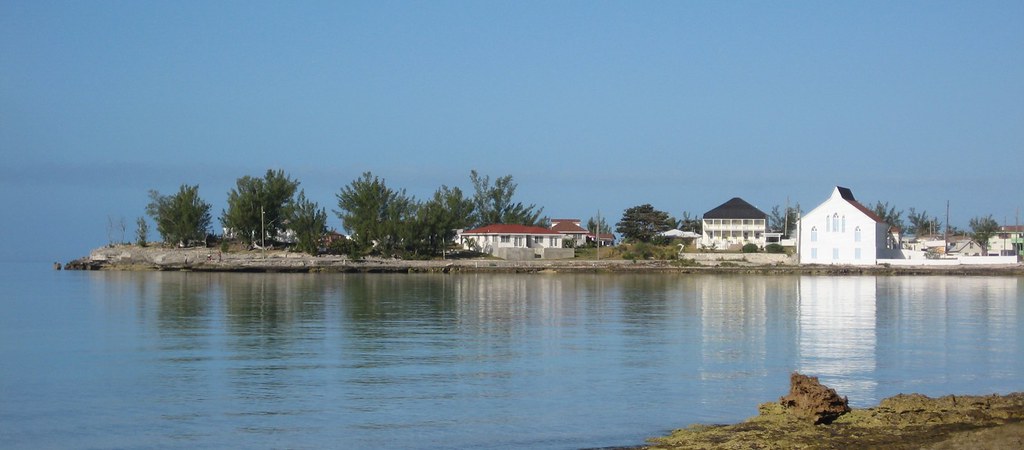
Sonnet: RHL, ‘Your Lot’

From prairie city to an island town;
from city festivals to empty sea;
from continental seasons, white, green, brown
to changeless warmth and high humidity.
No one could hope for love more fierce, more loyal,
more honest, constant through good times, harsh tests,
raising our varied children as they boil
off along individual paths and quests
with a fierce love for them in their success
and even more, their fulfilled happiness.
You miss the north’s reliable forethought,
but not your parents, siblings and cold strife.
There’s always trade-offs, getting where you’ve got.
Just don’t look back. You chose your lot in life.

*****

Two questions: Is it a “sonnet” if the rhyme scheme is non-standard and there’s no real volta? And is it better to accept the unconventional form that the poem was comfortable in, or to try to beat it into more standard shape?

Obviously, I chose to leave it with its imperfections as I wrote it; but that might be from laziness more than anything else. Yes, I *do* work on poems after the first draft… usually… but once I’ve got something halfway acceptable I tend to stop. If I’ve got it to the point where I could easily learn to recite it, then it’s good enough.

But non-traditional sonnets are simply not as engaging, as well-balanced, as rhetorically forceful, as either the Petrarchan or the Shakespearean can be. Those forms have an elegance, a beauty, a structure that leads to a sudden insight or a punchline in a way that at its best (partly due to the rhyme scheme and partly due to the unbalanced “halves” separated by the volta) feels not just well-phrased but unquestionably true.

So this sonnet, if it is a sonnet, is second best. Still good enough to have been published recently in Pulsebeat – thanks, David Stephenson!

Photo: “Part of Governor’s Harbour, Across the Bay” by tylerkaraszewski is licensed under CC BY 2.0.

Susan McLean, ‘High School Pride’

Sleek in their strength and beauty, haughty, lithe,
prowling alone or stalking in a pack,
they cut down herds of victims like a scythe,
then search for fresh meat, never looking back.
The world is theirs, and all the grazers in it.
They cull the weak, the callow, the unwary.
The pack itself can change at any minute,
for all alliances are temporary.

How fine to be the hunters, not the prey,
to ambush, wound, or take down all they see!
While we, their hapless quarry, would contrive
to be as cruel and merciless as they
if we could share in their ascendancy—
not noticing how few of them survive.

*****

Susan McLean writes: “High school can be as harsh as any nature documentary in demonstrating Darwinian survival of the fittest. It is a time when popularity and fitting in can seem all-important, and when those at the top of the social hierarchy often take pleasure in harassing or snubbing those below. Two scientific studies gave the impetus for this poem. One was a study of apex predators such as lions, which showed that despite their power and ferocity, they had a surprisingly high mortality rate. The other was a study of people who were unpopular in high school, which found that later in life they tended to be happier and better adjusted than those who had been popular in high school. The whole concept of “high school pride,” which stoked artificial rivalries between schools that were then played out on the battlefield of sports and other competitions, was part of a mentality that endorsed winning and belittled losers.

“This sonnet first appeared in the online journal 14 by 14, and later was published in my second poetry book, The Whetstone Misses the Knife. The octave follows the pattern of an English sonnet, with quatrains rhymed in alternating lines: ABABCDCD. But the sestet switches to the less predictable rhyme scheme of the Italian sonnet: in this case, EFGEFG. The surprises of the rhyme scheme are meant to mirror the surprises in the twists of the conclusion.”

Susan McLean has two books of poetry, The Best Disguise and The Whetstone Misses the Knife, and one book of translations of Martial, Selected Epigrams. Her poems have appeared in Light, Lighten Up Online, Measure, Able Muse, and elsewhere. She lives in Iowa City, Iowa.
https://www.pw.org/content/susan_mclean

Photo: “Clique” by San Diego Shooter is licensed under CC BY-NC-ND 2.0.

Non-traditional sonnet: Marcus Bales, ‘The Durable Rain’

The durable rain was conducting its drumming descent
Without any decent regard for the dawning of day
As if a dim evening was all of the morning it meant
To allow from a sun that was doing a landscape in grey.
Never begin with the weather the boffins have said.
If nature’s as stormy and dark as a novelist’s mind
The reader will sneer at the metaphor. Offer instead
A prose that’s so difficult readers are left far behind.
But back to my tale. Is it cozy inside, or does rain
Express what discursive description would talk past in vain?
Does a cry break a heart when the kettle releases its steam
Or, piping, awaken a lover up out of their dream?
What it will mean will depend on your context and age.
A poem exists in the reader and not on the page.

*****

Marcus Bales writes: “The first four lines rolled out without much trouble. I had let the dogs out after they’d woken me at what they thought was the right time but which to me was five in the a.m. It was cold and grey but not rainy at all. Who can figure how the brain works. I did worry briefly about the alliteration but finally put it off, hoping it would sound like rain on the roof. Sort of. And it seemed portentous and poetry-like, but where to go from that?

“I don’t know where I first heard that you’re not supposed to open with the weather. It sounds like one of those pieces of advice the internet kicks up from time to time purportedly by Elmore Leonard, along the lines of “You know those parts that readers skip over? Don’t write those.” Or “You got to know when to hold ‘em and know when to fold ‘em.” Advice that is absolutely both spot-on and worthless at one and the same time. If you know you don’t need any advice; if you need advice, it’s because you don’t know. It makes sense in that maddening way of all advice, but it is untakeable. However much you may agree that the reader doesn’t care what the weather is, they care what happens and who it happens to, there I still was without anyone there to have something happen to, except the damn rain.

“Sitting at breakfast reading my usual dollop of Wodehouse, I noticed that when things are going well for his characters the weather gets some generous play, and when not, not. Then I reflected that really I don’t have a large supply of written descriptions of the weather from anywhere. There’s ‘Neutral Tones’, of course, where the weather is a metaphor for the breaking relationship, and “Nothing that is not there and the nothing that is.” And ‘Stopping By Woods’ where the weather is the reason for the stopping, or the first lines of ‘Journey of the Magi’. There’s Auden’s ‘In Memory of Yeats’, Housman’s cherries hung like snow, if that even works, though who Snow was and how Housman knew is a mystery. And after that it’s vague references to this or that month or season generally in Keats, Poe, Byron, or Shelley, and the inference that all of Yeats happens in the summer what with swans and people fighting the horses of the sea, and all. And finally, again, all those descriptions of the morning in the Blandings and the golf stories. After that my memory starts to flail about. This isn’t the sort of thing where research is indicated at five in the ack emma. Perhaps you remember more examples of how the weather is used in prose and poetry, but it’s too late now, isn’t it.

“I wasn’t sure how to go on. It seemed as if nearly the whole practice of poetry in English was against me, aside from the sub-genre of song with all those deep and crisp and evens, and sleigh rides that began to echo in the back of my head, along with all those singers who seem to be perpetually crying or dancing or walking in the rain. Then I thought well, why not use that? I might get three or four lines out of it, and then maybe something else would occur to me. Well, I got my four lines and arrived at the volta of the sonnet, if sonnet it turned out to be. What now?

“Turning at the question that had stopped me I trod upon that patch for a few lines, and then I had got to the couplet. Well, I really had nothing, did I, among all this meta- bit, and what I had seemed to call for some digging into the whats and whys of how literature worked. Well, of course no one knows. I worried some about having failed to provide any context for the reader to see me through, and put it aside to eat breakfast.

“After that, and a shower, and a bit of humor watching the dogs return to the scene of the five o’clock crime outside to chase a squirrel in the yard, somehow the notion of context reasserted itself, and I remembered a sort of juicy quote from a professor 50 years ago who was gassing on about how a poem isn’t the sounds or the words or the meanings as the poet meant them, but rather the unpredicatable ways that the people misread poems. I recall he had half a dozen examples right to hand, as scholars so annoyingly seem to do, but I couldn’t bring a single one to mind. Fortunately, I’m a poet, not a scholar, so I don’t have to be able to give good – or any – examples, so I decided to steal his assertion and let it go at that.

“And there it is. A complete mishmash of false starts, interrupted middles, and squishy endings. Enjoy!”

Not much is known about Marcus Bales except that he lives and works in Cleveland, Ohio, and that his work has not been published in Poetry or The New Yorker. However his ‘51 Poems‘ is available from Amazon. He has been published in several of the Potcake Chapbooks (‘Form in Formless Times’).

Photo: “Rainy Day” by SammCox is licensed under CC BY-NC-ND 2.0.
Gail White, ‘In Answer to Your Questions’

Your Uncle Harry doesn’t know himself
where he left his will. You’ve tried his desk? The dresser?
the farthest reaches of the kitchen shelf?
The dead are under a great deal of stress,

and they forget. As for your other question–
whether you’ll find true love–Venus and Mars
are conjoined over Pisces, which suggests an
absolute negative on singles bars.

It’s a good year for travel, cooking classes,
learning the waltz and the electric slide.
Go where the people are. Going to Mass is
recommended if you’ve never tried.

In late July, beware of traffic fines.
That’s it. You’ve only paid for fourteen lines.

*****

Gail White writes: “This is a favorite of mine. I was trying to think like a medium. (I don’t believe in fortune-telling really, but I was once told to beware of traffic fines, and I got one.) Also, I think I really stuck the landing on this one.”

Gail White is the resident poet and cat lady of Breaux Bridge, Louisiana. Her books ASPERITY STREET and CATECHISM are available on Amazon. She is a contributing editor to Light Poetry Magazine. “Tourist in India” won the Howard Nemerov Sonnet Award for 2013. Her poems have appeared in the Potcake Chapbooks ‘Tourists and Cannibals’, ‘Rogues and Roses’, ‘Families and Other Fiascoes’, ‘Strip Down’ and ‘Lost Love’. ‘In Answer to Your Questions’ is collected in ‘Asperity Street‘. Her new light verse chapbook, ‘Paper Cuts‘, is now available on Amazon.

Photo: “Fortuneteller” by eric.minbiole is licensed under CC BY-NC 2.0.

Using form: biform poem: Daniel Galef, ‘A Poke of Gold to the Lady That’s Known as Lou’

I saw the sigh in your pretty eye
    When you dreamed that I’d be yours,
But those who steal me fast reveal
    My shine is the start of wars.

First I passed through the purse of a miner who nursed
    A chill. He seemed to be
Just a helping of hurt in a flannelette shirt
    From Plumtree, Tennessee.

It’s the goal of gold to be bought and sold
    And melted and poured in a mould.
From the day they scratched me out of that patch
    Of dirt, I’ve been near as cold.

Now again I change hands, and again the sands
    Run out, and men lie dead.
Good chances, I’d rate, that the heftier weight
    Is a couple of rounds of lead.

I’ve been sought by those men—half a dozen or ten—
    Who flash gold in pokes and pounds,
Who begged you for dances and killed for your glances—
    It’s not as nice as it sounds.


I saw the sigh in your pretty eye when you dreamed
That I’d be yours, but those who steal me fast
Reveal in my shine is the start of wars. First I passed
Through the purse of a miner who nursed a chill. He seemed
To be just a helping of hurt in a flannelette shirt
From Plumtree, Tennessee. It’s the goal of gold
To be bought and sold and melted and poured in a mould.
From the day they scratched me out of that patch of dirt,
I’ve been near as cold. Now again I change hands, and again
The sands run out, and men lie dead. Good chances,
I’d rate, that the heftier weight is a couple of rounds
Of lead. I’ve been sought by those men—half a dozen or ten—
Who flash gold in pokes and pounds, who begged you for dances
And killed for your glances—It’s not as nice as it sounds.

*****

Daniel Galef writes: “Last month Robin posted ‘Casey to His Bat,’ a poem which scans as both a sonnet and as fourteeners in ballad meter. The intro mentioned that I’d written a few more of this type of poem after ‘Casey,’ one of which was titled ‘A Poke of Gold to the Lady That’s Known as Lou.’
As much as I loved the challenge of writing the Casey sonnet, I felt the form had to be justified somehow by the subject, and so, just as ‘Casey’ followed Ernest Thayer* in its alternate scheme of iambic heptameter couplets, each of the subsequent convertible sonnets, part of my Imaginary Sonnets series of persona poems, is also a response to or parody of a specific existing poem in a different meter which the sonnet doubles.
The second convertible sonnet, ‘A Poke of Gold to the Lady That’s Known as Lou’, is a riff on the famous narrative poems of Robert Service ‘The Shooting of Dan McGrew’ and ‘The Cremation of Sam McGee’ in his 1907 collection Songs of a Sourdough. (Like Thayer, Service is sometimes scorned as a jingle-writer partly because of his popularity and his populism, writing in the vernacular voice of Yukon prospectors.) Both of these narrative poems are written in a much looser anapestic ballad meter with more inversions and extra syllables than sonnets normally allow. While ‘McGrew’ has the basic ballad rhyme scheme, scanning as heptameter couplets like ‘Casey,’ ‘McGee’ has a much denser scheme, adding on top of these end-rhymes a pattern of dimeter internal rhyme. I loved the much greater challenge of compounding this rhyme scheme with that of a Petrarchan sonnet, but, due to the anapests, the finished product feels less like a sonnet than ‘Casey ‘did.
This poem appeared in Snakeskin Poetry in 2017, and, although it is not included in my book Imaginary Sonnets published this year, you will find, in the poems there, these same immortal threads: gold (p. 41), murder (p. 71), poetic parody (p. 72), and Canada (p. 19). danielgalef.com/book/
*Thayer’s poem, possibly the last American poem to have massive popular appeal to the extent that it was commonly memorized for fun and performed on the vaudeville stage, was published in 1888, the same year as the florid Victorian sonneteer Eugene Lee-Hamilton published Imaginary Sonnets, which inspired my book.”

*****

Daniel Galef’s first book, Imaginary Sonnets, is a collection of persona poems all from the point of view of different historical figures and objects, including Nossis the Epizephyrian, Christopher Smart’s cat, and a breakfast taco. Besides poetry, he has written plays that won the McGill University Drama Festival, flash fiction selected for the Best Small Fictions anthology, and last year he placed second in the New Yorker cartoon caption contest, which doesn’t really mean anything but he’s been telling everyone anyway.

Sonnet: RHL, ‘Halloween’

I sing the changing seasons of the year
And, as leaves fall, I celebrate my death.
Each inhalation may be my last breath;
Each year I lose another near and dear.
So many people live life in Death’s fear,
The very word <cough> Dead’s a shibboleth –
Paint on false youth like old Elizabeth –
Yet half the planet’s Spring, while it’s Fall here.

Eternal life is ever to be felt,
For death, rebirth, are always intertwined
In pious hopes, in science still unseen.
The pagan in me – Viking, Druid, Celt –
All celebrate when Life’s return’s divined.
It’s Halloween, so I will dress in green.

*****

This sonnet with its Petrarchan rhyme scheme (ABBA ABBA CDE CDE) was originally published in The Lyric a couple of years ago. “Founded in 1921, The Lyric is the oldest magazine in North America in continuous publication devoted to traditional poetry.”

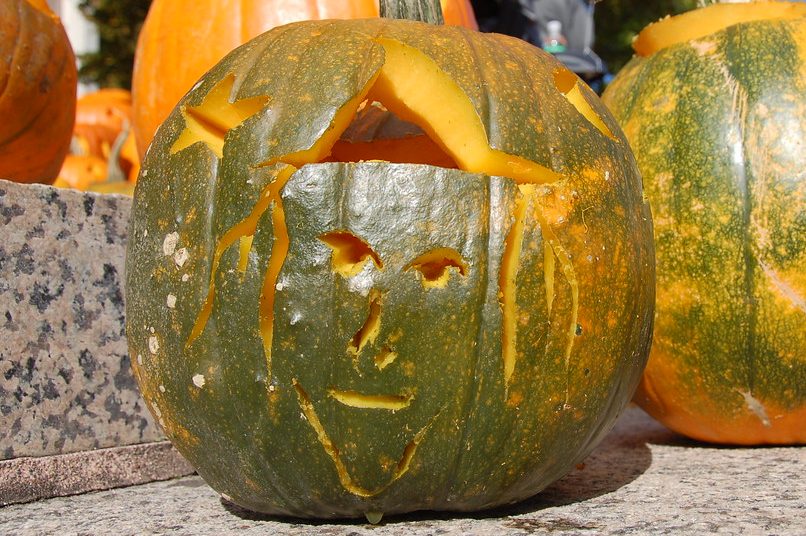
Green pumpkin carved into witch face jack-o-lantern” by Chris Devers is licensed under CC BY-NC-ND 2.0.
Non-traditional sonnet: RHL, ‘The Range of Change’

In times of no change, the advantage lies
with those who are receptive to being taught.
Parents and teachers may seem truly wise,
avoiding dangers with which life is fraught;
the stories of the old none would despise
when they hold all the answers that are sought.

In times of constant change, advantage shifts
to those who, hating school, go and explore.
Old answers fail. Fresh questions cause great rifts
with parents who are seen as wise no more;
questions now turn up unexpected gifts
in crossing unknown seas to virgin shores.

Remain alert that there’s a range of change
from none, to gradual, to fast, to strange.

*****

A sonnet, or not? 14 lines of iambic pentameter, rhyming regularly and with a final couplet. Though not in either of the standard English forms, it has the organised, compressed, reflective sense of the sonnet. Recently published in Shot Glass Journal, Online Journal of Short Poetry. Thanks, Mary-Jane Grandinetti!

Climate change icon” by Tommaso.sansone91 is marked with CC0 1.0.

Using form: biform poem: Daniel Galef, ‘Casey to his Bat’

(as a sonnet after Eugene Lee-Hamilton’s 1888 collection “Imaginary Sonnets”)

You’re swell! No wizard’s-wand or Rod of Aaron
With this ease can whack one past the glove
The way a sparrow weaves through trees. No baron
Wields your power—you’re the scepter of
A king, and blood descendent of the club
That Hercules did swing. That bat was blessed!
It knocked the blocks off lions. (Not a cub—
A full-grown beast.) Herc wore its skin, the rest
Cooked up for grub. My point: We’ll stand immobile.
It’s beneath us—just a dud. To swing
At these poor lulus would insult your noble
Blood. One pitch will come—the air will sing—
We’ll know that this is it. We’ll swing. We’ll hit!
The crowd will cheer! We’ll run! We’ll win!—Oh, shit.

~ ~ ~ ~ ~ ~ ~ ~ ~ ~ ~ ~ ~ ~ ~ ~ ~ ~ ~ ~ ~ ~ ~ ~ ~ ~ ~ ~ ~ ~ ~ ~

(in the meter of Ernest Thayer’s 1888 poem “Casey at the Bat”)

You’re swell! No wizard’s-wand or Rod of Aaron with this ease
Can whack one past the glove the way a sparrow weaves through trees.
No baron wields your power—you’re the scepter of a king,
And blood descendent of the club that Hercules did swing.
That bat was blessed! It knocked the blocks off lions. (Not a cub—
A full-grown beast.) Herc wore its skin, the rest cooked up for grub.
My point: We’ll stand immobile. It’s beneath us—just a dud.
To swing at these poor lulus would insult your noble blood.
One pitch will come—the air will sing—we’ll know that this is it.
We’ll swing. We’ll hit! The crowd will cheer! We’ll run! We’ll win!—Oh, shit.

*****

Daniel Galef writes: “I wrote this poem in 2017 while I was a student at McGill University and looking for anything to work on except my work. I have always loved both math and language, as well as making them kiss like two Barbies you mash together, and “Casey” was inspired by a couple of happy arithmetical coincidences: First, that there are exactly 70 metrical feet (or 25.52 imperial metres) in either one sonnet or 20 lines of ballad meter. Second, that both Ernest Thayer’s famous ballad “Casey at the Bat” and Eugene Lee-Hamilton’s not-so-famous collection Imaginary Sonnets were published in 1888.
The speaker of “Casey” is the mighty mock-hero of Ernest Thayer’s poem, subtitled a “Ballad of the Republic,” which is composed of standard ballad meter: rhyming couplets in iambic heptameter or alternating lines of tetrameter and trimeter. Thayer’s was possibly the last American poem to have massive popular appeal to the extent that it was commonly memorized for fun, performed on the vaudeville stage, and adapted into multiple films and even Disney cartoons. I memorized it in college as a party trick, which I’m quite eager to try out if I ever get invited to any parties.
As far as I know, this is the first sonnet* of its kind. I wrote another after, which was published first. Now that my first book is out,** I’ve written a third and fourth, but am still in the process of trying to find them loving homes in some journal or website where they can frolic and play with the other little sonnets. Of course, nothing’s wholly original. When I was a child I read a short poem by Mary Youngquist in a Willard Espy book which was readable as eight lines of six syllables or six lines of eight syllables. Robin informed me when the second of these was first printed (“A Poke of Gold” in Snakeskin Poetry in 2019; “Casey” was published in Able Muse in 2020) that the French surrealist Louis Aragon was toying with similar four-six/six-four patterns in the 1940s. But I think these are the first sonnets!
If you liked these, by all means check out my book, Imaginary Sonnets, available wherever sonnets are sold—but try here first: danielgalef.com/book/

*Sometimes they’re sonnets! I don’t really know what to call these. “Convertible sonnets” makes it sound like the rain will get in if you leave the top down, and “transforming sonnets” are plastic toys that come with a kid’s meal. The inaugural issue of the Journal of Wordplay called it an “equivocal sonnet,” and linked it to the 19th century genre “equivoque.” If you alternate the letters of sonnet and ballad, you get “sboanlnleatd.”*** Or, if you change the lineation of the poem only on a full moon: “were-sonnets”?
**Imaginary Sonnets (Able Muse Press, 2023), inspired by the Lee-Hamilton book—70 persona poems all from the point of view of different historical figures, literary characters, and inanimate objects, including Lucrezia Borgia, Wernher von Braun, and a new brand of breakfast taco.
***Both “sonnet” and “ballad” come from the Old Occitan troubadours; “sonnet” is a diminutive of “song” whereas “ballad,” a cognate with “ballet,” comes from “dance.”

*****

Daniel Galef’s first book, Imaginary Sonnets, is a collection of persona poems all from the point of view of different historical figures and objects, including Nossis the Epizephyrian, Christopher Smart’s cat, and a breakfast taco. Besides poetry, he has written plays that won the McGill University Drama Festival, flash fiction selected for the Best Small Fictions anthology, and last year he placed second in the New Yorker cartoon caption contest, which doesn’t really mean anything but he’s been telling everyone anyway.

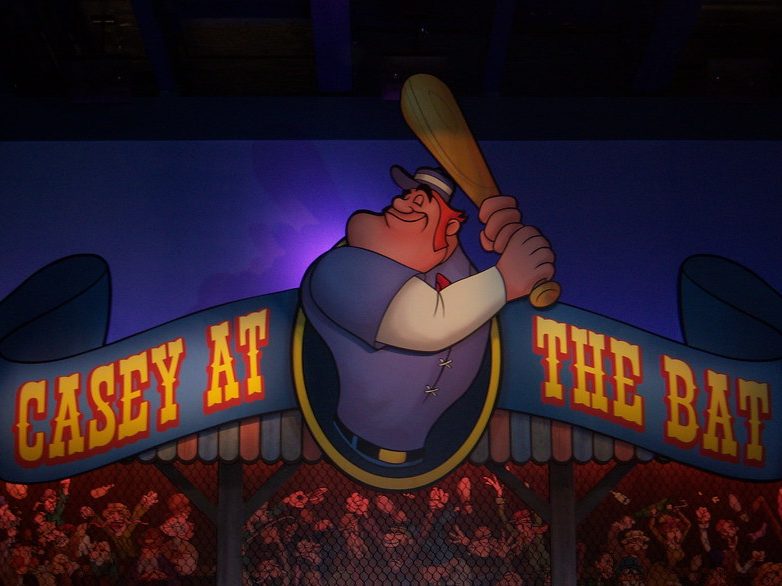
Photo: “Casey At The Bat at Games On The Boardwalk” by Castles, Capes & Clones is licensed under CC BY-ND 2.0.

Sonnet: ‘Sad, Actually’

Unreconstructed, with unhealthy heft—
the image of uncivilised great ape—
a fraud who tries to win by lies and theft,
a man who’d propagate by power and rape,
racist extoller of his genes alone,
a would-be genocidal patriarch,
successful in some twilight Darwin zone,
uncultured as a mugger in the park…
But note, behind the thin success veneer,
the shallow love of gold and gilt and glitz,
gloating dismissals and the bloated sneer,
the self-aggrandisement that never quits:
an unloved child’s in some deep down recess,
the secret of the man’s unhappiness.

*****

I can’t help feeling sorry for people who were raised so badly that they have never learnt to find security, inner peace, personal meaning. On the other hand I can’t help rejoicing when some destructive, selfish racist is exposed as a cheat and a fraud under the control of a foreign power, and is removed from positions of authority. I think of that sympathy/schadenfreud dichotomy as a healthily balanced contradiction; but then, I’m a Libra…

This sonnet (Shakespearean, being in iambic pentameter and rhyming ABAB CDCD EFEF GG) has just been published in Shot Glass Journal, an online journal of short poetry. Most of what they publish is not formal verse, but most of mine is.

Photo: “File:Vladimir Putin and Donald Trump (2019-06-28) 06.jpg” by Presidential Press and Information Office is licensed under CC BY 4.0.

Using form: irregular sonnet: Jane Blanchard, ‘Premises’

After an argument I listen hard
to noises in our common house—the ticking
of clocks, the humming of fans, the creaking of floors,
the rumbling of pipes, the ringing of phones, the groaning
of springs, the clacking or clinking of keys, the droning
of television, the drumming of laundry, the clicking
of locks, the tumbling of ice, the squeaking of doors—
all louder once a morning has been marred.
Hours may pass as I interpret sound
by sound—source, frequency, duration. Some
attention goes to silences, which pound
and pound, but not to show where each comes from.
Throughout, peace can be found in knowing you
are also wondering when words are due.

*****

Jane Blanchard writes: “This sonnet from Metes and Bounds was first published in Mezzo Cammin (Summer 2017). It is rather irregular, especially in the octave, but such deviation seems appropriate for the subject, at least to me. This poem is largely a list, yet it has narrative and lyrical elements, too, and the experience described, I hope, is easily perceived.”

A native Virginian, Jane Blanchard lives and writes in Georgia. Her latest collection with Kelsay Books is Metes and Bounds (2023).

Photo: detail of the cover of Metes and Bounds.