Tag Archives: story

Weekend read: Aaron Poochigian, ‘Not Atoms’

When, strolling through the Village, I discover

one lonesome shoe, a jeweled but dogless collar,
the crushed rose of a hitman or a lover,
barf like an offering, a half-burnt dollar,
“Scream” masks holding traffic-light-top vigil,
loose lab rats among the morning glories
or Elmo trapped inside a witch’s sigil,

I love the universe because it’s made of stories.

*****

Aaron Poochigian writes: “I live in the East Village, which is party central, especially on the weekends. The images in this poem are mostly random stuff I saw the mornings after. I didn’t include the people passed out on the sidewalk (just check to make sure they’re still breathing). The structure (one-line beginning, six-line list, one-line ending) came to me from a beautiful Tang-dynasty poem, ‘Visiting the Taoist Priest Chang’, by Liu Changqing.”

Aaron Poochigian’s ‘Not Atoms’ was originally published in New Verse Review. For reference, here is Liu Changqing’s poem in Aaron Poochigian’s translation:

Under the faint trail’s guidance I discover

a footprint in the phosphorescent moss,
a tranquil lake where low clouds love to hover,
a lonesome door relieved by rampant grass,
a pine grown greener since the thundershowers,
a cold springs fed by mountains far away.

Mingling with these truths among the flowers,
I have forgotten what I came to say.


Aaron Poochigian earned a PhD in Classics from the University of Minnesota and an MFA in Poetry from Columbia University. His latest poetry collection, American Divine, the winner of the Richard Wilbur Award, came out in 2021. He has published numerous translations with Penguin Classics and W.W. Norton. His work has appeared in such publications as Best American Poetry, The Paris Review and Poetry.
aaronpoochigian.com
americandivine.net

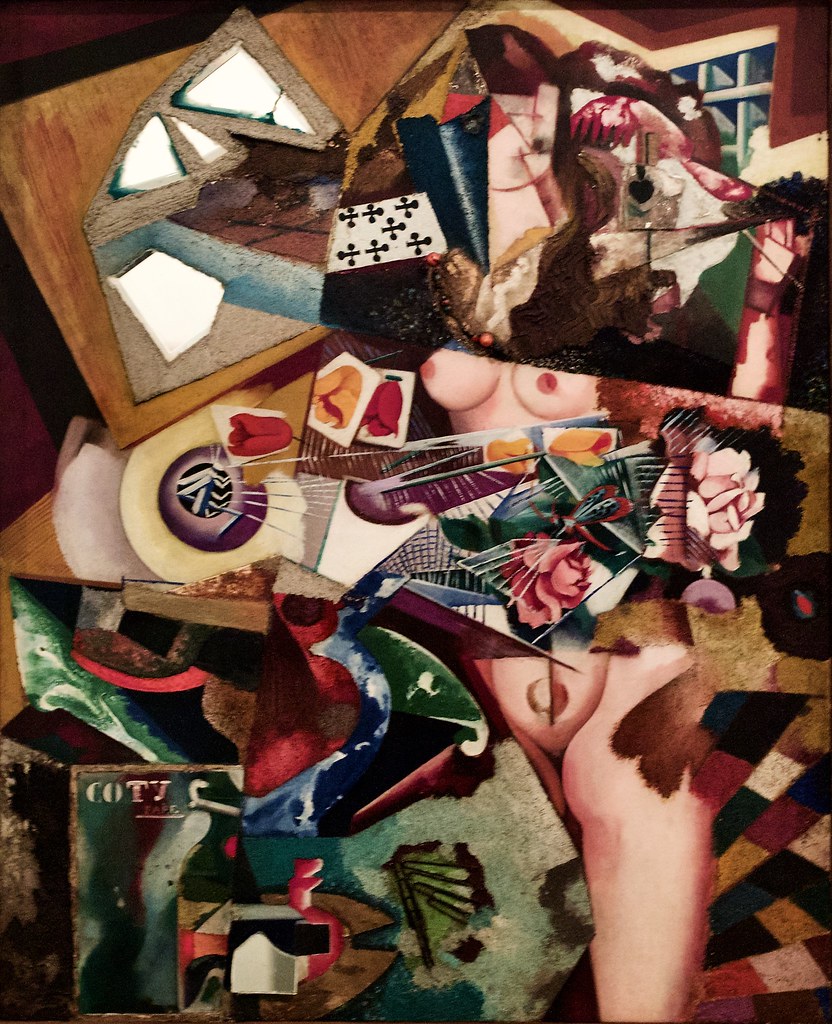
Photo: “Untitled [Coty] (c.1917) – Amadeu de Souza-Cardoso (1897-1918)” by pedrosimoes7 is licensed under CC BY 2.0.
Marcus Bales, ‘This Be The Verse’

Post this, post that, post-modernists –
   Denying narrative’s cabal.
The story that they tell insists
   It’s not a story after all.

New Criticism made them see
   That reading closely what was said
Meant cutting off biography,  
   And authors might as well be dead.

Like raisin oatmeal cookies, picked
   In hopes of chocolate chip, they bust
Your faith in how things seem. You’re tricked
   To only trust in doubting trust.

Without the person or the text,
   No human mind, no human heart,
I guess we know what’s coming next:
   Let the AIs do the art.

*****

Marcus Bales writes: “This is one of what I call my habitual poems. I have a perfectly good stand-alone idea, and start to work on it, but the parody turntable in my head takes over and the needle slides down into the groove and instead of stealing only the world-weary and faintly snarky Larkin tone it turns out I steal the whole poem. 

I have a file of these to be revised away from parody and into something that is less parodic, or at least less immediately noticeable as theft. 

The problem is I’m lazy about this stuff. There is a straightforward tradition of doing these kinds of parodicish things in song, called ‘filks’, and I’ve done some of them. It’s carried over into the same sort of thing in poems. The groove is there, the tonality is familiar, the original is familiar, and like the soap coming out of your hand in the shower, clunk, it hits the floor. 

So, since Robin asked me to write this, I’ve got a revised version for you. It loses some of the immediacy of Larkin’s opening, of course, but I’ll bet if you hadn’t got that in your head associated with this one first, this second version would only have marked a faint echo — and you might not of noticed how Larkinesque it is at all.”

Editor’s note: Bales revised the first and fifth lines; the originals read:
They fuck you up, post-modernists,
(…)
But others fucked them up to see

Hence his Larkin references.

Not much is known about Marcus Bales except that he lives and works in Cleveland, Ohio, and that his work has not been published in Poetry or The New Yorker. However his ‘51 Poems‘ is available from Amazon. He has been published in several of the Potcake Chapbooks (‘Form in Formless Times’).

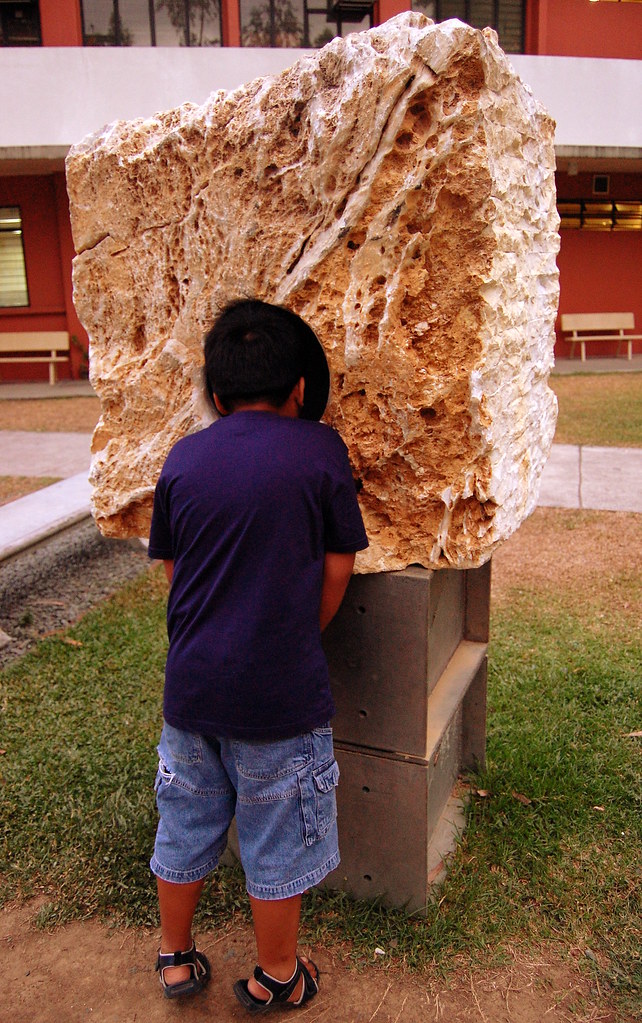
Photo: “Post-Modern Urinal” by ~MVI~ (warped) is licensed under CC BY 2.0.

Potcake Poet’s Choice: Tom Vaughan, “Save the Last Page for Me”

We choose what gives us meaning. I
chose you. That’s why
when people ask
me to unmask
and tell them if I’m ‘happy’, they
head off astray:
that’s not the glue.
But what I knew –
in the first minute, when we met
(part pledge, part threat) –
was that our text
defines, connects.

Of course, it’s only when you turn
the last page, learn
its backward view,
say farewell too,
that you can fully understand
an author’s plan.
So bugger books
and how we’ll look
to hooked, impatient readers who
will hurry through
to reach the end.
Leave that unpenned.

Tom Vaughan writes: “The poem I would choose to represent myself, Save the Last Page for Me, first published in Staple, represented a particular challenge. I’d come across the form (‘minute’ poems, i.e. 60 syllables in each stanza, with rhyming couplets and a pattern of four or two foot lines) which it was suggested was only for comic poetry. I wanted to say something serious, and hope I succeeded. Writing the poem was also another reminder that at least sometimes the more you work within the confines of a strict form, the more you discover what you wanted to say. The poem is about my wife, Anne.”

Tom Vaughan is not the real name of a poet whose previous publications include a novel and two poetry pamphlets (A Sampler, 2010, and Envoy, 2013, both published by HappenStance). His poems have been published in a range of poetry magazines. He currently lives and works in London.

https://tomvaughan.website