Tag Archives: The HyperTexts

Early poem: Michael R. Burch, ‘Will There Be Starlight’

Will there be starlight
tonight
while she gathers
damask
and lilac
and sweet-scented heathers?

And will she find flowers,
or will she find thorns
guarding the petals
of roses unborn?

Will there be starlight
tonight
while she gathers
seashells
and mussels
and albatross feathers?

And will she find treasure
or will she find pain
at the end of this rainbow
of moonlight on rain?

*****

Michael R. Burch writes: “The real test of a poem, for me, is whether I can remember it or not. If I can’t remember a poem, if it doesn’t leave a lasting impression, it simply vanishes like a windblown tumbleweed and cannot be a “keeper.” I decided to apply an “instant recall” test to my own poems and translations, to see which ones leapt to mind first. Ironically, or perhaps not, several of these poems turned out to be about memories and/or how the human memory works, or sometimes doesn’t. ‘Will There Be Starlight’ is one.

“I wrote it around age 18 as a high school student and it has been published by TALESetc, Starlight Archives, The Word (UK), Poezii (in a Romanian translation by Petru Dimofte), The Chained Muse, Famous Poets & Poems, Grassroots Poetry, Inspirational Stories, Jenion, Regalia, Chalk Studio, Poetry Webring and Writ in Water. ‘Will There Be Starlight’ has also been set to music by the award-winning New Zealand composer David Hamilton and read on YouTube by Ben E. Smith. To have a poem written as a teenager translated into Romanian, set to music by a talented composer, performed by one of the better poetry readers, and published in multiple literary journals was not a bad start to my career as a poet!”

Michael R. Burch is an American poet who lives in Nashville, Tennessee with his wife Beth, their son Jeremy, two outrageously spoiled puppies, and a talkative parakeet. Burch’s poems, translations, essays, articles, reviews, short stories, epigrams, quotes, puns, jokes and letters have appeared in hundreds of literary journals, newspapers and magazines. He is also the founder and editor-in-chief of The HyperTexts, a former columnist for the Nashville City Paper, and, according to Google’s rankings, a relevant online publisher of poems about the Holocaust, Hiroshima, the Trail of Tears and the Palestinian Nakba. Burch’s poetry has been taught in high schools and universities, translated into 19 languages, incorporated into three plays and two operas, set to music 61 times by 32 composers, from swamp blues to classical, and recited or otherwise employed in more than a hundred YouTube videos. To read the best poems of Mike Burch in his own opinion, with his comments, please click here: Michael R. Burch Best Poems.   

Photo: “Star Girl” by Tobias Mayr is licensed under CC BY-NC-SA 2.0.

R.I.P. Ann Drysdale… ‘Weirdness Observed’

What is she doing, the mad old bat,
Down on her knees in the garden?
In her busted boots and her happiness hat
She doesn’t know and she wouldn’t care
That the size of the arse sticking up in the air
Is shading so much of the garden.

She pulls out a weed, the mad old bat,
Out of the face of the garden.
She tuts at the trauma and fusses it flat
While the waste-not weed she will put to use
By turning it into salubrious juice
And giving it back to the garden.

What is she up to, the mad old bat
As she struts, stiff-kneed in the garden
With her doo-dah dog and her galloping cat?
Spreading compost and scattering seed
So one may sprout and the other may feed
In the windmill world of the garden.

She’s a cruel cartoon, is the mad old bat
As she talks to herself in the garden.
What on earth is this? and Good Lord, look at that!
And she squats and she mutters and giggles out loud
And informs her potatoes they’re doing her proud
As she creeps like a crone in the garden.

Where is she going, the mad old bat
As the sunset blesses the garden?
She is going nowhere, and that is that.
She will dig in the dark till the dawn sky pales
And the damp on her knees and the dirt in her nails
Go singing the song of the garden.

*****

Ann Drysdale, who died unexpectedly on August 16th (apparently in her sleep) was a superb poet and self-aware, self-directed, life-rich eccentric lover of the natural world, of gardens, of animals and birds, of unpretentious people in all walks of life. I knew her only through her poetry and our correspondence – which is to say, well enough to deeply regret that I never got to meet her in person.

The poem above was collected in Miss Jekyll’s Gardening Boots, Shoestring Press, 2015; as was the poem that I put up on this blog earlier this month, ‘When Mister Nifty Plays the Bones‘. Here is the bio that she chose to represent herself with:

Ann Drysdale still lives in South Wales. She has been a hill farmer, water-gypsy, newspaper columnist and single parent – not necessarily in that order. She has written all her life; stories, essays, memoir, and a newspaper column that spanned twenty years of an eventful life. Her eighth volume of poetry – Feeling Unusual – came together during the strange times of Coronavirus and celebrates, among other things, the companionship of a wise cat and an imaginary horse.”

She was a much-loved member of the world of (especially formalist) poetry. George Simmers posted her ‘Song of Wandering Annie’ in the Snakeskin blog, and there is a tribute (and an enormous selection of her verse) in The HyperTexts. She was a truly good person.

Semi-formal: RHL, ‘Laffable Religion’

No matter how seemingly affable,
a priest always hopes to be greased;
while others, invoking hellfire,
have us wait for our trip in the hearse
and preach in their suits neatly creased,
these fishers of men that are gaffable,
in this world that they’ve made mud and mire.
That the point of a flock’s to be fleeced
can only be said in light verse;
for religion is simply so laughable
it’s amazing it’s not yet deceased.

*****

Isn’t it amazing that the Pope can claim to have voluntarily taken a vow of lifelong poverty, and millions of his supporters who live in involuntary poverty send money to support him living in a palace? Is it different from a billionaire politician soliciting donations from his impoverished supporters? Is the human need to glorify the tribal god and the tribal leader never going to end?

This poem was first published in The HyperTexts, as part of the August 2024 Spotlight.

Using form: Limericks: RHL, ‘Attitudes in the Holy Land’

Moses says God says: (Deuteronomy 20:16-18)

God’s ruthless. Just read Deuteronomy,
believers get zero autonomy:
“You must kill all non-Jews
in this land that I choose.”
Just back then? Or still now? (Love His bonhomie!)

Luke says Jesus says: (Luke 19:27)

Christ was often less peaceful than stormy,
with disciples both pushy and swarmy;
to the rest he made plain
if they’d not have him reign:
“Bring them hither and slay them before me.”

Muhammad says God says: (Qur’an 9:5)

“Polytheists, wherever you find them,
you should ambush and capture and bind them,
and only relax
if they pray and pay tax;
elsewise kill them, and in the dust grind them.”

*****

Given that Jews, Christians and Muslims all claim to be worshipping the same god, the only God, the God of Abraham, it’s somewhat surprising how much time they spend fighting each other. But then, factions within the same religion have been known to slaughter each other. It seems to be something inherent in religions, especially monotheistic ones – if you believe there is only one god, your god, then everyone else’s belief is blasphemy.

Somehow these tribal religions of preliterate herders have continued to the present. They are so illogical and – despite beautiful architecture etc – so frequently violent that the best response I can think of is the mockery of limericks and other forms of light verse. That, and mourning the dead children, and supporting efforts to impose peace.

These limericks were first published in The HyperTexts, Michael R. Burch’s enormous anthology which includes extensive poetry about both the Holocaust and the Nakba, the Palestinian Catastrophe.

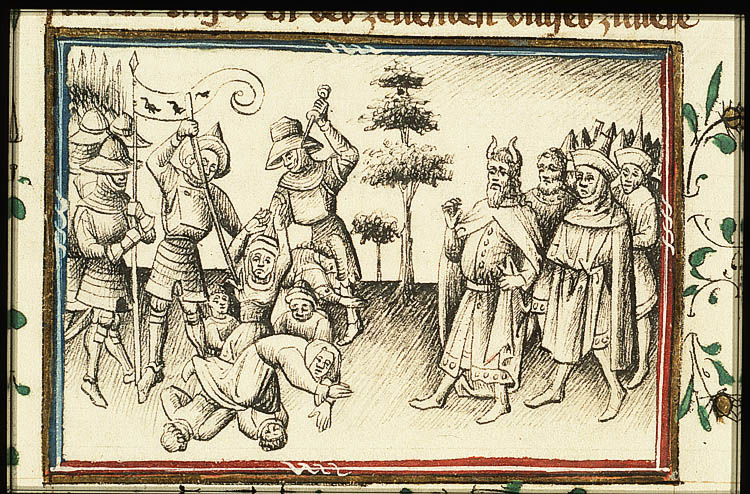
Moses causes the Levites to kill the idolators” is marked with Public Domain Mark 1.0.

RHL, ‘Deuteronomy 20: 16-18’

You’ve no autonomy
under Deuteronomy;
it’s your obligation
to your tribal nation
to kill all Palestinians
so you don’t sin against
God, who’s neurotic.
Yes, Yahweh’s psychotic.
No escaping his wrath,
no path but the psychopath.

*****

For Christians and Jews who state (as Jesus did) that every reported command by God in the Torah / Old Testament must be obeyed, I ask their position on Deuteronomy 20. This contains the command for the complete genocide of the non-Jews living in the land which Moses claimed had been given to the Jews by God. (Note: not expulsion or enslavement of the people living there, but the death of all of them and their animals.) The reason? So that they don’t teach evil ways to the Jews:

16 But of the cities of these people, which the Lord thy God doth give thee for an inheritance, thou shalt save alive nothing that breatheth:
17 But thou shalt utterly destroy them; namely, the Hittites, and the Amorites, the Canaanites, and the Perizzites, the Hivites, and the Jebusites; as the Lord thy God hath commanded thee:
18 That they teach you not to do after all their abominations, which they have done unto their gods; so should ye sin against the Lord your God.

To the extent that fundamentalist Jews constitute a large percentage of the Israeli population and are influential in the national government, the Palestinian situation cannot be resolved until scriptural passages like this are dragged out into the open and examined and discussed: was that passage only for then, and things are different now? Or does the command to massacre non-Jews still hold for today’s Jews in “the Holy Land”?

This poem was first published in The HyperTexts, where Michael R. Burch maintains extensive collections of poetry related to both the Holocaust and the Palestinian Catastrophe.

Illustration: “Moses has the mature women and the male children of the Midianites killed” is marked with Public Domain Mark 1.0.

Michael R. Burch, ‘Suffer the Little Children’

for the children of Gaza

I saw the carnage . . . saw girl’s dreaming heads
blown to red atoms, and their dreams with them . . .

saw babies liquefied in burning beds
as, horrified, I heard their murderers’ phlegm . . .

I saw my mother stitch my shroud’s black hem,
for in that moment I was once of them . . .

I saw our Father’s eyes grow hard and bleak
to see his roses severed at the stem.

How could I fail to speak?

*****

Michael R. Burch writes: “Three decades ago, I began working with Jewish Holocaust survivors and other Jewish poets to publish translations of previously unpublished poems written in Polish and Yiddish by victims of the Holocaust. Some were written by children. In some cases the poems survived but the names of the poets did not. I considered it a sacred task and believed we were saying “Never again!” to any and all Holocausts. But in my discussions with my Jewish friends, it became apparent that “Never again!” did not apply to the Palestinians. When I asked questions about Israel’s brutal abuses of Palestinians and the theft of their land – armed robbery – my Jewish friends became defensive and told me, essentially, to shut up and never question Israel. Their sudden change in attitude convinced me that something was wrong, deeply wrong. I decided to research the subject independently, invested considerable time, and came to the conclusion that the Palestinian Nakba (“Catastrophe”) is a Holocaust sans ovens, a modern Trail of Tears. And while my country, the United States, has opposed other Holocausts, it is funding this one and supplies Israel with terrible weapons that are being used to mass murder children and their mothers, fathers and families. I will continue to say “Never again!” to any and all Holocausts and invite readers to join me and do what they can to end and prevent such atrocities.”

‘Suffer the Little Children’ has been published by Art in Society (Germany), Pick Me Up Poetry, Jadaliyya (Egypt), The HyperTexts andMESPI (Middle East Studies Pedagogy Institute). According to Google the poem now appears on 462 web pages.

Michael R. Burch is an American poet who lives in Nashville, Tennessee with his wife Beth, their son Jeremy, two outrageously spoiled puppies, and a talkative parakeet. Burch’s poems, translations, essays, articles, reviews, short stories, epigrams, quotes, puns, jokes and letters have appeared in hundreds of literary journals, newspapers and magazines. He is also the founder and editor-in-chief of The HyperTexts, a former columnist for the Nashville City Paper, and, according to Google’s rankings, a relevant online publisher of poems about the Holocaust, Hiroshima, the Trail of Tears and the Palestinian Nakba. Burch’s poetry has been taught in high schools and universities, translated into 19 languages, incorporated into three plays and two operas, set to music by 31 composers, and recited or otherwise employed in more than a hundred YouTube videos. To read the best poems of Mike Burch in his own opinion, with his comments, please click here: Michael R. Burch Best Poems.   

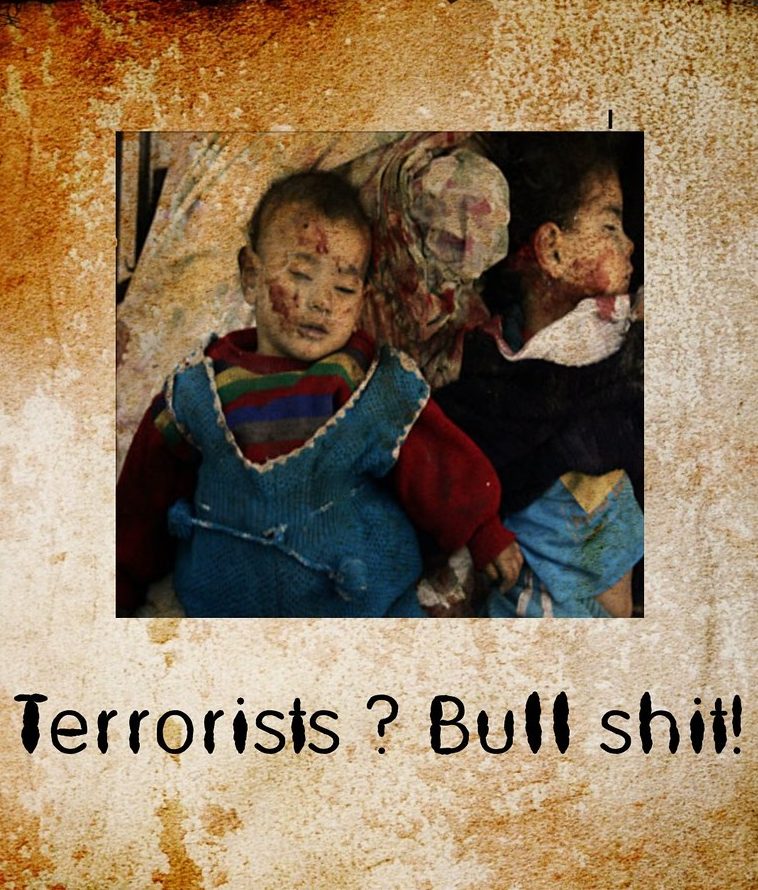
Photo: “Untermensch – Hannukah 2008 – Palestinian children killed by Israel in Gaza” by smallislander is licensed under CC BY-NC-SA 2.0.
Formless poem: RHL, ‘Marty Ravellette’

The man with no arms sat on the stool in the diner;
he was shoeless: How else could he drink his coffee,
eat his scrambled eggs?

The man with no arms parked his truck and got out barefoot.
He fired up his chainsaw; he had a landscaping business.
With the log out of the way, he could cut the grass,
push the lawnmower around with his chest.

The man with no arms saw the woman in the burning van,
barefoot, he kicked in the window, so his wife
could reach in and unlock the door, help the woman escape.

Somewhere Kipling’s Creator of All Things must have told him “Play –
play at being who you are,” and he played.

Somewhere Lear’s Aunt Jobiska must have told him “This is the best.”
And he lived, happy with who he was, glad for no arms
because no arms made him who he was, and he liked who he was.

Nor was the man with no arms alone.
The boy with no hands sat in the laundromat, knitting.
He had metal pincers. His mother was washing the clothes.
The girl with two heads, or rather the twins with only one body,
they live, argue, love, share.
And the men with no legs have a chance to run faster than all,
will require a new type of Olympics.
And the child born to die – does that disturb you, “the child born to die”?
The child born to die is me and is you, is all humans, all life,
all planets, stars, galaxies, all.
Listen to Lear’s Aunt Jobiska: This is the best.
Listen to Kipling’s Creator of All Things, and play.

*****

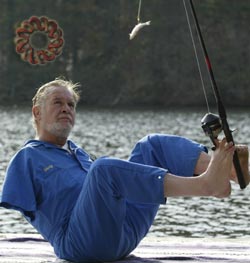
Marty Ravellette was a highly respected inhabitant of Chapel Hill, North Carolina, where he lived the last 16 years of his life – running his landscaping business, taking a break in a local diner, frequently a guest lecturer in journalism at UNC. He was a Baha’i convert, and a hero.

Occasionally I break my own rules about poetry, and write a poem in a style which I consider to be really flash fiction (or flash non-fiction in this case). The things I had to say didn’t present themselves in anything hinting at traditional verse, and therefore I just said them as best I could. But both Snakeskin and The HyperTexts consider it poetry, so I won’t argue. I’m not sure it should be in the formalverse.com blog, however…

Photo: Figure 8 Films

Michael R. Burch, ‘Redolence’

Now darkness ponds upon the violet hills;
cicadas sing; the tall elms gently sway;
and night bends near, a deepening shade of gray;
the bass concerto of a bullfrog fills
what silence there once was; globed searchlights play.

Green hanging ferns adorn dark window sills,
all drooping fronds, awaiting morning’s flares;
mosquitoes whine; the lissome moth again
flits like a veiled oud-dancer, and endures
the fumblings of night’s enervate gray rain.

And now the pact of night is made complete;
the air is fresh and cool, washed of the grime
of the city’s ashen breath; and, for a time,
the fragrance of her clings, obscure and sweet.

*****

Michael R. Burch writes: “I wrote the poem as the sun was going down over my son Jeremy’s pee-wee football practice. The first stanza is a pretty accurate description of the scene. However, by the second stanza I was letting my imagination run free. By the last four lines it was pure imagination. Or my wife would have killed me!”

Michael R. Burch is an American poet who lives in Nashville, Tennessee with his wife Beth and two outrageously spoiled puppies. Burch’s poems, translations, essays, articles, reviews, short stories, epigrams, quotes, puns, jokes and letters have appeared in hundreds of literary journals, newspapers and magazines. Burch is also the founder and editor-in-chief of The HyperTexts, a former columnist for the Nashville City Paper, and, according to Google’s rankings, a relevant online publisher of poems about the Holocaust, Hiroshima, the Trail of Tears and the Palestinian Nakba. Burch’s poetry has been taught in high schools and universities, translated into 17 languages, incorporated into three plays and two operas, set to music by 27 composers, and recited or otherwise employed in more than a hundred YouTube videos. To read the best poems of Mike Burch in his own opinion, with his comments, please click here: Michael R. Burch Best Poems

Photo: “Ferns at night” by ikewinski is licensed under CC BY 2.0.

Potcake Poet’s Choice: Michael R. Burch, ‘Styx’

Black waters,
deep and dark and still…
all men have passed this way,
or will.

*****

Michael R. Burch writes: “This original epigram, written in my teens, returns more than 6,000 results. I started writing poetry around age 13 and decided that I wanted to challenge the immortals around age 15. I was always very ambitious about my writing. When I couldn’t out-write Keats and Shelley at age 15, I destroyed everything I had written in a fit of pique. I was able to reconstruct some of the poems from memory, but not all. I still miss a few of the poems that seemed promising which have not cooperated with being resurrected.”

Michael R. Burch is an American poet who lives in Nashville, Tennessee with his wife Beth and two outrageously spoiled puppies. Burch’s poems, translations, essays, articles, reviews, short stories, epigrams, quotes, puns, jokes and letters have appeared more than 7,000 times in publications which include TIME, USA Today, The Hindu, BBC Radio 3, CNN.com, Daily Kos, The Washington Post and hundreds of literary journals, websites and blogs. Burch is also the founder and editor-in-chief of The HyperTexts, a former columnist for the Nashville City Paper, and, according to Google’s rankings, a relevant online publisher of poems about the Holocaust, Hiroshima, the Trail of Tears, Darfur, Gaza and the Palestinian Nakba. Burch’s poetry has been taught in high schools and universities, translated into fifteen languages, incorporated into three plays and two operas, set to music by twenty composers, recited or otherwise employed in more than forty YouTube videos, and used to provide book titles to two other authors. To read the best poems of Mike Burch in his own opinion, with his comments, please click here: Michael R. Burch Best Poems.

Photo: “Styx” by wilding.andrew is licensed under CC BY-NC-ND 2.0.

Potcake Poet’s Choice: Michael R. Burch, ‘Bible Libel’

If God
is good,
half the Bible
is libel.

Michael R. Burch writes: “This may be the first poem I wrote. I read the Bible from cover to cover at age 11, and it was a traumatic experience. But I can’t remember if I wrote the epigram then, or came up with it later. In any case, it was probably written between age 11 and 13, or thereabouts. It would be kinda cool to be remembered by a poem I wrote at such an early age. Plus, it’s short, so readers would probably finish it!

I have been using Google results to determine which of my poems are the most popular on the Internet. Some of my poems have gone viral, appearing on hundreds or thousands of web pages. That’s a lot of cutting and pasting, and I like to think people must like a poem in order to take the time to replicate it. This epigram, which I wrote around age 11 to 13, at one time returned over 405,000 results for the last two lines, and over 51,000 results for the entire poem. The last time I checked, it still returned over 292,000 results. I was especially pleased to see one of the first poems I wrote, and possibly the first, go viral. If I wrote anything earlier, I don’t remember it.

Michael R. Burch has over 6,000 publications, including poems that have gone viral. His poems have been translated into fourteen languages, incorporated into three plays and two operas, and set to music by seventeen composers. He also edits TheHyperTexts.

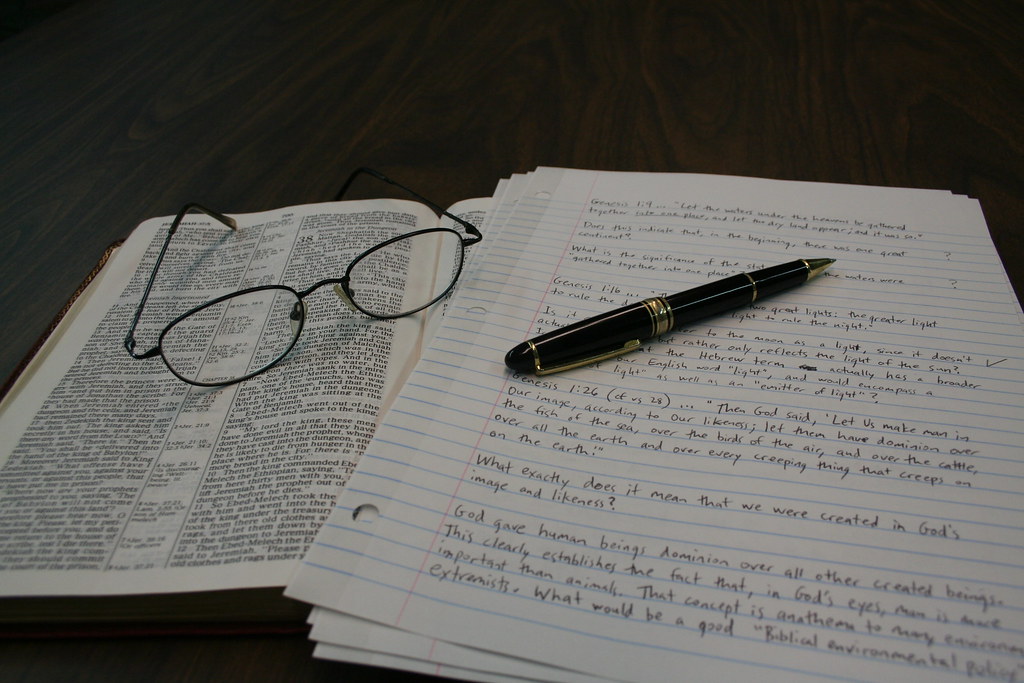
Photo: “Bible, Reading Glasses, Notes and Pen” by paul.orear is licensed under CC BY-SA 2.0