Tag Archives: using form

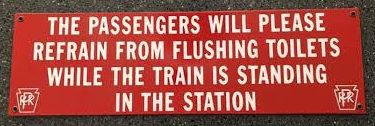
Using form: Odd poem: British Railways toilet sign

Passengers will please refrain
from flushing toilets while the train
is standing in the station.

*****

It is my (perhaps flawed) understanding that this particular wording originated in the UK. Signs instructing passengers to refrain from flushing toilets while at a station were widely used in the UK throughout the mid-20th century, specifically from the nationalization of British Railways in 1948 through the 1960s. The signs were a standard fixture in passenger carriages, typically made of cast iron or enamel for durability. The signs began to disappear as British Rail modernized its signage in 1965, and gradually replaced older rolling stock with newer models. 

At the time these signs were posted, British trains utilized a “hopper” or “direct discharge” system: toilets consisted of a simple chute or a water-flushed system that emptied human waste directly onto the railway tracks. Because waste dropped straight down, flushing while stationary at a station would deposit raw sewage directly onto the platform-side tracks, creating severe hygiene and odor issues for passengers and staff. Although the first retention tanks (which hold waste for later disposal) were introduced in 1981, the transition away from “hopper” toilets was slow. As recently as 2018, approximately 10% of British train carriages still discharged waste onto tracks, with the practice only largely being eliminated by 2023 after significant government and industry pressure. 

It is not known which railway employee successfully created and implemented the phrasing—”Passengers will please refrain from flushing toilets while the train is standing in the station”. Perhaps they did it surreptitiously, anonymously; but the catchy rhythm and rhyme became so ubiquitous that it was set to the tune of Dvořák’s Humoresque No. 7 and became a popular piece of cultural folklore in both the UK and US.

Supreme Court Justice William O. Douglas and Yale law professor Thurman Arnold take full credit for the “Bawdy Song.” In his autobiography, Go East, Young Man (pp. 171–72), Douglas notes, “Thurman and I got the idea of putting these memorable words to music, and Thurman quickly came up with the musical refrain from Humoresque.” Here is an incomplete version of that work:

“Passengers will please refrain
From flushing toilets while the train
Is in the station. Darling, I love you!
We encourage constipation
While the train is in the station
Moonlight always makes me think of you.
If the woman’s room be taken,
Never feel the least forsaken,
Never show a sign of sad defeat.
Try the men’s room in the hall,
And if some man has had the call,
He’ll courteously relinquish you his seat.
If these efforts all are vain,
Then simply break a window pane-
This novel method used by very few.
We go strolling through the park
Goosing statues in the dark,
If Sherman’s horse can take it, why can’t you?”

Using form: RHL, ‘Formal vs Free’

Look: formal verse can be china for tea,
a golden goblet, a mug made of clay.
Free verse is putting mouth to stream to drink.
Yes, you could cup your hands… but do you think
museums want to buy that to display
your “memorable skill”, your “artistry”?

*****

‘Formal vs Free’ is published in the current ‘Blue Unicorn‘, in a section loaded, as often, with verse about verse.

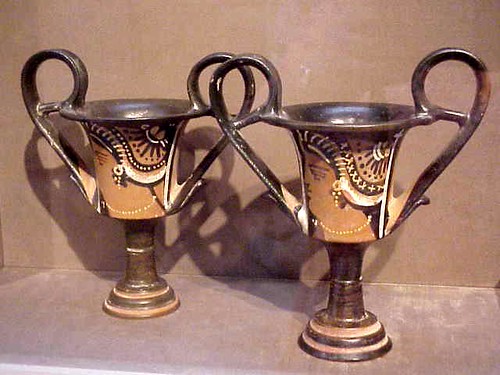
Photo: “Red-figured Greek Red-Figure Kantharos (Drinking Vessels) with Female Heads 320-310 BCE Terracotta” by mharrsch is licensed under CC BY-NC-SA 2.0.

Using form: Tritina: Nicole Caruso Garcia, ‘Love Poem in Winter, with Blackout Shades’

Beginning with a line by Aimee Nezhukumatathil

My husband is a pale blur. The dark
turns grainy as the blue hour tints our bedroom,
my glasses somewhere near the nightstand’s edge.

He could almost be U2’s guitarist, Edge:
goatee, pale arms, black T-shirt, trademark dark
wool skull cap. Me: his groupie. His hotel room.

Distortion fades. Before he leaves the room,
I feel a toe-squeeze, hear an air-kiss: edge
of day, his way of sugaring the dark,

our portrait in the darkroom of a marriage.

*****

Nicole Caruso Garcia writes: “The inspiration for the tritinaLove Poem in Winter with Blackout Shades‘ came from a workshop led by Matt. W. Miller at the 2022 Poetry by the Sea Conference. He had us select one line from among a dozen or so poems by other poets, then use the line use as a springboard and incorporate it somewhere in a new poem of our own. My poem’s first sentence is a line from the middle of Aimee Nezhukamatathil’s ‘I Could Be a Whale Shark‘.” 

Love Poem in Winter with Blackout Shades‘ was first published in Crab Orchard Review.

Nicole Caruso Garcia’s full-length debut OXBLOOD (Able Muse Press) received the International Book Award for narrative poetry. Her work appears in Crab Orchard ReviewLightMezzo CamminONE ARTPlumeRattleRHINO, and elsewhere. Her poetry has received the Willow Review Award and won a 2021 Best New Poets honor. She is an associate poetry editor at Able Muse and served as an executive board member at Poetry by the Sea, an annual poetry conference in Madison, CT. Visit her at nicolecarusogarcia.com.

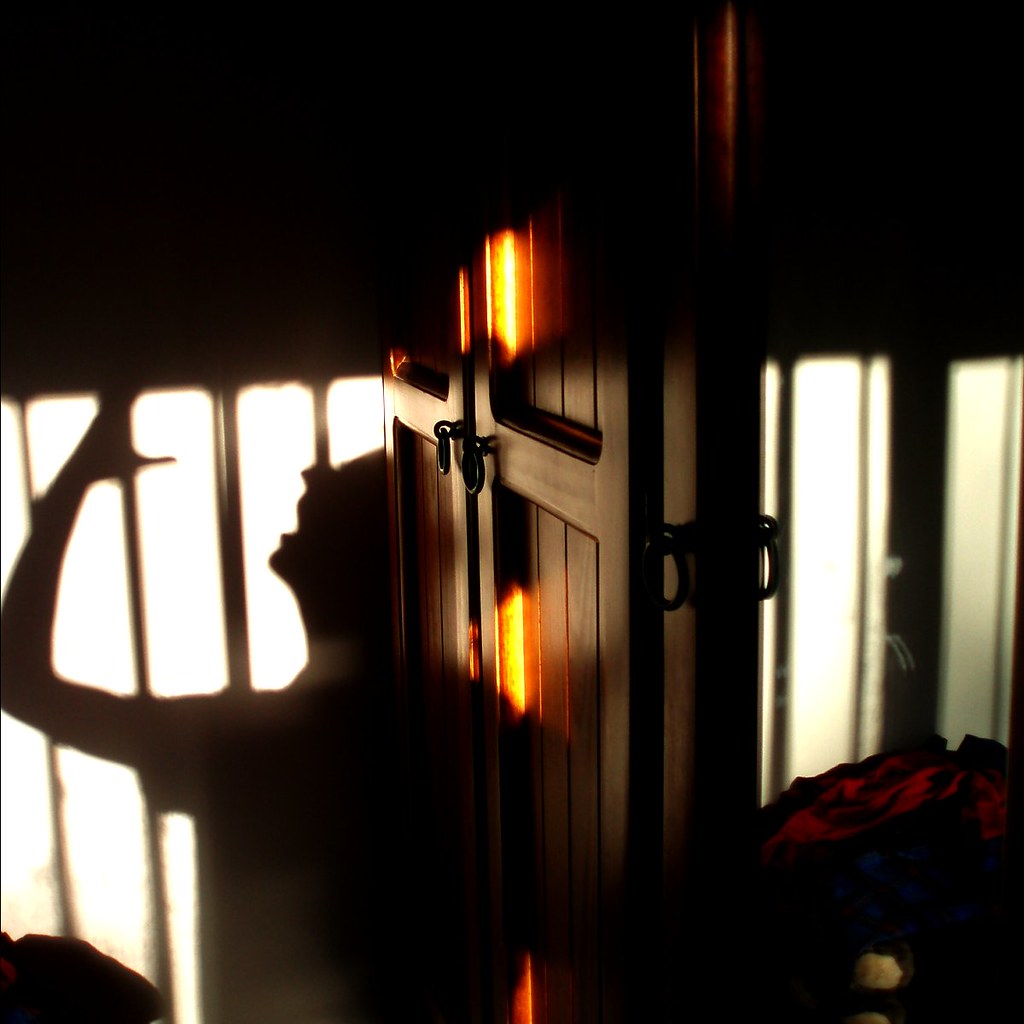
Photo: “29/05/2009 (Day 3.149) – We Are Sane” by Kaptain Kobold is licensed under CC BY-NC-SA 2.0.

Using form: Iambic trimeter: Susan McLean, ‘Danse Macabre’

The dancers, taut as bows,
burn in their joyous fire.
They whirl, entwine, and pose
in friezes of desire.

No skeletons appear
to shock the celebration.
The dancers, bowing, hear
a rapturous ovation.

Outside, the wind blows colder.
Although she’d rather linger,
she senses on her shoulder
the tap of a light finger.

And, though she came alone
and doesn’t need a ride,
a shadow, thin as bone,
attends her, stride for stride,

then leaves her, still denied.
But the end is not in doubt.
The skeleton inside
eventually wants out.

*****

Susan McLean writes: “I wrote this poem after attending a performance of Ailey II, the junior corps of dancers in the company founded by Alvin Ailey. It was on a cold night in autumn around Halloween, and even though there was nothing sinister about the dances I witnessed, I was reminded of the medieval Dance of Death, in which skeletons appear to people in the midst of their daily routine to summon them away to death. One of the most memorable images of that theme occurs at the end of Ingmar Bergman’s film The Seventh Seal, and I have seen it portrayed also on the wooden bridge in Lucerne in Switzerland. The poem is written in three-beat lines of iambic trimeter, which reminded me of a stately waltz.”

‘Danse Macabre’ originally appeared in THINK Magazine.

Susan McLean has two books of poetry, The Best Disguise and The Whetstone Misses the Knife, and one book of translations of Martial, Selected Epigrams. Her poems have appeared in Light, Lighten Up Online, Measure, Able Muse, and elsewhere. She lives in Iowa City, Iowa.
https://www.pw.org/content/susan_mclean

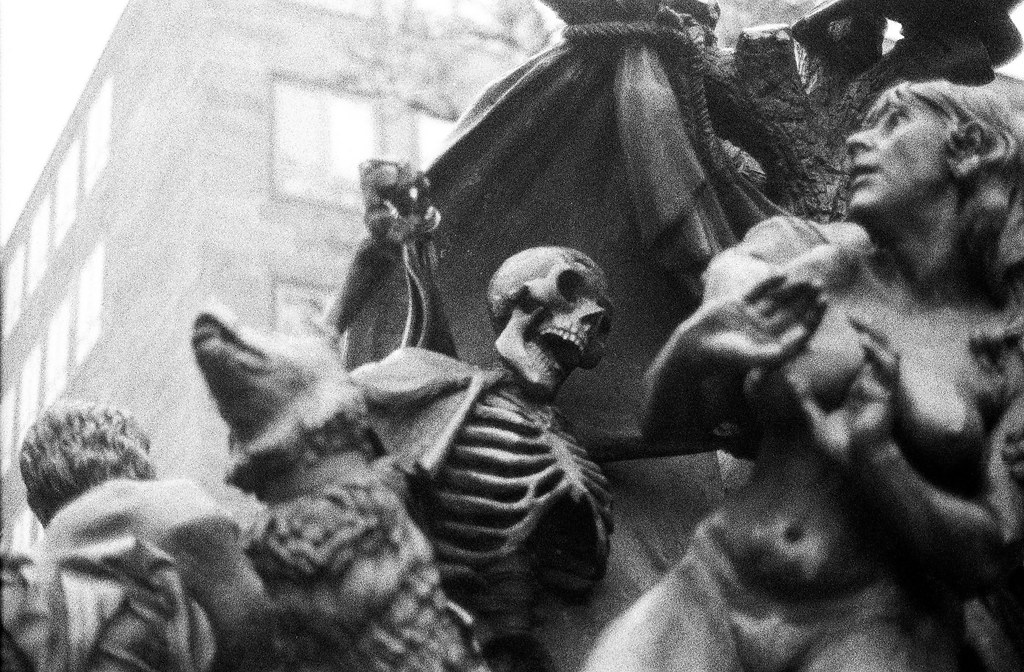
la danse macabre” by a magic monkey! is licensed under CC BY-NC-SA 2.0.

Using form: Basic Me: Nicole Caruso Garcia, ‘Po-Biz Ars Poetica’

Form is a slippery seed to be grasped.
Free verse is form with its bra hook unclasped.
Blocked is me chewing my fanciest pens.
Pun is a test of my spouse and my friends.
Drunk is the poet who’s making a pass.
Prize is a unicorn chased by an ass.
Tome is Uranus-sized ego unbound.
Deep is the grave of my darlings I’ve drowned.
Rhyme is the hill where I’m willing to die.
Meh is the mic hog who sounds like AI.
Crit is a cig from a firing squad.
Light is the thirstiest verse. Please applaud.

*****

Nicole Caruso Garcia writes: “‘Po-Biz Ars Poetica‘ came about after I stumbled upon a metrical form Mary Meriam invented called the “Basic Me.” (I will include the link to its “rules” here.) Although Meriam says, “Basically, it means ‘what are your words and how would you define them?,” here I ascribed each trait to “po-biz” rather than to myself.”

Po-Biz Ars Poetica‘ was first published in the Winter/Spring 2025 issue of Light, where Nicole Caruso Garcia is the Featured Poet.

Nicole Caruso Garcia’s full-length debut OXBLOOD (Able Muse Press) received the International Book Award for narrative poetry. Her work appears in Crab Orchard ReviewLightMezzo CamminONE ARTPlumeRattleRHINO, and elsewhere. Her poetry has received the Willow Review Award and won a 2021 Best New Poets honor. She is an associate poetry editor at Able Muse and served as an executive board member at Poetry by the Sea, an annual poetry conference in Madison, CT. Visit her at nicolecarusogarcia.com.

Photo: “ENSACT Conference Social Action in Europe, Dubrovnik 2009” by sharon.schneider is licensed under CC BY-NC-SA 2.0.

Using form: Quatern: Susan McLean, ‘Cropped’

He doesn’t care for flowers or for fruit,
so don’t implore him not to clip or prune
the fig trees and camellias. His pursuit
of geometric form makes him immune

to luscious tastes and beauties others crave.
He doesn’t care for flowers or for fruit,
so once the buds appear, don’t try to save
them from his trimmer. All your pleas are moot.

He holds a tidy yard in high repute,
a verdant symbol of his mastery.
He doesn’t care for flowers or for fruit,
but takes some pleasure in your misery

as he destroys what you had hoped to see.
His need to have control is absolute,
and you can’t argue with machinery.
He doesn’t care for flowers or for fruit.

*****

Susan McLean writes: “This poem started with my desire to write a quatern, a form that I had encountered in Chad Abushanab’s workshop on rare poetic forms at the Poetry by the Sea conference in 2024. A quatern is four quatrains long, and the first line of stanza one becomes the second line of stanza two, and so on. As for the poem’s content, it grew out of a dispute about gardening practices with someone I know well. I was unable to convince him to change his ways. I should add that his ascribed motives are all conjectural on my part, not based on anything he said. But poets don’t really lose an argument; they just take the opportunity to restate it as a poem. This poem first appeared in the August 2025 issue of Snakeskin.”

Susan McLean has two books of poetry, The Best Disguise and The Whetstone Misses the Knife, and one book of translations of Martial, Selected Epigrams. Her poems have appeared in Light, Lighten Up Online, Measure, Able Muse, and elsewhere. She lives in Iowa City, Iowa.
https://www.pw.org/content/susan_mclean

Photo: Snakeskin

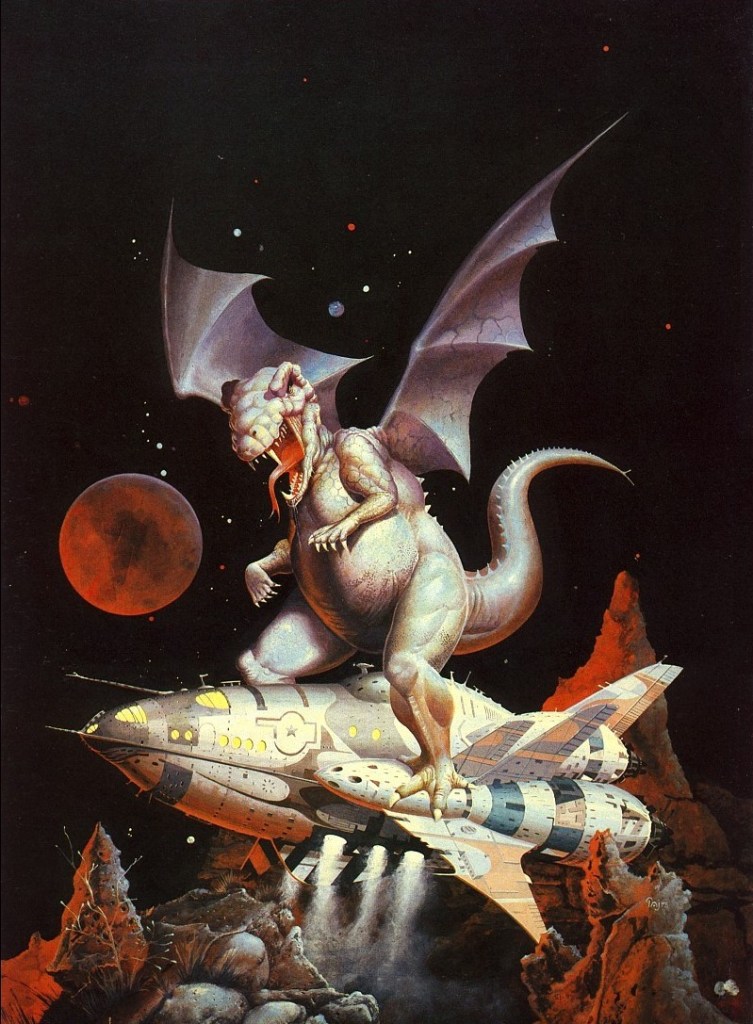
Ekphrastic SF poem: Simon MacCulloch, ‘Rocket Ride’

A dinosaur straddles a rocket
And whether the pilot within
Was trying to launch it or dock it
To finish a trip or begin,
It looks like a fight that the dinosaur might
By weight and ferocity win.

But how did it mount there? Its wings
Though bat-like are really too small
To soar to the perch where it clings
Indeed, to get airborne at all
It better hold tight as the rocket takes flight
For if it slips off it will fall.

The monster can only have boarded
The spaceship when close to the ground
(Its huge-muscled hind legs afforded
The strength for a crouch and a bound)
And as it gains height in the star-speckled night
It will squat, legs and tail firmly wound.

A rodeo cowboy! Each buck
Of boosters a challenge to greet!
A contest of power, skill, luck
To see if a lizard can beat
This beast that takes fright at the terrible sight
Of a dragon that thinks it’s in heat.

For that is the heart of the matter:
This brute who bears down from above
Will scrabble and buffet and batter
Then, spent, wrap as close as a glove
With licks to invite its cold mate to requite
Its misallied dinosaur love.

*****

Simon MacCulloch writes: “Rocket Ride was inspired by Peter Andrew Jones’s book cover painting for The Second Experiment (Granada Books, 1975); the poem was first published in Aphelion.”

Simon MacCulloch lives in London and contributes poetry to a variety of print and online publications, including Reach Poetry, View from Atlantis, Pulsebeat Poetry Journal, Spectral Realms, Black Petals and others.

Image © Peter Andrew Jones 1975


Villanelle variation: James B. Nicola, ‘My MFA’

I thought I’d go and get my MFA
since college never taught me how to write.
It’s not that I had anything to say;
 
I needed somehow, though, to spend the day
and, existentially I guess, the night
as well. So I went for an MFA
 
in Creative Writing. I did OK,
creatively. My grammar was a fright,
and there was nothing that I had to say,
 
but you got extra points for this. The way
you said squat was what mattered. Outasite, 
I thought, which, when I got my MFA,
 
I didn’t know was not a word. But stay,
they’d said, you can’t create if you’re uptight.
There is no wrong or right. And who’s to say
 
that parts of speech, or lie in lieu of lay,
or topic sentences, are not a blight
on Creativity? What could I say?
I’d paid a lot to get my MFA.

*****

James B. Nicola writes: “Purists take note. ‘My MFA‘ is not quite a villanelle, since the repeated lines vary so much. I suppose Elizabeth Bishop started the ball rolling with ‘(Write it!)’ in the last line of her now-famous villanelle (or is it?) ‘One Art.’ Like her, I am originally from Worcester, Massachusetts; perhaps that explains our consaguinity.”

James B. Nicola’s poetry has appeared internationally in Acumen, erbacce, Cannon’s  Mouth, RecusantSnakeskinThe South, Orbis, and Poetry Wales (UK);  Innisfree and  Interpreter’s House (Ireland); Poetry Salzburg (Austria), mgversion2>datura (France);  Gradiva (Italy); EgoPHobia (Romania); the Istanbul Review (Turkey); Sand and The Transnational (Germany), in the latter of which his work appears in German translation;  Harvests of the New Millennium (India); Kathmandu Tribune (Nepal); and Samjoko (Korea). His eight full-length collections (2014-2023) include most recently Fires of Heaven: Poems of Faith and Sense, Turns & Twists, and Natural Tendencies. His nonfiction book Playing the Audience won a Choice magazine award.

‘My MFA’ was originally published in the current Lighten Up Online

Photo: “creative-writing-ideas Atlanta GA” by agilemktg1 is licensed under CC BY 2.0.

RHL, ‘On a Modern “Poem”’

The thoughts are fresh, the images are good;
the style is clean, the tone both wise and terse;
the whole thing would be memorable, it would…
if only it had been expressed in verse.

*****

I’m always embarrassed if I have an idea for a poem, and I fail to find an expression of it in rhyme as well as rhythm. That’s because, of the hundreds of poems or pieces of poems in my head, all but a tiny handful are remembered because they are expressed in verse. You can remember the gist of an idea on the strength of the idea; but if you want to remember its exact expression, word for word, it’s far easier if it’s in verse. For this purpose, blank verse is better than prose; but rhymed verse is superior.

You may have lots of partial memories of Winnie the Pooh from childhood – the Hundred Acre Wood, Eeyore’s moans and groans – but actual word-for-word memory is likely to attach to the few snippets of verse in the book, such as:
Isn’t it funny
How a bear likes honey.
Buzz! Buzz! Buzz!
I wonder why he does?

My little gripe above was originally published in Light earlier this year.

Photo: “Al declaims” by jovike is licensed under CC BY-NC 2.0.

Julia Griffin: Translation: ‘C.P. Cavafy’s Waiting For The Barbarians’

Why are we here in the agora, say?

We’ve got the Barbarians coming today.

Why are the senators resting their jaws?
Why don’t they legislate?  What about laws?

We’ve got the Barbarians coming today.
Nobody knows how it’s going to play;
If any legislate, it will be they.

Why is our Emperor out of his bed,
Sitting in state at the gate there instead,
Wearing a gorgeous great crown on his head?

We’ve got the Barbarians coming today.
They must be met in an elegant way:
Greeting their chieftain, the Emperor’s goal
Is to award him an exquisite scroll,
Giving him titles to make his eyes roll.

Why do our consuls and praetors appear
Dressed to the nines in their purplest gear?
Why are there amethysts all up their arms,
Emeralds everywhere, greener than palms?
What are those fabulous sceptres they hold,
Fancily fashioned in silver and gold?

We’ve got the Barbarians coming today.
This sort of thing’s their idea of cachet.

Why are our orators keeping us waiting,
Not, as per usual, loudly orating?

We’ve got the Barbarians coming today.
Oratory bores them.  They like a display.

Why does it suddenly seem such a mess?
Why the confusion, the seriousness?
Why is there emptiness now in the square?
Why the pervasively secretive air?

Not one of them came, and the day is now done.
People are saying the war has been won;
Hence there are no more Barbarians.  None.

No more Barbarians – what shall we do?
I’ve not come up with an answer yet.  
                                                         You?

*****

Julia Griffin writes: “I’ve always loved Cavafy’s ‘Waiting for the Barbarians’ and had the thought that it would go well into rhyme.  This somehow necessitated changing the ending a little…” Her translation appears in the current Lighten Up Online.

See also the Wikipedia article, https://en.wikipedia.org/wiki/Waiting_for_the_Barbarians_(poem)

Julia Griffin lives in south-east Georgia/ south-east England. She has published in Light, LUPO, Mezzo Cammin, and some other places, though Poetry and The New Yorker indicate that they would rather publish Marcus Bales than her. Much more of her poetry can be found through this link in Light.

Photo: “Barbarian looking but a real cool dude (8197985443)” by Frank Kovalchek from Anchorage, Alaska, USA is licensed under CC BY 2.0.