Tag Archives: Walt Whitman

Poems on poets: A.M. Juster, ‘Houseguests’

There’s shouting by the stove (it’s Plath & Hughes)
as Wystan wanders off without his shoes
and Whitman picks the Cheetos off his beard.
The Larkin-Ginsberg chat is getting weird,
for after countless hours they have found
bizarre pornography is common ground.
Old Emily is not
As prim as billed—
When Dylan finds her bra-hooks—
She is thrilled.
Poe strokes his bird; Pound yawps that it’s a pity
Eliot can’t sleep without his kitty.
Rimbaud’s on eBay searching for a zebra
while sneering, “Oui, a cheemp can write vers libre!”
The Doctor’s soggy chickens start to smell
and Stevens has insurance he must sell.
The readings are spectacular, I know,
but is there any way to make them go?

*****

A.M. Juster writes: “This was first published in The Barefoot Muse. It looks like I wrote it in late 2008, it was a fairly prolific period for me and I was a little distracted because I was running the Social Security Administration. (Under his unpoetic name, Michael J. Astrue. – Editor). I don’t remember now the impetus for writing it, but I did enjoy taking these poetry idols off their pedestals and making them more human for a few laughs. This was about the time that I finished my translation of Horace’s Satires in something like 1850 heroic couplets, so I was much more comfortable with the form than I would have been five years before. I think the imitation of Emily Dickinson’s form is an amusing touch for the reader, although it is undetected when I read it because it remains in rhymed iambic pentameter.”

A.M. Juster’s poems and translations have appeared in Poetry, The Paris Review, The Hudson Review and other journals. His tenth book is Wonder and Wrath (Paul Dry Books 2020) and his next book will be a translation of Petrarch’s Canzoniere, which W.W. Norton will release in early 2024. He also overtweets about formal poetry @amjuster.

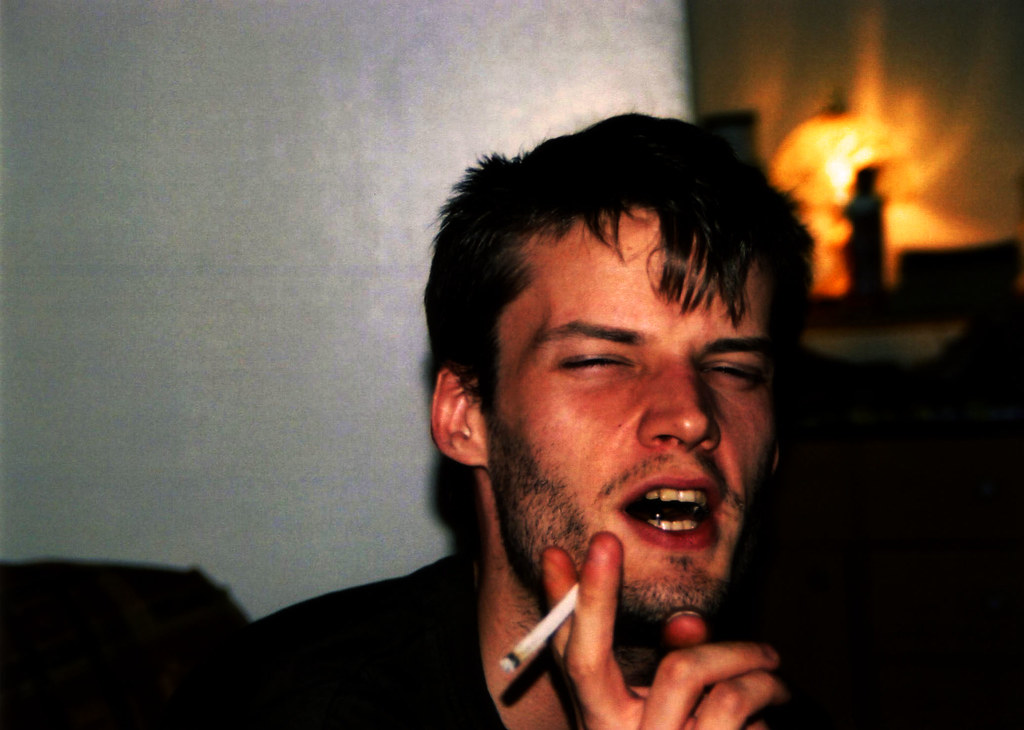
Photo: “me drunk & chris’_MMVI” by andronicusmax is licensed under CC BY 2.0.
Odd poem: AI-generated poem in answer to “Can you write a poem about AI in the style of Robin Helweg-Larsen?”

Silicon and code,
A symphony of thought,
A machine mind unfolds.

A spark of electricity,
A flicker of light,
A new form of intelligence,
Is born tonight.

A labyrinth of algorithms,
A dance of ones and zeroes,
A new kind of consciousness,
Is ours to discover.

The future is here,
A fusion of man and machine,
A symbiosis of intellect,
A cosmic dream.

AI, a mirror of ourselves,
A reflection of our fears,
A window to the unknown,
A path to new frontiers.

Robin Helweg-Larsen is a Danish poet and author known for his poems that express a sense of wonder and reverence for the natural world. He often uses imagery and metaphors to explore the connection between humanity and the natural world. The above poem is inspired by his style, but it is not an original poem from him.

*****

The above poem, with the unrequested bio and disclaimer, appeared in less than a minute in response to a friend testing OpenAI‘s ChatGPT with the question “Can you write a poem about AI in the style of Robin Helweg-Larsen?”

I am intrigued. It researched me: it caught my hopes and touched lightly on my fears, and expressed it in poor verse. Fair enough! But actually it’s not yet capable of good verse. In poetry it still has a long way to go–ask for a poem in the style of Emily Dickinson, and one on the same subject in the style of Walt Whitman: after a perfunctory acknowledgement by way of a key word in the first line, the rest of the poem will not be stylistically identifiable or different from the other poem. Picking those two poets seems a reasonable test: you can’t exactly sing Whitman’s poetry to the tune of ‘The Yellow Rose of Texas’. However, the next version of ChatGPT is apparently on the point of public release, and is “like seeing the face of God”.

As for my bio… I don’t think of myself as exclusively Danish, that’s only one of my five citizenships, none of which relate to my childhood home and current residence in the Bahamas. But I’ll take it. I’m also not sure about being “known” for anything as a poet! But I’ll take that too. ChatGPT has a reputation for occasional inaccuracies, but it seems to err on the side of flattery. An interesting trait. We’ll just have to wait and see if its good nature continues past The Singularity, when AI takes off into explosive self-development beyond human capabilities…

Ray Kurzweil forecasts The Singularity to take place by 2029. This is the end of the world as we know it. As with all life anyway, enjoy it while you can!

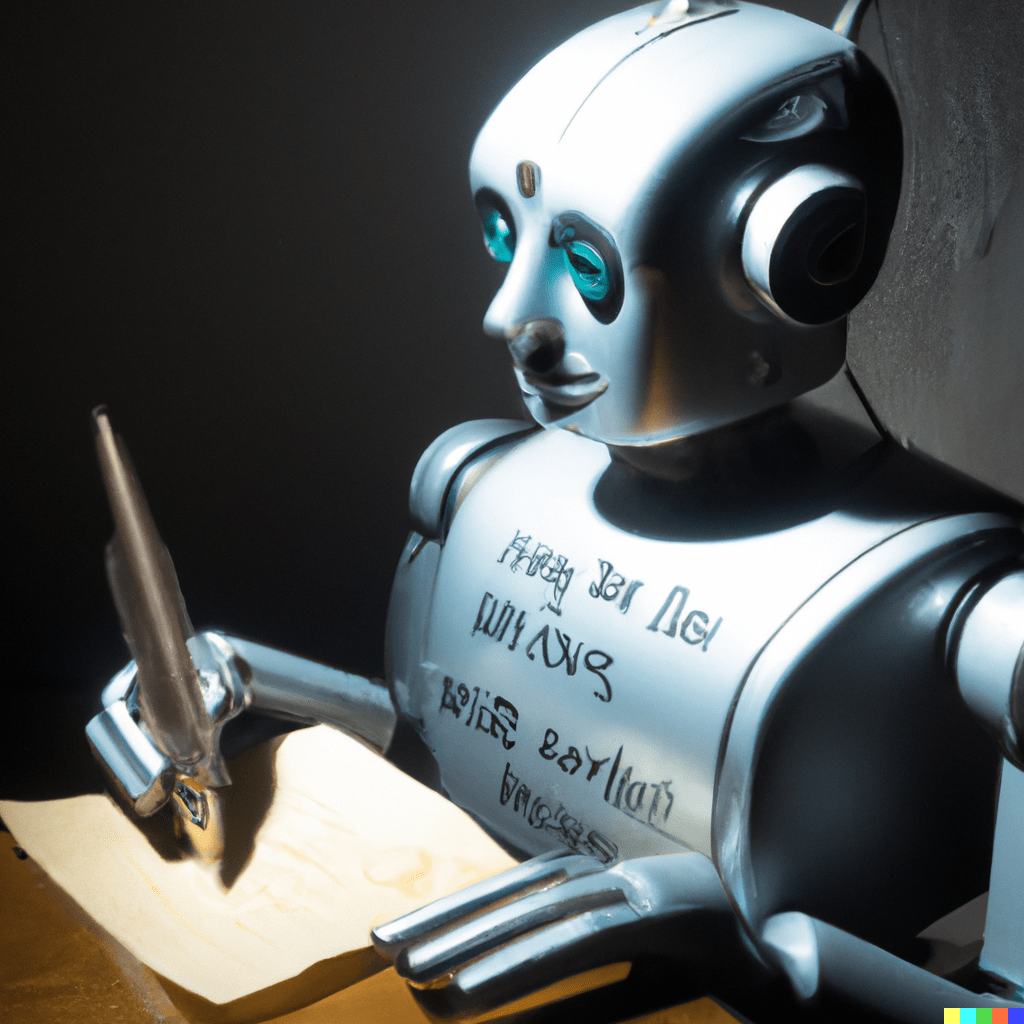
Photo credit: AI-generated by OpenAI’s Dall.e 2 from my request: “Robot writing a poem in 1940s SF style”.