Tag Archives: Ezra Pound

Odd poem: Horace, ‘An Epilogue’, tr. by W.E. Gladstone

Now have I reared a monument
more durable than brass,
And one that doth the royal scale
of pyramids surpass,
Nor shall defeated Aquilo
destroy, nor soaking rain,
Nor yet the countless tide of years,
nor seasons in their train.
Not all of me shall die: my praise
shall grow, and never end,
While pontiff and mute vestal shall
the Capitol ascend,
And so a mighty share of me
shall Libitina foil.
Where bellows headstrong Aufidus,
where, on his arid soil,
King Daunus ruled a rural folk,
of me it shall be told
That, grown from small to great, I first
of all men subtly wrought
Aeolian strains to unison
with our Italian thought.
So take thine honours earned by deeds;
and graciously do thou,
Melpomenè, with Delphic bays
adorn thy poet’s brow.

*****

Making a name for himself at Oxford as a conservative orator, Gladstone evolved into a reform-minded politician, enacting legislation that in later years he ruefully called socialist. He was strongly opposed to war and was outspoken against the Opium Wars in which Britain forced China to legalise the importation of opium (“a war more unjust in its origin, a war more calculated in its progress to cover this country with permanent disgrace…”) and the Crimean War for which as Chancellor of the Exchequer he refused to borrow money, but raised the income tax rate by half in order to make the war less popular (“The expenses of a war are the moral check which it has pleased the Almighty to impose upon the ambition and lust of conquest that are inherent in so many nations … The necessity of meeting from year to year the expenditure which it entails is a salutary and wholesome check, making them feel what they are about, and making them measure the cost of the benefit upon which they may calculate.”)

Queen Victoria complained that Gladstone “addressed me as though I were a public meeting” and far preferred his political rival Disraeli. Disraeli published a dozen novels as well as short stories, poetry, drama and nonfiction. Gladstone at least translated a bit of Horace into verse. Here is the original ‘Odes, 3.30’:

Exegi monumentum aere perennius
regalique situ pyramidum altius,
quod non imber edax, non aquilo impotens
possit diruere aut innumerabilis
annorum series et fuga temporum.
non omnis moriar multaque pars mei
vitabit Libitinam; usque ego postera
crescam laude recens, dum Capitolium
scandet cum tacita virgine pontifex.
dicar, qua violens obstrepit Aufidus
et qua pauper aquae Daunus agrestium
regnavit populorum, ex humili potens,
princeps Aeolium carmen ad Italos
deduxisse modos. sume superbiam
quaesitam meritis et mihi Delphica
lauro cinge volens, Melpomene, comam.

I have taken the Gladstone translation from the excellent ‘Poem Into Poem’ (ed. George Steiner, Penguin) which also contains Ezra Pound’s translation:

This monument will outlast metal and I made it
More durable than the king’s seat, higher than pyramids.
Gnaw of the wind and rain? Impotent
The flow of the years to break it, however many.
Bits of me, many bits, will dodge all funeral,
O Libitina-Persephone and, after that,
Sprout new praise. As long as
Pontifex and the quiet girl pace the Capitol
I shall be spoken where the wild flood Aufidus
Lashes, and Daunus ruled the parched farmland:
Power from lowliness: ‘First brought Aeolic song to Italian fashion’–
Wear pride, work’s gain! O Muse Melpomene,
By your will bind the laurel. My hair, Delphic laurel.

I’ll take Gladstone’s version any day. No surprise.

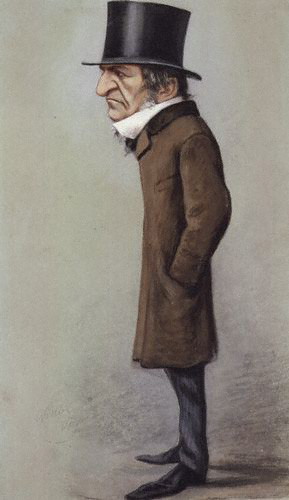
Illustration: drawing of Gladstone by Carlo Pellegrini, published in Vanity Fair 6 February 1869

Poems on poets: A.M. Juster, ‘Houseguests’

There’s shouting by the stove (it’s Plath & Hughes)
as Wystan wanders off without his shoes
and Whitman picks the Cheetos off his beard.
The Larkin-Ginsberg chat is getting weird,
for after countless hours they have found
bizarre pornography is common ground.
Old Emily is not
As prim as billed—
When Dylan finds her bra-hooks—
She is thrilled.
Poe strokes his bird; Pound yawps that it’s a pity
Eliot can’t sleep without his kitty.
Rimbaud’s on eBay searching for a zebra
while sneering, “Oui, a cheemp can write vers libre!”
The Doctor’s soggy chickens start to smell
and Stevens has insurance he must sell.
The readings are spectacular, I know,
but is there any way to make them go?

*****

A.M. Juster writes: “This was first published in The Barefoot Muse. It looks like I wrote it in late 2008, it was a fairly prolific period for me and I was a little distracted because I was running the Social Security Administration. (Under his unpoetic name, Michael J. Astrue. – Editor). I don’t remember now the impetus for writing it, but I did enjoy taking these poetry idols off their pedestals and making them more human for a few laughs. This was about the time that I finished my translation of Horace’s Satires in something like 1850 heroic couplets, so I was much more comfortable with the form than I would have been five years before. I think the imitation of Emily Dickinson’s form is an amusing touch for the reader, although it is undetected when I read it because it remains in rhymed iambic pentameter.”

A.M. Juster’s poems and translations have appeared in Poetry, The Paris Review, The Hudson Review and other journals. His tenth book is Wonder and Wrath (Paul Dry Books 2020) and his next book will be a translation of Petrarch’s Canzoniere, which W.W. Norton will release in early 2024. He also overtweets about formal poetry @amjuster.

Photo: “me drunk & chris’_MMVI” by andronicusmax is licensed under CC BY 2.0.

Why “formal” verse?

This blog is dedicated to the proposition that not all poetry is equal – indeed, that not all of it is even poetry. “Poetry” went off the rails in the 20th century for a variety of reasons – accidentally? suicidally? – but it is slowly getting back on track.

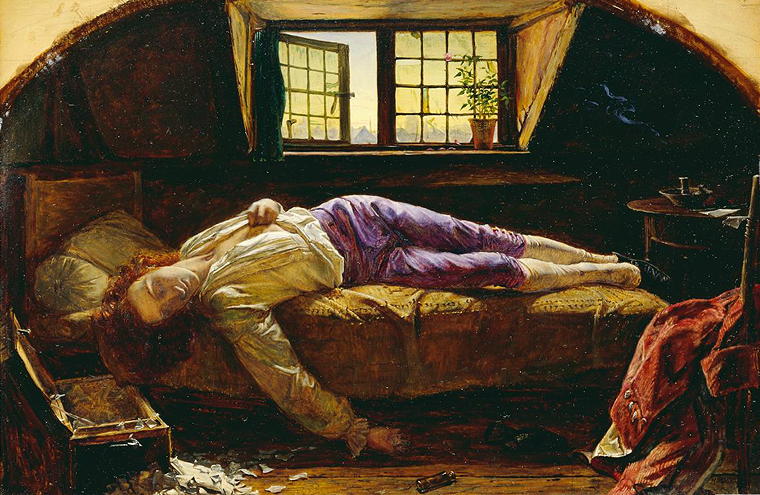
Chatterton

“The Death of Chatterton” – the poet died at 17 (it is uncertain whether he committed suicide or took an accidental overdose, trying to cure himself of venereal disease).

“Poetry – the best words in their best order,” said Coleridge. Aristotle says “rhythm, language and harmony,” and that it is the use of harmony that distinguishes poetry from the other language-based forms. “Harmony” again from Thomas Campion, talking of poetry as the “ioyning of words to harmony”. Ezra Pound rewrites Aristotle’s definition as “Poetry is a composition of words set to music”.

This requirement for “rhythm”, “harmony”, “music” is what has been missing from most of what people styled “poetry” through the last 50 years. But it never goes away from popular culture, because it lives in musicals, rock, c&w, rap, the chants of street protests, and the nursery rhymes and lullabyes sung to babies. It never goes away from popular culture, because it is deeply ingrained in all of us, beginning with the heartbeat that surrounds us before we are born.

And rhyme, rhythm, alliteration and other tricks of formal poetry are not just some meaningless style: they are the hooks on which we hang our memory of the exact words. Ask anyone to recite a poem, and it will be a song, a nursery rhyme, or something else with strong formal elements to it. If you want something to be memorable – not in the sense of remembering the experience, but of remembering a text word for word – if it is anything more than a dozen words, it is far, far more easily remembered if it has rhythm and rhyme.

This blog argues that formal elements are essential to poetry. “Free verse” may be insightful, emotional, witty, descriptive (or, often, none of those), but it isn’t poetry. It’s prose.