Tag Archives: Wordsworth

Using form: continued poem: Conor Kelly, ‘Daffodils’

Those daffodils that I recall
While lying on a bed settee
Are faded now, their petals fall
In nature and in memory.

It’s time to rise, to go outside
And head off for a subway ride.
I’m in New York’s YMCA
Undressing for a midday swim;

A poet could not but be gay
With bodies toned up in the gym.
But I am getting no cheap thrills
From dongs like dangling daffodils.

I twinkled at the twinkies there
Tossing their heads in sprightly dance
Or heading for the sauna where
I might get lucky if, by chance,

One of the bronzed and buffed young men
Is eager for my fountain pen.
But, sadly, no one needs to hear
This exiled poet strut his stuff.

I am an old Romantic queer,
Ignored, unloved. I’ve had enough.
I join the hustling New York crowd
And wander lonely as a cloud.

*****

Conor Kelly writes: “Daffodils was submitted as a prompt poem to Rattle (https://www.rattle.com) and was printed in the Summer 2024 issue of the magazine. The prompt was to continue where another poem left off. So I disturbed Wordsworth on the couch where he lay remembering daffodils and sent him on his gay way to modern New York where he had some dubious adventures. I kept the stanzaic form, the metre, the rhyme scheme and even some of the original lines. I left him where he began, wandering lonely as that singular cloud.”

Conor Kelly was born in Dublin and spent his adult life teaching in a school in the city. He now lives in Western Shore, Nova Scotia from where he runs his twitter (X) site, @poemtoday, dedicated to the short poem. He has had poems printed in Irish, British, American, Canadian and Mexican magazines. He was shortlisted for a Hennessy New Irish Writers award. At the ceremony one of the judges, Fay Weldon, asked him, “Where are you in these poems?”  He is still asking himself that same question.

https://www.instagram.com/conorkelly.poems/

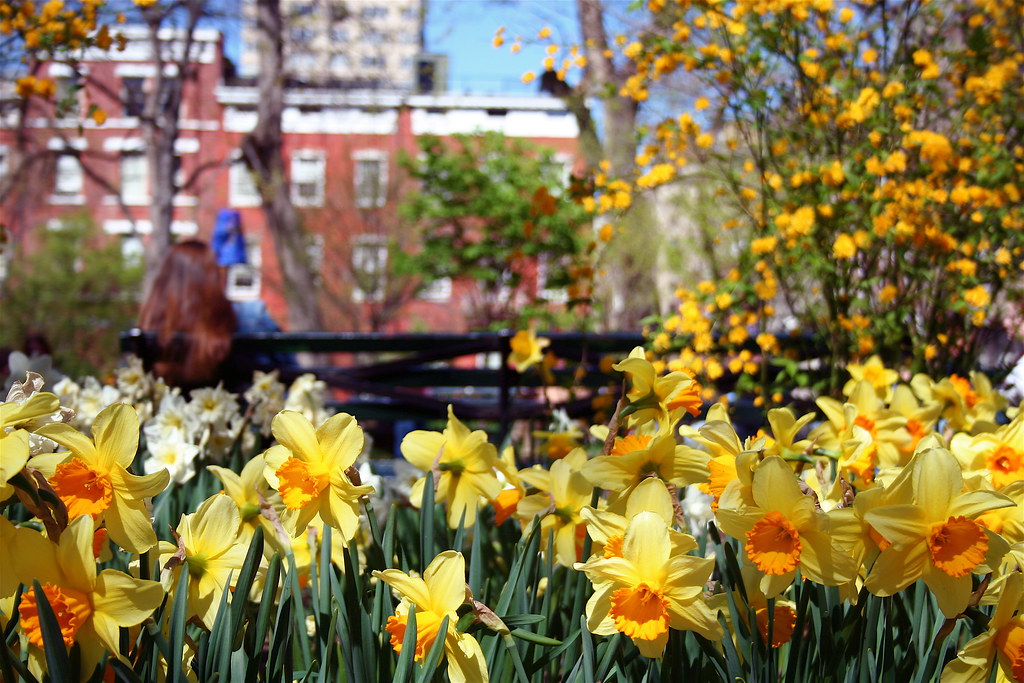
Photo: “park, school” by presta is licensed under CC BY-NC 2.0.
Using form: Acrostic Sonnet: Mike Mesterton-Gibbons, ‘Lonely As A Cloud’

Life’s trials left me lonely as a cloud
On high until I found some daffodils,
Not in an adventitious golden crowd
Extending by a lakeside near some hills
Like Wordsworth in his poem, but below
York’s city walls on sloping grassy banks,
Arrayed in row upon enticing row.
So I plucked half a dozen from the ranks
And clasped them and, like Wordsworth, felt a rapt
Companionship that filled me with renewed
Light-heartedness … until a copper tapped
On my left shoulder and rebuked me—”Dude,
Unlicensed flower picking’s stealing”—then
Detained my blooms … to leave me lone, again.

*****

Editor’s comment: Mike Mesterton-Gibbons has produced a Shakespearean sonnet acrostically spelling out the title and theme that references one of the best-known poems in the English language. A full discussion of Wordsworth’s original (text, background, modifications, reception, various photos, etc) is in Wikipedia – including the suggestion that Wordsworth originally came up with “I wandered lonely as a cow” until his sister Dorothy told him “William, you can’t put that.” But rather than Wordsworth’s blissed-out ending, Mesterton-Gibbons goes full circle to a rueful police-induced return to loneliness.

Mike Mesterton-Gibbons is a Professor Emeritus at Florida State University who has returned to England to live in York, where he once attended university after going to school in Cumbria near the Lake District.  His poems have appeared in Autumn Sky Poetry Daily, Better Than Starbucks, the Creativity Webzine, Current Conservation, the Ekphrastic Review, Grand Little Things, Light, Lighten Up Online, MONO, the New Verse News, Oddball Magazine, Rat’s Ass Review (where this poem was first published), the Satirist, the Washington Post and WestWard Quarterly.  Links to all these poems can be found at  https://www.math.fsu.edu/~mesterto/Unscramble/wordplay.html

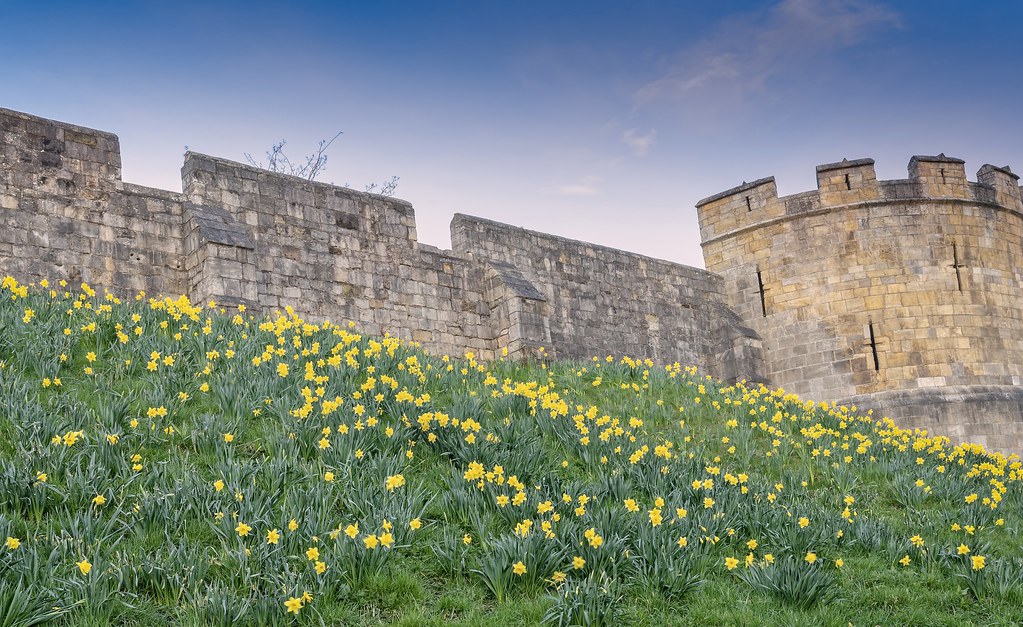
Photo: “York: City Walls and Daffodils” by jack cousin is licensed under CC BY-NC-ND 2.0.

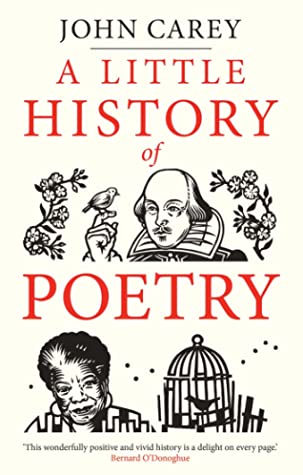
Review: ‘A Little History of Poetry’ by John Carey

A fascinating overview of the history of world poetry with a decidedly Anglo-American slant, very engaging and informative and yet inevitably irritating for wasting space on some aspects while ignoring other favourite poets–depending on the reader’s bias, of course.

Consisting of 40 seven- or eight-page chapters, the book leads with Gilgamesh and information new to me despite my familiarity with the poem; then the Greek and Latin classics, where I am vaguely interested but uninformed; then Anglo-Saxon poetry where I am incited to read more. And so it goes: a bit of this, a bit of that, with a lot of chatty biographical tidbits, clarifying who I want to read more of (Chaucer, Wordsworth, Hardy, the Thirties Poets, the Movement), confirming who is of no interest to me (Spenser, Milton, American Modernists, American Confessional poets). The chapter on Dickinson and Whitman had a very useful perspective; the one on Marianne Moore and Elizabeth Bishop was a waste of space. There seemed less insight in general as we moved into the 20th century, especially regarding American poets.

One thing that surprised me was to find how the hymns quoted in the chapter ‘Communal Poetry’–‘When I survey the wondrous cross’, ‘Rock of ages, cleft for me’, ‘Amazing grace’, ‘Abide with me’–summoned up my decade of boarding school’s daily religion and made for a long meditation on the role of religious poetry in the forced familiarity with meter and rhyme. It almost justifies daily church attendance. But missing from this History is the similar role in other religions: the hymns of Hinduism, the Hebrew chants, the hypnotic rhythm and rhyme of the Quran… all aspects of verse being used to make a message word-for-word memorable, all building the use of poetry.

The other omissions were of English-language poets outside the Anglo(including Irish)-American sphere: I think McCrae is the only Canadian mentioned (for ‘In Flanders Field’), and Claude McKay (who?) and Derek Walcott the only other Commonwealth poets; also missing are modern ballad-writing poets like Bob Dylan; and, my particular peeve, no mention of either e.e. cummings or Gwendolyn Brooks.

I find Brooks and cummings the greatest American poets of the 20th century with the exception of Auden and Eliot (however you like to classify their nationalities). Their omission may reflect ignorance on the part of author John Carey, or they may have been left out as not fitting into his groupings of Modernists and members of the Harlem Renaissance. Whatever the reason, it’s a major flaw… in what is still a highly readable and rereadable history.

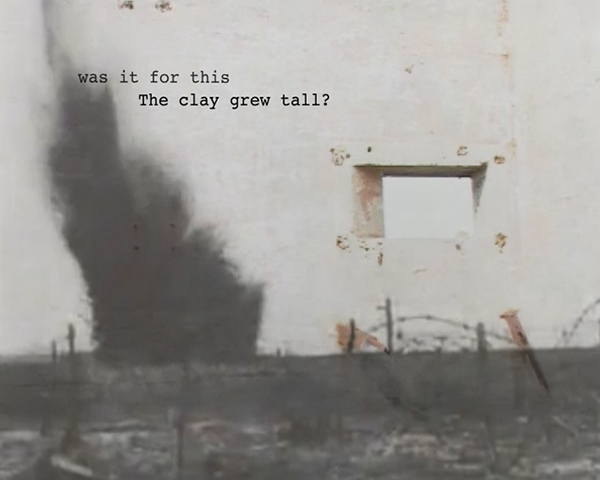
Poem: “Said Poor Mrs. Owen”

Wilfred Owen

(“Futility” by Robbie Kerr) 

Said poor Mrs. Owen
To her son Wilfred
Why must you always
Write of the trenches?
Why can’t you write
Like that nice Mr. Wordsworth
Of flowers?

Said Mrs. Picasso
To her son Pablo
Why must you always
Paint so distortedly?
Why can’t you paint
Like that nice Mr. Monet
Some flowers?

Because we don’t always
Create what we celebrate,
Sometimes we model the
Things that we’d like to change,
Things we don’t like, or just
Things that we think about –
Thoughts of ours.

This poem was published in The Road Not Taken – a journal of formal poetry that is edited by Kathryn Jacobs in connection with Texas A&M University at Commerce, TX.

Technically the poem lacks some aspects of what we tend to assume is “form”, notably extensive rhyme, alliteration or assonance. But each of the stanzas has the same seven-line form, with two stressed syllables in each of the first six lines and a shorter seventh line. The first two stanzas have virtually identical structure, though one deals with poetry and the other with painting, and the third stanza answers them. The last lines repeat and rhyme.

It is really the natural rhythm of the poem that allows it to be included in a journal of formal poetry. In the sense that “form” is any trick of verse that allows it to be remembered word for word, form can be a lot broader than some of the narrow definitions of formal verse.