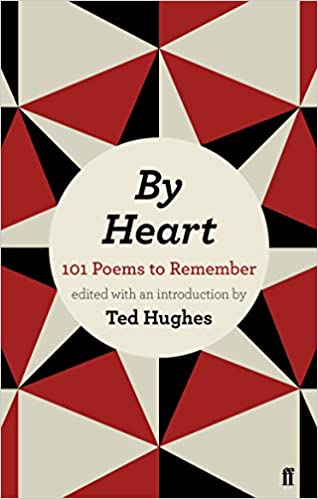
This book’s theme is the memorisation of poems, and there are things I like and things I don’t like about both Ted Hughes’ introduction to the subject and the 101 poems that he has chosen.
First, the introduction. I like that it encourages people to learn poems by heart. But although the book’s title is ‘By Heart‘, Hughes instead teaches ‘by head’. His method is extremely cerebral, using the kind of image-association-chain taught by neuro-linguisitic program consultants to help you remember the names of business associates and clients. Hughes would have you construct a Cumberbatch-Sherlock Holmes ‘mind palace’. Taking Hopkins’ poem ‘Inversnaid’ as an example, Hughes explains that the opening lines
This darksome burn, horseback brown,
His rollrock highroad roaring down,
can be dealt with as follows:
For ‘peaty burn’ it might be enough simply to imagine, like a frame in a colour film, a dark torrential mountain stream coming down among boulders. But to make sure it is ‘burn’ and not ‘stream’ that you remember, it might be better to imagine the stream actually burning, sending up flames and smoke: a cascade of dark fire, scorching the banks. The next item, ‘brown horse’, now has to be connected to the burning stream. The most obvious short-cut is to put the horse in the torrent of fire, trying to scramble out – possibly with its mane in flames.
He then goes on to connect it to the horse causing an avalanche (rollrock highroad) which comes down on a lion (roaring down), and so on.
My difficulty with all this is that the images he is creating are simply not what the poem is about. When Hopkins writes ‘burn’ meaning stream, it’s not appropriate to set it on fire. Of course the poem summons up images, and they are useful for memorizing… but for godssake, why not think of it as a Scottish stream rather than setting it on fire? The burn is brown and in spate, and rocks are rolling down it and it makes a roaring noise – and that is the picture you can hold in your head as you recite Hopkins’ lovely rich words, without having to involve fires, animals and avalanches.
It seems to me that Hughes is in danger of losing the beauty of the actual poem by going through his ‘mind palace’ activities. He appears to be reducing the memorisation of poetry to a party trick, performed at the expense of the poem itself. If he didn’t love the poem for its actual imagery, what did he love it for? When he memorised a poem, did he check it off and then forget it? Wouldn’t all the peripheral imagery have gotten in the way when he tried to recite the poem a few decades later? Better and safer to my mind to stay with the essential images and the richness of the language, rather than setting fire to a stream because the poet uses the word ‘burn’.
And this leads in to my thoughts about the selection of the 101 poems to be learnt by heart. Auden, Blake, Dickinson, Eliot, Frost, Wordsworth and Yeats each get at least five poems, and Shakespeare over a dozen. The less-represented poets are a wider mix, from John Betjeman to Elizabeth Bishop, Elizabeth Barrett Browning, Lewis Carroll… The poems themselves are interesting, and many of them are perfect for memorising, so it is a worthwhile read.
But I don’t think it appropriate to waste five or six pages on the 130 or 170 lines of Blake’s ‘Auguries of Innocence’ or Wordsworth’s ‘Tintern Abbey’. Perhaps Ted Hughes learnt those two along with Blake’s ‘The Tyger’ and Wordsworth’s ‘Upon Westminster Bridge’, but the latter two are far more suitable than the former for a book that is meant to encourage others to achieve memorisation.
Again, most of the poems are good for learning by heart, but too many of them have none of the qualities that make it easy to learn poetry in English: rhyme, metre, alliteration, wordplay. William Empson’s translation of the Japanese poem ‘From the Small Bird to the Big’ is interesting, but inappropriate for this book. The same goes for Pound’s ‘The Return’ and Eliot’s ‘Marina’ – inappropriate because they are missing the music, the song-like qualities, that make memorisation easy. Easy, that is, if you are learning by heart, as the book’s title requires.


 Form in Formless Times